Creep Testing of High-Temperature Alloys: What Every Engineer Needs to Know
- Mar 13
- 12 min read
Creep testing of high-temperature alloys is one of the most critical and least understood areas of materials qualification in Indian industry today. Whether you are designing components for power generation, aerospace structures, chemical processing equipment, or pressure vessels, the question is always the same: will this material hold its shape and strength when exposed to heat and load over months or years?
That is not a question you can answer from a material certificate alone. It requires controlled, long-duration testing under elevated temperature and stress — the kind of testing that simulates what a component will actually experience in service. This is what creep testing is for, and this is why getting it right matters.
This article explains what creep testing is, why high-temperature alloys behave the way they do, what a rigorous test process looks like, and how TCR Engineering approaches this work — from specimen receipt to final report.
What Is Creep and Why Does It Matter for High-Temperature Alloys?
Creep is the slow, time-dependent deformation of a material under sustained mechanical load, particularly at elevated temperatures. It is not a sudden failure. It is a gradual process — and that is precisely what makes it dangerous in engineering applications.
Most metals that behave perfectly well at room temperature begin to creep when they are subjected to a combination of high temperature and constant stress. The higher the temperature relative to the material's melting point, and the higher the applied stress, the faster creep progresses.
For engineering alloys used in boilers, turbines, furnace components, and heat exchangers, creep is not a theoretical concern — it is a real design constraint. A component that creeps beyond acceptable limits can distort, lose dimensional integrity, or ultimately fracture through a process called stress rupture.
The Three Stages of Creep
Understanding creep means understanding how it evolves over time:
• Primary creep: The initial stage where the creep rate decreases over time as the material strain-hardens.
• Secondary (steady-state) creep: The most important stage for engineering design. The creep rate stabilises and remains roughly constant. This is the stage most creep tests are designed to characterise.
• Tertiary creep: The creep rate accelerates rapidly, leading to necking and ultimately fracture. This is what engineers need to avoid in service.
For high-chromium steels, nickel-based superalloys, and refractory alloys, the secondary creep rate and the time to rupture are the two parameters that matter most for component design and life assessment.
Which High-Temperature Alloys Are Most Commonly Creep Tested?
In India's industrial landscape, the materials most frequently submitted for creep evaluation include:
• High-chromium ferritic and martensitic steels (P91, P92, T22, T91) — widely used in power plant boilers and steam pipelines
• Austenitic stainless steels (SS 304H, SS 316H, SS 347H) — used in petrochemical and chemical processing equipment
• Nickel-based superalloys (Inconel 625, Inconel 718, Hastelloy C-276) — used in aerospace and high-performance industrial applications
• Cobalt-based alloys — used in gas turbine components and wear-resistant high-temperature parts
• Refractory metals and alloys — used in furnace components, heating elements, and specialised industrial equipment
Each of these material families has its own creep behaviour, sensitivity to temperature ranges, and failure mechanisms. A test protocol designed for P91 steel is not directly applicable to Inconel 718. This is why the test temperature, stress level, specimen geometry, and test duration must all be defined with reference to the specific material and its intended service conditions.
The ASTM E139 Standard: What It Covers and Why It Is the Reference
The governing standard for creep and stress rupture testing of metallic materials is ASTM E139 — Standard Test Methods for Conducting Creep, Creep-Rupture, and Stress-Rupture Tests of Metallic Materials. This is the benchmark that TCR Engineering follows for all creep testing work.
ASTM E139 specifies requirements across several critical areas:
• Specimen geometry: The standard defines acceptable gauge diameters and gauge lengths. Round bar specimens with a defined gauge section are most common. The gauge length to diameter ratio matters for accurate strain measurement.
• Temperature control and measurement: Temperature must be measured and controlled within defined tolerances. The standard specifies thermocouple placement, the number of thermocouples, and acceptable temperature gradients along the gauge length.
• Load application: The load must be applied smoothly and held constant throughout the test. Deadweight loading systems are commonly used for this reason — they are inherently stable and require no active control.
• Strain measurement: Creep strain is measured directly using extensometers or indirectly through crosshead displacement, with the standard specifying the precision required.
• Data recording: Time-elongation data must be recorded at sufficient intervals to fully characterise the creep curve and identify the transition between creep stages.
• Reporting requirements: The standard defines what must be included in the test report, including material identification, specimen dimensions, test temperature, applied stress, test duration, and measured creep parameters.
Compliance with ASTM E139 is not simply about following a checklist. It is about ensuring that the test data generated is meaningful, reproducible, and comparable with data from other laboratories and from published literature. This matters enormously when test data is used for design calculations, fitness-for-service assessments, or regulatory submissions.
Expert Perspective: Why Test Rigour Defines Data Quality
"In creep testing, the quality of the data you get out is entirely determined by the quality of the setup and controls you put in. Temperature gradients that seem small on paper — even a difference of five or ten degrees Celsius along the gauge length — can produce measurable differences in creep rate. That is why we pay very close attention to thermocouple placement, furnace stability, and specimen alignment before we even begin a test. When clients are using our data to make design decisions or assess component life, there is no room for ambiguity in the setup."
— Mr. Avinash Tambewagh, Senior Technical Specialist, TCR Engineering
Mr. Tambewagh leads technical discussions on creep and elevated temperature testing at TCR Engineering and is the primary point of contact for engineers and project teams seeking to understand test feasibility, specimen requirements, and result interpretation. His hands-on experience with long-duration testing across multiple alloy systems gives him a practical perspective that goes well beyond the standard.
TCR Engineering's Creep Testing Infrastructure
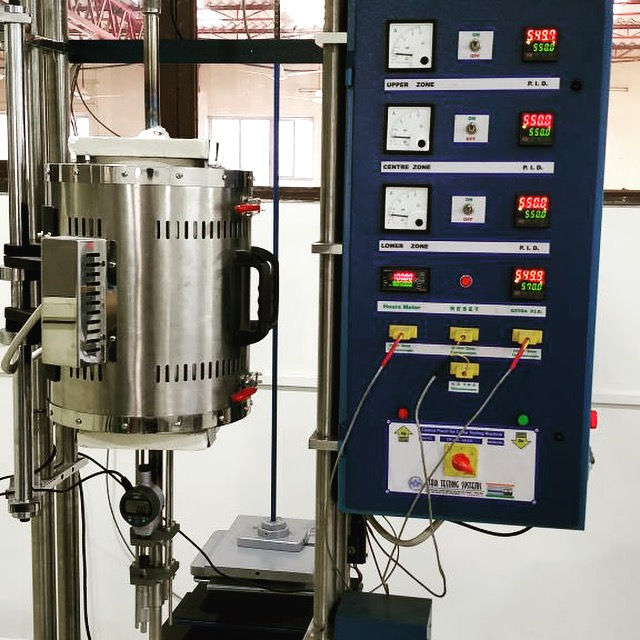
TCR Engineering's laboratory is equipped to conduct creep and elevated temperature testing across a broad range of materials and service conditions. The facility currently operates six constant-load creep testing machines with a capacity of 50 kN each — a significant resource that allows multiple long-duration tests to run simultaneously without disruption.
Test Capabilities at TCR Engineering
Constant load creep testing per ASTM E139
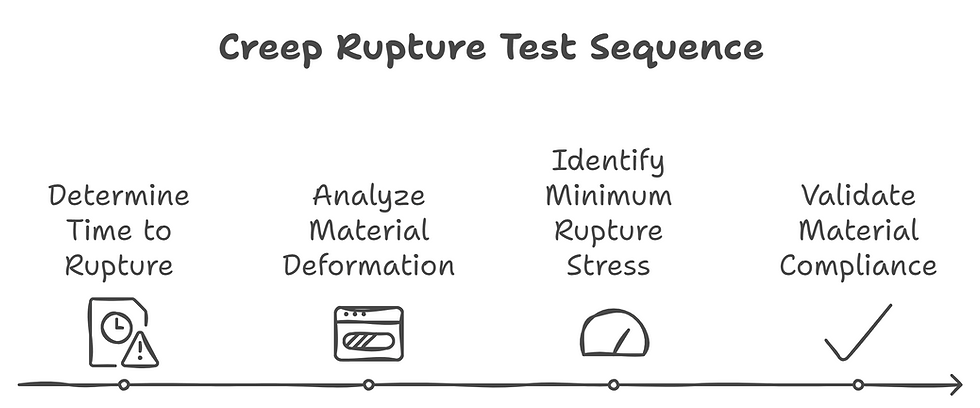
Stress rupture testing — running specimens to failure to determine time-to-rupture under specific stress-temperature combinations
Elevated temperature tensile testing — for materials characterisation at temperature, often conducted as a companion test to creep work
Long-duration creep exposure studies — tests exceeding standard durations for research, residual life assessment, or material development programmes
Testing is conducted at customer-specified temperatures and stress levels, subject to machine capacity and specimen configuration. The laboratory handles tests up to 650°C under its standard creep test programme, and up to 1000°C for high-temperature alloy evaluations requiring elevated test conditions.
What the Test Report Covers
Every creep test report issued by TCR Engineering includes the following parameters as a minimum:
• Type of alloy and material grade
• Specimen descriptor and identification
• Test temperature (°C) — as measured and maintained during the test
• Applied stress (MPa)
• Gauge diameter and gauge length
• Test duration (hours)
• Average ambient temperature and average relative humidity during the test
• Measured creep rate (per hour) — the key output for secondary creep characterisation
Additional data — including full time-elongation curves, photographs, or failure mode documentation for rupture specimens — can be included based on project requirements.
Common Mistakes in Creep Testing and How to Avoid Them
Creep testing is a long-duration test, and errors that go undetected early in the test can invalidate results that took weeks or months to generate. Here are the most common mistakes TCR Engineering observes when reviewing test specifications or previous test data:
1. Poorly Defined Test Conditions
Submitting a specimen for testing without specifying the exact temperature and stress level leads to assumptions that may not match the intended service conditions. Every creep test must begin with a clear test matrix: what temperature, what stress, and what duration or criterion for test termination.
2. Non-Standard Specimen Dimensions
Creep results are sensitive to specimen geometry. Specimens that do not conform to ASTM E139 requirements — incorrect gauge length to diameter ratio, inadequate thread engagement, or surface finish that introduces stress concentrations — will produce data that cannot be reliably used or compared.
3. Inadequate Temperature Uniformity
A furnace that maintains the correct average temperature but has significant temperature gradients along the gauge length will introduce errors in the measured creep rate. This is why TCR Engineering uses multiple thermocouples and verifies temperature uniformity before and during testing.
4. Ignoring Environmental Conditions
For long-duration tests, ambient temperature and humidity fluctuations in the laboratory environment can influence results, particularly for specimens that are sensitive to oxidation or atmospheric effects. TCR Engineering records and reports average ambient conditions throughout the test duration as part of standard reporting.
5. Misinterpreting Creep Rate Data
The measured creep rate is only meaningful in the context of the steady-state (secondary) creep stage. Reporting a creep rate calculated from primary creep data — where the rate is still decreasing — overstates the material's deformation behaviour and can lead to non-conservative design assumptions.
How to Prepare for a Creep Test Submission: A Practical Guide
If you are planning to submit specimens to TCR Engineering for creep testing, here is what you need to have ready before the first conversation:
Material grade and specification: The exact grade designation (e.g., P91 to ASTM A335, Inconel 625 to ASTM B443), along with any relevant heat treatment condition.
Test temperature and stress level: These should be defined based on the intended service conditions or the design life assessment methodology being used.
Expected test duration: If a specific duration is required (e.g., 1,000 hours for a material qualification programme), state this upfront. If the test is to run to rupture, indicate that as the criterion.
Specimen drawing or dimensions: Either provide a specimen drawing or confirm that specimens will be machined to ASTM E139 standard dimensions. Confirmation is needed before specimen acceptance.
Number of specimens: Creep test programmes frequently require multiple specimens per test condition to establish data scatter and confidence intervals.
Once TCR Engineering receives these details, the technical team — led by Mr. Avinash Tambewagh — will review feasibility, confirm slot availability across the six creep testing machines, and provide a commercial quotation with a tentative schedule.
Real-World Scenario: Qualifying a High-Chromium Steel for Power Plant Application
Consider a project team working on a new supercritical power plant in India. The design specifies P91 steel for the high-pressure steam headers, operating at approximately 600°C and a design stress of around 80 MPa. Before the material is approved for the final design, the engineering team needs creep data to validate the design life assumptions.
The test programme, in this case, would typically include:
A minimum of three test conditions spanning a range of temperatures and stress levels above and below the design point — to generate data that can be extrapolated using established methods such as the Larson-Miller parameter.
Tests run to 1,000 hours or longer per condition, with creep rate data recorded throughout.
Rupture specimens at the highest temperature and stress conditions, to establish the stress rupture envelope.
This is exactly the kind of programme TCR Engineering is equipped to support — with the machine capacity to run multiple conditions simultaneously and the technical expertise to interpret and report the results in a format that feeds directly into design and fitness-for-service calculations.
How Creep Testing Charges Are Structured in India
Creep testing in India is typically priced on the basis of:
• Test temperature range — tests above 650°C require more specialised furnace equipment and consumables, which is reflected in the charge structure.
• Test duration — the base charge covers a defined period (typically up to 100 hours), with additional charges applied on a per-hour or part-thereof basis for longer tests.
• Number of specimens — each specimen occupies one machine for the full test duration, so machine time is the primary cost driver.
• Special instrumentation requirements — such as continuous extensometer-based strain recording, additional thermocouples, or oxidation protection measures.
GST at prevailing rates (currently 18%) is applicable on the total invoiced value. TCR Engineering requires 100% advance payment with a confirmed work order before tests are initiated. Turnaround time is confirmed after the actual specimens are received and inspected at the laboratory.
Why Engineers and Project Teams Choose TCR Engineering for Creep Testing
TCR Engineering has built its reputation in high-temperature mechanical testing over years of consistent, technically rigorous work. For creep testing specifically, the factors that distinguish TCR from generic testing laboratories include:
• Dedicated creep testing infrastructure: Six constant-load creep machines at 50 kN capacity each, all maintained to ASTM E139 requirements.
• Temperature range coverage: Testing from ambient elevated temperatures up to 1000°C, covering the full range of alloys used in Indian power, petrochemical, and industrial applications.
• Technical depth: The team understands the materials, not just the machines. This matters when test conditions need to be defined, results need to be interpreted, or anomalies in creep behaviour need to be explained.
• Comprehensive reporting: Every report includes all parameters required for downstream use — specimen details, environmental conditions, creep rate, and full traceability.
• Accessible technical consultation: Mr. Avinash Tambewagh and the TCR technical team are available for pre-test discussions to ensure the test programme is correctly specified before specimens are submitted.
For engineers, QA/QC professionals, and procurement teams evaluating testing service providers, the question is not just whether a laboratory can run a creep test — it is whether they can generate data you can trust and use with confidence.
Frequently Asked Questions About Creep Testing of High-Temperature Alloys
What is creep testing and why is it needed for high-temperature alloys?
Creep testing measures the slow, time-dependent deformation of a metal under constant load at elevated temperature. It is needed because many alloys that are strong at room temperature will gradually deform or fail when subjected to sustained stress at high temperatures — a behaviour that cannot be predicted from short-duration tensile testing alone.
What standard is used for creep testing in India?
The most widely used standard for creep and stress rupture testing of metallic materials is ASTM E139. This standard specifies specimen geometry, temperature measurement and control requirements, load application, data recording, and reporting requirements. TCR Engineering conducts all creep tests in accordance with ASTM E139.
What is the difference between a creep test and a stress rupture test?
A creep test is run for a defined duration or until a defined creep strain is reached, with the primary output being the creep rate (particularly in the steady-state stage). A stress rupture test is run until the specimen fractures, with the primary output being the time to rupture under the specified stress and temperature conditions. Both tests are conducted on the same type of equipment and are often part of the same material evaluation programme.
What temperature range does TCR Engineering cover for creep testing?
TCR Engineering's creep testing facility handles temperatures up to 650°C under its standard programme and up to 1000°C for high-temperature alloy evaluations. All six creep machines (50 kN each) are available for customer-specified temperature and stress conditions.
What specimen dimensions are required for creep testing?
Specimens should conform to ASTM E139 standard dimensions — typically round bar specimens with a defined gauge diameter and gauge length. The exact dimensions depend on the material and the test configuration. Customers should either provide specimens already machined to drawing, or share their material and test requirements so TCR Engineering can specify the appropriate dimensions.
How long does a creep test take?
Creep test duration depends entirely on the test specification. Short tests may run for 100 hours or less. Research or material qualification programmes frequently run tests for 1,000 hours, 3,000 hours, or longer. Stress rupture tests run until the specimen fails, which could be anywhere from tens of hours to several thousand hours depending on the material and test conditions. TCR Engineering confirms turnaround time after receiving the actual specimens and reviewing the test specification.
What information should I provide when enquiring about creep testing?
To receive a meaningful technical assessment and quotation, you should provide: the material grade and specification, the required test temperature(s) and stress level(s), the expected test duration or termination criterion, specimen dimensions or a reference to ASTM E139 standard specimens, and the number of specimens. TCR Engineering's technical team can then review feasibility, confirm capacity, and provide a quotation.
Who should I contact at TCR Engineering for technical discussions on creep testing?
For technical discussions on creep testing requirements, test protocol, and feasibility assessment, contact Mr. Avinash Tambewagh at TCR Engineering on +91-22-67380941. Mr. Tambewagh leads the laboratory's high-temperature mechanical testing team and is the primary technical contact for creep and stress rupture testing enquiries.
Conclusion
Creep testing of high-temperature alloys is not a commodity service. It requires the right equipment, the right test protocol, the right environmental controls, and — critically — the technical expertise to ensure that every data point generated is reliable and usable. For engineers working on power generation, petrochemical, aerospace, or industrial infrastructure projects in India, getting this right is not optional.
TCR Engineering brings together the physical infrastructure — six constant-load creep machines, temperature capability up to 1000°C, full ASTM E139 compliance — and the technical depth to support both straightforward material qualification tests and complex, multi-condition research programmes.
If you are evaluating materials for high-temperature service and need creep or stress rupture test data you can trust, reach out to TCR Engineering's technical team to discuss your requirements.