
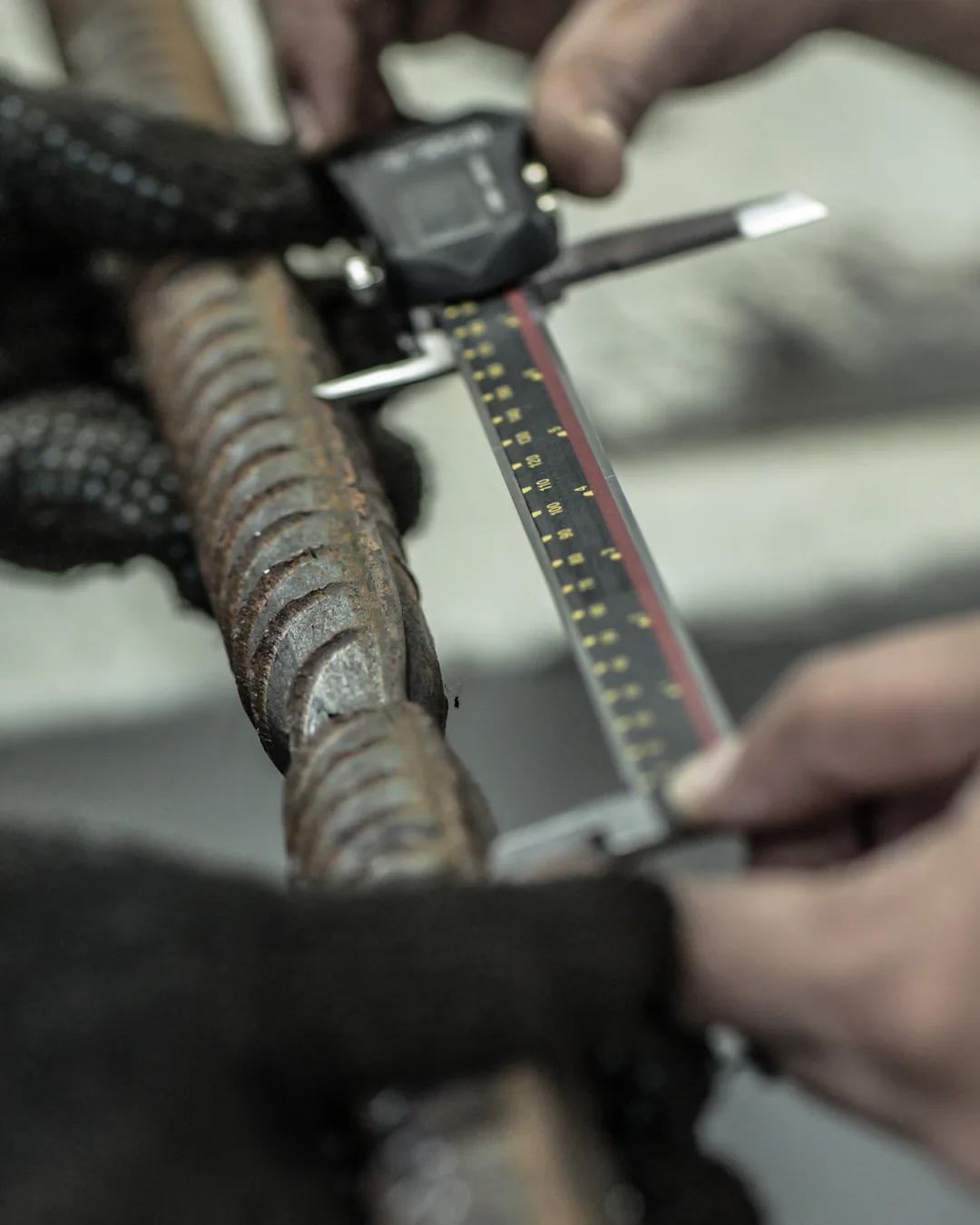
Services · Materials Testing
TMT Rebar Testing per IS 1786
Thermo-mechanically treated reinforcement bar is specified by what it does under load and by what it is made of, and IS 1786 sets both. Tensile, bend and re-bend, and composition, on one bench.
Request a Quote
In brief
TCR Engineering Services Pvt. Ltd., a NABL ISO/IEC 17025:2017 accredited laboratory in Navi Mumbai, tests TMT reinforcement bar to IS 1786 under certificate NABLT0726MH18640: static tensile for yield, ultimate tensile strength and elongation, bend and re-bend for ductility, and composition by spectrometry or wet chemistry. Where the bar is joined by a mechanical coupler rather than a lap, the coupler is a separate qualification under IS 16172 and is carried on Rebar Coupler Testing per IS 16172, where the BIS accreditation for that route sits.
What does IS 1786 require a TMT bar to demonstrate?
Strength, ductility and composition, each by a separate test, and a bar that passes one and fails another does not comply. The tensile test establishes yield stress, ultimate tensile strength and elongation; the bend and re-bend test establishes that the bar tolerates being worked without cracking; the chemical analysis establishes that the composition is the one the grade allows.
The three are not interchangeable and none substitutes for the others. A bar that meets its tensile numbers on a composition outside the grade is a bar whose weldability and long-term behaviour are not the ones the designer assumed.
- Static tensile: tensile strength and elongation on Fe 500 D and Fe 415 D and S grades, up to 45 mm diameter, per IS 1786.
- Bend and re-bend: specimens bent to the specified angle and straightened, then inspected for cracking, which is the ductility check that matters on site.
- Spectro or wet chemical analysis: composition confirmed against IS 1786, and against IS 16651:2017 where the reinforcement is stainless.
- Pull-out: bond behaviour of the bar in concrete, per IS 2770.
Why does the bend and re-bend test matter more than it looks?
Because it is the only test on the list that reproduces what happens to the bar on site. Reinforcement is bent, sometimes straightened, and occasionally bent again at the point of fixing, and a bar that has passed a tensile test in a laboratory can still crack when a steel fixer works it in the cold.
Re-bend also carries an ageing step, which is what separates it from a simple bend. The specimen is bent, aged, and then straightened, so the test asks whether the bar's ductility survives strain ageing rather than only whether it survives the first bend.
What is the difference between testing the bar and testing the coupler?
The bar is qualified against IS 1786 as a material. The coupler is qualified as a splice under the coupler standard, which means the assembly of bar, coupler and thread is tested as one load path, with tests the bar itself never sees: slip measurement, cyclic tension and compression reversal, and fatigue.
That is a different buyer and a different acceptance route, so it sits on a different page. TCR is the first BIS-accredited commercial laboratory in India for IS 16172 rebar coupler testing across all diameters from 8 mm to 40 mm, and 50+ manufacturers have been guided through the ISI mark certification process. Both are covered on Rebar Coupler Testing per IS 16172.
| TMT bar, IS 1786 | Mechanical splice | |
|---|---|---|
| What is qualified | The bar as a material | The bar, coupler and thread as one load path |
| Strength | Yield, ultimate tensile, elongation | Static tensile on the assembly |
| Ductility | Bend and re-bend, with ageing | Slip, measured as permanent extension after loading |
| Cyclic behaviour | Not required | Cyclic tension and compression reversal, and fatigue |
| Composition | Spectro or wet chemistry to the grade | Coupler material, EN8D and 45C8 |
| Where it sits | This page | Rebar Coupler Testing per IS 16172 |
Which grades and diameters are covered?
Fe 415 and Fe 500 in their D and S variants, up to 45 mm diameter, and stainless reinforcement to IS 16651:2017. Grade and diameter together decide the specimen preparation and the machine, which is why both are asked for at the enquiry stage rather than at the sample stage.
IS 1786 governs the grade designations themselves, so a bar outside those grades is tested against whatever specification the order names instead. The constraint is not the bar, it is whether the acceptance criterion is written down before the test rather than after it.
Overview
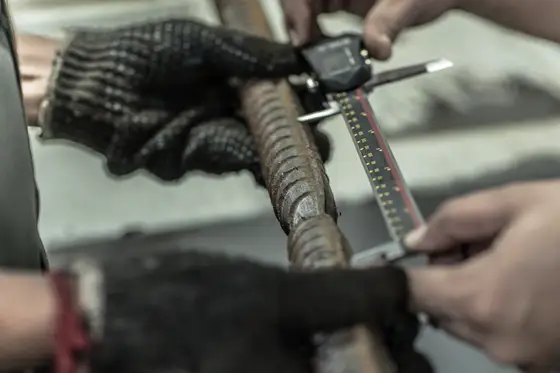
TCR Engineering Services, based in Navi Mumbai, tests thermo-mechanically treated (TMT) reinforcement bar to IS 1786: tensile strength and elongation, bend and re-bend ductility, and chemical composition. Where the bar is joined by a mechanical coupler rather than a lap, that splice is a separate qualification and is carried on Rebar Coupler Testing per IS 16172.
- Static tensile, IS 1786: tensile strength and elongation on Fe 500 D and Fe 415 D and S grades, up to 45 mm diameter, run on the mechanical testing frames.
- Bend and re-bend: specimens bent to the specified angle and straightened, then inspected for cracking, with an ageing step before the re-bend.
- Spectro or wet chemical analysis: composition confirmed against IS 1786, and against IS 16651:2017 where the reinforcement is stainless.
- Bond in concrete, IS 2770: pull-out testing of the bar in reinforced concrete.
- Adjacent scope on the same bench: HT strand for high speed rail and bridges, and aluminium formwork qualification.
Tensile, yield, elongation, re-bend, weldability and composition are the IS 1786 menu, and a bar has to satisfy all of them rather than the one the order happens to name. Grade and diameter together decide the specimen preparation and the machine, which is why both are asked for at the enquiry stage rather than when the sample arrives.
Related insights
1 published insight on this site bears directly on TMT Rebar (IS 1786). It is below; the full index carries all 165 Materials Testing insights.
-
Pull-Out Test on TMT Bars: Understanding Bond Strength That Actually Holds Your Structure Together
TCR Engineering's pull-out test on TMT bars evaluates bond strength for Fe 550D reinforcement from 8mm to 32mm diameter following IS 2770.
Frequently asked questions
What tests does IS 1786 require for TMT rebar?
Static tensile for yield stress, ultimate tensile strength and elongation; bend and re-bend for ductility, with an ageing step before the re-bend; and chemical composition by spectrometry or wet chemistry against the grade. Bond behaviour in concrete is a separate test, per IS 2770.
What is the difference between a bend test and a re-bend test?
A bend test bends the specimen to a specified angle and inspects it for cracking. A re-bend test bends it, ages it, and then straightens it, so it asks whether the bar's ductility survives strain ageing rather than only the first bend. Re-bend is the closer analogue of what happens to reinforcement on site.
Do you test rebar couplers as well as the bar?
Yes, but under a different standard and on a different page. Couplers are qualified as mechanical splices, and TCR is the first BIS-accredited commercial laboratory in India for that testing across all diameters from 8 mm to 40 mm. Coupler testing is carried on the rebar coupler page.