

Services · Inspection Manpower and Third-Party Services
Third Party Inspection Agency in India
Factory audit, OEM development, raw-material inspection, initial and in-production checks, random inspection, and loading supervision. Field inspectors attend supplier sites across India so that the overseas buyer sees the goods judged before they leave the country.
Request a Quote
In brief
TCR Engineering Services Pvt. Ltd. is an independent third party inspection agency in India, founded 1973 in Navi Mumbai. Its API-, ASNT-, CSWIP- and AWS CWI-credentialled inspectors cover factory audit, raw material, stage and final inspection and loading supervision, and the samples they draw are tested at its NABL ISO/IEC 17025:2017 accredited laboratory, certificate NABLT0726MH18640.
How TCR Works as a Third Party Inspection Agency
TCR Engineering's third-party inspectors hold API, ASNT, CSWIP and AWS CWI credentials and work at vendor premises across India, from raw material verification through stage inspection to final inspection and loading supervision. Samples drawn during inspection are tested at TCR's NABL ISO/IEC 17025:2017 accredited laboratory in Navi Mumbai, so inspection findings and test certificates carry one accountable signature.
- Credentials held: API, ASNT, CSWIP and AWS CWI.
- Where: at vendor premises across India.
- Stages covered: raw material verification, stage inspection, final inspection and loading supervision.
- Where the samples go: TCR's NABL ISO/IEC 17025:2017 accredited laboratory in Navi Mumbai.
- Why that matters: inspection findings and test certificates carry one accountable signature.
Third-Party Inspection or Source Inspection: Which Page Answers Your Question?
The two services overlap, because both put an independent TCR inspector at the vendor's works before goods ship. Third-party inspection is the buyer's programme across a whole order. Source and vendor inspection is how a material lot is sampled, marked, tested and released, and who does it. Each question is answered once, on the page named below.
| The question | Answered on |
|---|---|
| Which inspections an order needs, stage by stage | Third-party inspection |
| What the buyer receives at each stage | Third-party inspection |
| What counts as evidence, and when the inspector stops and escalates | Third-party inspection |
| What an AQL sample does and does not protect | Third-party inspection |
| What TCR is and is not accredited for as an inspector | Third-party inspection |
| How a material lot is sampled, stamped, tested and released | Source and vendor inspection |
| Who inspects: the service lines and each inspector's credential | Source and vendor inspection |
| The governing standards, approvals and client empanelments | Source and vendor inspection |
| Saudi Aramco vendor inspection categories, and HIC and SSC witness in India | Source and vendor inspection |
Assuring Quality for International Clients
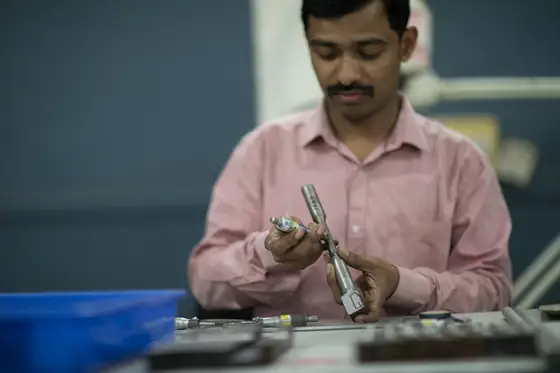
TCR Engineering is an independent third-party inspection company in India, working for buyers at home and overseas. Its inspectors cover every phase of an order at the supplier's works, from the factory audit before the order is placed to loading supervision at despatch, and samples drawn on the way are tested in TCR's own NABL-accredited laboratory.
The service lines follow the phases of an order. Choose the phases that carry your risk; a first order from a new vendor usually needs every phase, a repeat order from a proven one may need only despatch.
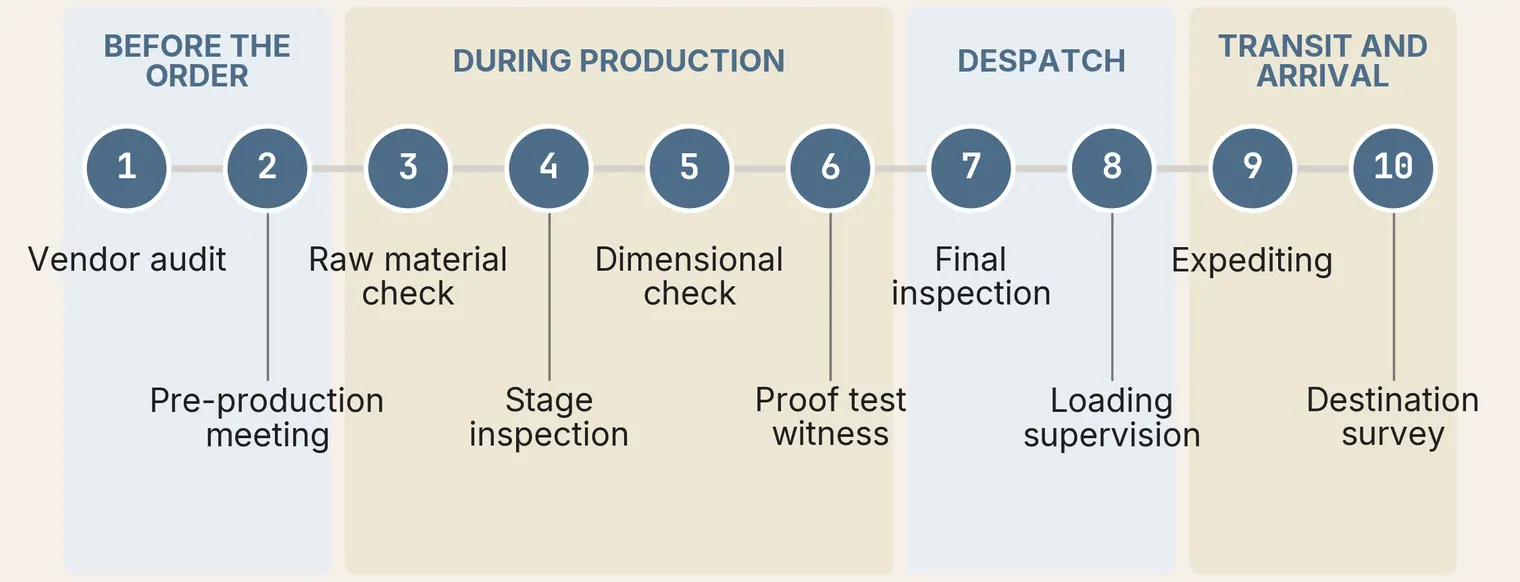
- Before the order: factory audit. Verifies that a supplier can meet the contract's quality, quantity and delivery terms, and supports OEM development, so fewer visits of your own are needed.
- During production: raw material, initial production and in-production checks. Material is verified before it is cut; production is watched from day one so a concern is raised early; visual checks and random material testing reduce what is left to find at final inspection. Random inspections can be added.
- During production: sample pick-up for testing. Samples are collected and labelled at the works and tested at TCR's laboratory: mechanical, chemical, PMI, NDT, metallography, corrosion, dimensional and product evaluation.
- At despatch: final inspection and loading supervision. Quality, quantity, packing and labelling are checked against your specification; the inspector then checks container condition, verifies packing units and seals the container.
- In transit: logistics management. Export documentation, customs and regulatory paperwork handled for the shipment.
What you receive at each stage is set out in the stage table below.
What makes an inspection third party, and why does it matter?
An inspection is third party when the organisation performing it has no stake in whether the item passes. The manufacturer wants to ship, the buyer wants to receive, and the inspector wants neither, which is the whole of the value and the reason the role exists as a separate contract rather than as a line in the supply agreement.
EN 10204, "Metallic products, Types of inspection documents", makes the distinction concrete, and it is the clearest way to see what independence buys. A Type 2.2 document carries results from the manufacturer's own non-specific inspection. A Type 3.1 carries results from specific inspection on the actual product, validated by the manufacturer's authorised inspection representative, who must be independent of the manufacturing department. A Type 3.2 carries the same specific inspection, validated additionally by the purchaser's representative or by an independent third-party inspector who has performed and witnessed the tests.
| Document | Whose inspection | On the actual product? | Who validates it |
|---|---|---|---|
| Type 2.1 | None. A declaration of compliance with the order | No test results at all | The manufacturer |
| Type 2.2 | The manufacturer's own, non-specific | No. Results from routine production, not from this consignment | The manufacturer |
| Type 3.1 | Specific, on the products supplied | Yes | The manufacturer's authorised inspection representative, independent of the manufacturing department |
| Type 3.2 | Specific, on the products supplied | Yes | The manufacturer's representative and the purchaser's representative, or an independent third-party inspector who performed and witnessed the tests |
Read the right-hand column. The step from 3.1 to 3.2 is not more testing; it is a second signature from someone with nothing to gain. That is what a buyer is purchasing when a third-party inspection agency is appointed.
When does a project need a third-party inspection agency in India?
When the cost of a wrong release exceeds the cost of watching it happen. That is a commercial test rather than a technical one, and it usually resolves to four situations: long-lead or bespoke equipment, a vendor being used for the first time, an item whose failure takes the plant down rather than the item, and any supply where a regulator, a lender or an overseas owner will later ask on what evidence it was accepted.
The fourth of those is the one buyers under-weight. An inspection not carried out cannot be reconstructed afterwards. Once the equipment is painted, boxed and on a truck, the only record that survives is the one somebody made at the time.
- Long-lead or bespoke items, where a rejection at site costs the schedule, not the part.
- A new or unproven vendor, or a vendor's new works, where the process capability is not yet evidenced.
- Safety-critical or plant-critical equipment, where the consequence is not the item.
- Regulated, financed or export supply, where the acceptance has to be defensible to somebody who was not there.
What does a third-party inspection company actually do at the vendor's works?
It reads the order into an inspection plan, agrees the hold and witness points before production starts, and then attends only those points, verifying against the approved documents rather than against a general impression. The output is a record at each stage and a release, or a non-conformance, at the end.
The sequence is deliberately front-loaded. Almost everything an inspector can usefully change is decided before the first cut, in the pre-inspection meeting where the plan, the applicable specification revision and the acceptance criteria are fixed.
- Pre-inspection meeting. The inspection and test plan, the hold and witness points, the specification revision in force, and what constitutes a release.
- Vendor assessment. The works, the calibration status of its equipment, the qualification of its welders and operators, and the quality management system.
- Stage inspection. Attendance at the agreed hold points, against the approved drawings and the approved procedures.
- Final inspection. Dimensional and visual verification, review of the manufacturer's records, and witnessing of the final tests.
- Release documentation. The inspection release note and, where the order calls for it, endorsement of the EN 10204 certificate at the agreed type.
- Loading supervision. Preservation, marking, packing and securing, because damage in transit is a failure of inspection as surely as a wrong weld is.
Two parts of that work have their own pages. Weld procedures, procedure qualification records and welder tests are reviewed, witnessed and endorsed under welding inspection. Where the order calls for it, plated fasteners and steel for hydrogen service are tested for hydrogen embrittlement at Mahape.
An Order, Stage by Stage, and What the Buyer Receives
TCR's third-party inspection runs to a written system: a manual, one guideline note per activity and a fill-in form for every record, so an inspector can execute it at a works they have not visited, on a product they did not make. The order is covered from the audit before it is placed to the survey after the goods arrive.
| Stage | Activity | What the buyer receives |
|---|---|---|
| Before the order | Vendor qualification audit | Audit report with findings and a conclusion: recommended, recommended with conditions, or not recommended |
| Order placed | Pre-production meeting and ITP review | Signed inspection and test plan with hold and witness points, and the minutes |
| Before fabrication | Raw material and consumable verification | Batch, expiry and certificate checked against every line of the schedule |
| During fabrication | Stage inspection | Witnessed stages, measured values and the visual acceptance recorded against the approved criteria |
| Finished item | Dimensional inspection | A measured dimensional record with a marked-up sketch |
| Proof test | Pressure or functional test witness | The witnessed test with its pressure, load or electrical record |
| Before despatch | Final and pre-shipment inspection | Final report, document audit and the inspection release note |
| At stuffing | Container loading supervision | Container condition, tally, securing, seal and verified gross mass |
| In transit | Expediting and progress monitoring | Progress against the contractual date |
| On arrival | Unloading and destination condition survey | Survey report and, where needed, the claim evidence pack |
Every stage ends in a written record for the buyer: a flash report after each visit, a non-conformance report when a finding is raised, the visit report with photographs, the container loading supervision report, the vendor audit report and the destination survey report. The reporting schedule for each order is agreed at enquiry and confirmed in the quotation.
Every document carries a number of the form TCR/TPI/year/job/form-sequence, so any report traces to its job without a register. A worked example of each report is shown to a prospective buyer on request; none is published.
What Counts as Evidence, and When the Inspector Stops
The inspector arrives holding the acceptance criteria: the tolerance, the hardness or thickness value, the visual acceptance level, the test pressure and hold time, the sampling plan. They are on the job card before travel. An inspector without them can watch but cannot inspect, and where no approved document carries a criterion, the answer is to escalate, not to decide.
- Measured before stated. A number in a report was measured or read off an identified instrument. ‘Satisfactory’ with no number behind it is an opinion.
- Witnessed and reviewed are kept apart. What the inspector saw happen is recorded separately from what was taken from the vendor's records.
- Missing is written MISSING. A blank cell reads as verified.
- Every photograph is captioned with a serial, the item, the location and what it shows; a defect is photographed twice, once to locate it and once close with a scale.
- An error in the buyer's instruction is flagged, not transcribed.
The inspector stops and escalates when a hold point has been passed without notice, when no approved document states the acceptance criterion, when the vendor proposes a material or procedure substitution, when a pneumatic test is proposed in place of a hydrostatic one, when access, photography or a record is refused, when a safety condition prevents the activity, or when the buyer's instruction conflicts with the approved documents. Acceptance of a design or of a deviation from the order is the purchaser's decision, and the report says so.
What an AQL Sample Does and Does Not Protect
An AQL is the acceptance level of a sampling plan, not a promise about the lot. Under ISO 2859-1, which TCR follows at third party inspections in India, the lot size and the AQL agreed in the order set the sample size and the accept and reject numbers, so a lot can pass with some defective units still in it.
- The order sets the AQL. Where none is given, it is agreed with the buyer before the visit.
- The lot size sets the sample. The lot size and the inspection level fix how many units are drawn; the AQL fixes how many defective units the sample may contain.
- A pass meets the plan. It does not prove the lot free of defects.
- The margin can be narrowed. A tighter AQL or a larger sample narrows it, at the cost of more units examined; if the margin is too wide for your product, say so at enquiry.
How should a third-party inspection services provider be judged?
By what can be checked, not by what is claimed. Three things are verifiable before an appointment is made: the accreditation and the scope it actually covers, the qualification of the individual inspectors who will attend, and whether the same organisation can test what it finds rather than sending it elsewhere.
The first is the one most often taken on trust. An accreditation certificate is a public record with a defined scope, and a test outside that scope carries no more weight than an unaccredited one, whatever the letterhead says.
- The accreditation, and its scope. TCR Engineering holds NABL ISO/IEC 17025:2017 certificate NABLT0726MH18640 across 1,483 scope items, verifiable at the NABL public record. NABL is a signatory to the ILAC Mutual Recognition Arrangement, under which an accredited report is accepted across 90+ economies.
- The inspectors, individually. Ask which qualification each attending inspector holds and whether it is current, not what the company's brochure lists.
- Whether findings can be tested in-house. An inspector who finds a suspect weld and has to send it to a third laboratory has added a handoff and a delay to the answer.
- The statutory and procurement recognitions that apply. TCR Engineering is an IBR Well-Known Material Testing Laboratory and a registered seller on the Government e Marketplace under ENEQ200001820172.
- Independence, in writing. Ask who else the inspector works for on the same project.
No superlative belongs in that list. "Best" is not a property a certificate can carry, and a provider that leads with it is asking to be judged on something unverifiable.
The Accreditation Position, Stated Plainly
A buyer is entitled to know what a TCR inspection report rests on before deciding what weight to place on it. TCR Engineering acts as an independent third party: it has no financial interest in the vendors it inspects, does not design, make, supply, install or maintain what it inspects, and reports to the purchaser who appoints it.
- The laboratory accreditation is real and verifiable. NABL ISO/IEC 17025:2017, certificate NABLT0726MH18640, 1,483 scope items, valid to 2 March 2030, on the NABL public record. It covers testing: a sample an inspection draws is tested under it.
- TCR is not accredited as an inspection body and does not claim to be. ISO/IEC 17020:2026, published on 27 March 2026 and replacing the withdrawn 2012 edition, sets the requirements for inspection bodies. TCR works as an independent third party under the terms of each inspection contract; a buyer who requires an accredited inspection body should say so at enquiry.
- Sampling follows ISO 2859-1:2026, the third edition of 22 January 2026, which replaces the 1999 edition, or ASQ/ANSI Z1.4 where the order names it, and ISO 3951-1:2022 for inspection by variables. The AQL is the buyer's; where none is given it is agreed before the visit.
- Competence: visual inspection by ASNT or PCN Level II inspectors, with CSWIP, AWS CWI, API 510, API 570 or API 653 credentials where the scope needs them; vendor audits led by an ISO 9001 or API Q1 lead auditor.
The Sectors the Procedures Are Written For
The system is general, and the guideline notes carry the product-specific checks. Beyond steel fabrication, castings, forgings, piping and pressure equipment, where TCR's inspectors have worked for decades, the procedures are written for the equipment families below, each with its own acceptance references.
| Equipment family | What the inspection covers | References the procedures cite |
|---|---|---|
| FRP and GRP pressure vessels, tanks and filtration vessels | Raw materials and resin batches, laminate and cure by Barcol hardness and thickness, dimensions, hydrostatic test witness, loading | ASME BPVC Section X, ASME RTP-1, BS EN 13121-3, ASTM D3299-26, ASTM D2583-25 |
| Solar and power equipment | Pre-dispatch inspection of PV modules, string inverters, HT and DC cables and ACSR conductor; routine test witness of power transformers and HT and LT panels; module mounting structures and their galvanising; pile foundation casting | The approved GTP and QAP of each order |
| Mechanical puzzle parking systems | Fabrication stage inspection of the steel structure, site erection and installation, and functional, safety and load test witness | The approved drawings and the order's ITP |
| Precision rotating equipment | Vendor assessment of machining, heat treatment and metrology capability; final inspection with a witnessed trial run | The purchase order's tolerances and measuring method |
| Bulk materials such as activated carbon | Sampling, sealing and chain of custody, testing at a NABL-accredited laboratory, and loading supervision | The purchaser's specification; ISO 2859-1 sampling |
Where an FRP vessel needs acoustic emission examination to ASME BPVC Section V Article 11 or ASTM E1067, it is mobilised separately as acoustic emission testing. Samples drawn at a works can be tested at TCR's laboratory, including composites and polymers.
Where is this service delivered?
Third-party inspection under this page, one of TCR's inspection manpower and third-party services, is delivered from India by TCR Engineering Services Pvt. Ltd., including inspection at Indian vendor works on behalf of overseas buyers, which is the larger part of the cross-border work.
Inspection delivered inside Saudi Arabia is a separate matter and a separate company. TCR Arabia Company Limited is a 60/40 joint venture with GAS Arabian Services, holding its own accreditation, operating its own practice and engaging Saudi Aramco approved inspectors on a contract basis; the group page is TCR Arabia. Enquiries for work performed inside the Kingdom belong there rather than here.
Related services and industries
Documents
Download the reference documents for this page. Every file is hosted on this domain and is also listed in the site document library.
Third-party inspection on video
A walk-through for buyers who source from Indian manufacturers: the ten stages of an order, what an AQL sample does and does not protect, and the laboratory behind the inspector.
Related insights
6 published insights on this site bear directly on Third-Party Inspection. They are below; the full index carries all 21 Inspection Manpower insights.
-
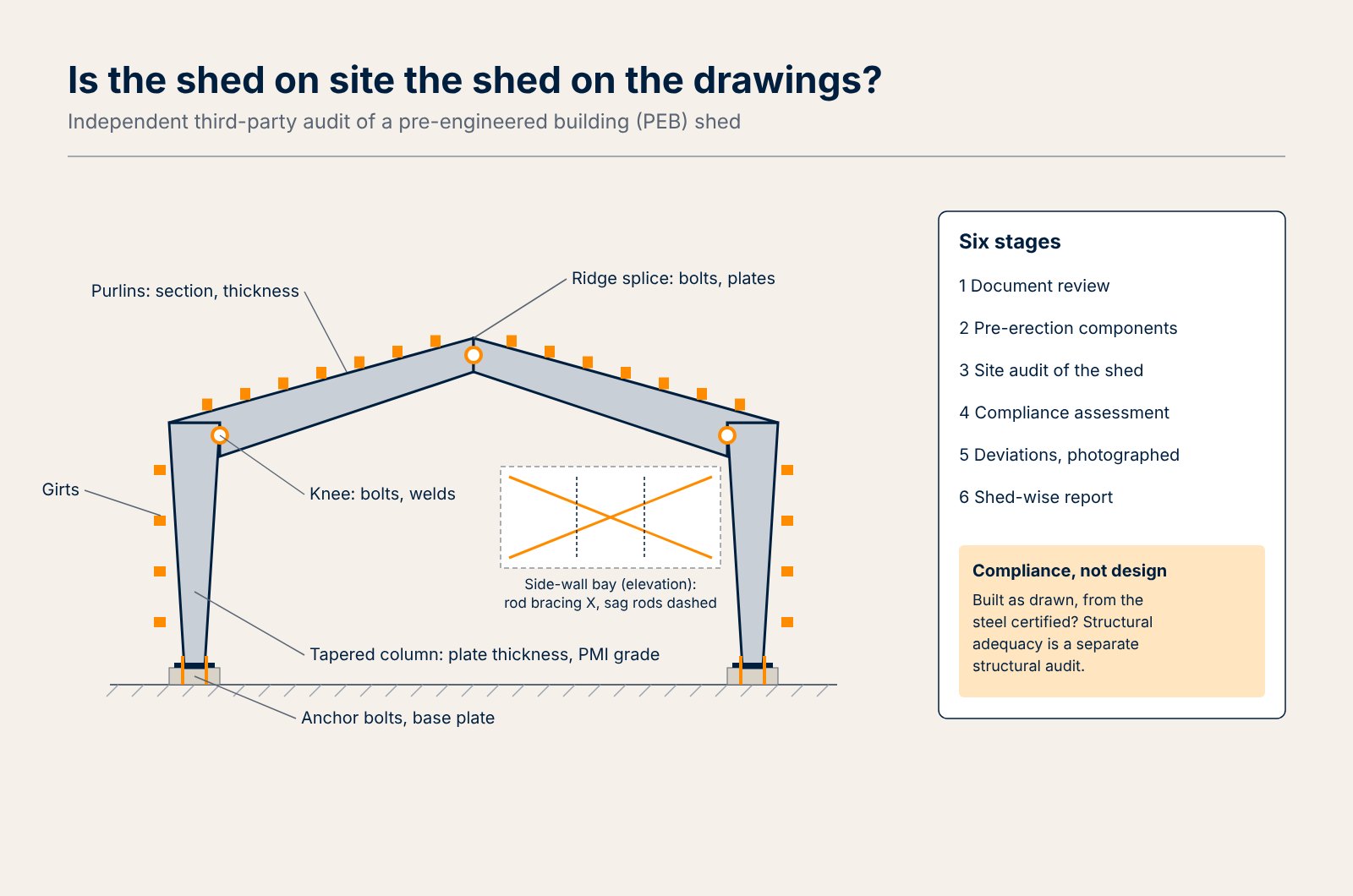
Third-party audit of PEB sheds in India: what an independent audit checks, and what it does not
TCR Engineering audits erected pre-engineered building sheds and their components against the approved drawings and mill certificates: section sizes,…
-
Third Party Inspection Services in India: EPC and Global Buyers Guide
TCR Engineering provides trusted third party inspection in India for EPC and international buyers, protecting quality at source since 1973.
-
Third Party Inspection Services Oil and Gas - Why Your Project's Success Depends on Getting Independent Eyes on Everything
Third party inspection services oil and gas - TCR Engineering provides independent pipeline, facility & tank inspection since 1973.
-
Third-Party Inspection of Imported Construction Materials
TCR Engineering offers trusted third-party inspection for materials sourced from India, ensuring quality before international shipment.
-
TCR wins Third Party Inspection Project of Rigid Perlite Insulation
TPI for Rigid Perlite Insulation products of Perma-Pipe Middle East (FZE) at their vendor locations in India
-
Castings and Forgings Third Party Source Inspection in India
TCR inspectors have strong experience in forgings and castings.



Frequently asked questions
What does TCR's third-party inspection cover?
The service spans factory audit, OEM development, raw material inspection, initial production check, in-production check, random inspection, final inspection and loading supervision. Field inspectors visit supplier sites across India, assess quality at each phase and report against the purchase order, approved drawings and the agreed quality plan.
How are samples drawn and tested?
Inspectors mark each item with a unique identification number and TCR stamp. Unless the buyer specifies a sampling plan, TCR draws a minimum of two samples plus one additional sample per batch of ten. Samples are tested at TCR's NABL ISO/IEC 17025:2017 accredited laboratory; if any sample fails, the lot is rejected.
What documentation does the inspection produce?
The inspection report is issued in the prescribed format with supporting documents such as stage inspection reports and test certificates, confirming acceptance against approved technical documentation and quality plans. Certification follows EN 10204 Type 2.2, 3.1 and 3.2 frameworks, and dispatched material carries the TCR stamp and serial or TC number for verification.
What are third-party inspection services?
Third-party inspection services are checks carried out at a vendor's works by an organisation independent of both the buyer and the manufacturer, so that the release of material or equipment rests on witnessed evidence rather than on the supplier's own assurance. They typically cover vendor assessment, stage and final inspection, release documentation and loading supervision.
What is the difference between an EN 10204 3.1 and a 3.2 certificate?
A Type 3.1 carries results from specific inspection on the products supplied, validated by the manufacturer's authorised inspection representative, who must be independent of the manufacturing department. A Type 3.2 carries the same specific inspection validated additionally by the purchaser's representative or by an independent third-party inspector who performed and witnessed the tests. The step is a second signature from someone with nothing to gain, not more testing.
Is TCR Engineering's third-party inspection work accredited?
TCR Engineering holds NABL ISO/IEC 17025:2017 certificate NABLT0726MH18640 across 1,483 scope items, and NABL is a signatory to the ILAC Mutual Recognition Arrangement, under which an accredited report is accepted across 90+ economies. It is also an IBR Well-Known Material Testing Laboratory and a Government e Marketplace registered seller, ENEQ200001820172.
Is TCR Engineering accredited as an inspection body under ISO/IEC 17020?
No, and TCR does not claim to be. TCR acts as an independent third party under the terms of each inspection contract. Its accreditation is NABL ISO/IEC 17025:2017, certificate NABLT0726MH18640, which covers testing, including samples an inspection draws. A buyer who needs an accredited inspection body should say so at enquiry.
Which reports does the buyer receive from a third-party inspection?
Every visit ends in a flash report, and a finding raised at the works ends in a non-conformance report. The buyer also receives the visit report with photographs, the container loading supervision report, the vendor audit report and the destination survey report, with the reporting schedule for each order confirmed in the quotation.
Where is TCR's third party inspection agency based, and where does it inspect?
TCR Engineering runs third party inspection from its laboratory at Mahape, Navi Mumbai, and its inspectors attend vendor works across India, including for overseas buyers who source from Indian manufacturers. Inspection inside Saudi Arabia is delivered by TCR Arabia, the joint venture with its own accreditation, under its own contracts.
Does TCR issue a third party inspection certificate?
Yes. After final inspection TCR issues an inspection release note and, where the order calls for it, endorses the manufacturer's EN 10204 Type 3.2 certificate as the independent third-party inspector who witnessed the tests. Tested material carries the TCR stamp and the serial or test certificate number, so the buyer can match the document to the item.