
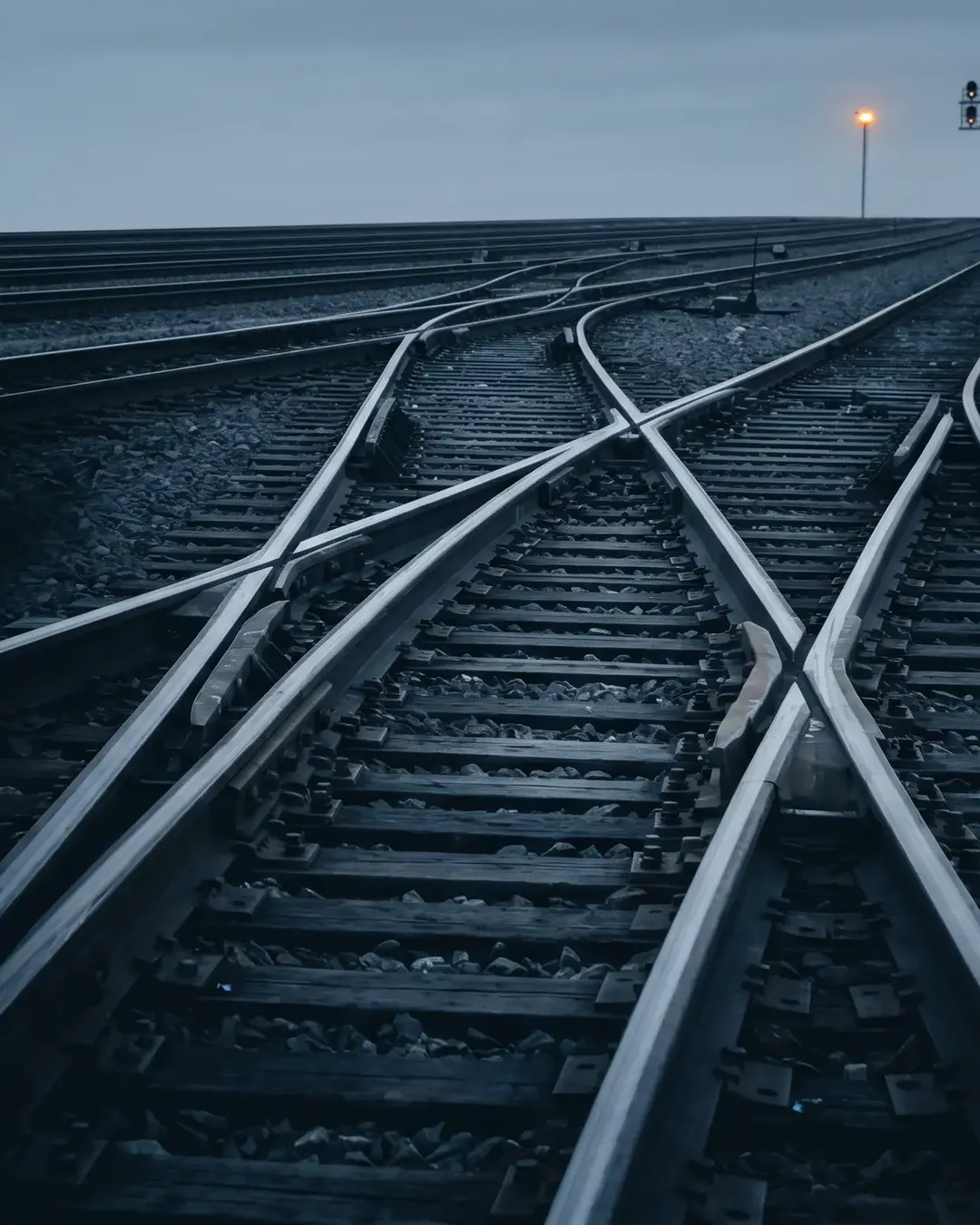
Industries
Railways
Rail Weld Fatigue and High Speed Rail Materials
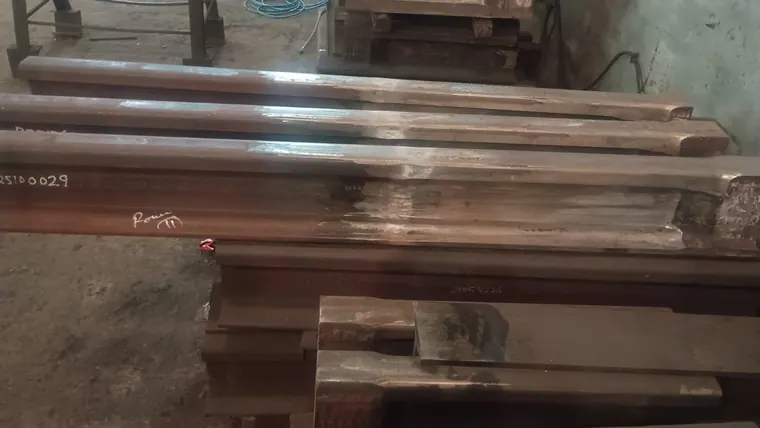
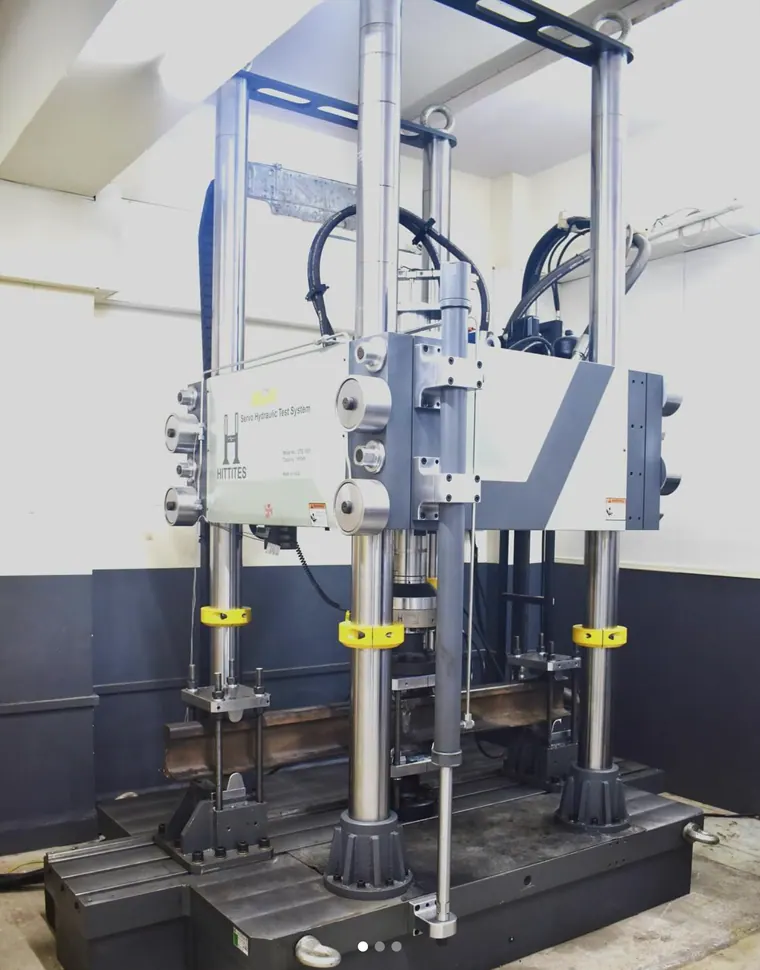
Rail weld fatigue programmes run to RDSO IRS:T-19 out to five million cycles, couplers to IS 16172, and the same bench serves the Mumbai-Ahmedabad High Speed Rail and the Haramain High Speed Rail in Saudi Arabia.
Request a QuoteIn brief
TCR tests rail, rail welds and the construction materials of India's rail corridors: rail and rail-weld fatigue to RDSO IRS:T-19 out to 5 million cycles, rebar couplers to IS 16172, and high-tensile strand, concrete and soil to NHSRCL and Shinkansen specifications across all three civil packages of the Mumbai-Ahmedabad High Speed Rail, with NDT on the Haramain High Speed Rail through TCR Arabia.
Key takeaways
- 7 plant sections, from track to rolling stock, and 7 families of damage mechanism are covered below.
- High speed rail work is reported against the Japanese Shinkansen specifications cross-referenced under the JICA-funded MAHSR scope, UIC 60 and EN 13674; the full standards matrix is below.
- 5 marquee engagements are documented on this page, led by all three civil packages of the Mumbai-Ahmedabad High Speed Rail.
- Welded rail joints are fatigue tested in four-point bending to RDSO IRS:T-19 and BS EN 14587 on the rail and rail-weld fatigue bench.
Overview
India’s first bullet train, the Mumbai-Ahmedabad High Speed Rail, and the metro systems of Mumbai, Delhi, Bangalore, Chennai, Hyderabad and Pune route their materials and NDT scope through TCR, alongside the Dedicated Freight Corridor, the conventional modernisation of Indian Railways and, through TCR Arabia, the Haramain High Speed Rail in Saudi Arabia.
- Rail and rail-weld fatigue: welded rail joints in four-point bending over a 1,000 mm span on the 1,000 kN frame, to 5 million cycles, per RDSO IRS:T-19 and BS EN 14587; method and standards.
- Rail steel: fatigue crack growth rate per EN 13674 and ISO 12108, run for Jindal Steel and Power rail supply.
- Failures investigated: rail and weld failures, and viaduct and bearing deterioration, across track, rolling stock and structures.
- Mechanisms: rolling-contact fatigue, head checking and squats, flash-butt and thermite weld defects, high-tensile-strand stress corrosion cracking, prestress loss, and bridge-bearing and expansion-joint wear.
Industry Context
Indian Railways is running the largest safety-led capital programme in its history. The FY26 outlay carries a large safety-related budget covering track renewals, bridges, road over bridges, level crossings, and the Kavach train protection rollout.
- Outlay: the FY26 outlay carries a large safety-related budget covering track renewals, bridges and road safety.
- High speed rail: the Mumbai-Ahmedabad corridor, India's first bullet-train corridor, in active execution under NHSRCL with three civil EPC packages (C1, C2, C3) running in parallel.
- Conventional and freight: the Vande Bharat semi-high-speed rolling-stock programme, the Eastern and Western Dedicated Freight Corridors, now in operation, metro-rail capex across approximately 30 Indian cities, and Indian Railways modernisation (track renewal, electrification and station redevelopment).
- GCC: the Haramain High Speed Rail between Mecca and Medina, the Riyadh Metro, the Dubai Metro and the Doha Metro.
- Emerging scope: the shift to 25 kV AC traction, which increases AC interference on the cathodic protection systems of parallel pipelines.
Safety spend of that order is, at its core, materials assurance spend: every rail weld, casting, coupler, and bridge member has to be proven against RDSO and IS requirements before it carries traffic. TCR has served that proof chain for decades, running rail-weld fatigue programmes to RDSO IRS:T-19 out to five million cycles, testing couplers and components to IS 16172, and inspecting railway bridges and structures in the field.
Electrification to 25 kV AC traction raises AC interference on the cathodic protection of parallel pipelines (see Pipelines and City Gas). The Indian Railways hydrogen-train demonstrator brings hydrogen embrittlement and storage scope, battery-traction multiple units on non-electrified branch lines bring battery-cell qualification, and the concrete and rebar of the high speed rail corridors carry civil testing for decades.
Plant Sections We Inspect
| Cluster | Equipment / Material |
|---|---|
| Track | Rail (UIC 60, Indian Railways IRS T-12), sleeper (PSC concrete), fastener system (Pandrol, fast-clip), ballast, sub-grade |
| HSR-Specific | Slab track (slab-on-mat or slab-on-asphalt), high-speed turnout, expansion joint, flash-butt welded long rail, thermite welded joint |
| Bridges and Viaducts | Box girder (segmental concrete), composite girder (steel-concrete), cable-stayed and arch structures, bearings (POT-PTFE, elastomeric, spherical), expansion joint |
| HT Strand and Tendons | High-tensile strand (IS 14268, ASTM A416) for prestressed concrete sleepers and viaduct girders |
| Tunnel | NATM and TBM tunnel lining, segmental lining, waterproofing membrane, drainage system |
| Station and Depot | Reinforced-concrete shells, steel canopy, depot maintenance pit, gantry rail |
| Rolling Stock | Wheel forging, axle forging, bogie frame, suspension component, brake rigging, traction motor mount, body shell |
Damage Mechanisms We Investigate
| Category | Mechanisms |
|---|---|
| Rail | Rolling contact fatigue, shelling, head checking, squat, internal flaw (transverse and longitudinal), wear |
| Wheel and axle | Surface fatigue, thermal cracking from braking, shelling, tread wear, axle bending fatigue |
| Bridge / viaduct | Reinforcement corrosion, HT strand stress corrosion cracking, bearing wear, expansion joint deterioration, prestressed concrete creep and shrinkage |
| Welded joint | Flash-butt weld fusion defect, thermite weld porosity, HAZ embrittlement |
| Track foundation | Sub-grade settlement, ballast contamination, drainage failure |
| Slab track | Slab cracking, mat fatigue, asphalt rutting under cyclic load |
| Rolling-stock fastener | Hydrogen embrittlement, fatigue |
Standards Coverage Matrix
- HSR-Specific
- Japanese Shinkansen specifications (cross-referenced under MAHSR via the JICA-funded scope); UIC 60 (international rail profile); EN 13674 (European rail-steel grades); IRS:T-12 (Indian Railways flat-bottom rails); EN 14587 (flash-butt welding of rails); IRS:T-19 (fusion welding of rails by the alumino-thermic process).
- HT Strand and Tendons
- IS 14268 (uncoated stress-relieved low-relaxation seven-ply strand for prestressed concrete); ASTM A416 (steel strand, uncoated seven-wire for prestressed concrete); EN 10138 (prestressing steels); IS 2090 (high-tensile steel bars used in prestressed concrete).
- TMT Rebar and Couplers (cross-vertical)
- IS 1786 (TMT rebar); IS 16172 (rebar couplers; the BIS-accredited first-in-India anchor); ACI 318; ASTM A615.
- Concrete (cross-vertical with Civil)
- IS 456 (plain and reinforced concrete code of practice); IS 1343 (prestressed concrete code of practice); IS 516 (Part 5/Sec 1):2018 (UPV) and Part 2 (rebound hammer); ASTM C39, C496, C617.
- Bridge
- IRC SP 35, IRC SP 18, IRC SP 40 (bridge inspection and rehabilitation); BS 5400; AASHTO LRFD Bridge Design Specifications.
- Welding
- ASME Section IX 2023; AWS D1.1 2025; AWS D1.5 (bridge welding code); IS 7318 (welder qualification).
- Indian Railways and IRSE
- Indian Railway Standard (IRS) specifications; Research Designs and Standards Organisation (RDSO) specifications; Institution of Railway Signal and Telecommunication Engineers (IRSE) framework; Commissioner of Railway Safety (CRS) inspection regime.
- Tunnel
- IS 4880 (criteria for design of tunnels conveying water); EN 1990 (Eurocode basis of structural design); FHWA Tunnel Design Guidelines.
Service Applications Across the TCR Continuum
Indian railways, metro systems, and the high-speed rail programme buy integrity across two distinct asset families: rolling assets (rail, wheelsets, axles, couplers, coach and wagon components) and fixed infrastructure (bridges, viaducts, station structures, overhead equipment masts). The recurring problems are rolling contact fatigue and weld failure in rail, fatigue of bogie components, corrosion of ageing riveted and welded bridges, and the sheer scale of the bridge inspection backlog, which is why TCR's 500+ bridge record matters to zonal railways and metro operators alike. The maintenance block is the railway's turnaround: possession windows are short, night-bound, and unforgiving. Procurement risk concentrates in rail steel, fastening systems, couplers, and structural steel quality. TCR Engineering and TCR Advanced service all five stages of the five-stage Trusted Relationship Model (see Why TCR) across both asset families.
- Stage One, Sourcing and Procurement
- Rail steel is qualified through fatigue crack growth rate testing per EN 13674 and ISO 12108, the programme TCR has run for Jindal Steel and Power rail supply, alongside tensile, hardness, and impact testing, chemical analysis, and microstructural evaluation. Reinforcement couplers and mechanical splices for viaduct construction are tested per IS 16172 and ISO 15630 under the BIS-accredited coupler programme, and fastening systems, elastomeric pads, and structural steel are verified against Indian Railway Standard and RDSO specifications, with vendor audits and sample picking.
- Stage Two, Construction and Commissioning
- On new corridors, metro viaducts, and station structures, TCR provides construction-stage quality assurance: welding procedure and welder qualification including thermite and flash-butt rail weld evaluation, radiography and ultrasonic testing of structural welds, concrete testing per IS 516, non-destructive concrete evaluation by ultrasonic pulse velocity per IS 516 (Part 5/Sec 1):2018 and rebound hammer per IS 516 (Part 5/Sec 4):2020, theodolite-based plumbness surveys on piers, and baseline records for every structure.
- Stage Three, In-Service
- In service, TCR delivers bridge inspection programmes drawing on the Federal Highway Administration Bridge Inspector's Reference Manual methodology and Indian Railways bridge codes, corrosion assessment of steel girders and overhead equipment masts, ground penetrating radar and subsurface mapping around foundations, and thermography of traction and electrical systems, structured so zonal railways and metro operators can prioritise the backlog by condition rather than age alone.
- Stage Four, Maintenance Blocks (Shutdown and Turnaround)
- Inside possession windows and workshop periodical overhauls, TCR provides non-destructive testing of axles, wheelsets, and coupler components by ultrasonic, magnetic particle, and penetrant methods, weld inspection on repaired girders, and load testing support for strengthened spans, sequenced to block timings so traffic resumes on schedule.
- Stage Five, Continuum
- Findings feed failure analysis of rails, axles, springs, and bridge components, fatigue life assessment of rolling stock and structural details, residual life certification of ageing bridges, structural stability assessment of station buildings and workshops, and engineering design review for strengthening and rehabilitation schemes, closing the loop back into the next procurement specification.
Named Clients
- India High Speed Rail
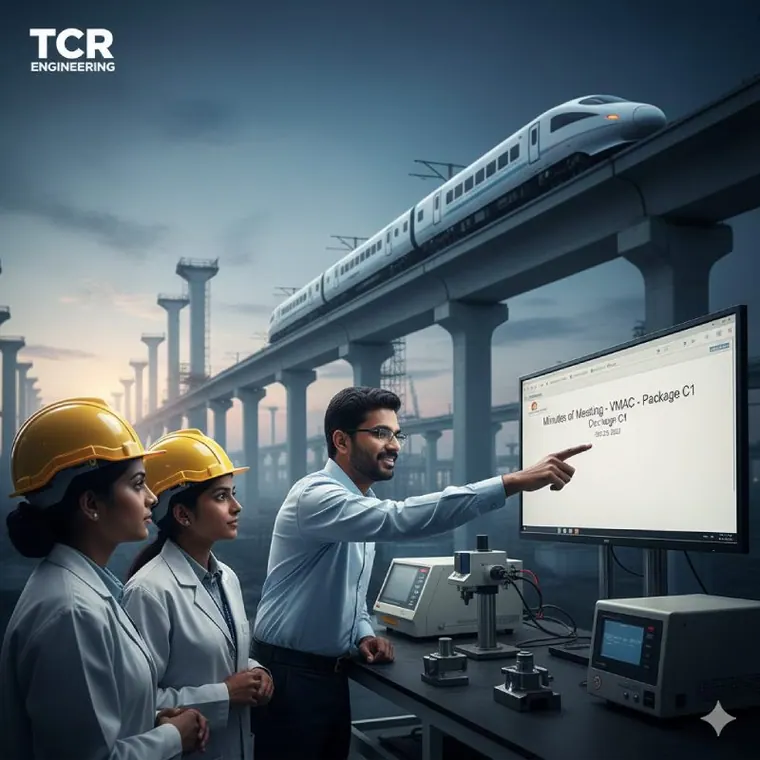
- National High Speed Rail Corporation Limited (NHSRCL); MAHSR civil EPC: MEIL-HCC (Package C1), Afcons (Package C2), Larsen and Toubro (Package C3); NHSRCL VMAC Meeting No. 13 dated October 23 2023 sets the materials and NDT scope.
- India Metro Rail
- Mumbai Metro Rail Corporation (MMRCL), Delhi Metro Rail Corporation (DMRC), Bangalore Metro Rail Corporation Limited (BMRCL), Chennai Metro Rail Limited, Kolkata Metro, Hyderabad Metro, Pune Metro, Nagpur Metro, Lucknow Metro, Jaipur Metro, Kochi Metro, Ahmedabad Metro, Surat Metro.
- Indian Railways and DFCC
- Indian Railways (Centre for Railway Information Systems CRIS, Research Designs and Standards Organisation RDSO, Northern, Western, Central, Southern, Eastern, South Central Railway zones); Dedicated Freight Corridor Corporation of India Limited (DFCCIL).
- India Mass Transit and Light Rail
- RITES (PSU consultancy and PMC); Mumbai Metropolitan Region Development Authority (MMRDA); CIDCO (Maharashtra empanelment for materials testing); Mumbai Coastal Road Project (cross-vertical reference).
- India EPC and Component Manufacturers
- Larsen and Toubro Construction; Afcons Infrastructure; HCC; MEIL; Tata Projects; Patel Engineering; SAIL Bhilai (rail steel); Tata Steel and JSW Steel (structural sections; cross-vertical with Steel).
- International HSR
- Haramain HSR (Mecca-Medina, KSA; TCR Arabia delivered ultrasonic testing and NDT services).
Marquee Projects
The railway record covers all three civil packages of the Mumbai-Ahmedabad High Speed Rail corridor under NHSRCL, ultrasonic testing and non-destructive testing on the Haramain High Speed Rail in Saudi Arabia through TCR Arabia, and Mumbai Metro Rail. Project, service anchor and year follow.
| Project | Service Anchor | Year |
|---|---|---|
| Mumbai-Ahmedabad High Speed Rail (NHSRCL Packages C1, C2, C3) | Civil testing under MEIL-HCC, Afcons, Larsen and Toubro; HT strand; rebar coupler; concrete; soil; HSR-spec materials per NHSRCL VMAC Meeting No. 13 | October 2023 onward |
| Haramain High Speed Rail, KSA | TCR Arabia delivered ultrasonic testing and NDT services | Construction era |
| Mumbai Metro Rail (MMRCL) | Materials testing, NDT, structural-steel verification | Continuous |
| Mumbai Coastal Road Project (cross-vertical reference) | Civil testing, sub-water bridge-pier inspection | Continuous |
| 500+ bridges across India | Robotic NDT, structural audit | Continuous |
On the Mumbai-Ahmedabad High Speed Rail corridor, TCR is engaged across all three civil packages (MEIL-HCC, Afcons, and Larsen and Toubro) under NHSRCL VMAC No. 13 dated 23 October 2023, covering concrete, reinforcement, structural steel, and track materials. Rail-weld fatigue qualification runs to RDSO IRS:T-29 and IRS:T-19, with flash-butt and aluminothermic welds taken to 5 million cycles.
High-tensile strand for high-speed-rail viaducts and prestressed bridge decks is qualified for tensile, stress-relaxation, and 2 million-cycle fatigue per IS 14268, ASTM A416, and ISO 15630-3.
Documents
Download the reference documents for this page. Every file is hosted on this domain and is also listed in the site document library.
Related insights
6 published insights on this site carry the Railways tag. The 6 most recent are below.
-
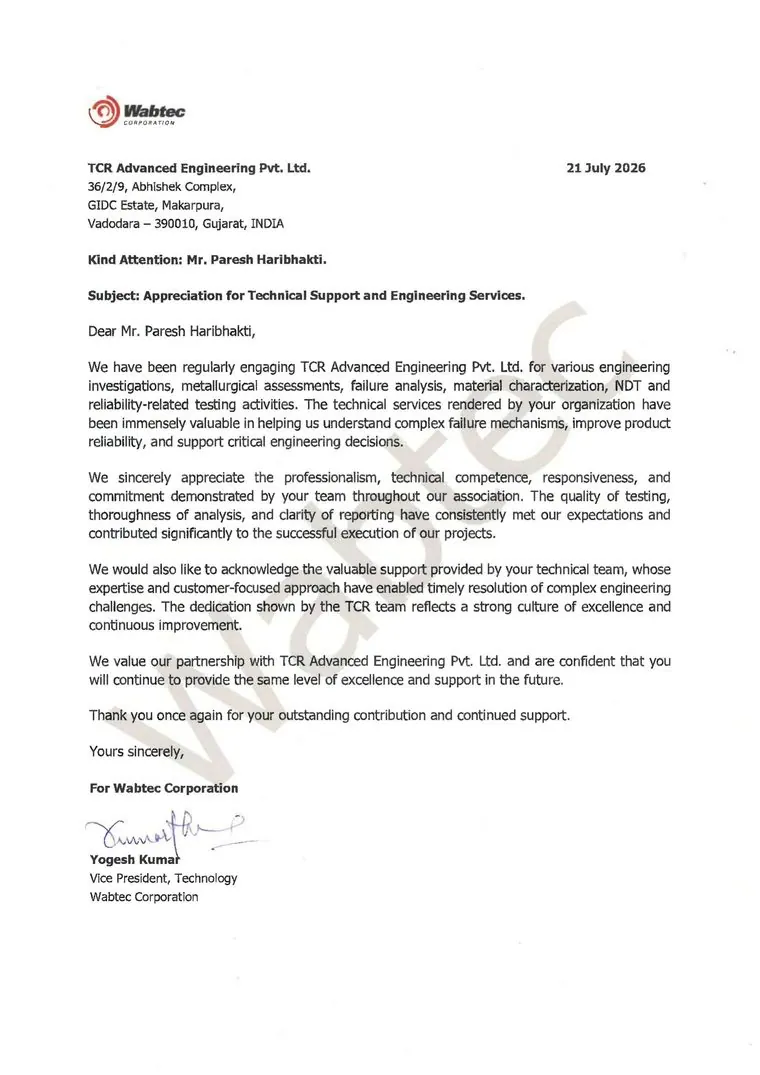
Wabtec Corporation Writes to TCR Advanced: Failure Analysis, Material Characterisation and Reliability Testing
Wabtec Corporation has written to TCR Advanced Engineering to record its appreciation for engineering investigations, metallurgical assessments,…
-
When 5 Million Cycles Determine If Your Railway Welds Will Survive 30 Years of Traffic
Railway track fatigue testing per RDSO IRS:T-29 validates weld joints through 5 million cycles. TCR's expertise prevents catastrophic track failures.
-
TCR Engineering Approved for India's Landmark High Speed Rail Project Testing
TCR Engineering approved by NHSRCL for Mumbai-Ahmedabad High Speed Rail testing. Materials testing lab serves multiple HSR packages since 2024.
-
Non-Destructive Testing (NDT) Services in India: Complete Guide to Methods, Applications & NABL Certified Solutions
NABL certified NDT testing services across India. Expert ultrasonic, radiographic & phased array inspection for industrial & civil projects.
-
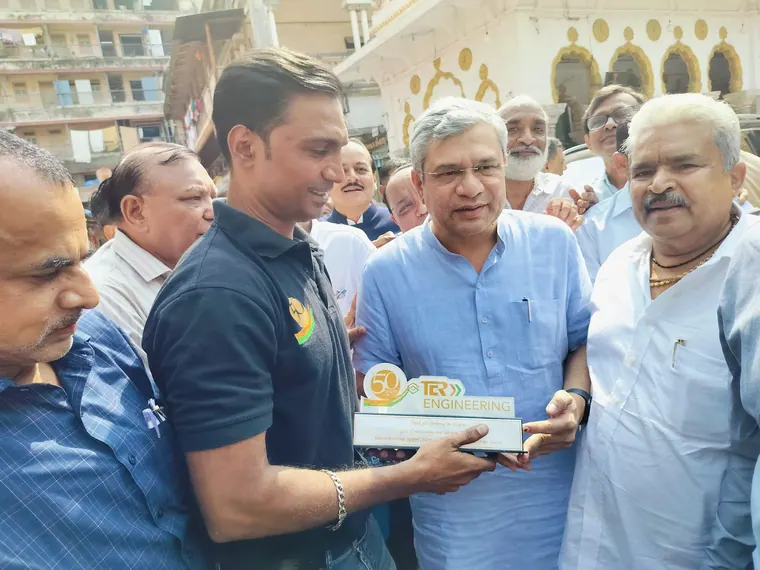
Railways Minister Ashwini Vaishnaw Meets TCR Engineering
Sh. Ashwini Vaishnaw, minister for Railways in India was presented a memento by Mr. Atul Yadav, PR and HR head of TCR Engineering Services.
-
Fatigue Testing - weld joints in rail tracks
TCR Engineering conducts Fatigue testing of weld joints in rail tracks as per IRS-T19, ISO 14587 & other National/International standards
Frequently asked questions
Does TCR test rail welds for Indian Railways?
Yes. TCR runs rail-weld fatigue programmes to RDSO IRS:T-19 and IRS:T-29, taking flash-butt and aluminothermic welds out to five million cycles, and tests couplers and components to IS 16172.
Is TCR engaged on the Mumbai-Ahmedabad High Speed Rail project?
Yes. TCR is engaged across all three MAHSR civil packages (MEIL-HCC Package C1, Afcons Package C2, Larsen and Toubro Package C3) under NHSRCL VMAC Meeting No. 13 dated 23 October 2023, covering concrete, reinforcement, structural steel and track materials.
Can TCR qualify high-tensile strand for viaducts and bridge decks?
Yes. High-tensile strand for high-speed-rail viaducts and prestressed bridge decks is qualified for tensile, stress-relaxation and 2 million-cycle fatigue per IS 14268, ASTM A416 and ISO 15630-3.
Does TCR inspect railway bridges?
Yes. TCR carries a 500-plus bridge inspection record covering corrosion of ageing riveted and welded bridges, serving zonal railways and metro operators in the field.
What standards govern TCR's high-speed rail materials testing?
Japanese Shinkansen specifications cross-referenced under the JICA-funded MAHSR scope, UIC 60, EN 13674, IRS:T-12, EN 14587 for flash-butt welding and IRS:T-19 for alumino-thermic welding of rails.