

Services · Asset Integrity and Engineering Consulting
Plant Structural Integrity
Your process units have been revamped many times. The concrete underneath them has not.
Request a Quote
In brief
TCR Engineering, a NABL ISO/IEC 17025:2017 accredited laboratory (NABLT0726MH18640) in Navi Mumbai, runs Risk-Based Inspection and Remaining Life Assessment programmes over the civil assets of Indian and GCC process plants: foundations, pipe racks, cooling towers, dyke walls, jetties and steel structures. The programme starts with a gap analysis of the inspection record the plant already holds.
The problem, in Indian numbers
Refinery count and installed capacity: Petroleum Planning and Analysis Cell, Installed Refinery Capacity, as on 1 April 2026. Commissioning years: Ministry of Petroleum and Natural Gas, refinery-wise Refining Capacity table, which carries each refinery’s commissioning year; fourteen of the twenty-three were commissioned in 1996 or earlier and thirteen of those fourteen carry nameplate capacity today. Form 1-A: Rule 3A, Maharashtra Factories Rules 1963.
The problem is data, not testing capacity
We run Risk-Based Inspection and Remaining Life Assessment for the foundations, pipe racks, cooling towers, dyke walls, jetties and steel structures your plant runs on. We start with a gap analysis of the inspection data you already hold, and we test only what is missing.
Most plants already hold a great deal of inspection data on their civil assets. Reports from a structural audit five years ago, drawings from commissioning, a repair record somewhere in maintenance, a survey commissioned after an incident. What almost no plant holds is a single view of whether that data is complete enough, current enough and traceable enough to carry a remaining-life conclusion.
That is where a structural integrity programme succeeds or fails, and it is where ours starts. Before any crew mobilises, we normalise your existing record into one dataset keyed to your own asset tags, and we score every source:
- was the issuing agency accredited at the date of test;
- was the technician certified;
- was the equipment calibrated;
- was the standard edition stated;
- is the raw element-level data there, or only a summary.
What comes out is a gap register that tells you exactly which assets have a usable record, which have a weak one, and which have none at all. The gap register then scopes the field campaign. On one recent fertiliser-plant block, that meant 41 per cent of the tests a standing menu would have called for, with concrete coring down 59 per cent, and 1,850 metres of buried drain survey added that the standard menu would not have touched at all. The drain reach turned out to carry the highest-risk finding on the site.
The ten civil asset classes
Almost every operating plant in India holds all ten. Each gets its own checklist, its own defined test set, its own deliverable and its own RBI segment.
- RCC foundations: equipment, vessel, column and pump foundations, pile caps and pedestals
- Pipe racks and cable tray supports: RCC and structural steel
- Process buildings, substations and control rooms
- Cooling tower structures: RCC, timber and FRP
- Storage tank dykes and bund walls
- Retaining walls and boundary structures
- Underground drainage and culverts
- Jetty and marine structures
- Roads, pavements and storm water channels
- Steel supports, accessways, platforms and technological structures
The five phases
The programme runs in five phases, from the record you already hold to a signed remaining-life number and a risk-ranked inspection interval per segment.
- Phase 1: Ingest and baseline inspection. Documentary record and baseline survey run together, so the survey crew is in the plant while the drawings are being read.
- Phase 2: Gap analysis. Every source is weighed for how far it can be trusted, and that decides what it is allowed to carry: a weak record contributes an observation, never a number in a remaining-life conclusion.
- Phase 3: Gap closure. Only the gaps the owner approves are tested. Where an existing report is sound and traceable, we use it. We do not repeat work you have already paid for.
- Phase 4: Assessment. Remaining Life Assessment first, then Risk-Based Inspection on top of it. The remaining-life method is stated before the number, and the number is a range with its confidence band.
- Phase 5: Verification. Five sequential gates: data integrity, independent technical peer review, structural engineer of record, quality release under ISO/IEC 17025:2017, and clearance from the office of the President.
We Read Before We Test
Most of the evidence a remaining-life conclusion needs is already in the plant's files, scattered across old audits, commissioning drawings and repair records. We read all of it before a crew is mobilised, weigh each record for how far it can be trusted, and test only where the record cannot carry the decision on its own.
- No record is thrown away. A report too weak to carry a number still carries an observation, and an old reading becomes a trend point, because two readings taken years apart at the same place say more than any single survey.
- Trust is earned by traceability. Who made a measurement, with what, to which standard and on which date decides what that record may support, whoever issued it, TCR included.
- Age is judged by the asset, not the calendar. A record stays current only as long as the thing it measured could not have changed, and a fire, a repair or a new load ends that sooner than any date.
- The owner decides what is tested. Every proposed test carries its reason, nothing is tested that the owner has not approved, and testing avoided is counted as a result.
A Remaining Life Is an Honest Range
A remaining life is the time until the governing deterioration mechanism reaches a limit that matters, and it is never a single number. We state the method before the result and give the result as a range whose width reflects the evidence, so a reader can see how much of the conclusion rests on measurement and how much on judgement.
- Confidence follows evidence, not alarm. A severe finding on complete data is a confident severe finding; a mild finding on thin data is an uncertain one, and the report says which.
- Where evidence is missing, the number is withheld. A blank is more useful than a guess, and the gap is recorded with what would close it.
- Every family keeps its own way of failing. Concrete, steel, marine piles and buried drains deteriorate differently, and each is judged by its own mechanism before any comparison is made.
- Where no validated model exists, we say so. Some mechanisms are monitored and described rather than extrapolated, because a life projected without a basis is not engineering.
Probability of Failure: Uncertainty Is Never Free
Probability of failure is taken from the pessimistic end of the remaining-life range, not from its centre. Two structures with the same expected life can therefore carry different risk: the one with thinner evidence has the earlier lower bound and ranks higher, which makes good data one of the least costly ways to reduce risk, on paper and in fact.
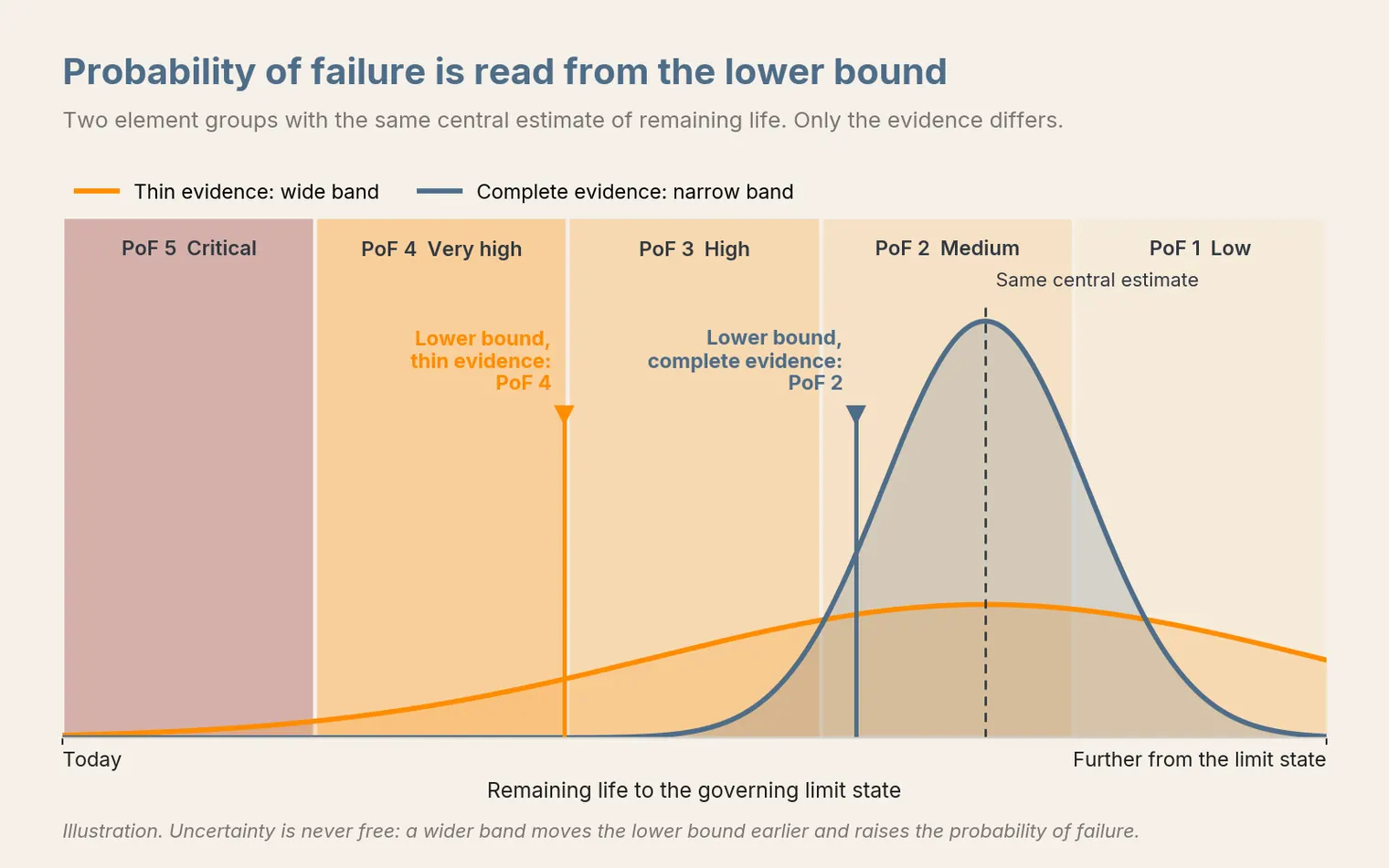
- Thin evidence costs priority. Better data narrows the range and can move an element down a level without a single repair.
- A clean appearance is not a pass. An element whose remaining life cannot be assessed is never ranked as low risk merely because it looks sound.
- Change raises probability. An unreviewed load, an undocumented repair or visible distress pushes an element up, because each weakens the basis of the estimate.
Consequence of Failure, and One Scale for Every Asset
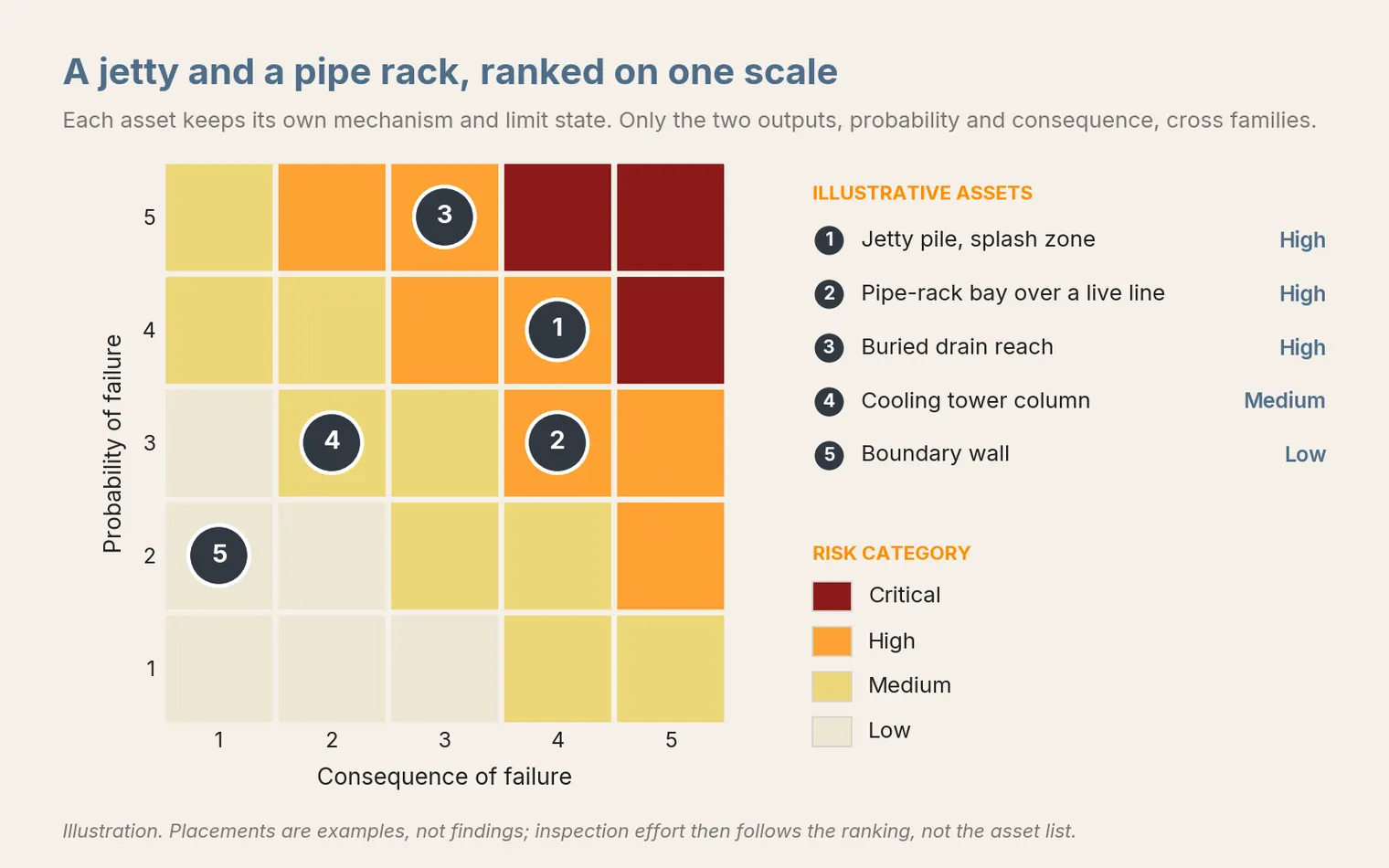
Consequence of failure asks what the plant stands to lose if an element fails: people, process containment, the environment, production and the licence to operate. The worst of these governs, never the average, and probability and consequence together place every civil asset, from a jetty pile to a boundary wall, on one risk scale.
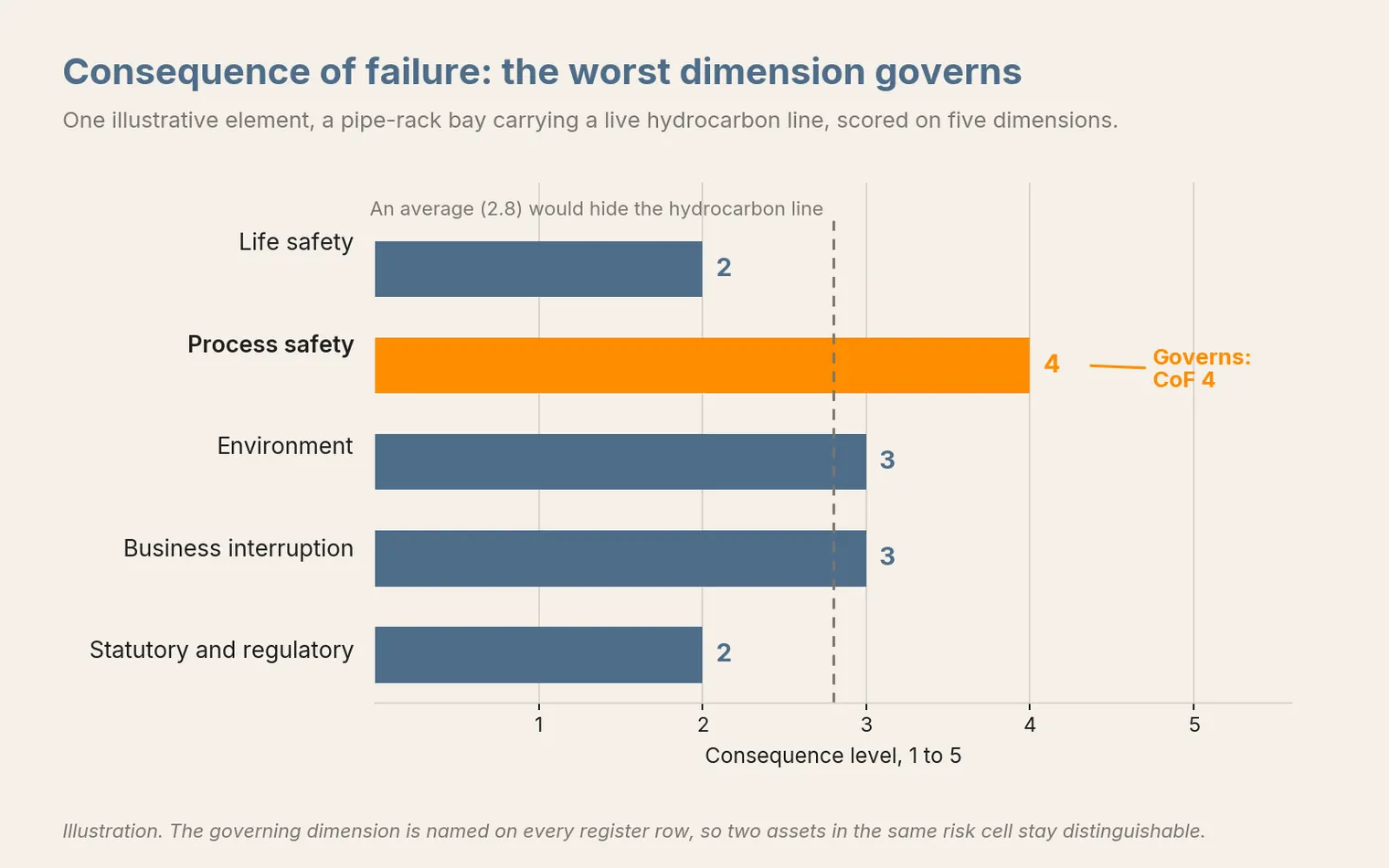
- The worst credible outcome governs. An average would let a quiet bay over a live hydrocarbon line rank beside a storeroom wall.
- One scale, many families. A jetty and a pipe rack are compared on their outputs, while each keeps its own mechanism, limit state and confidence on the register.
- Effort follows risk. How often an asset is inspected, how much of it is covered and how urgently it is acted on are set by where it sits on the scale, so the budget moves to the assets that need it.
- Events bring the next visit forward. A fire, a spill, a new load or a finding on a sister structure resets the clock, whatever the calendar says.
The codes we work to
Every result on a structural integrity report carries the standard, part, section and year actually applied, so a reader can check it against the code rather than take it on trust. The families below are the ones a plant civil programme draws on.
- Concrete and durability: the IS 456 and IS 516 families, with ASTM and ACI methods where an Indian standard is silent.
- Structural steel and coatings: IS 800, and the ISO 12944 and ISO 4628 families for protective coatings.
- Loads, seismic and geotechnical: IS 875, IS 1893 and IS 1904.
- Marine and buried structures: the BS 6349 series, IS 4651 and OISD-STD-170.
- Roads and drainage: the IRC series and the MoRTH Specifications.
- Risk and quality: API RP 580 and 581 as the adapted risk-ranking basis, ISO 13822 for existing structures, and ISO/IEC 17025:2017.
A note on editions
IS 13311 (Part 1), for ultrasonic pulse velocity, has been withdrawn by the Bureau of Indian Standards and superseded by IS 516 (Part 5/Sec 1):2018; IS 13311 (Part 2), for rebound hammer, is superseded by IS 516 (Part 5/Sec 4):2020. A great many plant inspection specifications in India still call the withdrawn parts up. Where a client specification names a withdrawn standard, we test to the standard in force, state both on the report, and tell the client. We do not silently substitute, and we do not silently comply.
What this programme is not
Two limits, stated here and in every output, because a reader evaluating a structural integrity supplier should not have to find them in a proposal.
- Not an API RP 580 compliant programme. The framework is adapted from API RP 580 and 581 risk-ranking logic, which is written for pressure equipment and piping rather than for civil structures. We say so in every output.
- Not a structural certificate. The report is a technical data synthesis for the structural engineer of record. It performs no structural capacity calculation.
Capacity questions, not certificates
Where residual section, cover, material strength or a load added since design raises a capacity question, the element goes into a Capacity Question Register with every as-found input and its tier: member geometry, material properties, the loads now carried, and the design basis then and now. The code check, and any Form 1-A certificate of stability under Rule 3A of the Maharashtra Factories Rules 1963, is made by the owner's structural engineer of record or appointed competent person, which keeps the capacity judgement independent of the organisation that inspected the asset. An urgent question is notified to the facility within 24 hours of the finding.
Single structures: chimneys, stacks, towers and cranes
The same discipline applies when the subject is one structure rather than a plant. Theodolite-based plumbness and straightness measurement on chimneys, stacks, towers and tall building cores returns a verticality deviation report, read against IS 4998 (Part 1) and the wind-load provisions of IS 875 (Part 3); finite-element stress analysis of crane structures, delivered at Aditya Birla Hindalco, Dahej, establishes the stresses a changed duty imposes. A building's statutory structural audit and its stability certificate follow their own route.
Technology Serves a Question
A technique earns its place in a programme only when it answers a question the record cannot. Laser scanning, drones, radar, thermography, underwater vehicles and in-situ replication are each recommended against a named gap, with the decision they will change stated first, because a catalogue of instruments is not advice.
- Laser scanning turns geometry into a baseline, and its real value arrives with the second survey, when true movement can be told apart from survey error.
- Drone close-visual survey reaches cooling tower shells, tall steel and roofs that are otherwise judged from the ground, subject to the facility's flight clearance.
- Underwater ROV survey reads the submerged and splash zones of jetty piles and intakes, with Planys Technologies.
- Ground-penetrating radar and infrared thermography decide where cores and repairs should go, before anything is cut.
- In-situ metallographic replication shows whether steel was affected by a fire or thermal event without removing a load-bearing member.
For an owner running the programme as a recurring cycle rather than a one-off study, AiOM keeps the register, the risk ranking and the inspection calendar live across facilities.
What We Hold Ourselves To
A structural integrity supplier is chosen as much for its limits as for its capabilities. These are the commitments that shape every programme we run, set down before the work starts so that an owner can hold us to them rather than discover them in a report.
- We test only what the owner approves. Every proposed test states why it is needed, and testing avoided because an existing record sufficed is reported as a result.
- Every number opens back to its readings. From a risk rating to the measurement behind it, each link in the chain is a record the owner can audit.
- Success is defined before the work starts. Where a programme begins with a pilot, the measures of success and the basis for going further are agreed with the owner first, so the result is judged against them.
- The owner's data stays the owner's. Records supplied to us and the results we generate for an owner belong to that owner and are held in confidence.
The evidence base
As at September 2026. Every figure is stated identically wherever it appears on this site.
Related services and industries
- Structural Audit (Section 353B of the Mumbai Municipal Corporation Act 1888)
- Remaining Life Assessment
- Risk-Based Inspection
- Fitness-for-Service
- Cathodic Protection
- In-Situ Metallography
- AiOM
- GPR, UPV and Subsurface Imaging
- Concrete, Cement and Aggregates
- Pavement Evaluation
- Bridge Inspection
- ROV Underwater Inspection
- Thermography and Drone Survey
- Turnaround Manpower
- Refining and Petrochemicals
- Fertilisers
- Power Generation
Documents
Download the reference documents for this page. Every file is hosted on this domain and is also listed in the site document library.
The programme, on video
A walkthrough of the argument this page makes, in three parts: why the civil estate of an aging plant needs attention now, how the inspection record a plant already holds becomes a ranked plan with probability and consequence of failure on one scale, and why the result can be trusted. The same argument is in the capability deck above.
Related insights
5 published insights on this site bear directly on Plant Structural Integrity. They are below; the full index carries all 92 Asset Integrity insights.
-
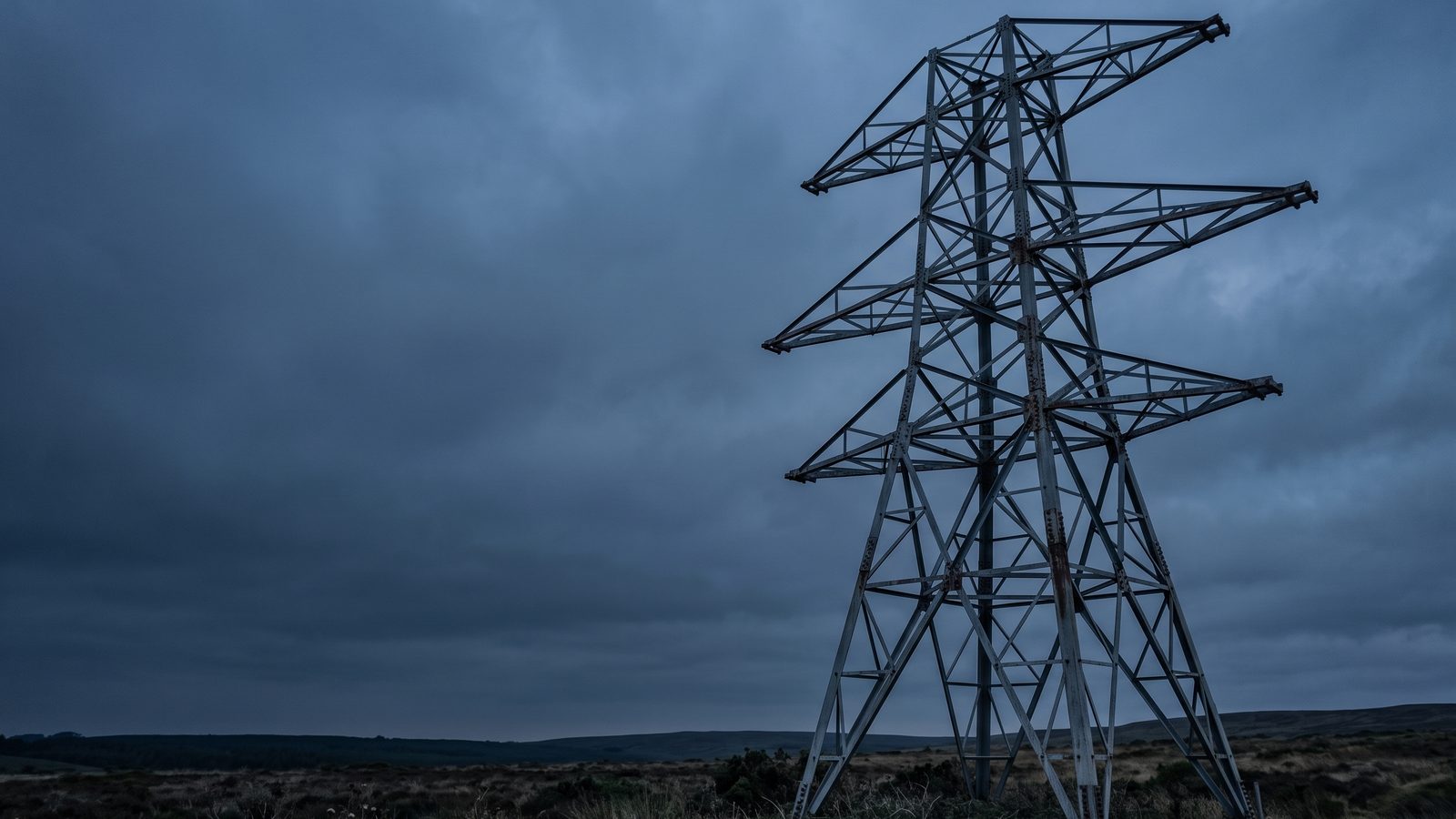
Remaining life of an ageing 220 kV transmission tower: the damage mechanisms that decide it and how they are found
An ageing 220 kV lattice tower is limited by zinc loss, stub corrosion, bolt and member damage and foundation distress. How each is found, judged and monitored.
-
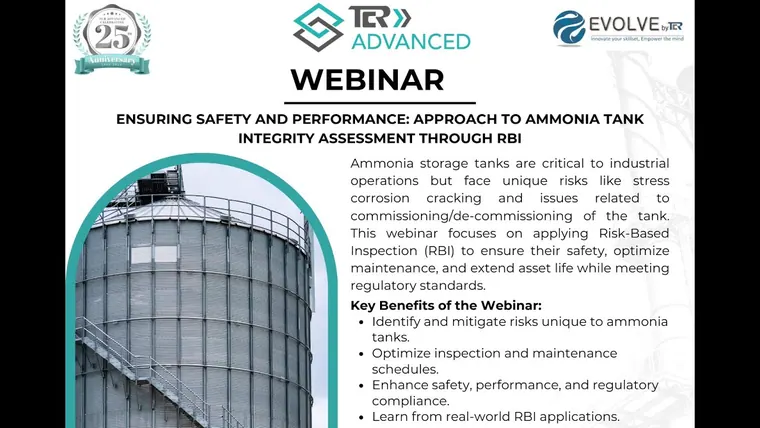
Ammonia Tank Integrity Using Risk-Based Inspection (RBI)
Optimise ammonia tank integrity with TCR's Risk-Based Inspection (RBI). Enhance safety, reduce downtime, and improve operational efficiency
-
Paresh Haribhakti - Plant Integrity Solution workshop
Plant Integrity Solution workshop hosted by KNPC
-
Ammonia tanks Integrity management and inspection challenges
Providing insights to damage mechanisms associated with Ammonia tank and RBI to improve integrity
-
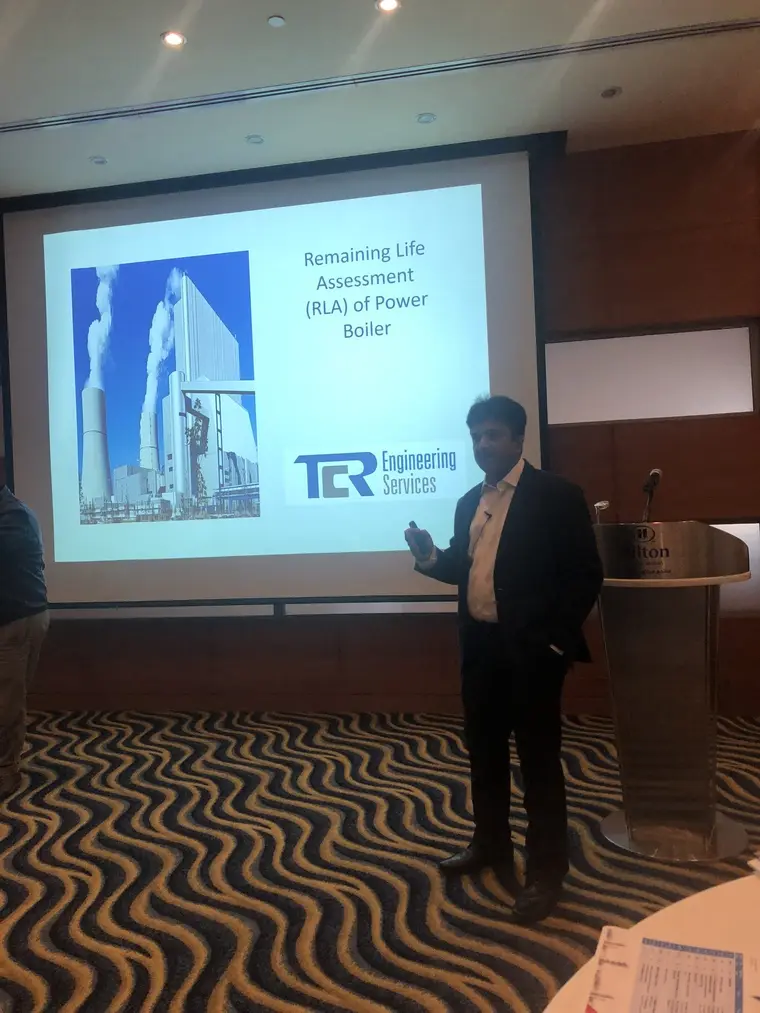
TCR’s strong experience in conducting Remaining Life Assessments
Noteworthy RLA projects undertaken by TCR

Frequently asked questions
What is the difference between a structural audit and a structural integrity programme?
A structural audit assesses condition at a point in time, usually against a statutory trigger. A structural integrity programme establishes the governing deterioration mechanism, estimates remaining life with a stated method and confidence band, ranks every asset by risk on one scale, and sets a recurring inspection interval per segment. The audit is an input to the programme.
Do you need to test everything?
No. We score the inspection data you already hold, and the resulting gap register scopes the field campaign. Where an existing report is traceable and current, it is used rather than repeated.
Is this an API RP 580 programme?
No, and we will not claim it is. The framework is adapted from API RP 580 and API RP 581 risk-ranking logic. Those standards are written for pressure equipment and piping. We state the adaptation in every output.
Who signs the report?
The report clears five gates: data integrity, independent technical peer review, the structural engineer of record, quality release under ISO/IEC 17025:2017 by our Head of Quality Assurance, and clearance from the office of the President. Where the statutory position requires a structural engineer's signature, an external registered structural engineer signs; TCR does not sign stability certificates.
How quickly can you mobilise?
First crew on site within 24 hours of permit clearance, and full campaign strength inside three weeks, with 100 to 200 personnel at peak. The constraint is permit clearance and site induction, not our resourcing.
Which standards do you test concrete to?
IS 456:2000 for the design basis; IS 516 for strength; IS 516 (Part 5 / Sec 1) for ultrasonic pulse velocity and IS 516 (Part 5 / Sec 4) for rebound hammer, both of which supersede the older IS 13311 parts; ASTM C876 for half-cell potential; IS 14959 and ASTM C1218 for chloride. Every result carries the standard, part, section and year actually applied.
How long is an existing inspection report usable for a remaining-life assessment?
For as long as the thing it measured could not have changed. Quantities that move quickly, such as settlement or coating condition, age fast; slower ones, such as concrete strength, last much longer; and an event such as a fire, a repair or an added load ends a record's currency whatever its date. An old record is kept as a trend point rather than discarded.
Does TCR certify the structural stability of plant structures?
No. TCR establishes every as-found input a capacity check needs and hands each question over in a Capacity Question Register. The code check, and any Form 1-A certificate of stability, is made by the owner's structural engineer of record or appointed competent person, which keeps that judgement independent of the organisation that inspected the asset.
What do probability of failure and consequence of failure mean for a civil structure?
Probability of failure reflects how soon an element could reach a limit that matters, read from the pessimistic end of its remaining-life range so that uncertainty raises it. Consequence of failure reflects the worst of what the plant could lose: people, process containment, the environment, production or its licence to operate. Together they place every civil asset on one risk scale.
Can a structural integrity programme start with one facility?
Yes. A pilot on one facility, across every civil asset class it holds, is the usual first step. The measures of success and the basis for moving to the full programme are agreed with the owner before the work starts, so the pilot is judged against them rather than on impression.