
Services · Civil and Infrastructure Testing
Door Shutter Testing per IS 4020
A door is one of the most-cycled components in a building. IS 4020 is where it is made to fail, before a site finds the same weakness.
Request a QuoteIn brief
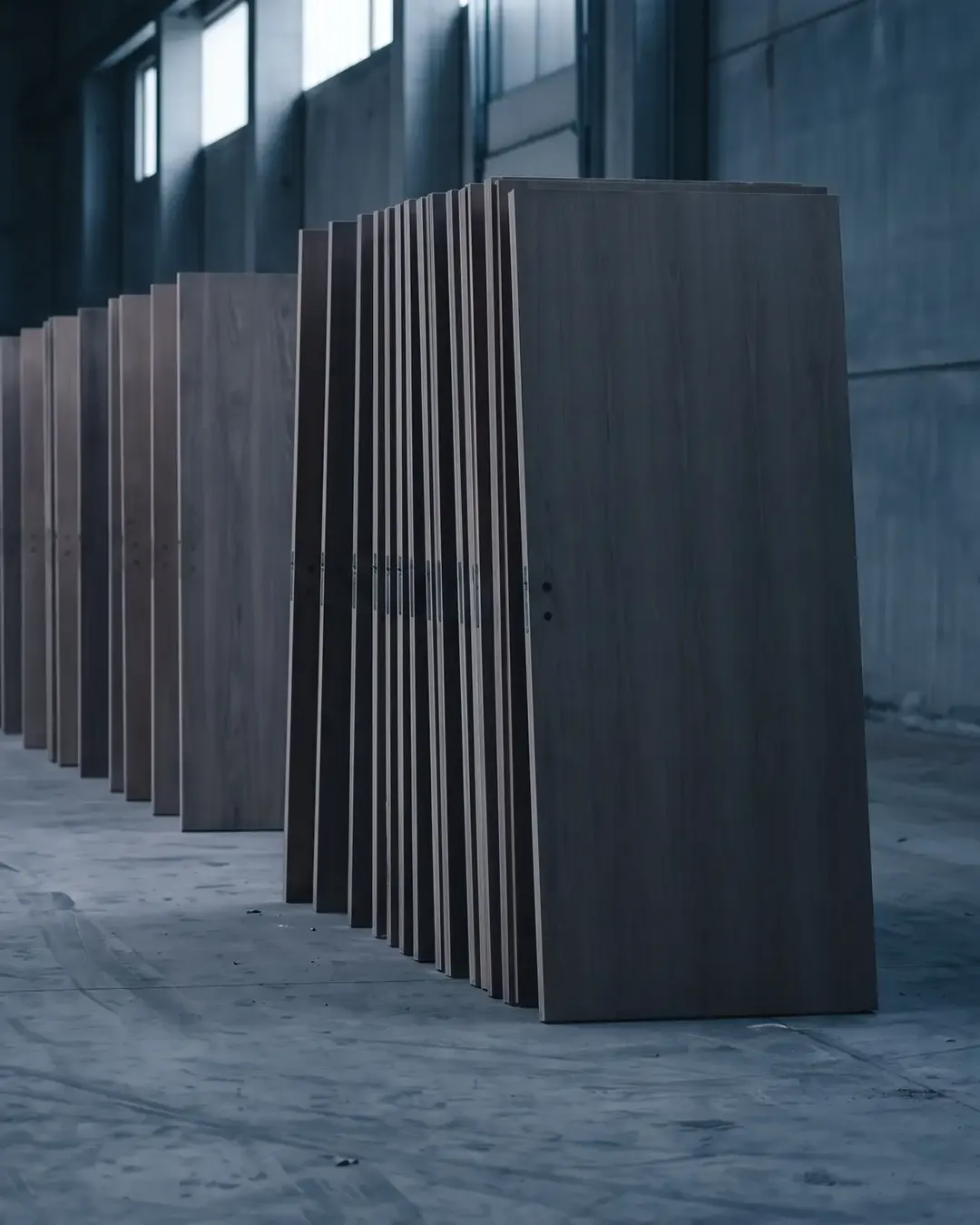
TCR Engineering Services Pvt. Ltd., testing since 1973, provides door shutter testing at Mahape, Navi Mumbai, to IS 4020 Parts 1 to 16, the Indian Standard methods of tests for door shutters. Flush, wooden and FRP shutters are checked for dimensions and squareness, flatness, local planeness, impact indentation, edge loading, buckling, shock, slamming, misuse and screw withdrawal.
- Method standard: IS 4020 (Parts 1 to 16) : 1998, run for the parts the product specification calls up.
- Acceptance read against: IS 2202 Parts 1 and 2, IS 2191 Parts 1 and 2, IS 1003 (Part 1), or the manufacturer's declared specification for FRP and proprietary shutters.
- Regulatory context: the Plywood and Wooden flush door shutters (Quality Control) Order, 2024, S.O. 1377(E) of 15 March 2024.
- Report: results against the stated specification, with sample identification, issued from the Mahape laboratory.
What Door Shutter Testing Establishes
A door shutter is loaded every time it is opened, closed or slammed, and almost all of those loads are eccentric: a hinge line carrying the weight, a lock rail taking the slam, fittings held by screws in an edge. IS 4020 loads the shutter the way service does, so a weakness shows in the laboratory.
- Dimensional accuracy and squareness: whether the shutter will hang in the frame it was made for.
- General flatness and local planeness: cupping, twist and warp against the standard's limits, and surface dips or bulges that show through a finish.
- Structural strength: flexure, edge loading and buckling resistance, which is what a tall shutter has to survive.
- Impact and shock: indentation from accidental impact, and the shock resistance sequence.
- Screw withdrawal resistance: whether the shutter will hold the hinges, handles and locks that will be driven into it.
- Bond and moisture behaviour: glue adhesion, knife test, end immersion and varying humidity.
- Durability: repeated slamming and the misuse sequence.
Door shutter testing is a programme rather than a single property, and it is run in the controlled sequence the standard sets. The results are read against the shutter's own product specification. IS 4020 Part 1 is general: it carries the conditioning and the reporting, and it is explicit that only the tests the individual specification calls up need be performed, which is why a test plan starts from the specification and not from the list of sixteen parts.
The IS 4020 Test Set, Part by Part
IS 4020 is published as sixteen parts, each one method. Part 1 is general and sets the conditioning and reporting; Parts 2 to 16 are the individual tests. The table maps each part to what it establishes.
| IS 4020 part | Test | What it establishes |
|---|---|---|
| Part 2 | Measurement of dimensions and squareness | Height, width, thickness and squareness against the specification |
| Part 3 | Measurement of general flatness | Cupping, twist and warp of the whole shutter |
| Part 4 | Local planeness test | Local dips and bulges in the face |
| Part 5 | Impact indentation test | Resistance of the surface to accidental impact |
| Part 6 | Flexure test | Behaviour of the shutter in bending |
| Part 7 | Edge loading test | Resistance of the edge to an applied load |
| Part 8 | Shock resistance test | Response to a shock applied to the face |
| Part 9 | Buckling resistance test | Resistance to forces that distort or buckle the shutter |
| Part 10 | Slamming test | Durability under repeated slamming cycles |
| Part 11 | Misuse test | Behaviour under the abuse a door actually receives |
| Part 12 | Varying humidity test | Dimensional response to a humidity cycle |
| Part 13 | End immersion test | Behaviour of the bottom edge in standing water |
| Part 14 | Knife test | Quality of the bond between face and core |
| Part 15 | Glue adhesion test | Integrity of the adhesive bond after conditioning |
| Part 16 | Screw withdrawal resistance test | Load at which a fitting screw pulls out |
IS 2202, IS 2191 and the Other Specifications the Results Are Read Against

IS 4020 is a set of methods, not an acceptance standard. What passes comes from the specification the shutter is sold against, and the specification is what decides which of the sixteen parts are run.
- IS 2202 (Part 1) : 2023, wooden flush door shutters, solid core type, with plywood face panels.
- IS 2202 (Part 2) : 2022, wooden flush door shutters, solid core type, with particle board, high density fibre board, medium density fibre board and fibre hardboard face panels.
- IS 2191 (Part 1) : 2022 and IS 2191 (Part 2) : 2022, wooden flush door shutters, cellular and hollow core type, with plywood face panels and with particle board and hardboard face panels.
- IS 1003 (Part 1) : 2003, timber panelled and glazed shutters. Outside the Quality Control Order below, and tested to the same IS 4020 methods.
FRP and other proprietary shutters are tested in TCR's civil testing laboratory to the IS 4020 methods against the manufacturer's own declared specification, which is named on the report as the basis of acceptance.
The Quality Control Order Behind the Test

Wooden flush door shutters are a mandatory-certification product in India. The Plywood and Wooden flush door shutters (Quality Control) Order, 2024, notified as S.O. 1377(E) on 15 March 2024 by the Department for Promotion of Industry and Internal Trade, requires the products in its schedule to carry the Standard Mark under a BIS licence.
- Commencement: 28 February 2025 in general, 28 May 2025 for small enterprises and 28 August 2025 for micro enterprises as defined under the MSMED Act, 2006. All three dates have now passed.
- Door shutters in the schedule: IS 2202 (Part 1) : 2023, IS 2202 (Part 2) : 2022, IS 2191 (Part 1) : 2022 and IS 2191 (Part 2) : 2022. The order's schedule as notified cites the 1999 edition of IS 2202 (Part 1); testing follows the current 2023 revision.
- Plywood in the same schedule: IS 303, IS 710, IS 5509, IS 1328, IS 4990 and IS 10701, covered on the plywood testing page.
- What it means for a test report: conformity is assessed under Scheme-I of Schedule-II of the BIS (Conformity Assessment) Regulations, 2018, so the specification and the IS 4020 methods behind it are a legal requirement for a product inside the schedule.
TCR Engineering is not a BIS certification body and does not grant the licence. What a manufacturer, an importer or a buyer gets here is the measurement: the IS 4020 tests the specification calls up, run and reported against the construction the shutter claims.
Where Door Shutter Testing Is Used
Door shutter testing is bought at three moments: when a product is being developed, when a production batch has to be released, and when a purchaser has to accept a consignment on site.
- Door manufacturers: type testing for a new construction, and routine batch verification against the specification.
- Plywood, particle board and FRP product manufacturers: evidence for a certification file and for a customer's incoming inspection.
- Builders and developers: acceptance testing of a consignment before it is distributed across a tower.
- Project management and quality-control teams: an independent reading when a supplier's own certificate is in dispute.
- Research and product development groups: comparison of core constructions, adhesives and face panels on measured numbers.
More in Civil & Structural Testing
No published insight on this site bears directly on Door Shutter Testing yet. The 3 most recent Civil & Structural Testing articles are below instead, and the full index carries all 44.
-
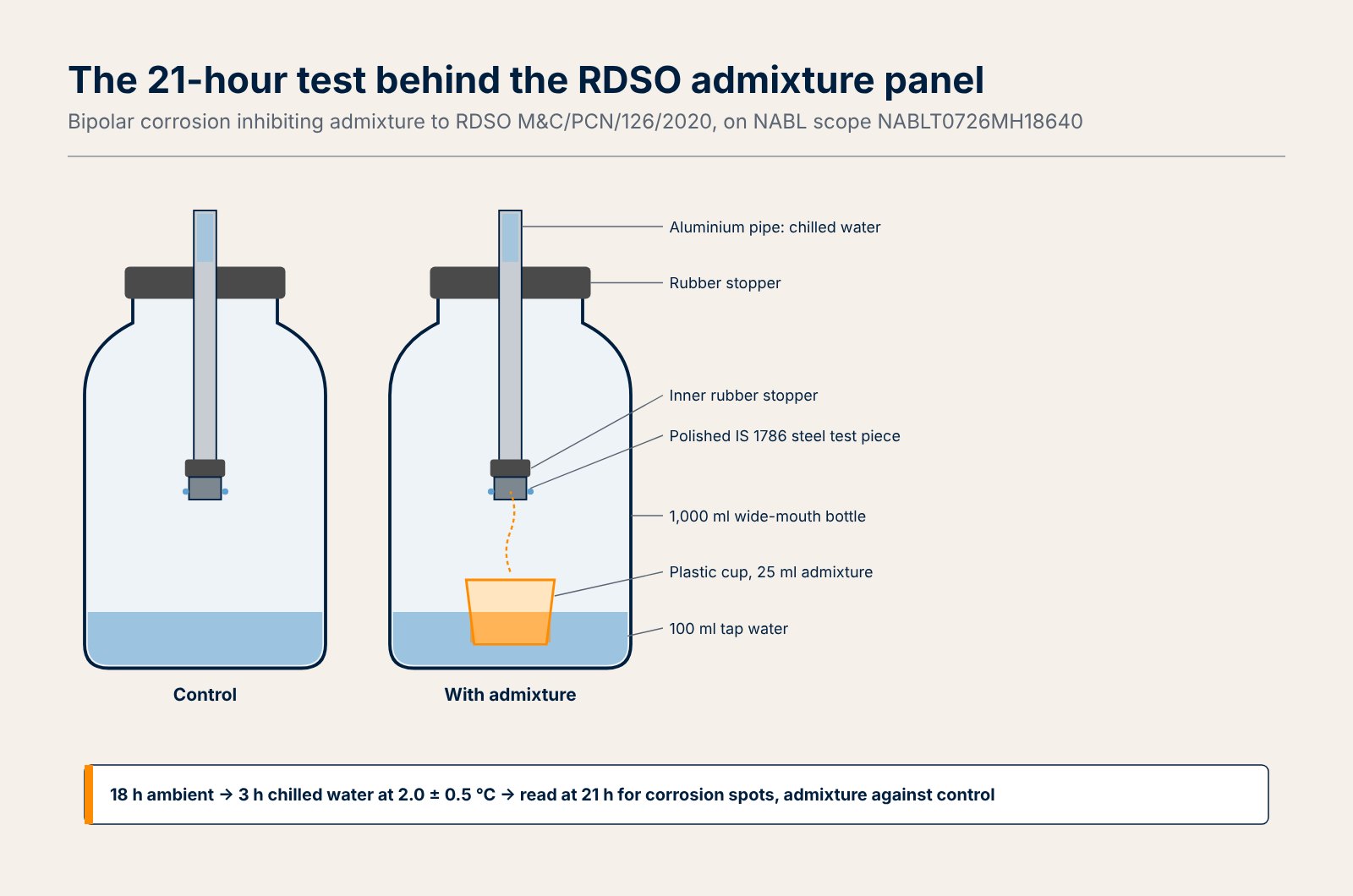
RDSO acceptance tests for a bipolar corrosion inhibiting admixture: the 21-hour accelerated corrosion test and the panel around it
TCR Engineering's Mahape laboratory runs the short-term acceptance panel for a Bipolar Concrete Penetrating Corrosion Inhibiting Admixture to RDSO…
-
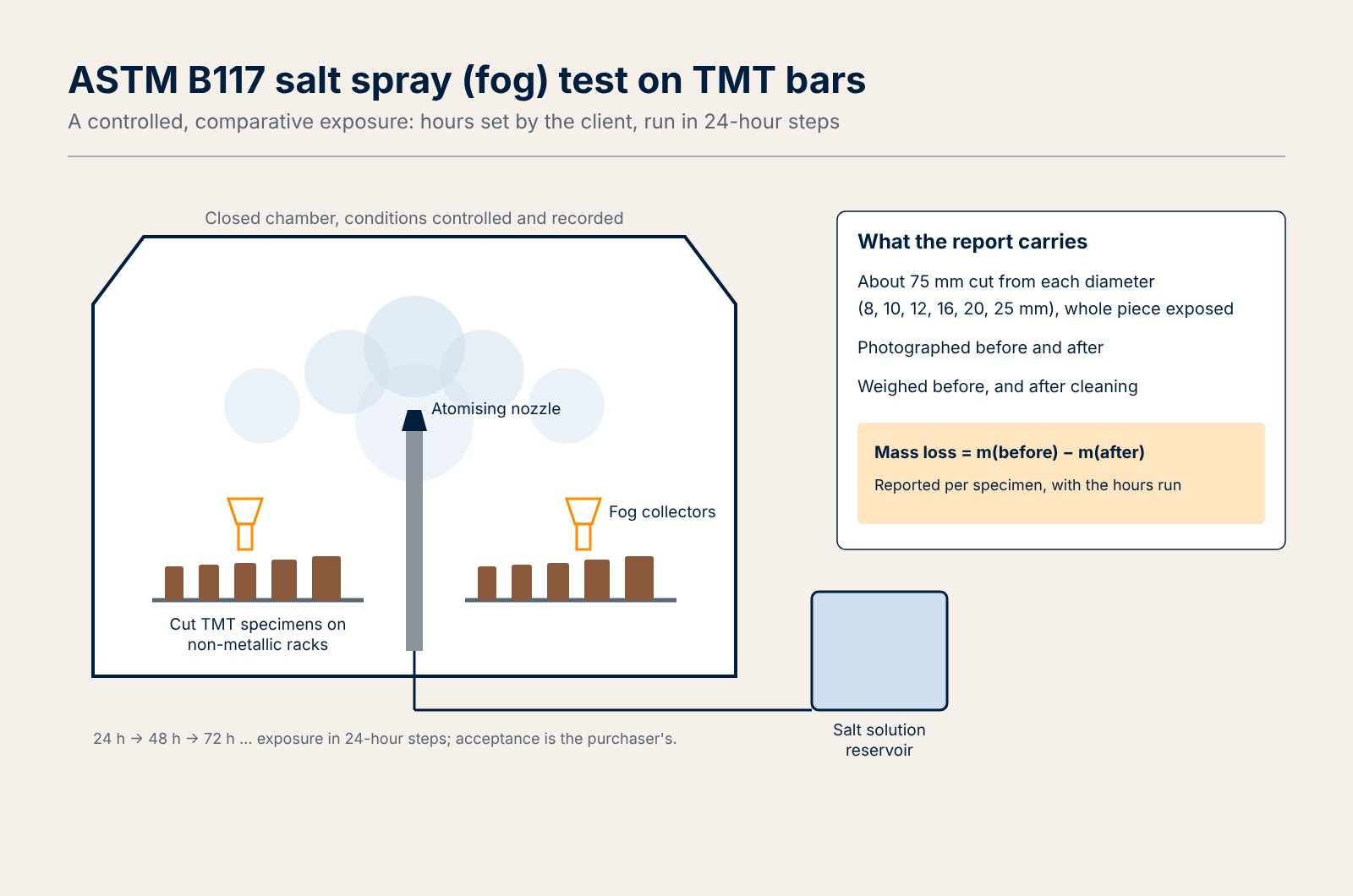
ASTM B117 salt spray testing of TMT bars at Mahape: what the test shows and what it does not
TCR Engineering's Mahape laboratory runs salt spray (fog) tests to ASTM B117 under NABL accreditation. Using a six-diameter TMT bar enquiry as the…
-
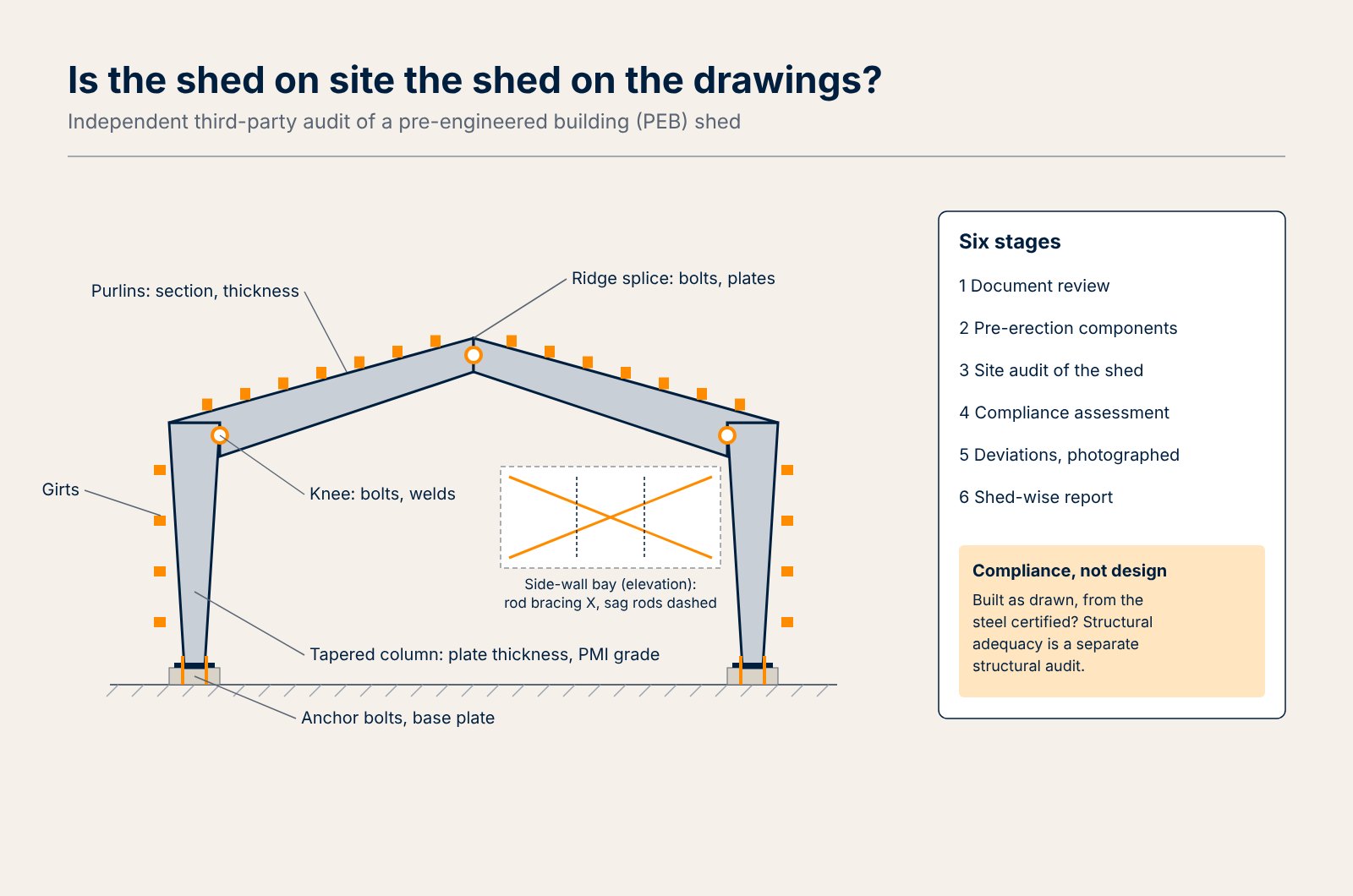
Third-party audit of PEB sheds in India: what an independent audit checks, and what it does not
TCR Engineering audits erected pre-engineered building sheds and their components against the approved drawings and mill certificates: section sizes,…
Read all 44 Civil & Structural Testing insights →All insights →
Frequently asked questions
Which standard governs door shutter testing in India?
IS 4020 (Parts 1 to 16) : 1998, the methods of tests for door shutters, third revision. The acceptance values come from the shutter's own product specification, such as IS 2202 Part 1 for solid core flush shutters with plywood face panels.
Do all sixteen parts have to be run on every door?
No. IS 4020 Part 1 states that only the tests called up by the individual product specification need be performed. The test plan is therefore built from the specification the shutter is sold against, which keeps the cost and the specimen count to what the claim actually requires.
Can FRP and other non-wooden shutters be tested?
Yes. The IS 4020 methods are applied to flush, wooden and FRP shutters. Where there is no Indian Standard product specification for the construction, the manufacturer's declared specification is named on the report as the basis of acceptance.
Is door shutter testing to IS 4020 within TCR's NABL scope?
No. TCR Engineering holds NABL certificate NABLT0726MH18640 with 1,483 accredited test items, and IS 4020 is not among them, so a door shutter report is issued outside the NABL scope. Where a project requires an accredited report, say so before sampling and we will confirm in writing what can and cannot carry the mark.
How many shutters are needed for a test?
It depends on the parts called up: several are destructive and some, such as slamming and misuse, are run in sequence on the same shutter. Send the specification, the shutter size and the construction, and the specimen count is confirmed before the consignment is drawn.
What is IS 2202?
IS 2202 is the Indian Standard specification for wooden flush door shutters of the solid core type: Part 1 (2023) with plywood face panels, and Part 2 (2022) with particle board, fibre board or hardboard face panels. It sets the values a shutter must meet; IS 4020 supplies the test methods, so a door shutter report names both.
Are flush door shutters covered by a BIS Quality Control Order?
Yes. The Plywood and Wooden flush door shutters (Quality Control) Order, 2024, S.O. 1377(E) of 15 March 2024, requires shutters to IS 2202 Parts 1 and 2 and IS 2191 Parts 1 and 2 to carry the Standard Mark under a BIS licence. TCR tests to those specifications and the IS 4020 methods; it does not grant the licence.