
Services · Civil and Infrastructure Testing
Plywood Testing per IS 1734
A panel that looks sound can still be a weak glue line. IS 1734 opens the bond rather than the surface.
Request a QuoteIn brief
TCR Engineering Services Pvt. Ltd., testing since 1973, provides plywood testing at Mahape, Navi Mumbai, to IS 1734 Parts 1 to 20, the Indian Standard methods of test for plywood. The set covers density and moisture content, glue shear strength, adhesion of plies, water resistance, tensile and static bending strength, screw holding power and dry heat.
- Method standard: IS 1734 Parts 1 to 20, run for the parts the grade and the application call for.
- Acceptance read against: the product specification, such as IS 303, IS 710, IS 5509, IS 4990, IS 1328 or IS 10701.
- Regulatory context: the Plywood and Wooden flush door shutters (Quality Control) Order, 2024, S.O. 1377(E) of 15 March 2024.
- Report: results against the stated standard, with sample identification, issued from the Mahape laboratory.
What Plywood Testing Establishes
Plywood performance is set by the veneers, the adhesive bond between them, the moisture the panel is carrying and the way the assembled board behaves in bending and under a fastener. A panel can present a clean, well-sanded face and still fail at a glue line, which is why the test set reads the interior of the board and not its surface.
- Density and moisture content: the two physical properties that govern dimensional stability, and the first indication of an unsuitable or under-seasoned board.
- Glue shear strength: the strength of the bond between veneers, measured directly, and the single most diagnostic number on the report.
- Adhesion of plies: whether the individual veneer layers resist separation after the conditioning the grade calls for.
- Tensile strength: determined along and across the grain, so the directional behaviour of the panel is on the record, not averaged away.
- Static bending strength: modulus of rupture and modulus of elasticity, for panels that carry load or span.
- Nail and screw holding power: plywood is almost always fastened mechanically, and the fastener is where a furniture or formwork failure usually starts.
- Resistance to dry heat and water resistance: stability at elevated temperature and after the water exposure the bonding class claims to survive.
Testing is the only way to separate a bonding class claim from a bonding class. A boiling-water-proof marking is a statement about the adhesive; the glue shear and water resistance results are the evidence for it.
The IS 1734 Test Set, Part by Part

IS 1734 is published as twenty parts, each a single method. TCR's civil testing laboratory runs the parts a given grade and application call for; the table below maps the properties most often specified to the part that governs them.
| Property | What it establishes | IS 1734 part |
|---|---|---|
| Density and moisture content | Physical condition of the board and its dimensional stability | Part 1 |
| Resistance to dry heat | Behaviour of the panel and its bond at elevated temperature | Part 2 |
| Glue shear strength | Strength of the adhesive bond between veneers | Part 4 |
| Adhesion of plies | Resistance of the veneer layers to separation | Part 5 |
| Water resistance | Whether the bond survives the exposure its class claims | Part 6 |
| Tensile strength | Strength along and across the grain | Part 9 |
| Static bending strength | Modulus of rupture and modulus of elasticity in bending | Part 11 |
| Nail and screw holding power | Withdrawal resistance of mechanical fasteners | Part 19 |
The remaining parts are available on request and are called up by particular grades: fire resistance (Part 3), the mycological test (Part 7), pH value (Part 8), compressive strength (Part 10), scarf joint (Part 12), panel and plate shear (Parts 13 and 14), central loading (Part 15), vibration (Part 16), long-time loading (Part 17), impact resistance (Part 18) and acidity and alkalinity resistance (Part 20).
The Product Specifications the Results Are Read Against

IS 1734 says how a property is measured. It does not say what value passes. The acceptance criteria come from the product specification the panel is sold against, and a plywood report is only actionable when both are named on it.
- IS 303 : 1989, plywood for general purposes, including the MR, BWR and BWP bonding classes.
- IS 710 : 2010, marine plywood.
- IS 5509 : 2021, fire retardant plywood.
- IS 4990, plywood for concrete shuttering work, where the panel is a formwork component and its reuse count is a commercial number.
- IS 1328 : 1996, veneered decorative plywood.
- IS 10701 : 2012, structural plywood.
- IS 14616 : 1999, laminated veneer lumber, run on the same bench.
Send the grade, the thickness and the specification the panel is being sold against, and the test plan follows from them.
The Quality Control Order Behind the Test
Plywood is no longer a voluntary standards market in India. The Plywood and Wooden flush door shutters (Quality Control) Order, 2024, notified as S.O. 1377(E) on 15 March 2024 by the Department for Promotion of Industry and Internal Trade, requires the products in its schedule to carry the Standard Mark under a BIS licence.
- Commencement: 28 February 2025 in general, 28 May 2025 for small enterprises and 28 August 2025 for micro enterprises as defined under the MSMED Act, 2006. All three dates have now passed.
- Plywood grades in the schedule: IS 303 : 1989, IS 710 : 2010, IS 5509 : 2021, IS 1328 : 1996, IS 4990 : 2011 and IS 10701 : 2012.
- Door shutters in the same schedule: IS 2202 Parts 1 and 2 and IS 2191 Parts 1 and 2, covered on the door shutter testing page.
- What it means for a test report: conformity is assessed under Scheme-I of Schedule-II of the BIS (Conformity Assessment) Regulations, 2018, so the specification and its test methods are a legal requirement for a product inside the schedule, not a commercial preference.
TCR Engineering is not a BIS certification body and does not grant the licence. What a manufacturer, an importer or a buyer gets here is the measurement: the IS 1734 properties, run and reported against the grade the product claims, which is the evidence a licence application, an incoming inspection or a dispute is argued on.
Where Plywood Testing Is Used

The buyers of a plywood report divide into those who make the panel, those who put it into a product, and those who have to accept it on a site. Each reads a different part of the same report.
- Plywood and panel manufacturers: routine quality control against the grade, and evidence for a certification file.
- Furniture and interior manufacturers: fastener holding and moisture behaviour, which is where a warranty claim originates.
- Construction companies and formwork suppliers: shuttering plywood to IS 4990, where panel stiffness and reuse are the economics of the job.
- Architects, consultants and project managers: incoming material verification before a large interior package is released.
- Product development and research teams: comparison of adhesive systems and veneer lay-ups on measured numbers.
More in Civil & Structural Testing
No published insight on this site bears directly on Plywood Testing yet. The 3 most recent Civil & Structural Testing articles are below instead, and the full index carries all 44.
-
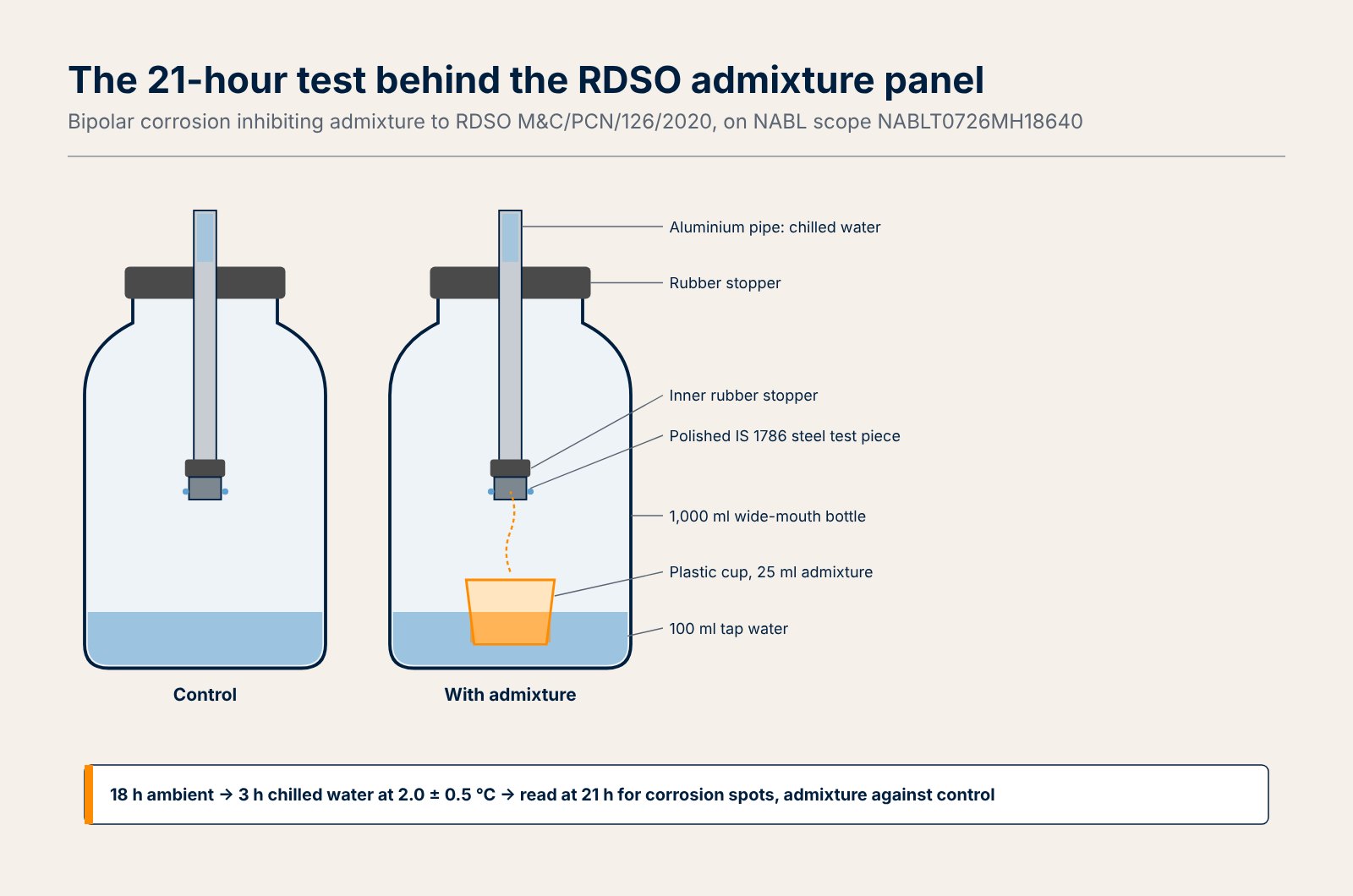
RDSO acceptance tests for a bipolar corrosion inhibiting admixture: the 21-hour accelerated corrosion test and the panel around it
TCR Engineering's Mahape laboratory runs the short-term acceptance panel for a Bipolar Concrete Penetrating Corrosion Inhibiting Admixture to RDSO…
-
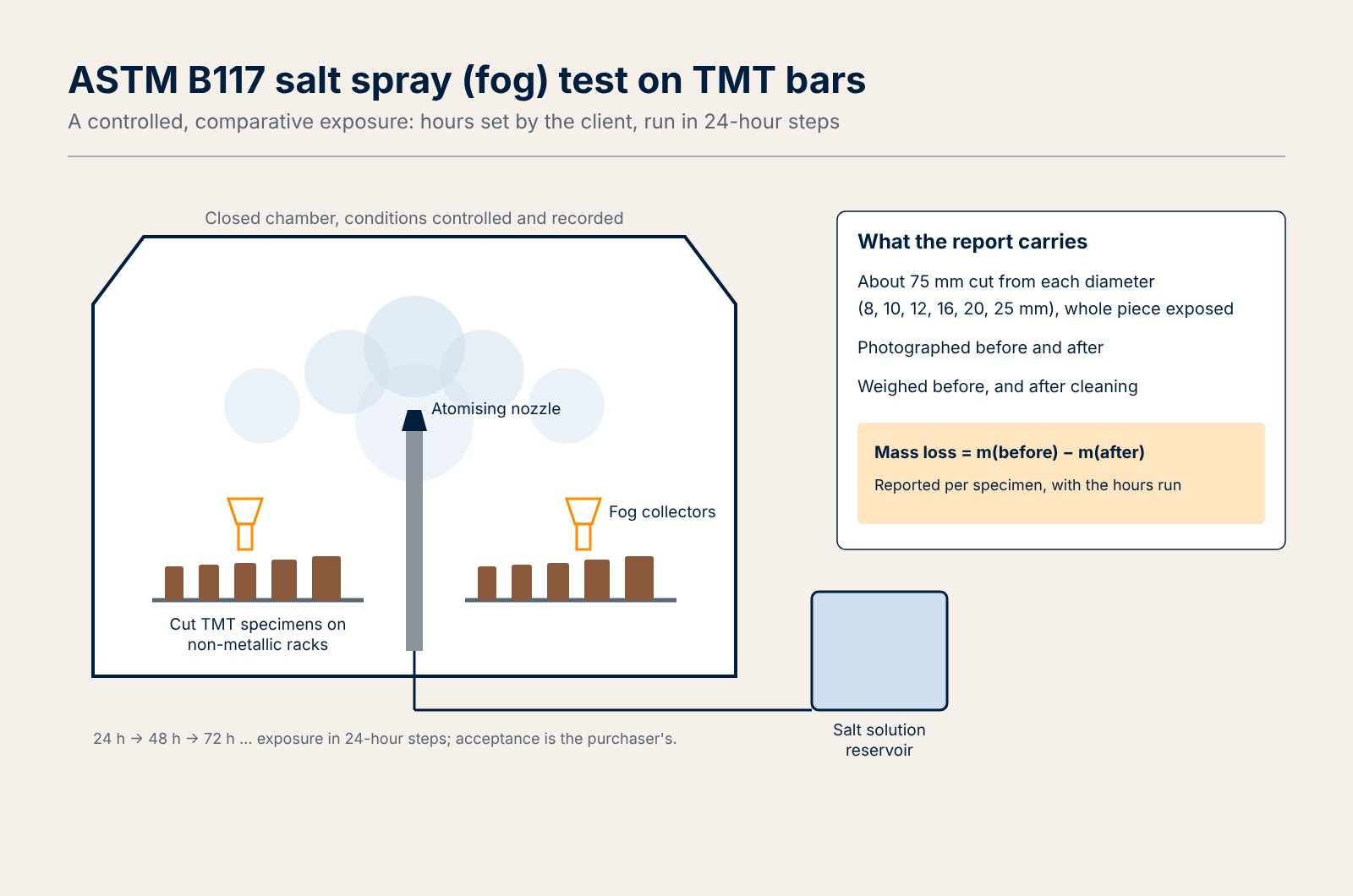
ASTM B117 salt spray testing of TMT bars at Mahape: what the test shows and what it does not
TCR Engineering's Mahape laboratory runs salt spray (fog) tests to ASTM B117 under NABL accreditation. Using a six-diameter TMT bar enquiry as the…
-
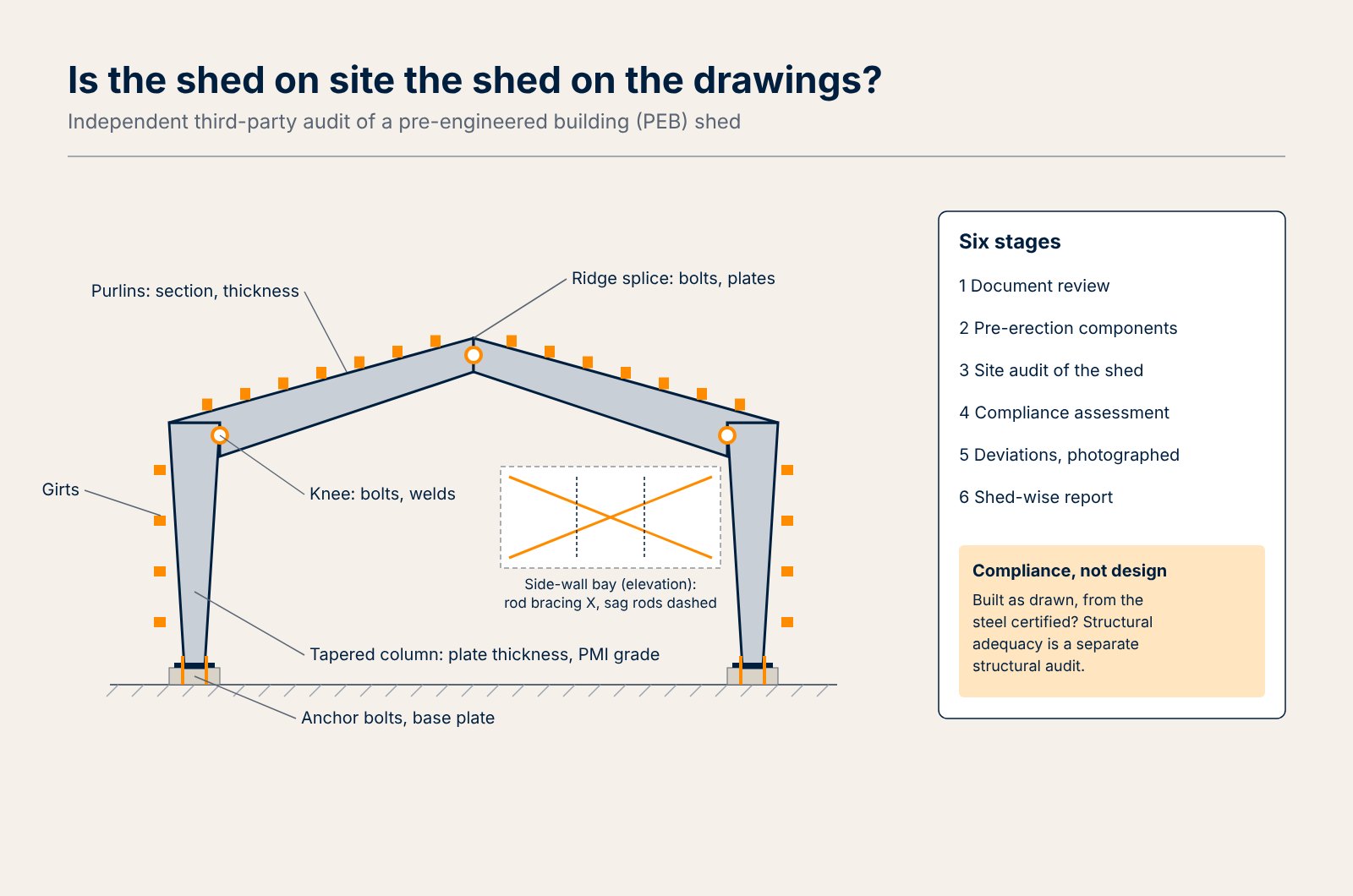
Third-party audit of PEB sheds in India: what an independent audit checks, and what it does not
TCR Engineering audits erected pre-engineered building sheds and their components against the approved drawings and mill certificates: section sizes,…
Read all 44 Civil & Structural Testing insights →All insights →
Frequently asked questions
Which standard governs plywood testing in India?
IS 1734, Parts 1 to 20, the Indian Standard methods of test for plywood. IS 1734 sets how each property is measured; the product specification (IS 303, IS 710, IS 5509, IS 4990) sets the value that passes.
What does glue shear strength tell you that a visual inspection cannot?
It measures the bond between veneers directly. A panel with a clean, well-finished face can still be weak at the glue line, and IS 1734 Part 4 is where that shows up before the panel is installed.
Is plywood testing to IS 1734 within TCR's NABL scope?
No. TCR Engineering holds NABL certificate NABLT0726MH18640 with 1,483 accredited test items, and IS 1734 is not among them, so a plywood report is issued outside the NABL scope. Where a project requires an accredited report, say so before sampling and we will confirm in writing what can and cannot carry the mark.
How much material has to be sent for a plywood test?
It depends on which parts of IS 1734 are called up and on the sampling clause in the product specification, because several parts are destructive and each needs its own specimens. Send the panel size, the thickness and the grade, and the sample quantity is confirmed before anything is cut.
Can TCR test laminated veneer lumber, door frames and door shutters too?
Yes. Door shutters are tested to IS 4020 Parts 1 to 16, laminated veneer lumber to IS 14616, and wooden door frames to IS 287 and IS 11215, all on the same building-materials bench at Mahape.
Where is TCR's plywood testing laboratory?
At TCR Engineering's laboratory in Mahape, Navi Mumbai, Plot EL-182, MIDC-TTC Industrial Area. Plywood runs on the same building-materials bench as door shutters and laminated veneer lumber. Send the grade, the thickness and the product specification, and the IS 1734 parts to be run and the specimens needed are confirmed before anything is cut.
Is plywood covered by a BIS Quality Control Order?
Yes. The Plywood and Wooden flush door shutters (Quality Control) Order, 2024, S.O. 1377(E) of 15 March 2024, requires the plywood grades in its schedule, among them IS 303, IS 710, IS 5509, IS 1328, IS 4990 and IS 10701, to carry the Standard Mark under a BIS licence. TCR tests to the specification; it does not grant the licence.