
Services · Materials Testing
Heat Treatment Verification Testing
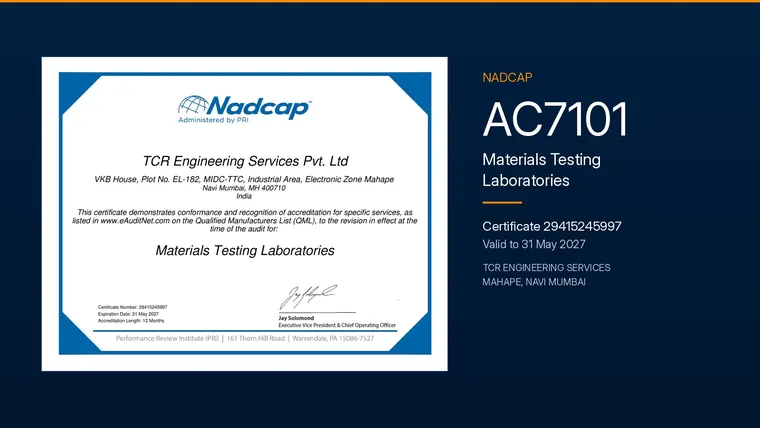
NADCAP AC7101 Materials Testing accreditation was granted in 2026 under Performance Review Institute certificate 29415245997, valid to 31 May 2027. TCR is the verification-testing partner to accredited heat treaters and does not heat-treat the parts it verifies.
Request a Quote
In brief
TCR Engineering Services Pvt. Ltd. verifies heat treatment for heat treaters and aerospace manufacturers at its Mahape materials testing laboratory in Navi Mumbai, India, accredited to NADCAP AC7101 Materials Testing and NABL ISO/IEC 17025:2017. Submitted samples are tested for hardness, case depth, grain size, decarburisation, microstructure and mechanical properties; TCR does not heat-treat the parts.
What Heat Treatment Verification Testing is
Heat treaters submit samples and TCR returns a NADCAP-accepted test report. TCR is the verification testing partner under NADCAP AC7101 Materials Testing. It is not the heat treater, and it holds no AC7102 Heat Treatment Process accreditation, which accredits the heat-treatment process itself.
- What TCR is: the verification testing partner under NADCAP AC7101 Materials Testing. Heat treaters submit samples and TCR returns a NADCAP-accepted test report.
- What TCR is not: the heat treater. It holds no AC7102 Heat Treatment Process accreditation and does not heat-treat the parts it verifies.
- Not to be confused with PWHT: post-weld heat treatment physically heats components and runs as a separate service under Non-Destructive Testing.
- What this service does: no thermal processing at all. It measures whether the heat treater's process delivered the intended metallurgical result, and reports the evidence.
The service is distinct from post-weld heat treatment. PWHT physically heats components, and TCR runs furnaces for it as a separate service under Non-Destructive Testing. Heat Treatment Verification Testing performs no thermal processing at all. It measures whether a heat treater's process delivered the intended metallurgical result, and it reports the evidence.
Which tests verify that a heat treatment was done correctly?
A heat treatment is verified by measuring what it was meant to produce: surface and core hardness, case depth on carburised, nitrided or induction-hardened parts, grain size, decarburisation depth, the microstructure itself and, where the order asks, tensile and impact properties. TCR Engineering reports each result against the specification the heat treater works to.
- Hardness: a traverse, with case-depth profiling per SAE J423.
- Retained austenite: by electro-polish and copper deposition with image analysis, performed under NADCAP AC7101.
- Grain size: ASTM E112. Decarburisation depth: ASTM E1077.
- Microstructure: examined against the applicable specification.
- Mechanical properties: added where the order calls for them.
- Processes covered: carburising, nitriding, carbonitriding, cyaniding, induction and flame hardening.
Case hardening is controlled through carburising, nitriding, carbonitriding, cyaniding, induction, and flame hardening, and each leaves a surface layer harder than the core. TCR measures the result: a hardness traverse and case-depth profiling per SAE J423, retained austenite by the electro-polish and copper-deposition method with calculation on image-analysis software, grain size per ASTM E112, decarburisation depth per ASTM E1077, and microstructural examination against the applicable specification. Mechanical properties are added where the order calls for them.
Which standards govern Rockwell, Brinell, Vickers and case-depth verification?
Testing runs to ASTM and SAE aerospace methods, read against the aerospace prime specifications the customer names.
| Property | Application | Standard |
|---|---|---|
| Hardness | Rockwell, Brinell, Vickers macro and micro | ASTM E18, ASTM E10, ASTM E92, ASTM E384 |
| Grain size | Prior-austenite and general grain size | ASTM E112 |
| Case depth | Case-depth profiling on hardened surfaces | SAE J423 |
| Retained austenite | From the microstructure by image analysis, under NADCAP AC7101, or by X-ray diffraction, outside the accredited scope | ASTM E975 (X-ray diffraction) |
| Decarburisation depth | Surface decarburisation on steel | ASTM E1077 |
| Inclusion rating | Cleanliness assessment | ASTM E45 |
| Etching | Microstructure development | ASTM E407 |
| Pyrometry and process reference | Heat-treatment process specification | SAE AMS 2750 |
| Heat treatment of steel raw material | Process specification reference | SAE AMS-H-6875 |
Reports are read against the aerospace prime specifications the customer works to, including Boeing BAC, Airbus AIPS, GE EM&S, and Rolls-Royce RPS, together with the SAE Aerospace Material Specification series and the MIL-DTL specification series.
The NADCAP position
The TCR group holds NADCAP AC7101 Materials Testing accreditation at two NABL-accredited laboratories, Navi Mumbai and Vadodara.
- TCR Engineering: AC7101 accredited 2026, PRI certificate 29415245997, valid to 31 May 2027.
- TCR Advanced Engineering, Vadodara: its own AC7101, PRI certificate 29227245998, also valid to 31 May 2027.
- Both laboratories: NABL accredited.
- Why the position is unusual: TCR is the first Indian group with two NADCAP AC7101 laboratories, and the NADCAP heat-treatment-accredited facilities in India are mostly captive aerospace operations, not independent commercial laboratories.
NADCAP AC7101 Materials Testing was accredited in 2026 for TCR Engineering under Performance Review Institute certificate 29415245997, valid to 31 May 2027. TCR Advanced Engineering at Vadodara holds its own AC7101 accreditation under Performance Review Institute certificate 29227245998, also valid to 31 May 2027. This positions the group as the verification testing partner for NADCAP-accredited heat treaters and aerospace component manufacturers. TCR is the first Indian group with two NADCAP AC7101 laboratories, and the NADCAP heat-treatment-accredited facilities in India are mostly captive aerospace operations rather than independent commercial laboratories.
Who it serves
The accreditation serves the aerospace, space, and defence supply chain.
- Organisations served: ISRO, DRDO, NPCIL, HAL, MIDHANI and Bharat Forge.
- Chandrayaan-3: the rocket-motor casing hardware cleared TCR's bench with no non-conformity observed.
- Non-conformities investigated: stress corrosion cracking, hydrogen embrittlement, fatigue, and inclusion and grain-size defects in flight hardware, forgings and rocket-motor casings.
TCR serves ISRO, DRDO, NPCIL, HAL, MIDHANI, and Bharat Forge. The rocket-motor casing hardware for Chandrayaan-3 cleared TCR's bench with no non-conformity observed. The same bench investigates stress corrosion cracking, hydrogen embrittlement, fatigue, and inclusion and grain-size non-conformities in flight hardware, forgings, and rocket-motor casings, and it verifies heat treatment on NADCAP-route samples.
Related insights
3 published insights on this site bear directly on Heat Treatment Verification. They are below; the full index carries all 165 Materials Testing insights.
-
TCR becomes the first Indian group with two NADCAP AC7101 accredited laboratories: Navi Mumbai and Vadodara
NADCAP has accredited TCR Engineering at Navi Mumbai and TCR Advanced at Vadodara for Materials Testing Laboratories under AC7101. India has 51…
-
Why Your Mill Certificate Isn't Enough: BS EN 10204 Type 3.2 Testing That Proves What You Are Actually Getting
BS EN 10204 Type 3.2 certification testing at TCR Engineering. Independent verification of tensile, hardness, and chemical analysis for materials.
-
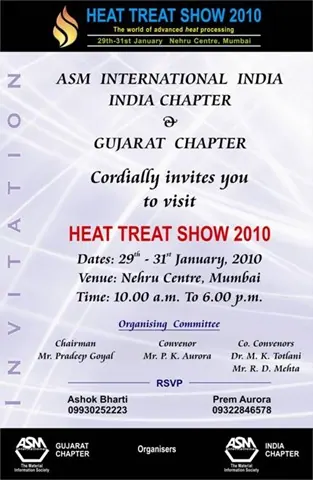
V.K. Bafna, Paresh Haribhakti at ASM Heat Treat Show
Paper on Metallurgical Quality Control for Heat Treatment Industries

Frequently asked questions
Does TCR heat-treat the parts it verifies?
No. TCR is the verification testing partner under NADCAP AC7101 Materials Testing, not the heat treater, and it holds no AC7102 Heat Treatment Process accreditation. Heat treaters submit samples and TCR returns the test report. Post-weld heat treatment of welds and pressure equipment, which TCR does perform, is a separate service under Non-Destructive Testing.
What does a heat-treatment verification report cover?
Hardness, with a traverse and case-depth profile where the part is case hardened, microstructural examination, grain size to ASTM E112, decarburisation depth to ASTM E1077 and, where the order calls for them, mechanical properties, each reported against the heat treater's specification. Retained austenite by image analysis is reported under NADCAP AC7101; by X-ray diffraction, outside the accredited scope.
Which NADCAP accreditation does TCR hold, and where?
NADCAP AC7101 Materials Testing, accredited 2026, at two NABL-accredited laboratories: Navi Mumbai under Performance Review Institute certificate 29415245997 and Vadodara under Performance Review Institute certificate 29227245998, both valid to 31 May 2027.
How is this different from post-weld heat treatment?
Post-weld heat treatment physically heats components, and TCR runs furnaces for it as a separate service under Non-Destructive Testing. Heat Treatment Verification Testing performs no thermal processing; it tests submitted samples and reports the result.
Which hardness tests are used to verify heat treatment?
Rockwell to ASTM E18 and Brinell to ASTM E10 measure surface and core hardness, and Vickers macro and micro indentation to ASTM E92 and ASTM E384 give the hardness traverse and case-depth profile, with case depth read to SAE J423. Rockwell, Brinell and Vickers to these ASTM methods are inside NABL certificate NABLT0726MH18640.