

Services · Civil and Infrastructure Testing
Concrete Testing Lab: Concrete, Cement and Aggregates
Acceptance runs against IS 516 and IS 456 for concrete, IS 383 and IS 2386 for aggregates, and IS 4031 for cement, with ASTM C39, ASTM C496, and the EN 12390 series where the specification calls for them.
Request a Quote
In brief
TCR Engineering's concrete testing lab at Mahape, Navi Mumbai, accredited to NABL ISO/IEC 17025:2017 under certificate NABLT0726MH18640, tests concrete, cement and aggregates for construction and infrastructure projects across India: cube and core compression, flexural strength, durability tests such as RCPT and water permeability, aggregate characterisation to IS 2386 and cement physical tests to IS 4031.
Samples are received at the Mahape laboratory, Plot EL-182, MIDC-TTC Industrial Area, Navi Mumbai 400 710, with further collection points listed on the laboratory and office network page.
The laboratory compresses cube and cylinder specimens on 2,000 kN and 3,000 kN machines and runs flexural, split tensile and core compression tests, rebound hammer surveys and Ultrasonic Pulse Velocity per IS 516 (Part 5/Sec 1):2018. Aggregates are tested for crushing value, impact value, Los Angeles abrasion, specific gravity and water absorption, and cement per IS 4031 for consistency, setting time, soundness, fineness and compressive strength.
What the Concrete Testing Lab Tests
TCR runs the full concrete-quality workflow: compression testing on cube and cylinder specimens on 2,000 kN and 3,000 kN capacity machines, flexural and split-tensile testing, core extraction and compression, rebound hammer surveys, and Ultrasonic Pulse Velocity per IS 516 (Part 5/Sec 1):2018.
- Compression: cube and cylinder specimens on 2,000 kN and 3,000 kN machines.
- Other strength tests: flexural and split-tensile, plus core extraction and compression.
- In-place assessment: rebound hammer surveys and Ultrasonic Pulse Velocity per IS 516 (Part 5/Sec 1):2018.
- Aggregate: crushing value, impact value, Los Angeles abrasion, specific gravity and water absorption.
- Cement, per IS 4031: consistency, setting time, soundness, fineness and compressive strength.
Aggregate characterisation covers aggregate crushing value, aggregate impact value, Los Angeles abrasion, specific gravity, and water absorption. Cement testing per IS 4031 runs across consistency, setting time, soundness, fineness, and compressive strength. The material range extends to cement (43-grade and 53-grade OPC), GGBS, fly ash, micro silica, admixtures, mixing water, and fine and coarse aggregate.
Which Concrete Durability Tests Are on the NABL Scope?
Beyond strength, the concrete testing lab measures how well concrete resists the water and chlorides that corrode its reinforcement. Every durability test below sits on TCR Engineering's NABL certificate NABLT0726MH18640, so the result carries the accredited signature that an RCPT or permeability clause in a specification asks for.
| Test | What it measures | Standard |
|---|---|---|
| Rapid chloride penetration test (RCPT) | Resistance of concrete to chloride ion penetration | ASTM C1202 |
| Chloride migration coefficient (RCMT) | Rate of chloride migration through the concrete | NT BUILD 492 |
| Water permeability | Depth of water penetration under pressure | IS 516 (Part 2/Sec 1), BS EN 12390-8 |
| Water absorption of cores | Absorption of the hardened concrete | BS 1881-122 |
| Chloride content | Acid-soluble and water-soluble chloride in hardened concrete | IS 14959 (Parts 1 and 2), BS 1881-124 |
| Sulphate and cement content | Sulphate, cement content and cement to aggregate ratio of hardened concrete | BS 1881-124, IS 516 (Part 11), ASTM C1084 |
Governing Standards
Concrete, cement, and aggregate acceptance is governed by the Indian standards below, with ASTM and EN methods available where a project specifies them.
| Method | What it measures | Standard |
|---|---|---|
| Cube and cylinder compression | Compressive strength of concrete | IS 516, ASTM C39 |
| Flexural strength | Flexural strength of concrete | IS 516 (Part 1/Sec 1), EN 12390 series |
| Split tensile | Split-tensile strength | ASTM C496 |
| Capping of cylinders | Specimen preparation | ASTM C617 |
| Sampling and analysis | Fresh-concrete sampling and workability | IS 1199 |
| Aggregate tests | Crushing, impact, abrasion, specific gravity, water absorption | IS 2386, IS 383 |
| Cement physical tests | Consistency, setting time, soundness, fineness, strength | IS 4031 |
| Ordinary Portland Cement grade | 43-grade and 53-grade OPC | IS 8112, IS 12269 |
| Concrete code of practice | Plain and reinforced concrete | IS 456 |
| Ultrasonic Pulse Velocity | Concrete homogeneity | IS 516 (Part 5/Sec 1):2018 |
| Concrete mix design | Mix proportioning and trial mix | IS 10262, IS 456 |
Where TCR Tests Concrete
TCR's concrete and aggregate testing supports flagship infrastructure builds: the Mumbai-Ahmedabad High Speed Rail packages under NHSRCL, the Larsen and Toubro Mumbai Metro and the Mumbai Coastal Road Project. On the Statue of Unity, built by Larsen and Toubro, TCR carried out mechanical, chemical, metallurgical and NDT testing through construction.
- Mumbai-Ahmedabad High Speed Rail: the NHSRCL packages.
- Larsen and Toubro Mumbai Metro.
- Mumbai Coastal Road Project.
- Statue of Unity, built by Larsen and Toubro: mechanical, chemical, metallurgical and NDT testing through construction.
- Delivered together: concrete testing alongside rebar coupler, soil and structural NDT through one NABL ISO/IEC 17025:2017 accredited laboratory.
On these projects, concrete testing runs alongside rebar coupler, soil, and structural NDT work through one NABL ISO/IEC 17025:2017 accredited laboratory.
Related insights
3 published insights on this site bear directly on Concrete, Cement and Aggregates. They are below; the full index carries all 43 Civil & Structural Testing insights.
-
Third Party Testing of Construction Materials: Your Complete Quality Assurance Partner in India
TCR Engineering's third party testing ensures construction material quality through IS-compliant concrete, aggregate, and admixture testing.
-
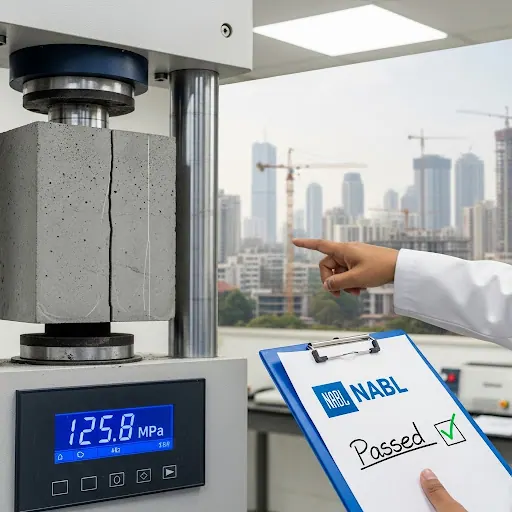
NABL Accredited Concrete Cube Compressive Strength Testing Mumbai: Your Construction Project's Foundation Depends on This
Mumbai's trusted NABL lab since 1973. TCR Engineering offers NABL-accredited concrete cube compressive strength testing.
-
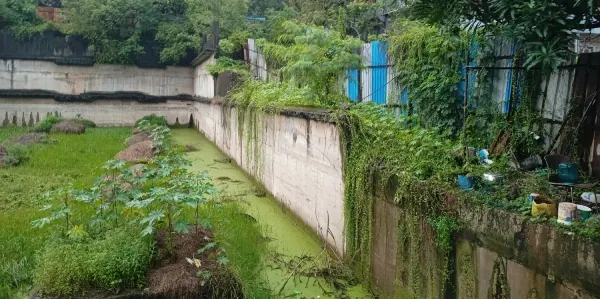
Structural Testing of Retaining Wall and Raft
TCR supports client with structural testing of existing retaining wall and raft using UPV, rebound hammer, core tests, and audit reporting.

Read all 43 Civil & Structural Testing insights →All insights →
Frequently asked questions
What concrete tests does the laboratory run?
Cube and cylinder compression on 2,000 kN and 3,000 kN machines, flexural, split tensile, core testing, rebound hammer surveys, and Ultrasonic Pulse Velocity per IS 516 (Part 5/Sec 1):2018.
Which standards govern concrete compressive strength?
IS 516 and ASTM C39 for compressive strength, with sampling and analysis to IS 1199.
What cement and aggregate tests are covered?
Cement physical tests per IS 4031 for consistency, setting time, soundness, fineness, and strength, and aggregate crushing, impact, Los Angeles abrasion, specific gravity, and water absorption per IS 2386 and IS 383.
Where has TCR tested concrete?
On the Mumbai-Ahmedabad High Speed Rail packages under NHSRCL, the Larsen and Toubro Mumbai Metro and the Mumbai Coastal Road Project. TCR also carried out mechanical, chemical, metallurgical and NDT testing through the construction of the Statue of Unity for Larsen and Toubro.
Are concrete durability tests such as RCPT NABL accredited at TCR?
Yes. The rapid chloride penetration test to ASTM C1202, chloride migration to NT BUILD 492, water permeability to IS 516 (Part 2/Sec 1) and BS EN 12390-8, core water absorption to BS 1881-122 and chloride content to IS 14959 are all on TCR Engineering's NABL certificate NABLT0726MH18640, tested at the Mahape laboratory.