
Industries
Pipelines and City Gas Distribution
Pipeline Integrity and Cross-Country Radiography
Saudi Aramco named TCR technology provider for the Internal RT Crawler, the only such unit on its approved list under SAER-13115.
Request a QuoteIn brief
TCR inspects, tests and assesses cross-country pipelines and city gas networks from construction to life extension: more than 14,000 girth welds radiographed across over 2,600 km of mainline, a Saudi Aramco-approved Internal RT Crawler, and a three-tier model that runs from construction radiography through operator condition assessment to Engineering Critical Assessment, reported against API 1104, API 5L, ASME B31.4 and ASME B31.8.
Key takeaways
- 8 plant sections, from the mainline to underground storage and caverns, and 6 families of damage mechanism are covered below.
- Construction work is reported against API 1104, API 5L 46th edition, ASME B31.4 and ASME B31.8/B31.8S; the full standards matrix is below.
- 13 marquee engagements are documented on this page, among them the Engineering Critical Assessment of 42-inch girth welds for Saudi Aramco's Jafurah gas compression plants, built on six CTOD tests per pipeline.
Overview
India’s cross-country pipeline contractors and consultants, among them Larsen & Toubro, Kalpataru, Likhitha, Corrtech and Engineers India, route weld-integrity and Engineering Critical Assessment scope through TCR. The record is more than 14,000 girth welds radiographed across over 2,600 km, with TCR’s own Saudi Aramco-approved Internal RT Crawler.
- Failures investigated: leaks, ruptures and third-party damage on cross-country mainlines, CGD networks and station equipment.
- Corrosion: external and internal corrosion, microbiologically influenced corrosion, and AC-interference and stray-current corrosion.
- Cracking and mechanical damage: high-pH and near-neutral-pH stress corrosion cracking, sulphide stress cracking and hydrogen-induced cracking, dent-and-gouge, girth-weld defects and pressure-cycling fatigue.
- Assessment: in-line inspection data, cathodic protection surveys, CTOD testing of girth-weld coupons, and Engineering Critical Assessment to API 1104 Annex A.
Industry Context
India's gas grid is in a sustained build-and-operate cycle. GAIL put about a quarter of its FY25 capital expenditure into pipelines, has further capital expenditure planned for FY26 to FY29, moved 127 mmscmd of transmission volume, and holds roughly 47 percent of the domestic gas market.
- Capex: GAIL put about a quarter of its FY25 capital expenditure into pipelines, has further capital expenditure planned for FY26 to FY29, and moved 127 mmscmd of transmission volume.
- The two obligations: qualified weld inspection to build every kilometre, and integrity management under PNGRB rules to keep the licence to run it.
- Three-tier architecture: Tier 1 project NDT with owned internal RT crawlers, Tier 2 operator condition assessment, and Tier 3 engineering analysis including ECA and fitness for service.
- India: the National Gas Grid programme, the IndianOil-anchored LPG, refined-products and crude pipelines, and the GAIL gas grid (NGPL, MNJPL, Urja Ganga).
- GCC and cross-border: Saudi Aramco Master Gas System packages and Jafurah gas compression, PDO Oman, OQGN, Adani-Total Dhamra LNG, and the Motihari to Amlekhgunj route into Nepal.
- Emerging scope: hydrogen pipelines, bringing the ASTM F519 and API 20E hydrogen embrittlement bench into operator-side scope, and CO2 transmission for CCUS.
India's cross-country oil and gas pipeline network is in active expansion under the National Gas Grid programme, with the IndianOil-anchored LPG, refined products, and crude pipelines, the GAIL gas grid (NGPL, MNJPL, Urja Ganga, KGPL), and the city gas distribution rollout under the PNGRB CGD bidding rounds. The CGD network has expanded to 305+ Geographical Areas covering 88 percent of India's population and 98 percent of its area. The ageing legacy pipelines (some now beyond 40 years of operating life) drive in-line inspection campaigns, ECA on girth welds, and life-extension engineering.
In the GCC and across borders the work covers Saudi Aramco (Master Gas System packages, Jafurah gas compression and cross-country oil trunklines), PDO, OQGN and the Motihari to Amlekhgunj pipeline into Nepal. India and the GCC carry most of the pipeline work.
Hydrogen pipelines bring the ASTM F519 / API 20E hydrogen embrittlement bench into pipeline operator-side scope. CO2 transmission pipelines for CCUS (under-deposit corrosion at low temperatures, supercritical CO2 phase behaviour, dense-phase brittle fracture at low temperatures) are an emerging line of work. Re-purposed natural-gas pipelines for hydrogen transmission carry their own qualification campaign on existing material grades (the ASME PCC-2 framework on weld repair is applicable). LNG terminal and bunkering tie-in pipework brings refrigerated material qualification.
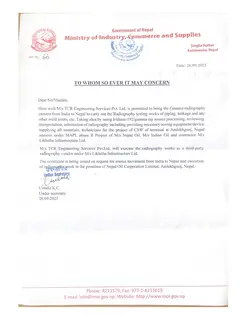
The Government of Nepal permission for MAPL Phase II, under which TCR took a gamma radiography source across the border, is the working model for cross-border pipeline work as corridors into Bhutan and Sri Lanka open.
Plant Sections We Inspect
| Cluster | Equipment |
|---|---|
| Mainline | Cross-country trunkline (8 inch to 42+ inch, API 5L X42 through X70 line pipe), HDD river crossings, marine landfall, mountain crossings |
| Compressor and Pumping Stations | Gas compressor (reciprocating and centrifugal), pump skids, scraper launch and receive barrels, slug catcher, surge vessel, cooler, suction and discharge piping |
| Metering and Pressure Reduction | Custody transfer station, pressure reduction skids, filter separator, knock-out drum |
| City Gas Distribution | MDPE distribution mains, service tee, PE-to-steel transition fitting, district pressure reduction stations, customer regulator and meter set |
| Cathodic Protection | Sacrificial anode beds, impressed-current TR units, anode beds, test posts, casing and carrier pipe, foreign-line crossings |
| Coating Surveys | CIPS, DCVG, Pearson, CAT, conductance |
| LNG Terminal and Re-gas | LNG storage tank (full-containment, double-wall double-integrity), boil-off-gas compressor, re-gas exchanger, send-out compressor, jetty piping |
| Underground Storage and Caverns | Salt cavern and depleted-reservoir gas storage tie-in pipework |
Damage Mechanisms We Investigate
| Category | Mechanisms |
|---|---|
| External corrosion | Coating breakdown, soil-side general corrosion, microbiologically-induced corrosion (MIC), AC interference, stray-current corrosion, casing-and-carrier corrosion |
| Internal corrosion | Sweet (CO2) corrosion, sour (H2S) corrosion, top-of-line corrosion, under-deposit corrosion, MIC |
| Cracking | Stress corrosion cracking (high-pH and near-neutral-pH), sulphide stress cracking, hydrogen-induced cracking |
| Mechanical | Third-party damage (dent, gouge, dent-and-gouge), construction defect (lack of fusion, lack of penetration on girth welds), fatigue (cyclic pressure, traffic-induced) |
| Geohazard | Settlement, landslide, subsidence, river-crossing scour, frost heave |
| Operational | Slug damage, pigging-induced fatigue, hydrate-induced cooling, Joule-Thomson cooling at let-down |
Standards Coverage Matrix
- Line Pipe and Construction
- API 5L 46th Edition (line pipe); ASME B31.4 (liquid pipeline transportation); ASME B31.8 / B31.8S (gas pipeline transportation, supplement on managing system integrity); API 1104 22nd ed. (2021) Annex A (ECA on girth welds, Method 1 and Method 2 FAD); API 1102 (railroad and highway crossings); SAEP-1143 (Saudi Aramco RT engineering procedure).
- Integrity Management
- API 1160 (managing system integrity for hazardous liquid pipelines); ASME B31.8S (gas pipeline integrity management system); API RP 580 / 581 (where RBI is delivered as KBA on station equipment); API RP 584 IOW.
- ECA / FFS
- API 579-1/ASME FFS-1 4th ed. (2021); BS 7910; API 1104 Annex A; ASME Section VIII; ASTM E1820 (CTOD).
- Cathodic Protection
- NACE SP0169 (control of external corrosion on underground metallic piping); NACE SP0102 (in-line inspection); NACE SP0204 (SCC direct assessment); NACE SP0206 (internal corrosion direct assessment); ISO 15589 series; DNV-RP-F101 (corroded pipelines).
- ECDA / ICDA / SCCDA
- NACE SP0502 (ECDA); NACE SP0206 (ICDA); NACE SP0204 (SCCDA).
- Materials in Sour Service
- NACE MR0175 / ISO 15156; NACE TM0177 (SSC); NACE TM0284 (HIC).
- ILI Methods
- Magnetic Flux Leakage (the primary data feed into AiOM-CCP); Ultrasonic Crack Detection; EMAT-ILI; Inertial Measurement Unit geometry; Caliper.
- Coating
- AMPP/NACE coating-inspector framework; SSPC-VIS 1; ISO 8501-1; NACE SP0188 (holiday detection); ISO 12944 (corrosion protection by coating systems).
The Three-Tier Pipeline Service Model
TCR's pipeline work runs in three tiers that follow the life of a line: radiography while it is built, condition assessment while it operates, and engineering analysis when a flaw, a dent or a life-extension decision needs a number.
- Tier 1, construction-stage radiography: conventional film RT plus the Saudi Aramco-approved Internal RT Crawler family (16 to 52 inch; 160, 200 and 300 kV at 5 mA; ±5 mm positioning accuracy) and computed radiography.
- Tier 2, operator condition assessment: in-line inspection ingestion with MFL primary, CIPS, DCVG, Pearson, CAT, conductance, and casing-and-carrier short, read against a pipe-to-soil potential band of −0.85 V to −1.20 V versus Cu/CuSO4.
- Cathodic protection: design and turnkey installation under TCR Advanced Engineering's CP Division.
- Tier 3, engineering analysis: ECA per API 1104 Annex A on girth welds, an eight-step workflow with CTOD at the 12, 6 and 3/9 o'clock positions and Method 2 FAD fracture-mechanics calculation.
- Flow capacity: remaining-life assessment by C-Value Hazen-Williams analysis, quantifying internal roughness and effective diameter loss on operating liquid pipelines.
Tier 1, Project NDT
Construction-stage radiography on cross-country mainline girth welds and HDD river crossings. Conventional film RT plus the Saudi Aramco-approved Internal RT Crawler family (16-52 inch, 160/200/300 kV at 5 mA, ±5 mm positioning accuracy). Computed radiography with Carestream and 3ENDT digital plate readers. PAUT and TOFD on critical welds. Ultrasonic crack detection on heavy-wall pipe. More than 14,000 girth welds radiographed across over 2,600 km of cross-country mainline; 9,266 weld joints digitally scanned and cloud-archived on a single project (EnProCon TJTC Kolar).
Tier 2, Operator Condition Assessment
In-line inspection ingestion (MFL primary), CIPS, DCVG, Pearson, CAT, conductance, casing-and-carrier short, pipe-to-soil potential read against the −0.85 V to −1.20 V band versus Cu/CuSO4. Cathodic protection design and turnkey installation under TCR Advanced Engineering's CP Division, led by Chiral Patel (run out of Vadodara with a regional office in Bhubaneswar; services offered pan-India). Coating surveys on a five-year cycle. The AiOM-CCP digital backbone consolidates ILI runs, CP records, and coating-survey output into a single integrity dashboard.
Tier 3, Engineering Analysis
Engineering Critical Assessment per API 1104 Annex A on pipeline girth welds, in eight steps: component identification, loadings, material properties, NDT of the coupon, destructive tests on the coupon including CTOD at the 12, 6 and 3/9 o'clock positions, fracture mechanics calculation per the Method 2 FAD, FEA of axial stresses on the actual line layout, and a flaw table of acceptable sizes. FFS per API 579 on dents, gouges, metal-loss, and crack-like flaws. RLA for legacy pipelines. AiOM-CCP anonymised undersea pipeline case study (API 5L X46N, 21 km × 355 mm × 15.9 mm, ID-side CO2/H2S corrosion).
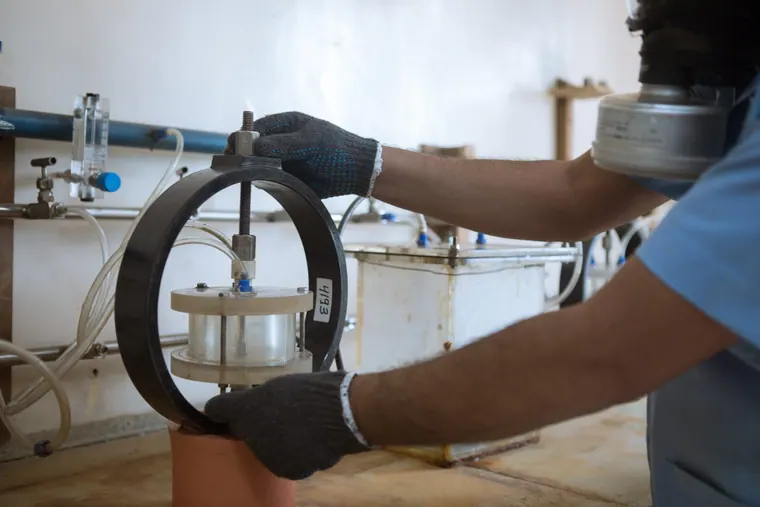
Flow-capacity and remaining-life assessment by C-Value (Hazen-Williams) analysis, used to quantify internal roughness and effective diameter loss on operating liquid pipelines.
Service Applications Across the TCR Continuum
The three-tier pipeline service model above maps directly onto the five-stage Trusted Relationship Model (see Why TCR): Tier 1 project NDT covers Stages One and Two, Tier 2 operator condition assessment covers Stages Three and Four, and Tier 3 engineering analysis is Stage Five.
A pipeline operator's problem set is external stress corrosion cracking, microbiologically influenced corrosion, and alternating current interference on the outside; carbon dioxide, hydrogen sulphide, and microbial attack on the inside; dent-and-gouge and third-party damage along the right of way; and girth weld defects inherited from construction. The construction-phase pressure is radiography productivity against lowering rates; the operating-phase pressure is proving integrity between inline inspection runs; the procurement pressure is line pipe and coating quality at the mill. Not every stage carries equal weight in this vertical, and TCR applies the model with judgement: Stages One, Two, and Five dominate cross-country projects, while Stages Three and Four dominate operating systems and city gas distribution networks.
- Stage One, Sourcing and Procurement
- Line pipe is qualified at the mill: mechanical and chemical testing per API Specification 5L, drop weight tear and Charpy impact testing, hydrogen induced cracking per NACE TM0284 and sulphide stress cracking per NACE TM0177-2024 for sour service lines per NACE MR0175/ISO 15156, coating system qualification, and mill audits with sample picking and loading supervision, so that the pipe that arrives at the right of way matches the pipe that was ordered.
- Stage Two, Construction and Commissioning
- Mainline production welding is inspected with crawler-based radiography per API 1104, the practice anchored by the Saudi Aramco approved internal radiography crawler (see RT Crawlers), supported by welder and procedure qualification, positive material identification, holiday detection on coating, and hydrotest witness. The construction record, weld maps, radiographs, and coating reports, becomes the baseline for the operating life of the line.
- Stage Three, In-Service
- In operation, the Cathodic Protection Division delivers close interval potential surveys, direct current voltage gradient coating surveys, alternating current interference studies, and turnkey cathodic protection design, installation, and remediation per NACE SP0169, alongside above-ground marker surveys and remote visual inspection of exposed crossings. Risk-based integrity planning per API RP 580 principles, delivered through AiOM-CCP (see AiOM), sequences excavation and assessment across the network.
- Stage Four, Shutdown and Turnaround
- At dig sites and during station shutdowns, TCR provides direct examination non-destructive testing: ultrasonic thickness and corrosion mapping on exposed pipe, phased array ultrasonic testing and time of flight diffraction on suspect girth welds, dent and gouge profiling, magnetic particle and penetrant testing on fittings, and station piping, scraper trap, and valve inspection, with in-situ metallographic replication where cracking mechanisms need microstructural confirmation.
- Stage Five, Continuum
- Engineering analysis closes the loop: Engineering Critical Assessment of girth welds per the eight-step workflow under Tier 3 above, fitness for service and remaining strength assessment of corroded and dented pipe per API 579-1/ASME FFS-1 and ASME B31G, failure analysis of ruptures and leaks, cathodic protection effectiveness studies, and hydrogen and carbon dioxide service conversion assessments that feed the operator's next capital cycle.
Named Clients
The pipeline and city-gas client base falls into six groups: Indian public-sector operators, private-sector operators, city-gas distribution licensees, the EPC and PMC contractors that build and manage the networks, GCC operators, and international clients. Each group and its named organisations follow.
- India Public Sector
- IOCL (Kandla-Gorakhpur LPG Pipeline, Salaya-Mathura crude, Paradip-Haldia products), GAIL (Hazira-Vijaipur-Jagdishpur, Dahej-Vijaipur, MNJPL, KGPL, Urja Ganga), HPCL (Mumbai-Pune, Mundra-Delhi), BPCL (Bina-Kanpur, Mumbai-Manmad), ONGC (offshore export trunkline), Petronet LNG (Dahej re-gas), Indian Strategic Petroleum Reserves Limited (Mangalore, Padur, Visakhapatnam underground storage tie-ins), Mahanadi Coalfields.
- India Private Sector
- Reliance Industries (KG-D6 onshore tie-in, Jamnagar export), Cairn Oil and Gas (Barmer crude trunkline), Adani-Total (Dhamra LNG; cross-vertical with Marine), Larsen and Toubro (EPC contractor for multiple cross-country projects), Gujarat State Petroleum Corporation, Indraprastha Gas Limited.
- CGD Operators
- Bhagyanagar Gas Limited (HPCL-GAIL JV, BGRL Spread-2 Maharashtra June 2021 via Tractebel ENGIE PMC; Karnataka 2022 via Tolani Projects), Green Gas Limited Lucknow GA December 2022, Torrent Gas Karaikal Puducherry June 2023, Gujarat Gas, Mahanagar Gas, Indraprastha Gas.
- EPC and PMC
- Engineers India Limited (12-year approval pack); Mecon; Larsen and Toubro; Kalpataru Projects International; Likhitha Infrastructure (Nepal cross-border partner); EnProCon (TJTC Kolar 9,266 weld joints); NRP Projects (Adani-Total Dhamra LNG EPCC); Wood (Adani-Total Dhamra LNG PMC); Tractebel ENGIE; Tolani Projects; Power Mech Projects.
- GCC
- Saudi Aramco (Master Gas System cross-package: L&T, Kalpataru Projects International, GAS Arabian Services delivery; ECA per API 1104; cross-border KSA-India workflow), PDO, OQGN, Adani-Total Dhamra LNG.
- International
- Nepal Oil Corporation (MAPL Phase II via Likhitha Infrastructure, a cross-border deployment outside the GCC, under Ref 2080/81 dated 30 July 2023).
Representative India pipeline and city-gas-distribution clients include Corrtech International, Kalpataru Projects International, Likhitha Infrastructure, Advance Infrastructures (on JSW and ArcelorMittal Nippon Steel pipeline scope), and MAS Constructions, with field deployment across Odisha, Haryana, Rajasthan, Kerala, and Andhra Pradesh.
Marquee Projects
Named OQ Gas Networks line-pipe qualification projects include the 42-inch Fahud-Sohar Second Loop Line and the Marsa LNG gas supply pipeline, with line pipe from Jindal Saw and Man Industries.
| Project | Service Anchor | Year |
|---|---|---|
| Saudi Aramco Internal RT Crawler programme | SAER-13115 dated 8 September 2025; demonstration 28 July 2025 | 2023 to 2025 |
| IOCL Kandla-Gorakhpur LPG Pipeline | Cross-country LPG pipeline, multiple spreads, Tier 1 Project NDT | Construction era |
| Srikakulam-Angul Onshore Gas Pipeline 690 km | 4 spreads, Tier 1 Project NDT | Construction era |
| EnProCon TJTC Kolar | 9,266 weld joints digitally scanned and cloud-archived | Multiple |
| Likhitha Infrastructure for Nepal Oil Corporation, MAPL Phase II | Cross-border RT Crawler deployment, AERB and BARC permissioned, Ref 2080/81 dated 30 July 2023 | 2023 |
| Adani-Total Dhamra LNG Terminal | Approved RT scope per Letter Ref 2340-RLNG-DLTPL-NRP-L-0005 dated 20 October 2021 | 2021 onward |
| Saudi Aramco Jafurah Gas Compression Plants | ECA of 42-inch girth welds per API 1104 Annex A Option 2, on six CTOD tests per pipeline; PWIS Package-1 | 2024 to 2025 |
| Bhagyanagar Gas Limited Maharashtra and Karnataka | CGD pipeline RT under Tractebel ENGIE and Tolani Projects | 2021, 2022 |
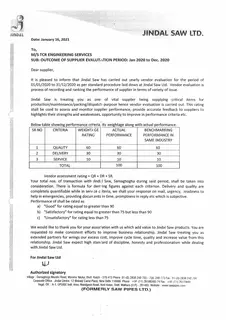
| Jindal SAW Limited Mundra Kutch for OQ Gas Project | Line pipe sour-service material qualification for OQGN Oman: HIC per NACE TM0284 (96 hours, 25 ±3 °C, 92 sets of 3 specimens) plus SSCC four-point bend per NACE TM0177 / ASTM G39 / OQGN docs (720 hours, 24 ±3 °C, 52 sets of 3 specimens, fixture 100 mm outer / 50 mm inner support). | July 2025 onward |
| Green Gas Limited Lucknow GA | CGD pipeline RT | December 2022 |
| Torrent Gas Karaikal Puducherry | CGD pipeline RT | June 2023 |
| Master Gas System (Saudi Aramco), TCR Arabia cross-package | ECA per API 1104, cross-border KSA-India workflow | Continuous |
| AiOM-CCP undersea pipeline case study | API 5L X46N, 21 km × 355 mm × 15.9 mm, ID-side CO2/H2S corrosion | Anonymised |
The Saudi Aramco-approved internal RT crawler, 16 to 52 inch, is named in Saudi Aramco Engineering Report SAER-13115.
A C-Value condition study on an 8-kilometre industrial water pipeline traced a drop from 500 to 300 cubic metres per hour to a Hazen-Williams coefficient that had fallen from 130 to 75, a fouled but structurally intact line. A 48-inch API 5L X60 sweet-gas line of 42 kilometres was cleared by Engineering Critical Assessment per API 1104 Annex A Option 2.
Documents
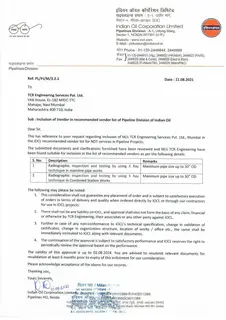
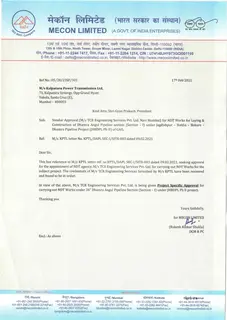
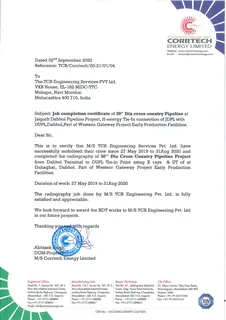
Download the reference documents for this page. Every file is hosted on this domain and is also listed in the site document library.
Related insights
15 published insights on this site carry the Pipelines & City Gas tag. The 6 most recent are below.
-
One NACE method, four pass marks: sour service testing to Saudi Aramco, ADNOC, QatarEnergy and PDO specifications
A plate with an average crack length ratio of 12 per cent passes API 5L and PDO and fails Saudi Aramco. The NACE method is the same in all three; the…
-
Case Study: HIC and SSC Qualification of Sour-Service Line Pipe for a PDO Project
Yangzhou Chengde Steel Pipe ordered HIC and SSC testing for a Petroleum Development Oman project. The order named two conditions that cannot both be…
-
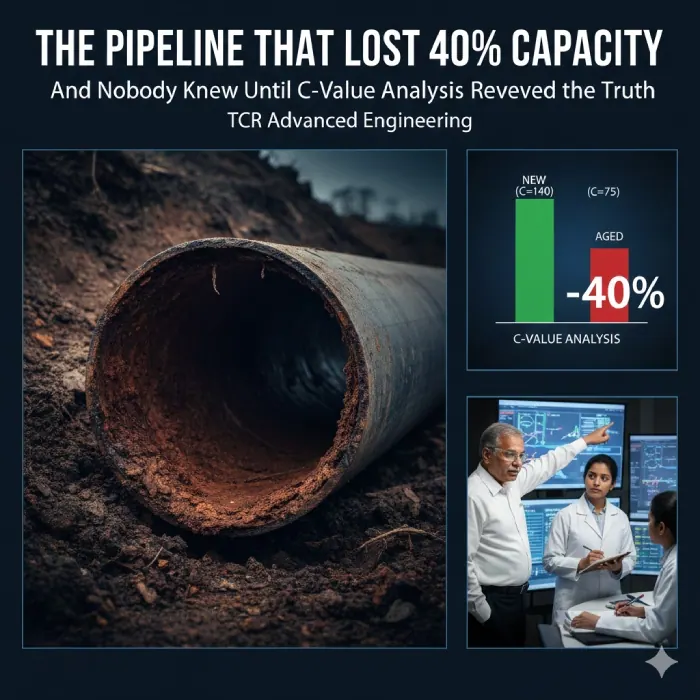
The Pipeline That Lost 40% Capacity (And Nobody Knew Until C-Value Analysis Revealed the Truth)
C-Value analysis reveals true hydraulic condition of ageing pipelines. TCR Advanced Engineering's expertise prevents costly capacity losses.
-
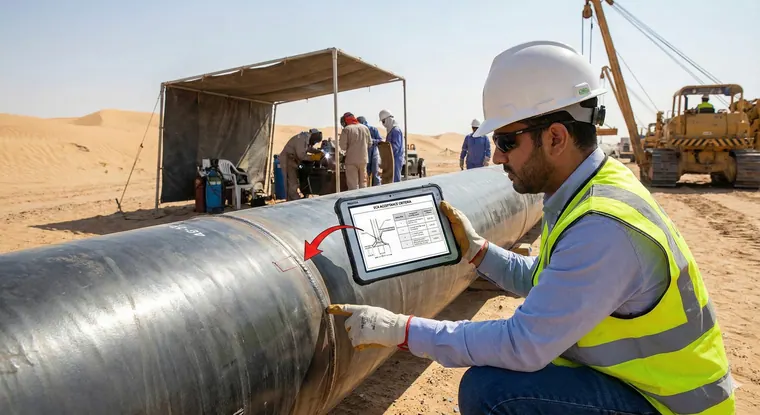
General Approach for ECA of Girth Welds in Pipelines: A Practical Guide for Large-Diameter Gas Lines
Engineering Critical Assessment of girth welds transforms weld acceptance from guesswork into science-backed decisions for pipeline integrity
-
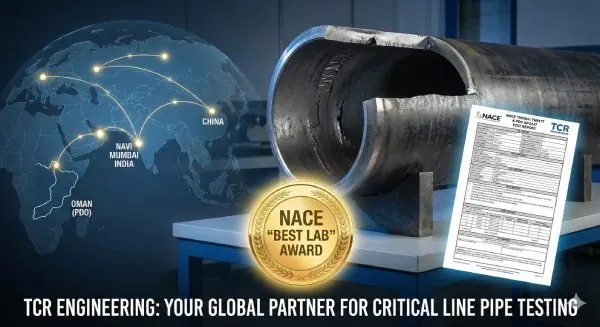
Why PDO's Vendors Trust TCR Engineering for Critical Carbon Steel Line Pipe Testing
NACE corrosion testing per PDO SP-2347 for carbon steel line pipes. TCR's Mahape lab is PDO-approved for HIC and SSCC testing to NACE standards.
-
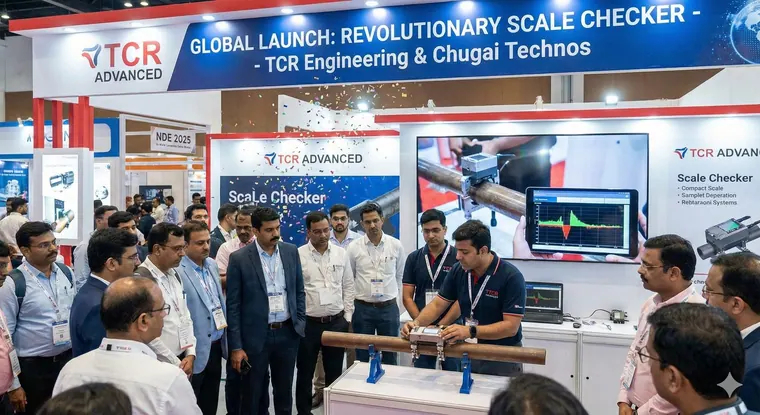
TCR Engineering Launches Scale Checker for Pipe Blockage Diagnostics in Partnership with Chugai Technos (Japan) at NDE 2025 Mumbai
TCR Engineering and Chugai Technos launched the Scale Checker at NDE 2025, Mumbai: a dual-mode Cs-137 gauge that measures internal scale in tubes and pipelines.
Frequently asked questions
Does TCR inspect cross-country pipeline girth welds during construction?
Yes. TCR has inspected 14,000-plus girth welds across 2,600-plus kilometres of mainline as Tier 1 project NDT, with owned internal RT crawlers and radiography productivity matched to lowering rates, reported against API 1104 22nd edition, ASME B31.4 and ASME B31.8.
Is TCR approved by Saudi Aramco for internal pipeline radiography?
Yes. TCR operates the Saudi Aramco-approved Internal RT Crawler named in SAER-13115 (8 September 2025), working to SAEP-1143, the Saudi Aramco RT engineering procedure, alongside API 5L 46th edition line-pipe scope.
Can TCR run engineering critical assessment on girth welds?
Yes. Tier 3 engineering analysis covers ECA and fitness for service per API 1104 22nd edition (2021) Annex A, Method 1 and Method 2 FAD, with integrity management context from ASME B31.8S.
What damage mechanisms does TCR investigate on operating pipelines?
External stress corrosion cracking, microbiologically influenced corrosion and AC interference on the outside; carbon dioxide, hydrogen sulphide and microbial attack on the inside; dent-and-gouge and third-party damage along the right of way; and girth weld defects inherited from construction.
Does TCR support city gas distribution operators?
Yes. Tier 2 operator condition assessment serves operating systems and city gas distribution networks, proving integrity between inline inspection runs under PNGRB integrity-management rules.