
Services · Materials Testing
Chemical Analysis Testing Laboratory
Sub-ppm tramp elements by graphite-furnace atomic absorption, parts-per-billion detection by ICP, and bullion assay under BSE/NSE/ICCL approval. Where no published protocol exists, the bench develops and validates the method itself.
Request a Quote
In brief
TCR Engineering Services Pvt. Ltd. runs a NABL ISO/IEC 17025:2017 accredited chemical analysis testing laboratory (certificate NABLT0726MH18640) at Mahape, Navi Mumbai, India. It analyses ferrous and non-ferrous metals, alloys, ores and slags by wet chemistry, OES, ICP, AAS, XRF and LECO combustion, reporting from percentage levels to parts per billion, and runs positive material identification on site.
Chemical composition analysis of ferrous and non-ferrous metals, alloys, slags, ores, and residues. The TCR chemical laboratory maintains a dedicated classical wet chemistry department. Bullion assay. TCR is a BSE/NSE approved assayer for precious metals and is an ICCL/BSE Approved Assayer plus Bharat Metal Exchange Association approved laboratory.
What does a chemical analysis testing laboratory analyse?
A chemical analysis testing laboratory determines what a material is made of. TCR's laboratory analyses ferrous and non-ferrous metals, ceramics, glass, refractories, minerals and ferro-alloys, supplied as drillings, turnings, solid pieces, powders or liquids, at percentage, ppm or ppb levels. It certifies grade against the purchase specification, settles disputes by wet chemistry and screens RoHS-restricted substances.
- RoHS compliance: non-destructive XRF screening plus ICP wet-chemical verification, with lead detection, for electronics, coatings and consumer-goods buyers.
- Materials analysed: ferrous and non-ferrous metals, ceramics, glass, refractories, minerals and ferro-alloys, to parts per billion or parts per million.
- Standards: ASTM E1086, E415, E1019, E1479 and E350 through E353, the IS 228 series, and product-specific compositional limits per the applicable ASTM, ISO and BIS standards. Inspection documents are issued to EN 10204.
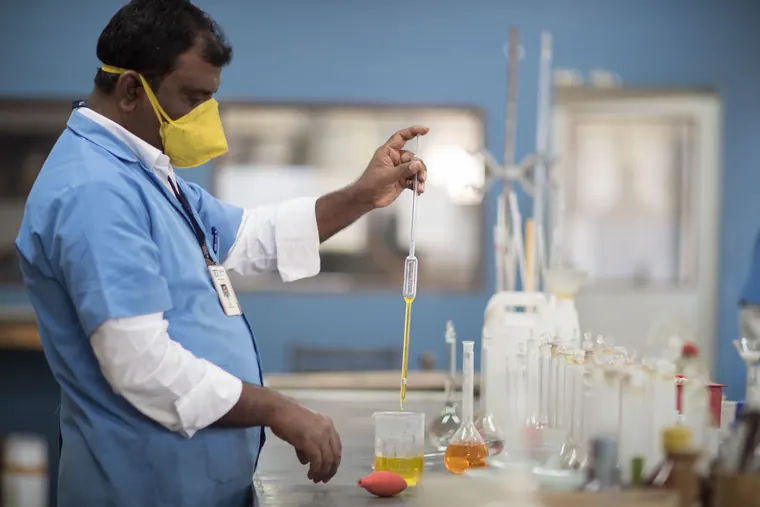
- Classical wet chemistry: gravimetry, where the species is determined by weighing, and titrimetry, by volume measurement of a liquid reactant.
- Condition monitoring: ferrography and oil analysis.
- Beyond routine analysis: method development, method validation and identification of unknown materials.
TCR's chemical analysis laboratory analyses ferrous and non-ferrous metals, ceramics, glass, refractories, minerals and ferro-alloys at ppb, ppm or percentage levels. TCR’s capabilities include Wet Chemistry, Optical Emission Spectroscopy (OES), Inductively Coupled Plasma (ICP) Spectrometer, Automatic Combustion based Carbon and Sulphur determinator, XRF spectrometer, and more.
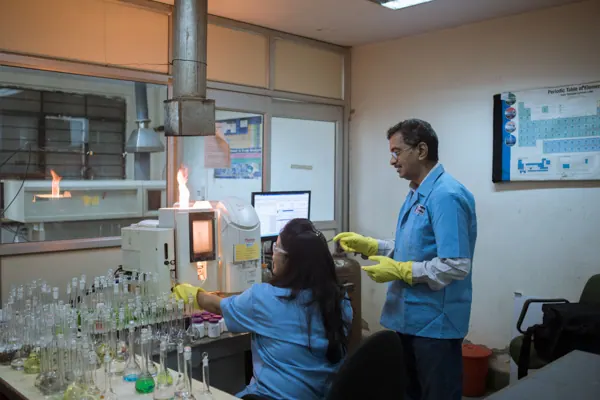
TCR's analytical chemists work across the spectrometer bench and the wet chemistry laboratory. TCR caters to all analytical requirements for Ferrous, Non-Ferrous Metals, Ceramics, Glass, Refractory, Minerals and Ferro Alloys. The chemical department analyses samples in all forms including drillings or turnings, solid samples, and liquids.
The Classical Wet Chemistry (bench chemistry) Department uses Gravimetry (chemical species is determined by weighing) and Titrimetry (involves volume measurement of a liquid reactant) procedures to analyse the chemical composition of materials. It assists in the identification of unknown materials and gaining an understanding of their chemical composition, structure and function. Most classical wet chemical methods can accommodate comparatively small amounts of a sample in diverse shapes or forms. The wet chemistry department complies with India's environmental standards and works from trace analysis down to very low detection levels.
TCR Engineering Material Testing Laboratory provides both analytical and interpretive expertise, including method development, method validation and identification of unknown materials. It reports at ppb, ppm or percentage levels, against standard specifications or client-supplied specifications, and develops customised analytical procedures for analysis of materials and substances for which no protocol is available.
Chemical Analysis by Classical Wet Method
Classical wet chemistry determines composition by weighing, which is gravimetry, and by titration, which is titrimetry, and it stays the referee route when an instrumental result is disputed. TCR Engineering runs a dedicated wet-chemistry department at Mahape, Navi Mumbai, accredited under NABL certificate NABLT0726MH18640 for the steel and alloy methods of ASTM E350 through E353 and the IS 228 series.
- Ferrous Metals (Including) C, S, P, Mn, Cr, Mo, Ni
- Non-Ferrous Refractory, Ceramics, and Minerals, Ferro Alloys (Fe-Mn, Fe-Si, Fe-Mn-Si, Fe-Mg-Si, Low C Fe-Cr, Fe-Mo)
- Non-Ferrous Metals (Each Additional Element)
- Elements Such As Co, Al, W, Cu, Sn, Ti, Mg, V In Steel
- Nitrogen / Boron / Palladium (Each Element)
- Purity Of Cu
- Purity Of Al, Zn, Pb, Ni, Bi, Cd, Sn, Mg, W, Ti
- Oxygen Analysis and Hydrogen Analysis
Bench equipment
- Microwave digestion system
- Four electro analysers
- Three electronic balances
- Vacuum pump
- Muffle furnaces
- Heating ovens
Chemical Analysis by Spectrometers
The spectrometric bench reads composition by exciting the sample and measuring what it emits, rather than by dissolving it. Which instrument answers the question depends on the element and the level: optical emission for the alloying elements, inductively coupled plasma and atomic absorption for impurities at parts per million and below, and energy-dispersive analysis for a feature too small to sample on its own.
- EDAX Analysis
- Complete Chemical Analysis up to 8 elements
- Impurities in PPM Level using AAS or ICP
Positive Material Identification (PMI) Testing
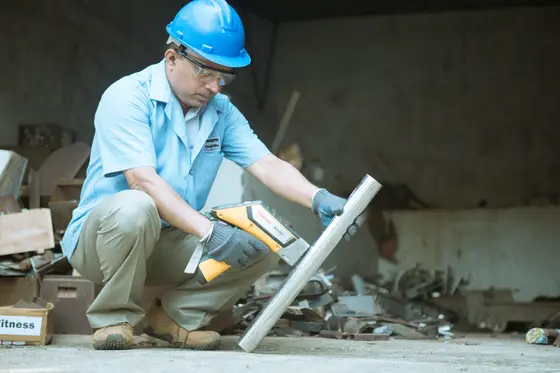
Positive material identification confirms that the alloy installed in an asset is the alloy the drawing specifies, by reading its chemistry where it stands rather than on a coupon in a laboratory. TCR Engineering Services Pvt. Ltd., a NABL ISO/IEC 17025:2017 accredited laboratory in Navi Mumbai, has completed 700+ PMI campaigns, and reports them under certificate NABLT0726MH18640, which carries 1,483 scope items.
The reason PMI exists is that material mix-ups are invisible. A carbon steel elbow fitted into a chrome-moly line looks identical from the outside and behaves identically until the temperature or the sour service finds it.
What is positive material identification?
PMI is the field verification of alloy composition on installed or delivered material, carried out to confirm that what is in the plant matches what was specified. It is normally run as a programme rather than as a single test, under API RP 578, "Guidelines for a Material Verification Program for New and Existing Assets".
The scope of that programme is set by consequence, not by convenience. API RP 578, third edition, February 2018, addresses metallic materials obtained directly or indirectly through distributors and contractors, and covers their supply, fabrication and installation. ASTM E1476 is the guide to metals identification, grade verification and sorting.
- New construction: verification of received material against the purchase specification, before it is welded in.
- Existing assets: verification of what is actually installed, typically driven by a corrosion or damage-mechanism review.
- After a modification or a repair: verification that the replacement matches the line class, including the weld.
What can handheld XRF not tell you?
Handheld X-ray fluorescence cannot see carbon, and carbon is what separates several of the grade pairs that matter most. XRF cannot identify elements lighter than magnesium, which puts carbon, boron and nitrogen outside its reach, so an XRF reading that confirms a stainless grade family still cannot tell 304 from 304L.
Optical emission spectrometry can. It excites the sample with a spark rather than with X-rays and measures carbon, phosphorus, sulphur, boron and nitrogen directly, which is what carbon-equivalent questions, low-alloy steels and weld chemistry actually require.
| Handheld XRF | Optical emission spectrometry (OES) | Laboratory chemical analysis | |
|---|---|---|---|
| Where it happens | On the installed asset | On the asset with a portable unit, or in the laboratory | In the laboratory, on a sample |
| Carbon, boron, nitrogen | Not measurable. Elements lighter than magnesium are outside the method | Measurable | Measurable, by LECO combustion for C and S |
| What it settles well | Alloy family and grade separation where the alloying elements differ, such as 304 against 316 | Carbon equivalent, low-alloy grades, weld chemistry, L versus non-L grades | Full certified composition against the specification |
| What it leaves open | Any question that turns on carbon content | Surface condition and preparation still govern the result | It needs a sample, so the asset is disturbed |
| Marks the asset? | No | A small burn mark at the test spot | Yes, material is removed |
| Typical use | Screening of every item in a line or a delivery | Resolving what the screening could not | Certification and dispute |
The practical rule follows from the table. Screen with XRF because it is fast and it marks nothing; escalate to OES the moment the question turns on carbon; go to the laboratory when the answer has to be certified or defended. TCR runs all three, which is why PMI sits on this page rather than on an NDT page: the escalation path ends in the same accredited chemistry laboratory that issues the certificate.
Carbon detection in the field is not new work here. The note PMI with carbon detection in India is the oldest record of it on this site.
What must a PMI report state?
A PMI report has to say what was tested, what it was tested with, and against what it was judged, because the report is the deliverable and the reading is not. At minimum it states the component and its location, the method and the instrument with its calibration traceability, the elements measured, the specification the result is compared against, and the accept or reject decision for each item.
Two lines decide whether the report survives review. The first is what the method could not measure, stated rather than left implied: a report that judges an L grade on an XRF reading alone is claiming something the instrument did not measure. The second is the boundary of the accredited scope, so the reader knows which results carry the accreditation.
- Component identification and location, recorded so a second party can return to it.
- Method and instrument, with calibration traceability.
- Elements measured, and the elements the method cannot measure.
- The specification or line class the result is judged against.
- Accept or reject per item, with the disposition of any reject.
- Which results fall inside the NABL scope and which do not.
Where PMI is delivered
PMI travels to the asset, which is why it is one of the few laboratory services that is genuinely portable. In India it is delivered by TCR Engineering Services Pvt. Ltd. from Navi Mumbai under certificate NABLT0726MH18640.
In Saudi Arabia the work is delivered by TCR Arabia Company Limited, a separate company and a 60/40 joint venture with GAS Arabian Services, holding its own IAS accreditation TL-783. The 700+ campaign figure is a group figure across India, Saudi Arabia and Kuwait; it is quoted here as the depth of the practice, not as a claim that any one entity holds another entity's approvals. See TCR Arabia.
Chemical Analysis by LECO
Combustion analysis determines carbon and sulphur in metal, ore and powder samples, supplied as solid material, drillings or powders. It complements ICP or OES in a full chemical analysis of a metallic sample.
- Oxygen by LECO
- Nitrogen by LECO
- Hydrogen by LECO
Steel and Cast Iron
- Determination Of Any One Element (%C)
- Determination Of Any One Element (Mn, Si)
- Determination Of Any One Element (Ni, Cr, S, etc.)
- Determination Of C, Mn, Si, S, P
- Complete Analysis Of Low Alloy Steel Up To 8 Elements Including C, S, P, Si, Mn, Ni, Cr, Mo
- Determination Of Any One Element in Stainless Steel
- Complete Analysis Of Stainless Steel up to 8 Elements
- Determination Of High Alloy Element (Cr, Ni, Mn)
- Determination Of Some Special Element (Cu, Ti, Co, V, W, Al) Per Element
- Complete Analysis Of High-Speed Steel (8 Elements) Per Element
- Determination Of Mo%
- Determination Of V%
- Nitrogen In Steel
Non-Ferrous Material
- Copper Base Alloys
- Determination Of Any One Element
- Complete Analysis Of 6 Elements
- Purity Test Of Cu
- Purity Test Of Other Non-Ferrous Element
Ferro Alloys
- Analysis of Main Element
- Each Subsequent Element
Tin, Aluminium, Lead Base
- Determination of Any One Element
- Complete Analysis of up to 8 Elements
- Purity Test
- Only Aluminium %
Other Tests
- pH Value Determination
- Sand Content (as SiO2)
- Acid Insoluble
- Sulphates, Chlorides, Silicates, Carbonates, Oxides of Iron Per Element
- Elemental analysis – Calcium, Magnesium, Potassium, Sodium, Iron Per Element
- Moisture Content
- Analysis on XRF per element
- Ash Content
- Material Certification
- Unknown Material Identification
- Trace Element Analysis
- Oil, Powdered Metal, & Chips/Shavings Analysis
- Solder Alloys (Tin/Lead)
- Quantitative and Semi-Quantitative Analyses
- Density of Powdered Metals
- Plating and Plating Solution Analysis
- Glass Analysis
- On-Site Positive Material Identification (PMI)
- Coating Identification
- Coating Weights
- Particle Size Analyser
Equipment
The chemical analysis bench runs these instruments:
- Optical Emission Spectrometry (OES): fast bulk analysis.
- Atomic Absorption Spectrometry (AAS): trace elements.
- Inductively Coupled Plasma Optical Emission Spectrometry (ICP-OES): multi-element scanning.
- Combustion Analysis (LECO): carbon and sulphur.
- Inert Gas Analysis (IGA): nitrogen and oxygen.
- Classical wet chemistry: verification and arbitration analyses.
- Glow Discharge Spectrometry (GDS): surface and depth-profile analysis.
- Energy Dispersive X-ray (EDAX): micro-analysis.
- X-ray Fluorescence (XRF): portable and bench alloy identification.
Atomic Absorption (AA) Graphite Furnace Spectrometer
Graphite furnace atomic absorption (GFAA) reaches sensitivities that other analytical techniques cannot, and determines residuals in metals at ppm and sub-ppm levels. GFAA is also particularly useful for the determination of low boiling point tramp elements in aerospace alloys.
- Detection range: parts per million and sub-parts-per-million residuals in metals.
- Application: trace-metal detection in material analysis.
- Why this technique: a sensitivity that is virtually impossible to reach by other analytical methods.
This method is particularly pertinent in material analysis for the detection of trace metals.
Inductively Coupled Plasma Spectrometer
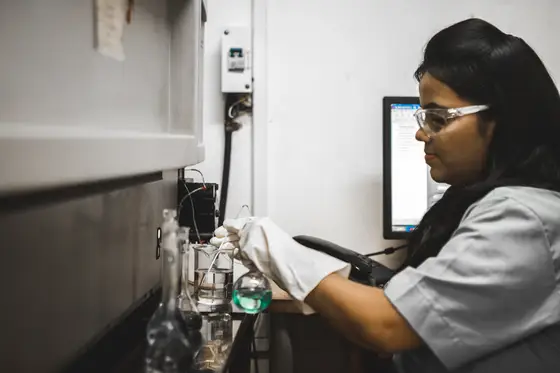
ICP is a spectrophotometric method carried out in solutions where high temperature argon plasma is used to reduce matrix effects, giving straight-line calibrations. Low sample weights can be analysed, and with a wide calibration range and parts-per-billion detection limits the instrument suits a broad range of trace work.
- Where it is reached for: trace and residual elements, at the point where optical emission reaches its detection limit.
- On this bench: impurity and residual-element analysis, and the wet-chemical verification leg of RoHS testing.
- Instrument practice: ASTM E1479 specifies the spectrometer itself; the reported result is always against the material-specific method.
Optical Emission Spectrometer
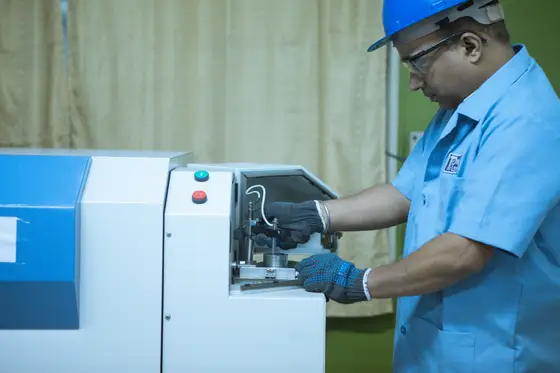
These instruments enable the rapid quantitative determination of a wide range of alloys including carbon/low alloy steels, stainless steels, cast irons, aluminium alloys, nickel alloys and copper alloys. Sample preparation is simple, which makes OES the first instrument used on an unknown alloy.
- What it settles that XRF cannot: carbon, phosphorus, sulphur, boron and nitrogen are measured directly, which is what carbon-equivalent questions, low-alloy grades and weld chemistry require.
- Accredited methods: ASTM E415 for carbon and low-alloy steel and ASTM E1086 for austenitic stainless steel, both on NABL certificate NABLT0726MH18640.
- What it costs the sample: a solid coupon with a prepared face, and a small burn mark at the test spot.
X-Ray Diffraction Spectrometer
X-Ray Diffraction Analysis (XRD) investigates the crystalline material structure, including atomic arrangement, crystallite size, and imperfections. The X-rays are generated by an X-ray tube, filtered to produce monochromatic radiation, collimated to concentrate, and directed towards the sample.
- What it answers that XRF and OES cannot: which crystalline phase the elements are in, rather than which elements are present. Composition and phase are two different questions and only diffraction settles the second.
- Residual stress: measured by the sin-squared-psi technique to ASTM E2860, on welds, machined components and shot-peened surfaces. See residual stress by XRD.
- Accreditation position: X-ray diffraction does not appear on NABL certificate NABLT0726MH18640. XRD results, residual stress to ASTM E2860 included, are reported as measurements made to the named method, outside the accredited scope.
Cement and Building Materials by WD-XRF
TCR Engineering analyses the chemical composition of cement, supplementary cementitious materials, refractories, limestone, silica and clay minerals, ceramics, glass, building materials, ores and ferroalloys by wavelength-dispersive X-ray fluorescence, on a Rigaku Supermini200 benchtop sequential WD-XRF spectrometer at Mahape, Navi Mumbai. Results are reported to IS 12803, ASTM C114 and ISO 29581-2.
- Instrument: a benchtop sequential wavelength-dispersive spectrometer with gas-flow proportional and scintillation detectors, whose geometry separates overlapping spectral lines that a hand-held energy-dispersive instrument cannot resolve.
- Sample preparation: fused bead or pressed pellet, both routes on site.
- Coverage: cement and cementitious materials, refractories, minerals, ceramics, glass, building materials, metals, ores and ferroalloys, in the families tabled below.
- Accreditation position: the XRF routes on building materials are not yet within the scope of NABL certificate NABLT0726MH18640. Accredited building-material chemistry continues under IS 4032, IS 1727, IS 3812 and IS 12813, and XRF is on the certificate for ferrous and non-ferrous alloys under ASTM E1476. The scope extension is in progress, and an XRF result on a building material is reported as a measurement made outside the accredited scope until it is granted.
- What still goes to the wet bench: loss on ignition, sulphate in a sulphide-bearing sample, carbon, boron and nitrogen, and any disputed cement result, which IS 12803 sends back to IS 4032 as the referee method.
| Material family | Governing method | Sample form |
|---|---|---|
| Cement and cementitious materials | IS 12803, ASTM C114, ISO 29581-2 | Powder, or clinker and lump |
| Supplementary cementitious materials | IS 12803, ASTM C114, ISO 29581-2 | Powder, or granulated slag |
| MgO and refractories | ASTM E1652, ASTM C114 route for oxide majors | Brick or castable, or powder |
| Limestone, lime and carbonates | ISO 29581-2 constituent-material route | Powder, or rock |
| Silica, sand and clay minerals | ISO 29581-2 constituent-material route | Sand or clay |
| Special minerals | ISO 29581-2 constituent-material route | Concentrate, or lump ore |
| Ceramics and tiles | ASTM C114 route for oxide majors | A full tile, or body fragments |
| Glass | ASTM C169 as the referee method | Cullet or fragments |
| Building materials | ASTM C114 route for oxide majors | Block, board, mortar or hardened concrete |
| Ferrous metals | ASTM E1476 for the accredited alloy route | Machined coupon sized to the sample holder |
| Non-ferrous metals | ASTM E1476 for the accredited alloy route | Machined coupon sized to the sample holder |
| Ores | ISO 29581-2 constituent-material route | Fines, or run-of-mine lump |
| Ferroalloys | ISO 29581-2 constituent-material route | Crushed alloy |
The full material list, the ASTM C114 rapid-method qualification protocol and the sample-quantity reasoning are set out in the commissioning note on this instrument. Building-material work is run with the civil and building materials bench.
Related services and industries
Related insights
2 published insights on this site bear directly on Chemical Analysis. They are below; the full index carries all 166 Materials Testing insights.
-
Chemical Analysis Testing: Why Material Composition Decides Project Outcomes
Chemical analysis testing verifies what your material actually contains. TCR's NABL-accredited lab covers OES, ICP-OES, wet chemistry & RoHS.
-
Precision Wet Chemical Analysis for FeV and FeNiMo Alloys at TCR
Trust TCR's wet chemistry lab for precise FeV & FeNiMo testing. Certified methods, expert chemists, and accurate results, every time.
Frequently asked questions
Which techniques does the TCR chemical analysis laboratory use?
The laboratory runs Optical Emission Spectrometry for fast bulk analysis, ICP-OES for multi-element scanning, Atomic Absorption and Graphite Furnace AAS for trace elements, XRF for alloy identification, LECO combustion for carbon and sulphur, inert gas analysis for nitrogen and oxygen, and classical wet chemistry for verification and arbitration analyses.
What materials and sample forms can be analysed?
TCR analyses ferrous and non-ferrous metals, ceramics, glass, refractories, minerals and ferro alloys, with detection from percentage levels down to ppm and ppb. Samples are accepted in all forms, including drillings, turnings, solid pieces, powders and liquids, and unknown materials can be identified through customised analytical procedures.
Is the chemical laboratory accredited?
Yes. TCR Engineering operates under NABL ISO/IEC 17025:2017 accreditation, certificate NABLT0726MH18640, covering 1,483 scope items across laboratory and site testing. NABL is an ILAC MRA signatory, so TCR test reports are accepted across more than 90 economies, including by A2LA, UKAS, DAkkS and Cofrac.
Can TCR test to client-supplied specifications or develop new methods?
Yes. The laboratory reports against standard specifications and client-supplied specifications, and develops customised analytical procedures for materials and substances where no published protocol exists. Method development, method validation and identification of unknown materials are part of the standing analytical and interpretive service.
What is positive material identification?
Positive material identification is the field verification of alloy composition on installed or delivered material, confirming that what is in the plant matches what was specified. It is normally run as a material verification programme under API RP 578, with ASTM E1476 as the guide to metals identification, grade verification and sorting, rather than as a single test.
Can PMI detect carbon?
Not with handheld X-ray fluorescence. XRF cannot identify elements lighter than magnesium, so carbon, boron and nitrogen are outside the method, and an XRF reading cannot separate 304 from 304L. Optical emission spectrometry measures carbon, phosphorus, sulphur, boron and nitrogen directly, and laboratory combustion analysis certifies carbon and sulphur.
Is TCR's PMI work NABL accredited?
Chemical analysis is performed under NABL ISO/IEC 17025:2017 certificate NABLT0726MH18640, which carries 1,483 scope items, including XRF analysis of ferrous and non-ferrous alloys to ASTM E1476. Every PMI report states which results fall inside the accredited scope and which do not. NADCAP AC7101 covers mechanical testing, metallography and hardness, not chemical analysis.
Which chemical analysis methods are on TCR's NABL scope?
Optical emission spectrometry of carbon, low-alloy and stainless steels to ASTM E415 and ASTM E1086, carbon and sulphur by combustion to ASTM E1019, wet chemistry of steels and alloys to ASTM E350 to E353 and the IS 228 series, and XRF alloy analysis to ASTM E1476 are on NABL certificate NABLT0726MH18640. XRD and WD-XRF on building materials are not.