

Services · Civil and Infrastructure Testing
Structural Audit Under Section 353B of the Mumbai Municipal Corporation Act 1888
The deliverable is the evidence for the Structural Stability Certificate, which a registered structural engineer signs, with a prioritised repair and rehabilitation scheme, built on a member-by-member visual survey, accredited non-destructive testing and laboratory analysis of cores, chloride and reinforcement. TCR has completed 1,200+ structural audits.
Request a Quote
In brief
TCR carries out statutory structural audits of buildings under Section 353B of the Mumbai Municipal Corporation Act 1888 and Section 265A of the Maharashtra Municipal Corporations Act 1949. The survey, the non-destructive testing and the laboratory analysis run under NABL certificate NABLT0726MH18640 to ISO/IEC 17025:2017.
- 1,200+ statutory structural audits delivered, across Mumbai, Navi Mumbai and Thane.
- Seven reinforced-concrete site methods on the accredited scope, at items 70 to 76 of certificate NABLT0726MH18640, so the readings in the report carry accreditation rather than an opinion. Three further methods do not, and the report says which.
- Registered with the Brihanmumbai Municipal Corporation, Roads Department registration Dy.Ch.E./4469/Rds./Plg. of 25 March 2026, and empanelled with CIDCO as a Material Testing Laboratory for Maharashtra.
- A three-year rate contract with Godrej Properties across the whole Mumbai Zone, from April 2026, for third-party testing of concrete, reinforcement steel, AAC blocks, tiles and stone, and aluminium formwork. The contract, and what it covers.
- Residual service life reported as a range with its assumptions printed, never as a single number.
Who has to do this, and how often
Four obligations run in parallel and they are not the same obligation. A cooperative housing society usually carries two of them, a factory occupier carries a third, and the interval a society secretary is actually asking about comes from the bye-laws rather than from the Act.
| Instrument | Applies to | Trigger | Cycle | Signed by |
|---|---|---|---|---|
| Section 353B, Mumbai Municipal Corporation Act 1888 | Every building in Greater Mumbai | Thirty years completed, counted from the earliest of the completion certificate, the permission to occupy under Section 353A, or physical occupation of half the built-up area | Certificate within one year of that date, then every ten years, or earlier if the Commissioner determines so on the condition of the building | A structural engineer registered with the Corporation |
| Section 265A, Maharashtra Municipal Corporations Act 1949 | Buildings in Navi Mumbai, Thane, Pune, Pimpri-Chinchwad and the other municipal corporations of the state | Thirty years completed | Structural stability certificate within one year, then every ten years | A structural engineer registered with the Corporation |
| Bye-law 75(a), Model Bye-Laws of Cooperative Housing Societies in Maharashtra, 2014 flat-owner type | Registered cooperative housing societies | Fifteen years | Once in five years from fifteen to thirty years. Once in three years above thirty years | An engineer on the corporation's approved panel |
| Rule 3A, Maharashtra Factories Rules 1963 | Every work of engineering construction in a factory | Before manufacturing begins, and after any extension, alteration, repair or addition | Certificate of stability in Form 1-A, once in each period of five years | A competent person as defined in the Rule, sent to the Chief Inspector of Factories |
The interval most often quoted wrongly. Section 353B says ten years, not five. The five-year and three-year cycles belong to the society bye-law, and both are real obligations on the same building at the same time. A society over thirty years old owes a bye-law audit every three years and a statutory certificate every ten.
Penalty. Where the corrective repairs identified are not carried out within six months, Section 471 of the Mumbai Municipal Corporation Act 1888 prescribes a fine of twenty-five thousand rupees or an amount equal to one year's property tax on the building, whichever is higher. The Commissioner may also carry out the repairs and recover the cost as an arrear of property tax.
What the audit consists of
Three parts, in order, and the order is the method. A visual condition survey that sets the sampling plan rather than following one, a non-destructive and laboratory stage that measures what the eye cannot, and a report that carries the root-cause diagnosis, the prioritised repair scheme, the specifications, the cost estimate and the certification route.
Part A. Visual condition survey
Every structural element inside and outside, member by member, against the architectural, RCC and structural drawings where they exist, with a full photographic record: columns, beams, slab soffits, load-bearing and infill walls, chhajjas, canopies, balconies, parapets, staircases and railings, the lift core, the terrace and water tanks, plumbing shafts, toilets, and external and internal plaster.
Each defect is recorded by type, meaning crack, spalling, exposed or corroded reinforcement, seepage, dampness, sagging, bulging, hollow plaster, honeycombing or settlement, with crack width in millimetres, extent in square metres or per cent, a severity grade, and its wing, floor and unit. Part A is what decides where Part B tests.
Part B. Non-destructive evaluation and laboratory analysis
Concrete strength and quality cannot be established by eye. The scope column below is the one a NABL assessor and a careful client both check, so it is on the page rather than in a footnote.
| Test | Method | On the NABL scope |
|---|---|---|
| Ultrasonic pulse velocity | IS 516 (Part 5/Sec 1):2018 | Yes, item 76 |
| Rebound hammer | IS 516 (Part 5/Sec 4):2020 | Yes, items 74 and 75 |
| Half-cell potential | IS 516 (Part 5/Sec 2):2021 and ASTM C876-22b | Yes, items 72 and 73 |
| Carbonation depth | IS 516 (Part 5/Sec 3):2021 and BS EN 14630 | Yes, items 70 and 71 |
| Core compressive strength | IS 516 (Part 4) | Yes |
| Acid-soluble and water-soluble chloride, hardened concrete and mortar | IS 14959 (Part 1):2001 and IS 14959 (Part 2):2001 | Yes |
| Sulphate content, hardened concrete and mortar | BS 1881 Part 124 | Yes |
| Cement content in hardened concrete | IS 516 (Part 11) | Yes |
| Tensile and re-bend testing of extracted reinforcement | IS 1608 (Part 1) and IS 1786:2008 | Yes |
| Cover-meter survey | Cover requirement per IS 456:2000 clause 26.4 | No, outside the accredited scope |
| Concrete resistivity, Wenner four-probe | No Indian Standard exists | No, outside the accredited scope |
| Ground-penetrating radar and drone facade capture | Instrument methods | No, outside the accredited scope |
Part C. Report, repair scheme and certification
Interpretation of the visual and NDT results together, root-cause diagnosis, a prioritised repair and rehabilitation scheme, technical specifications and draft tender documents, cost estimates, tender scrutiny, periodic inspection of the repair work, and the Structural Stability Certificate on completion.
Who signs the certificate
A Structural Stability Certificate is valid only when it is signed by a structural engineer on the receiving corporation's own approved register. TCR runs the survey, the testing, the laboratory analysis and the engineering assessment; the certificate is issued in association with empanelled structural engineers who hold those registrations. That division is stated on the face of every report.
Registrations held by the empanelled consultants
- Licensed Structural Engineer, Brihanmumbai Municipal Corporation (BMC, the Municipal Corporation of Greater Mumbai). This is the registration Section 353B requires the signatory to hold for a building in Greater Mumbai.
- Licensed Surveyor, Brihanmumbai Municipal Corporation.
- Repair Panel, Maharashtra Housing and Area Development Authority (MHADA).
- Competent Person for structural stability under the Factories Act, which is the qualification Rule 3A of the Maharashtra Factories Rules 1963 requires for a Form 1-A certificate of stability.
- Technical Person, Town Planning and Valuation Department, Government of Maharashtra.
Approvals across the receiving authorities
Work is accepted by the Municipal Corporation of Greater Mumbai, the Navi Mumbai Municipal Corporation, the Mira Bhayandar Municipal Corporation, the Vasai Virar City Municipal Corporation, the Public Works Department of Maharashtra and the Central Public Works Department.
Professional standing and specialist competence
- Chartered Engineer, The Institution of Engineers (India), corporate membership current.
- Chartered Valuer, The Institution of Valuers, Fellow Life Member.
- High-rise structural engineering.
- Proof consultancy, the independent second check on another engineer's design, which several authorities require above a stated height or span.
- Value engineering.
- Earthquake-resistant design and ductile detailing of tall structures.
What the panel does beyond the certificate
The same consultants are retained on the repair itself, which is where a structural audit either earns its fee or becomes a document in a file: concept design for the remedial scheme; design in reinforced concrete and in shear wall, that is reinforced concrete box, systems; cost-effective and lower-impact design options set against the do-nothing case; scrutiny of the architect's and the contractor's drawings and design; coordination with the architect, the engineer, the other consultants and the contractor through to completion; and the technical advisor, planner and structural engineer roles through the repair contract.
Building health grading
Every element carries a severity score and an extent score, and the two roll up into one building health grade. The weighting is printed on the face of the report rather than held behind it: superstructure the largest share, then secondary structural elements, then waterproofing and seepage, then services, then finishes.
| Grade | Condition | What it means for the society |
|---|---|---|
| Grade 1 | Sound | Routine maintenance |
| Grade 2 | Minor repairs | Plan within the year |
| Grade 3 | Major repairs | Budget and tender now |
| Grade 4 | Extensive repair and strengthening | Structural intervention, phased occupancy |
| Grade 5 | Unsafe | Vacation or redevelopment recommended |
Residual service life
Reported as an indicative range and never as a single number, by three independent routes that are made to argue with each other. Where they disagree the report says so, because a residual life the three routes agree on and a residual life two of them contradict are not the same finding.
- Carbonation route. The time remaining before the carbonation front reaches the reinforcement, projected from the measured cover and the measured carbonation depth at the structure's present age, plus a propagation period bracketed by the half-cell and resistivity classes.
- Chloride route. The measured chloride profile through the cover, fitted and projected to the threshold at rebar depth. IS 456:2000 Table 7 caps total acid-soluble chloride at 0.6 kg per cubic metre of concrete for reinforced concrete containing embedded metal. Note the unit: IS 456 states kilograms per cubic metre of concrete, not a percentage by weight of cement. That form is BS 8110 and ACI, and quoting it as an IS 456 figure is wrong.
- Condition-trend route. The observed rate of crack and seepage progression, where earlier records exist.
Residual service life is an engineering opinion under stated assumptions, not a guarantee. That sentence is on the face of the report as well as on this page.
Field execution and timeline
A single building runs three to five weeks end to end, in six phases. The first is paced by the society rather than by TCR, and the ones that follow are not, so a committee that resolves early gets its certificate before the monsoon rather than after it.
| Phase | Work | Duration |
|---|---|---|
| 0 | Society committee resolution, access permissions, document checklist | Client-paced |
| 1 | Desk study and sampling plan: all accessible ground-floor columns, a defined proportion of upper-floor elements, every location of worst distress, a random spread across the remainder | 2 to 3 days |
| 2 | Visual condition survey | 1 to 2 days per wing |
| 3 | Non-destructive testing and sample collection | 2 to 4 days |
| 4 | Analysis, engineer review, repair schedule, residual life assessment | 5 to 7 days |
| 5 | Certified report and municipal submission | 3 to 5 days |
Services and finishes, because they drive the repair budget
Seepage is a principal driver of reinforcement corrosion in Indian residential buildings, so plumbing leak points and terrace, tank and toilet waterproofing are mapped against the corrosion findings rather than treated as a separate trade by a separate contractor.
The survey also records electrical panel condition, wiring type and age, insulation resistance, earthing resistance and unauthorised extensions; and the finishes, covering plaster, tiling, doors, windows and mild-steel railings. A repair scheme that fixes the concrete and leaves the leak that caused it is a repair scheme that will be repeated.
Proof
The bench behind the certificate is the same bench that carries the group's civil and infrastructure work, and it is accredited, registered and empanelled where each of those words means something a receiving authority can check. Every figure below is in the Company Profile and in the site's own facts register, not in this page's prose alone.
- 1,200+ statutory structural audits delivered.
- 500+ bridges inspected across India, and a separate Brihanmumbai Municipal Corporation programme of March 2026 covering 400+ bridges by AI-assisted robotic underwater inspection.
- BMC Roads Department registration Dy.Ch.E./4469/Rds./Plg., 25 March 2026, and CIDCO eMTL empanelment for Maharashtra.
- The Mahape laboratory, NABL certificate NABLT0726MH18640, 1,483 accredited scope items, valid to 2 March 2030, with ILAC Mutual Recognition Arrangement reciprocity across more than ninety economies. The quality page carries the certificates.
Documents
Download the reference documents for this page. Every file is hosted on this domain and is also listed in the site document library.

More in Civil & Structural Testing
No published insight on this site bears directly on Structural Audit yet. The 3 most recent Civil & Structural Testing articles are below instead, and the full index carries all 42.
-
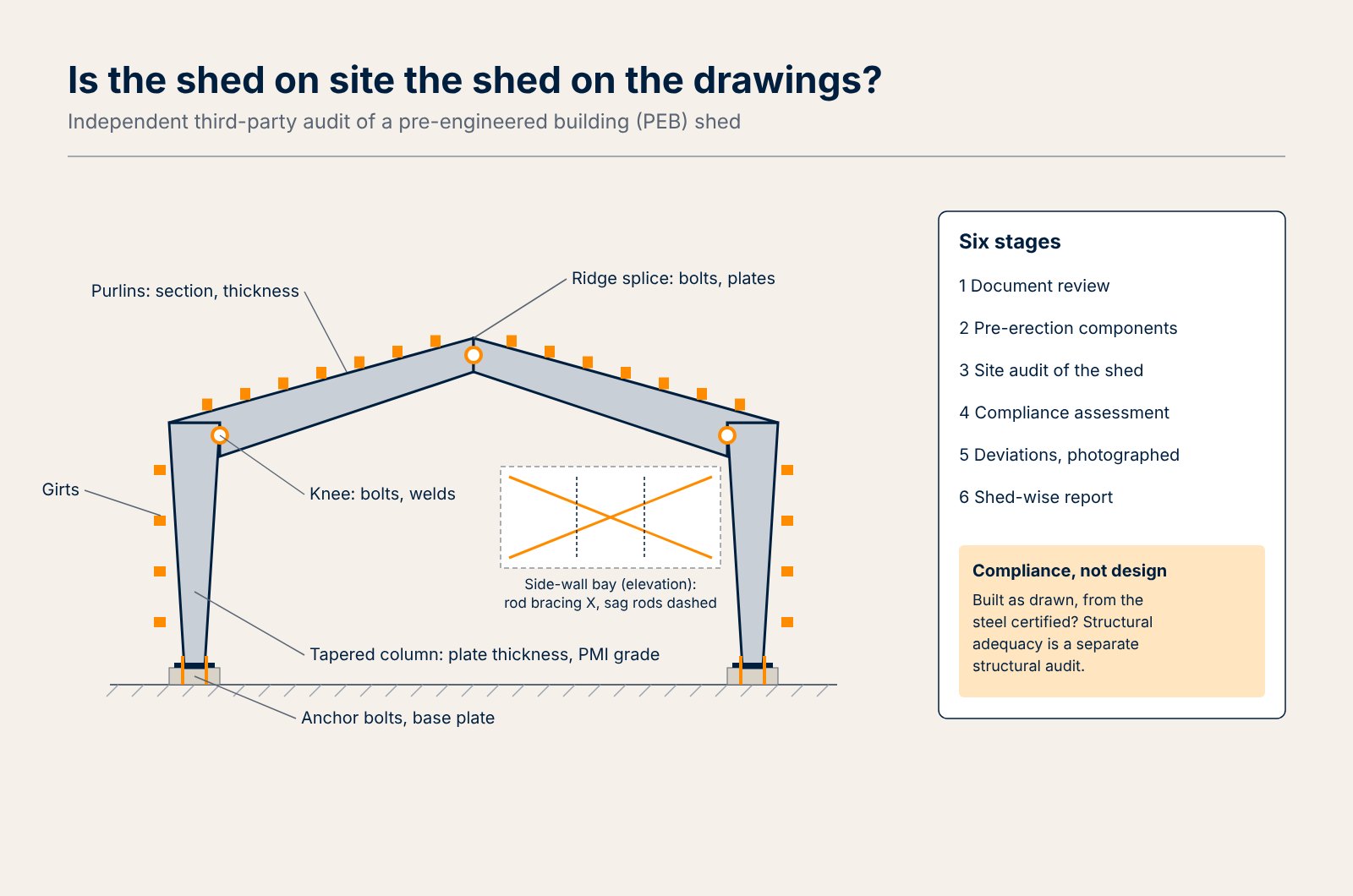
Third-party audit of PEB sheds in India: what an independent audit checks, and what it does not
TCR Engineering audits erected pre-engineered building sheds and their components against the approved drawings and mill certificates: section sizes,…
-
Remaining life of an ageing 220 kV transmission tower: the damage mechanisms that decide it and how they are found
An ageing 220 kV lattice tower is limited by zinc loss, stub corrosion, bolt and member damage and foundation distress. How each is found, judged and monitored.
-
TCR commissions a WDXRF spectrometer for building materials, and what ASTM C114 demands of an XRF result
A wavelength-dispersive XRF spectrometer is now on the bench at Mahape for 195 building materials and alloys. What ASTM C114 demands before an XRF…


Read all 42 Civil & Structural Testing insights →All insights →
Frequently asked questions
Which law requires a structural audit in Mumbai?
Section 353B of the Mumbai Municipal Corporation Act 1888. Outside Greater Mumbai the equivalent provision is Section 265A of the Maharashtra Municipal Corporations Act 1949, which covers Navi Mumbai, Thane, Pune, Pimpri-Chinchwad and the other corporations of the state.
How often is a structural audit required?
The statute says within one year of the building completing thirty years, and every ten years after that, or earlier if the Commissioner determines so on the condition of the building. A registered cooperative housing society carries a separate and more frequent obligation under bye-law 75(a) of the state model bye-laws: once in five years between fifteen and thirty years, and once in three years above thirty. Both run on the same building at the same time.
What applies to a factory rather than a housing society?
Rule 3A of the Maharashtra Factories Rules 1963. Every work of engineering construction needs a certificate of stability in Form 1-A from a competent person as defined in the Rule, once in each period of five years and after any extension, alteration, repair or addition, sent to the Chief Inspector of Factories.
Who signs the certificate?
A structural engineer registered with the receiving corporation. TCR runs the survey, the non-destructive testing, the laboratory analysis and the engineering assessment, and the Structural Stability Certificate is issued in association with empanelled structural engineers who hold that registration. The division of responsibility is stated on the face of every report.
What happens if the audit is not done, or the repairs are not carried out?
Where the corrective repairs identified are not carried out within six months, Section 471 of the Mumbai Municipal Corporation Act 1888 prescribes a fine of twenty-five thousand rupees or an amount equal to one year's property tax on the building, whichever is higher. The Commissioner may also carry out the repairs and recover the cost as an arrear of property tax.
How long does it take?
Three to five weeks per building, end to end, across six phases. The first phase, the society resolution and the access permissions, is paced by the client; the rest is not.
Is the testing accredited?
The seven reinforced-concrete site methods at items 70 to 76 of NABL certificate NABLT0726MH18640 are accredited, along with the core, chloride, sulphate, cement-content and reinforcement testing at Mahape. Cover-meter survey, Wenner four-probe resistivity and ground-penetrating radar or drone capture are not, and both this page and the report say so. A blanket "NABL accredited structural audit" claim would be wrong.
Can you tell us how long the building will last?
As an indicative range with its assumptions stated, by three independent routes: carbonation, chloride and observed condition trend. Not as a single number, and not as a guarantee. Residual service life is an engineering opinion under stated assumptions.