

Services · Civil and Infrastructure Testing
Bitumen Testing and Road Materials
Road-materials acceptance is governed by IS 73 for paving bitumen, IS 1203 for penetration and IS 1206 for viscosity, IRC SP 53 for modified binders, IRC 37 for flexible pavement design, and the MoRTH Specifications for Road and Bridge Works.
Request a Quote
In brief
TCR Engineering, Navi Mumbai, coordinates bitumen testing and bituminous-mix testing for road works in India through a qualified partner laboratory, keeping sampling oversight and the reporting: penetration, ductility, softening point, viscosity, Marshall stability and modified bitumen, aligned to IRC and MoRTH specifications. These tests are outside TCR Engineering's NABL certificate NABLT0726MH18640.
The scope also covers flash and fire point, aggregate gradation, and cold-mix and warm-mix asphalt qualification, aligned to Indian Roads Congress specifications for state and national highway works.
What Bitumen and Road-Materials Testing Covers
Bitumen and bituminous-mix testing is delivered through a qualified partner laboratory under TCR Engineering's coordination, sampling oversight, and reporting. The scope runs from binder consistency to full mix qualification, aligned to Indian Roads Congress and MoRTH specifications for state and national highway works.
- Binder: penetration, ductility, softening point, flash and fire point, and viscosity.
- Mix: Marshall stability and flow value.
- Aggregate: gradation.
- Modified binders: PMB and CRMB.
- Cold-mix and warm-mix asphalt: qualification.
- Delivery: through a qualified partner laboratory under TCR's coordination, sampling oversight and reporting.
What Does Each Bitumen Test Establish?
Each bitumen test answers one acceptance question about the binder or the mix, and IS 73 sets the grade requirements for paving bitumen. TCR reads the partner laboratory's results against the specification the project names, so the report states what each result means for acceptance of the binder, the mix and the road.
| Test | What it establishes |
|---|---|
| Penetration (IS 1203) | The consistency of the binder, read with viscosity to confirm its grade |
| Viscosity (IS 1206) | Resistance to flow, the property by which IS 73 grades paving bitumen |
| Softening point | The temperature at which the binder softens, its resistance to flow in hot weather |
| Ductility | How far the binder stretches before it breaks, a measure of flexibility and cohesion |
| Flash and fire point | The temperatures at which vapour from heated binder ignites, which sets the safe heating limit |
| Marshall stability and flow value | The load a compacted bituminous mix carries and its deformation at that load, for mix design and acceptance under the MoRTH Specifications |
| Modified binders (PMB and CRMB) | The performance of polymer and crumb-rubber modified bitumen against IRC SP 53 |
Governing Standards
The road-materials scope is governed by the designations below, with penetration tested to IS 1203 and viscosity to IS 1206.
| Test | What it measures | Standard |
|---|---|---|
| Penetration | Binder consistency and grade | IS 1203 |
| Viscosity | Binder flow resistance | IS 1206 |
| Paving bitumen | Binder specification and grade | IS 73 |
| Modified bitumen (PMB, CRMB) | Modified-binder performance | IRC SP 53 |
| Flexible pavement design | Pavement thickness design | IRC 37 |
| Bituminous mix acceptance | Road and bridge works specification | MoRTH Specifications for Road and Bridge Works |
Delivery and Oversight
Because the bituminous work runs through a qualified partner laboratory, TCR retains sampling oversight and issues the reporting, so the client keeps a single accountable point of contact for road-materials acceptance.
- What TCR retains: sampling oversight and the reporting, so the client keeps a single accountable point of contact.
- Specifications: Indian Roads Congress for state and national highway works, and the MoRTH Specifications for Road and Bridge Works.
- Complements: TCR's in-house pavement evaluation and concrete testing, within the same civil and infrastructure testing practice.
Related insights
2 published insights on this site bear directly on Bitumen and Road Materials. They are below; the full index carries all 42 Civil & Structural Testing insights.
-
TCR’s Role in Rebar Coupler Performance Testing
Redefining strength in every bridge, road, and building with advanced rebar testing.
-
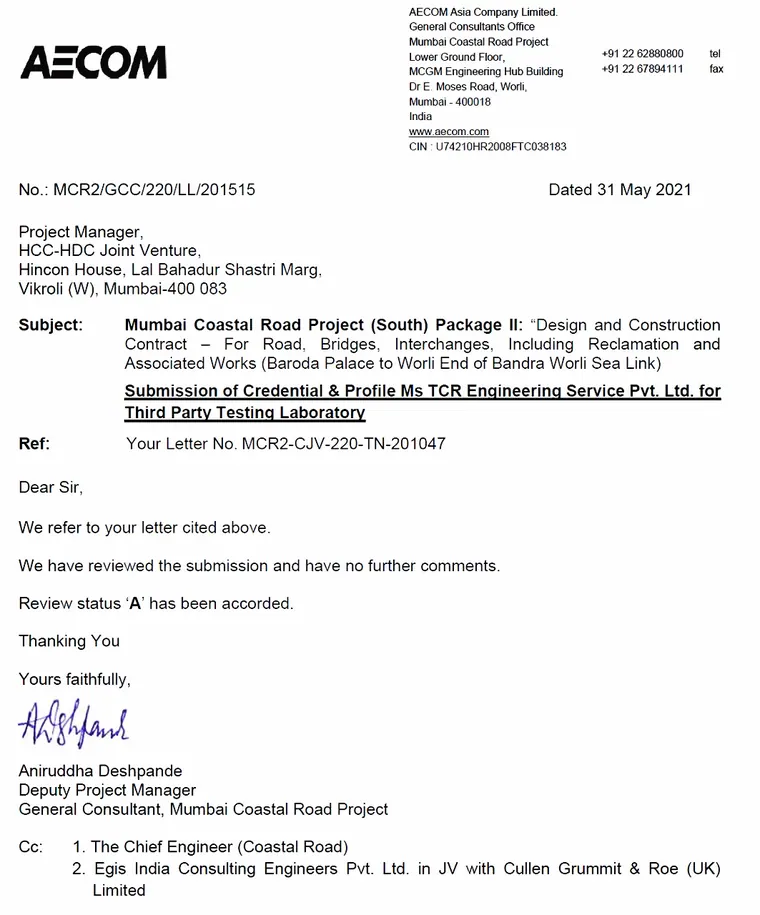
Mumbai Coastal Road
TCR Engineering a materials testing service provider for Mumbai Coastal Road Project

Read all 42 Civil & Structural Testing insights →All insights →
Frequently asked questions
What bitumen tests does TCR coordinate?
Penetration, ductility, softening point, flash and fire point, viscosity, Marshall stability and flow value, aggregate gradation, modified bitumen (PMB and CRMB), and cold-mix and warm-mix asphalt qualification.
Which standards govern penetration and viscosity?
Penetration is tested to IS 1203 and viscosity to IS 1206, with paving bitumen specified to IS 73.
How is the bituminous testing delivered?
Through a qualified partner laboratory under TCR Engineering's coordination, sampling oversight, and reporting.
Which road specifications does the scope follow?
IRC SP 53 for modified bitumen, IRC 37 for flexible pavement design, and the MoRTH Specifications for Road and Bridge Works.
Is bitumen testing within TCR's NABL scope?
No. Bitumen and bituminous-mix tests are not on TCR Engineering's NABL certificate NABLT0726MH18640. They are run at a qualified partner laboratory under TCR's coordination, with TCR keeping the sampling oversight and issuing the reporting, so the client deals with one accountable point of contact for road-materials acceptance.