
Services · Asset Integrity and Engineering Consulting
Fastener and Bolting Failure Analysis
A bolt almost never fails because it was too weak. It fails because it was too hard, too loose, or full of hydrogen.
Request a QuoteOverview
TCR Engineering Services Pvt. Ltd., a NABL ISO/IEC 17025:2017 accredited and NADCAP AC7101 accredited laboratory in Navi Mumbai, investigates failed bolts, studs, nuts, screws and other threaded fasteners. The work separates hydrogen embrittlement, stress corrosion cracking, fatigue, overload and heat-treatment defects, using fractography, hardness, microstructure and chemistry.
The Four Failures That Account for Most Broken Bolts
Threaded fasteners fail in a small number of characteristic ways, and the four below cover the large majority of cases that reach a laboratory. They are separated by the fracture mode and by hardness, not by the appearance of the broken bolt.
- Hydrogen embrittlement: delayed, brittle, intergranular fracture in a high-strength fastener, typically within hours or days of being tightened. The hydrogen comes from electroplating, pickling, phosphating, cathodic protection or a corroding service environment. Hardness above roughly 39 HRC is the threshold at which susceptibility becomes the governing risk.
- Stress corrosion cracking: branched, largely brittle cracking that needs a susceptible alloy, a sustained tensile stress and a specific environment together. In bolting it is most often found at the first engaged thread, which is where the tensile stress peaks.
- Fatigue: beach marks and a final fast-fracture zone, almost always starting at the thread root or the head-to-shank fillet. The usual root cause is under-tightening, because a joint that separates puts the cyclic load into the bolt instead of into the clamped members.
- Overload: ductile necking with dimpled rupture, or brittle cleavage in a material below its transition temperature. The question that follows is whether the load was outside design or the bolt was below grade.
Galling, thread stripping, decarburisation and improper heat treatment make up most of the remainder, and each is settled by a specific measurement rather than by inspection.
The Measurements That Decide It
Fastener investigations are unusually well served by standards, because the acceptance criteria for hardness, microstructure and mechanical properties are published for every common grade.
| Measurement | Method | What it settles |
|---|---|---|
| Hardness, surface and core | ASTM F606/F606M, ISO 898-1, ASTM E18 and E384 | Whether the fastener met its grade, and whether it sat above the hydrogen-embrittlement susceptibility threshold |
| Microstructure and decarburisation | ASTM E1077 for decarburisation depth, ASTM E3 and E407 for preparation and etching | Whether the heat treatment produced the tempered martensite the grade requires, and whether the surface lost carbon |
| Fractography | SEM with EDS on the fracture surface | Intergranular against transgranular, dimples against cleavage, and the composition of anything at the origin |
| Chemical analysis | ASTM E415 and ASTM E1019 | Grade conformance, including the boron and the alloying that the hardenability of the section depends on |
| Mechanical properties | ASTM F606/F606M and ASTM A370, wedge tensile and proof load | Whether the fastener would have met its grade before it was installed |
| Hydrogen embrittlement susceptibility | ASTM F519 notched-specimen sustained load, ASTM F1940 process control | Whether a plating or coating process introduces hydrogen, which is a process qualification rather than a post-mortem |
| Coating and plating | Thickness, adhesion, and salt spray to ASTM B117 where called for | Whether the corrosion protection specified was actually applied |
Chemical analysis, mechanical testing, metallography and hardness are performed under NABL certificate NABLT0726MH18640. For aerospace fasteners the same bench is NADCAP AC7101 accredited, PRI certificate 29415245997, under scope codes AC7101/3 mechanical, AC7101/4 metallography and AC7101/5 hardness and conductivity.
Hydrogen Embrittlement, and Why It Is a Process Question
Hydrogen embrittlement is the failure that most often ends in a commercial dispute, because the fastener met every specification on the certificate and broke anyway. The hydrogen was introduced after the material was made, and usually by a process step someone else owned.
- Internal hydrogen embrittlement comes from manufacturing: acid pickling, electroplating, phosphating or an electrochemical cleaning step. It is controlled by baking within a defined window after plating, and the failure often traces to a bake that was late, short or omitted.
- Environmental hydrogen embrittlement comes from service: cathodic protection, a corroding surface, or a sour environment generating hydrogen at the metal surface. It has no manufacturing fix and is a material selection and hardness question.
- The evidence: intergranular fracture at the first engaged thread or the head fillet, delayed failure under a sustained static load, no corrosion product at the origin, and hardness at the top of or above the grade range.
- The prevention: ASTM F519 qualifies whether a plating process embrittles, and ASTM F1940 controls it in production. Both are process tests, and both are run before the fastener is installed, not after it breaks.
Where a batch failure is suspected, the investigation extends to the unfailed fasteners from the same lot. That is what separates a single defective item from a consignment that has to be recalled.
Where Bolting Failures Are Decided
The consequence of a fastener failure is out of all proportion to the cost of the part, which is why the investigation is usually urgent and usually contested.
- Flanged joints in process plant: a stud failure is a containment failure, and the investigation runs alongside the leak and the incident report.
- Structural and infrastructure connections: high-strength friction-grip bolting, where hardness, coating and installed tension are the three things that get checked.
- Rotating and reciprocating machinery: connecting rod, coupling and foundation bolting, where fatigue from an under-tightened joint is the usual mechanism.
- Aerospace and defence fasteners: run on the NADCAP AC7101 accredited bench, against the standing 21-item aerospace test menu.
- Wind, marine and offshore bolting: where the environment and the cathodic protection system are part of the mechanism, not part of the background.
Where the failure raises a question about the joint rather than the bolt, the work continues as a root cause failure analysis of the assembly, and where it raises a question about a population, as a knowledge-based risk assessment.
Related services and industries
Related insights
6 published insights on this site bear directly on Fastener Failure Analysis. They are below; the full index carries all 92 Asset Integrity insights.
-
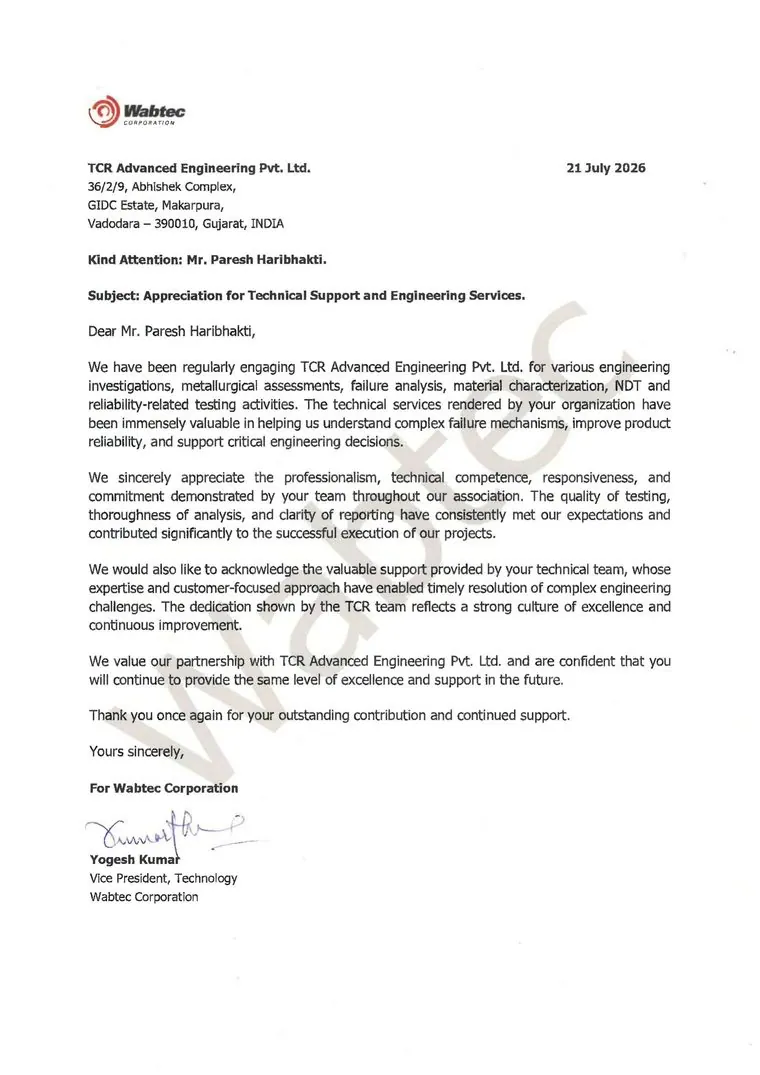
Wabtec Corporation Writes to TCR Advanced: Failure Analysis, Material Characterisation and Reliability Testing
Wabtec Corporation has written to TCR Advanced Engineering to record its appreciation for engineering investigations, metallurgical assessments,…
-
Boiler Tube Failure Analysis
Boiler tube failure analysis reveals the metallurgical evidence behind costly power plant outages and provides proven solutions to prevent recurrence.
-
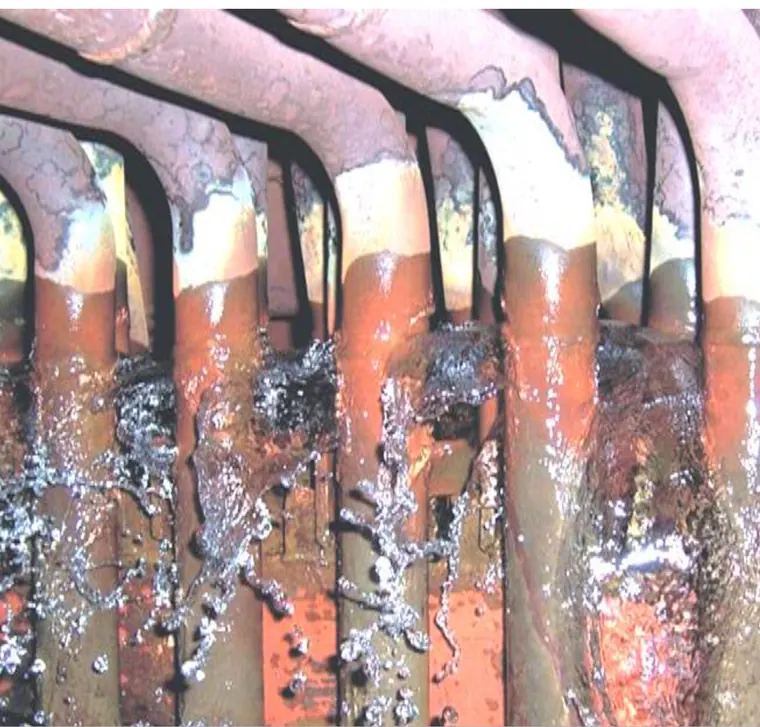
Boiler Tube Failure Analysis: A Complete Investigation Guide for Power Plants
A complete guide to boiler tube failure investigation: the waterside, fireside, temperature and mechanical damage mechanisms, and how each is proved.
-
Why Failure Analysis Metallurgical Laboratory India Services Prevent Million-Dollar Disasters
Failure analysis metallurgical laboratory India prevents million-dollar disasters. TCR Engineering's 50+ years expertise identifies root causes.
-
Hindalco Commends TCR for Failure Analysis Expertise
TCR Advanced delivers expert metallurgical analysis for Hindalco cranes, ensuring safety, efficiency, and reliability in critical operation
-
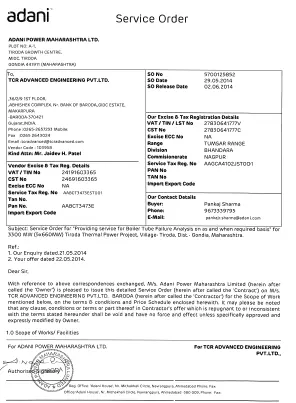
Failure Analysis project from Adani Power Plant
Boiler tube failure at the 5x660 MW Tiroda Thermal Power Plant in Gondia


Frequently asked questions
What is the most common cause of a broken bolt?
Fatigue from under-tightening, and hydrogen embrittlement in high-strength fasteners. A joint that has lost preload puts the cyclic load into the bolt rather than into the clamped members, and a fastener above roughly 39 HRC is susceptible to hydrogen introduced by plating, pickling or the service environment. The fracture mode separates the two.
How do you prove hydrogen embrittlement after the event?
By the fracture mode and the circumstances together: intergranular fracture at the first engaged thread or the head fillet, delayed failure under a sustained static load, no corrosion product at the origin, and hardness at or above the top of the grade range. Hydrogen itself has usually left the part by the time it is examined, which is why the evidence is fractographic rather than analytical.
Can you test whether a plating process embrittles fasteners?
Yes. ASTM F519 qualifies a plating or coating process using notched specimens under sustained load, and ASTM F1940 is the production process control test. Both are run before fasteners are installed. They are the answer to a recurring problem, where a post-mortem is only the answer to one failure.
Do you test fasteners against ISO 898-1 as well as the ASTM standards?
Yes. Property classes to ISO 898-1 and grades to ASTM F3125 (which now carries grades A325 and A490) and the SAE series are all read against their own acceptance criteria, using the test methods of ASTM F606/F606M and ASTM A370.
Is the aerospace fastener work accredited?
The test methods are. TCR Engineering holds NADCAP AC7101 Materials Testing accreditation, PRI certificate 29415245997, under scope codes AC7101/3 mechanical, AC7101/4 metallography and AC7101/5 hardness and conductivity, alongside NABL certificate NABLT0726MH18640.
How many fasteners should be sent from a suspect batch?
Send the failed items and unfailed items from the same lot. A single fractured bolt establishes the mechanism; the unfailed items from the same lot establish whether the batch shares the condition, and that is the difference between replacing one part and recalling a consignment.