
Services · Materials Testing
HIC and SSC Testing per NACE TM0284 and TM0177, for Saudi Aramco, ADNOC and PDO Specifications
NACE TM0177 runs across all four of its methods, A to D, TM0284 hydrogen-induced cracking is reported as crack length, thickness and sensitivity ratios on sectioned specimens, and a hydrogen-induced disbonding facility per ASTM G146 was commissioned in April 2026.
Request a Quote
In brief
TCR Engineering runs HIC testing to NACE TM0284 and SSC testing to NACE TM0177 and TM0316 at its NABL ISO/IEC 17025:2017 materials testing laboratory (NABLT0726MH18640) in Navi Mumbai, India, judging steels, alloys and polymers against NACE MR0175/ISO 15156 and Saudi Aramco, ADNOC, PDO and OQGN acceptance criteria. Hydrogen induced disbonding to ASTM G146 is reported outside the accredited scope.
- Approvals: approved by PDO for HIC and SSC testing, and approved by OQGN.
- Recognition: the NACE International award, Excellent Laboratory in the Private Sector.
- Controls: HIC reference and control specimens made and held in-house.
- Equipment: autoclaves designed and built in-house for sour, hydrogen and non-standard environments.
- Exposure: the full standard duration every time, 96 hours for HIC and 720 hours for SSC, never an accelerated proxy.
What is the difference between HIC and SSC testing?
Hydrogen-induced cracking (HIC) testing to NACE TM0284 exposes unstressed steel to H2S and reports crack length, thickness and sensitivity ratios. Sulphide stress cracking (SSC) testing to NACE TM0177 or TM0316 holds the steel under tensile stress in H2S and reports whether it cracks. TCR Engineering runs both in Navi Mumbai; the table sets out every sour service method.
| Test and standard | How it is run, and what the report gives |
|---|---|
| Sulphide stress cracking (SSC), tensile NACE TM0177 Method A |
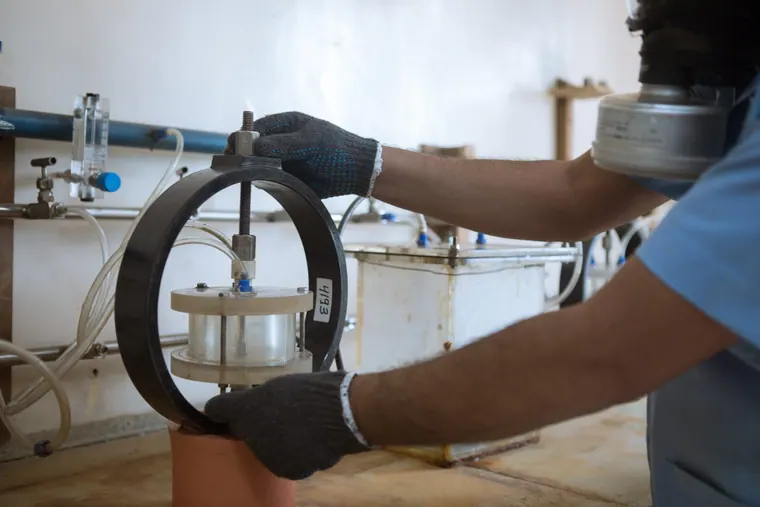
Constant load on proof rings in H2S-saturated solution, 720 hours. Report: failure or no failure at each applied stress. |
| SSC, bent beam NACE TM0177 Method B |
Three-point bent-beam specimens, 720 hours. Report: cracking or no cracking. |
| SSC, C-ring NACE TM0177 Method C |
C-ring specimens cut from tubulars. Report: cracking or no cracking. |
| SSC, double cantilever beam NACE TM0177 Method D |
Wedge-loaded DCB specimens. Report: a fracture-mechanics resistance to SSC, KISSC. |
| SSC at temperature and pressure NACE TM0177 |
In autoclaves at 90 °C and 16 bar, or 120 °C and 20 bar. Report: as for the method run. |
| Four-point bend SSC NACE TM0316; ASTM G39 |
Tension face in the test solution, stress set by strain gauges, 720 hours. Report: cracking on the tension face. |
| Slow strain rate SSC screening NACE TM0198 |
Corrosion-resistant alloys pulled to failure at a slow strain rate in a sour environment. Report: time-to-failure, elongation and reduction-of-area ratios against an inert environment. |
| Hydrogen-induced cracking (HIC) NACE TM0284 |
Unstressed specimens in Solution A or B, 96 hours. Report: crack length, thickness and sensitivity ratios (CLR, CTR, CSR) per section. |
| Stepwise cracking and stress-oriented HIC (SOHIC) NACE TM0103; NACE TM0284 with NACE TM0177 Method A |
Extended HIC exposure under applied stress, for sour-service line pipe. Report: stress-oriented crack arrays and stepwise linkage. |
| Hydrogen induced disbonding ASTM G146 |
Clad and overlay-welded specimens in hydrogen at temperature and pressure, then cooled, for clad pressure vessels and overlays in refining and petrochemical sour service; facility commissioned April 2026. Report: disbonding of the cladding, found by ultrasonic testing; specimen drawing and sample sizes. |
| CTOD after H2S pre-charging ISO 15653; ISO 12135; BS 8571 |
96 hours in NACE TM0177 Solution A, loaded within 20 minutes of removal; developed for Larsen and Toubro. Report: the weld toughness with hydrogen inside it; see CTOD testing. |
| Hydrogen embrittlement of fasteners, bolting and cylinder steel ASTM F519; ASTM F1624; API 20E; ISO 11114-4:2017 |
Sustained-load and incremental step-load tests on plated, coated and sour-service bolting, and ISO 11114-4 tests on seamless steel for Type I hydrogen cylinders. Report: pass or fail at the specified load; see hydrogen embrittlement testing. |
| Non-metallics in sour service NORSOK M-710 Rev. 3 |
Sealing, sealing-related and load-bearing polymers such as Zytel, ULTEM and Ryton, aged in sour fluid. Report: retention of properties after ageing. |
The governing frameworks are NACE MR0175/ISO 15156 for oil and gas production, NACE MR0103 for refining and EFC 16 for carbon and low alloy steels. Hydrogen induced disbonding, hydrogen embrittlement and CTOD each have their own page; SSC and HIC are set out in full below.
Operator Specifications: Saudi Aramco, ADNOC, PDO and OQGN
A NACE method says how to run a sour service test; the operator's specification says what passes. TCR runs HIC, SSC and SOHIC to the operator's own amendments, Saudi Aramco 01-SAMSS-016, ADNOC AGES-SP-07-003, PDO SP-2161 and SP-2347, and OQGN G14-PD-PL, and confirms the edition the purchase order names before a specimen is cut.
| Requirement | By operator specification |
|---|---|
| Scope of the document |
|
| HIC acceptance, average per specimen |
|
| Further HIC limits |
|
| Control sample |
|
| HIC retest |
|
| Test solution and gas |
|
| SSC method |
|
| SSC acceptance |
|
| Hardness |
|
| Inclusion rating, ASTM E45 |
|
ASTM E45 inclusion rating, Methods A and D, sits inside NABL certificate NABLT0726MH18640 with NACE TM0284, TM0177 and TM0316, ASTM G39 and EFC 16, so the inclusion rating an operator asks for and the cracking test it protects come from one accredited laboratory. The inclusion method itself is on metallurgical evaluation.
Saudi Aramco accepts HIC results only from laboratories its own departments approve, and PDO from laboratories on its approved list or ISO/IEC 17025 laboratories its materials engineer accepts. TCR is approved by PDO for HIC and SSC testing; for Saudi Aramco and ADNOC orders, the approval route is confirmed with the buyer at enquiry.
How an Operator-Specification Programme Runs
The test is the easy part. Most rejected sour qualifications fail on paper: a control sample missing from the batch, a specimen that cannot be traced to its plate, or a report that leaves out a line the specification demands. TCR runs every operator programme in the order below.
- Read the order. The operator's specification and its revision, the product form, the heat-treatment condition and any test parameters the order changes; where two parameters in the order cannot both be true, the question goes back before testing starts (case study).
- Trace the specimens. Location, orientation and rolling direction on the plate or pipe recorded, specimens hard-stamped, and thinnest and thickest plate from a heat tested where the specification asks for both.
- Include the control. An HIC control sample with demonstrated susceptibility, average CLR above 20 per cent, in every batch the specification requires it for. TCR makes and holds its own control specimens.
- Verify the environment. Solution pH at the start and end, H2S purity, and H2S concentration by iodometric titration at saturation and at the end of the exposure.
- Expose for the full period. 96 hours for HIC; 720 hours for SSC and four-point bend, with stress set by strain gauges where the specification asks for them.
- Section, measure and report to the specification. CLR, CTR and CSR per section and per specimen, photographs, hardness and the data list the operator's own reporting clause sets, against the operator's acceptance criteria rather than the bare NACE method.
Sulphide Stress Cracking per NACE TM0177
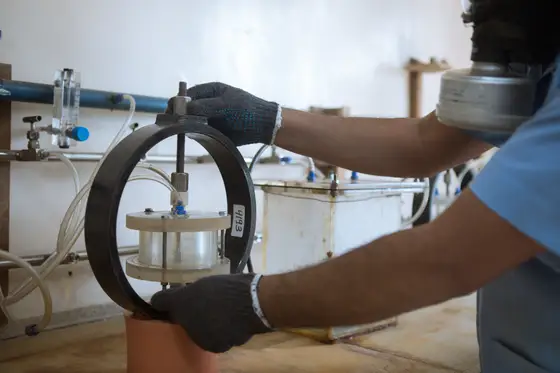
Sulphide stress cracking is hydrogen embrittlement cracking that starts when a susceptible steel carries tensile stress, applied or residual, in water containing H2S. TCR runs NACE TM0177-2024 by all four of its methods, with Methods A and B in routine use, and confirms the completion date for each programme in the quotation.
- Solutions: A (acidified), B (acidified and buffered) and C (for martensitic stainless steel). Solution A is used unless the order specifies B or C, and H2S is bubbled through the solution for the whole exposure.
- Temperature: 24 °C and 90 °C, with autoclave exposures at 90 °C and 16 bar and at 120 °C and 20 bar.
- Duration: 720 hours (30 days) of exposure for Methods A and B, with specimen preparation before it and crack examination and reporting after it; the completion date is confirmed in the quotation.
- Report: a description of the sample, the procedure, the solution pH before and after exposure and the result of each specimen, for a single test or a cluster.
| Product | Sample |
|---|---|
| Plate | 16 mm thick × 160 mm long |
| Pipe | A 160 mm long piece of any diameter, cut to a 16 mm wide strip |
| Bar | A 160 mm long piece of any diameter |
Hydrogen-Induced Cracking per NACE TM0284
Hydrogen-induced cracking needs no applied stress: hydrogen from sulphide corrosion collects at inclusions and splits the steel parallel to its surface. NACE TM0284 exposes unstressed specimens of pipeline and pressure vessel plate steels for 96 hours at ambient temperature and pressure, after which every specimen is sectioned and each crack measured under the microscope.
- Solutions: Solution A, acidified brine, or Solution B, synthetic seawater to ASTM D1141, with H2S bubbled through for the whole exposure.
- Measurement: crack length ratio (CLR), crack thickness ratio (CTR) and crack sensitivity ratio (CSR), in per cent, per section and per specimen.
- Report: a description of the sample, the procedure, the solution pH before and after exposure, the three ratios and photographs of the cracked sections.
- Pieces tested: a set of 3 up to 88 mm thick or in diameter, and 5 above 88 mm.
- Acceptance: NACE TM0284 reports the ratios and sets no pass mark; the limits come from the purchase order and the operator specification in the table above.
| Product | Sample |
|---|---|
| Plate | 150 mm × 150 mm with the rolling direction marked; 250 mm × 250 mm above 80 mm thick |
| Pipe | 200 mm long up to 2 in OD; 100 mm long above 2 in OD |
| Bar | 300 mm long up to 3 in diameter; 200 mm long above 3 in to 5 in; 100 mm long above 5 in |
Approvals and Programmes Delivered
Sour service qualification at TCR is run to the purchase specification, and the laboratory holds the approvals that let the result stand: PDO approval for HIC and SSC testing, OQGN approval, a place on the PDO AVME MCI-121 approved laboratory list, and a multi-year JSRS certificate for the Oman market.
- PDO specifications: SP-2347 (carbon steel line pipe), SP-2337 (materials selection for production systems) and SP-2161 (materials selection and corrosion control for surface facilities).
- OQGN: G14-PD-PL Version 1 (May 2024), with line pipe for the 42-inch Fahud-Sohar Second Loop Line and the Marsa LNG gas supply pipeline.
- Mills served: Jindal Saw, Man Industries and Tsingshan Steel Pipe, with qualification samples sent in by Chinese, Korean and European mills.
- Operators: sour-service projects for Shell.
- Research: a crevice corrosion and electrochemical study for ITER-India at the Institute for Plasma Research, on autoclaves and reference specimens TCR designed and built for it; ITER France cross-checked the report.
- Further reading: HIC and SSC qualification of sour-service line pipe for a PDO project, and one NACE method, four pass marks across Saudi Aramco, ADNOC, QatarEnergy and PDO.
Corrosion Testing Beyond Sour Service
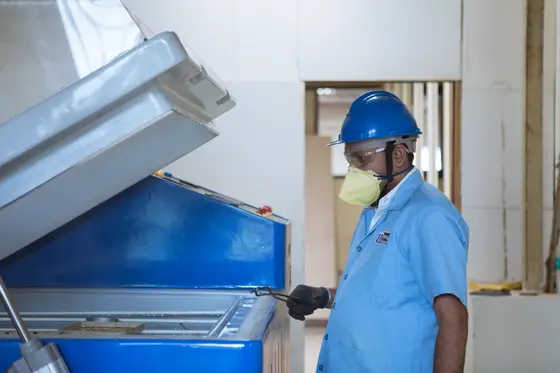
The same laboratory runs the corrosion tests that stainless steels, aluminium alloys, coatings and implants are bought against: intergranular attack, pitting and crevice resistance, chloride and polythionic acid stress corrosion, electrochemical polarisation and salt spray. The method is chosen to suit the grade and the phase the specification is screening for.
| Material or mechanism | Standards |
|---|---|
| Intergranular attack, austenitic stainless steel | ASTM A262 Practices A, B, C, E and F; ISO 3651-1 (Huey) |
| Intergranular attack, ferritic stainless steel | ASTM A763 Methods W, X, Y and Z |
| Intergranular attack, ferritic, austenitic and duplex stainless steel | ISO 3651-2 Methods A, B and C |
| Intergranular attack, nickel-rich chromium-bearing alloys | ASTM G28 |
| Pitting and crevice corrosion | ASTM G48 Methods A to F: ferric chloride pitting and crevice tests, and critical pitting and crevice temperatures; pit evaluation per ASTM G46 |
| Intermetallic phases in duplex stainless steel | ASTM A923 Methods A, B and C |
| Chloride stress corrosion cracking | Boiling magnesium chloride per ASTM G36, and boiling calcium chloride, both to ONGC and EIL specifications; ASTM G123 |
| Polythionic acid stress corrosion cracking | ASTM G35 |
| Electrochemical | ASTM G5 and G61 polarisation; corrosion rate from Tafel slopes per ASTM G102; electrochemical impedance spectroscopy for polarisation resistance, double-layer capacitance and corrosion rate |
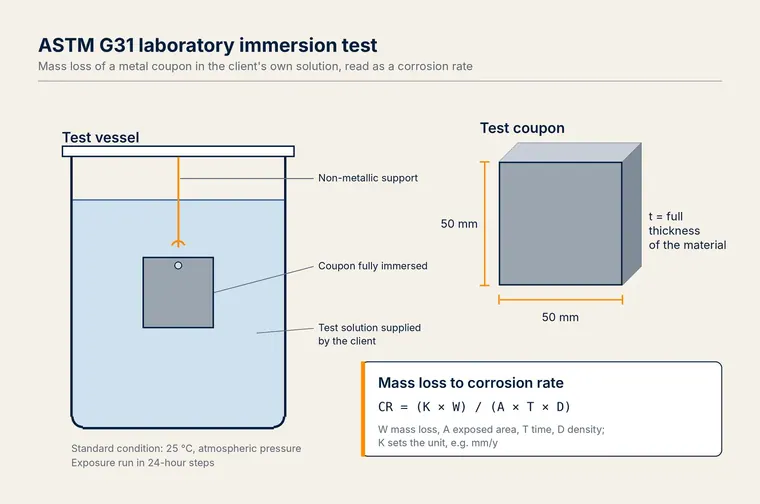
| Immersion and weight loss | ASTM G31, with specimens prepared, cleaned and evaluated per ASTM G1 |
| Aluminium alloys, 2xxx and 7xxx aerospace series | Stress corrosion by alternate immersion per ASTM G44, G47 and G103; exfoliation per ASTM G66 (ASSET) and G34 (EXCO); intergranular attack per ASTM G67 (NAMLT) and G110 |
| Copper alloys | ASTM B858 ammonia vapour stress corrosion; ASTM B577 cuprous oxide (hydrogen embrittlement susceptibility) in copper |
| Cobalt-chromium implants | ASTM F2129 cyclic potentiodynamic polarisation |
| Salt spray | ASTM B117; ISO 9227 neutral (NSS), acetic acid (AASS) and copper-accelerated acetic acid (CASS); ASTM G85 |
| Cathodic disbonding of coatings | ASTM G8 and G42 |
The ASTM A262 practices
ASTM A262 has five practices because intergranular attack has more than one cause: chromium carbides, nitrides or intermetallic phases at the grain boundaries. Only the most strongly oxidising solutions reveal intermetallic phases, so where a test is meant to find carbides alone, a less oxidising solution is chosen.
| Practice | Solution and exposure, and the result |
|---|---|
| A, oxalic acid etch | Electrolytic etch in oxalic acid. Result: a rapid screen of the etched structure, used to accept material and never to reject it. |
| B, Streicher | 24 to 120 hours boiling in ferric sulphate and 50 % sulphuric acid. Result: weight loss, a quantitative measure of attack from chromium carbide precipitation in stainless steels and nickel alloys. |
| C, Huey | Five boiling periods of 48 hours each in 65 % nitric acid. Result: corrosion rate per period, against the maximum the customer specifies; finds chromium-depleted zones and intermetallics such as sigma phase, and checks the heat treatment. |
| E, Strauss | Boiling copper, copper sulphate and 16 % sulphuric acid, then a 180° bend over a diameter equal to the specimen thickness. Result: visual examination of the bend for intergranular fissures. |
| F | Boiling copper, copper sulphate and 50 % sulphuric acid. Result: weight loss on as-received material. |
For Practice C the order states the maximum permissible corrosion rate and, where it applies, the sensitising heat treatment.
The senior technical team works on corrosion problems from oil and gas production and transmission, energy conversion and nuclear power systems, and the range covers weight loss, intergranular, pitting, corrosion fatigue, stress corrosion, sulphide stress and hydrogen-induced cracking. Tests listed under third-party inspection witness, including classification societies, are run at TCR or at the witnessing party's own laboratory where the contract requires it.
Related services and industries
- Materials Testing Laboratory
- Coating Evaluation and Inspection
- Fatigue and Fracture Toughness Testing
- CTOD Testing
- Hydrogen Induced Disbonding Testing
- Hydrogen Embrittlement Testing
- Composite, Plastic, Rubber, and FRP/GRP Testing
- Oil and Gas Upstream
- Pipelines and City Gas Distribution
- Refining and Petrochemicals
- Aerospace
- Automotive
Related insights
9 published insights on this site bear directly on Corrosion and Sour Service. The 6 most recent are below; the full index carries all 166 Materials Testing insights.
-
ASTM G31 immersion corrosion testing at Mahape: how a metal behaves in your own liquid
TCR Engineering's Mahape laboratory runs ASTM G31 laboratory immersion tests: a coupon of the client's metal, in the client's own solution, weighed…
-
One NACE method, four pass marks: sour service testing to Saudi Aramco, ADNOC, QatarEnergy and PDO specifications
A plate with an average crack length ratio of 12 per cent passes API 5L and PDO and fails Saudi Aramco. The NACE method is the same in all three; the…
-
Case Study: HIC and SSC Qualification of Sour-Service Line Pipe for a PDO Project
Yangzhou Chengde Steel Pipe ordered HIC and SSC testing for a Petroleum Development Oman project. The order named two conditions that cannot both be…
-
NORSOK M-710 Sour Gas Corrosion Testing for Composites and Polymers
NORSOK M-710 corrosion testing for composites and polymers: how the standard works, what labs must provide, and where most programmes go wrong.
-
CTOD Testing with H2S Hydrogen Pre-Charging: What Sour Service Projects Actually Require
TCR Engineering runs CTOD fracture toughness testing with H2S hydrogen pre-charging to ISO 15653, ISO 12135, and NACE TM0177, for sour service weld…
-
NACE Corrosion Testing Laboratory NABL Certified - Why Your Pipeline's Life Depends on Getting This Right
NACE corrosion testing laboratory NABL certified - TCR Engineering provides HIC, SSC & SCC testing for oil & gas since 1973.


Frequently asked questions
How long does a NACE TM0177 SSC test take?
NACE TM0177 specifies a 30 day (720 hour) exposure for Method A tensile and Method B bent-beam tests, with H2S bubbled through the solution throughout. Specimen preparation comes before the exposure and crack examination and reporting follow it, and TCR confirms the completion date for each programme in the quotation.
What does NACE TM0284 HIC testing report?
An unstressed specimen is exposed for 96 hours to Solution A (acidified brine) or Solution B (simulated seawater) saturated with H2S. Sections are then examined under the microscope and any cracks measured to compute Crack Length Ratio, Crack Thickness Ratio and Crack Sensitivity Ratio, reported with solution pH before and after exposure.
Which client specifications can TCR qualify against?
Project qualification runs to client procurement specifications including Petroleum Development Oman SP-2347, SP-2337 and SP-2161, and OQGN G14-PD-PL Version 1 (May 2024). The laboratory is PDO and OQGN approved, holds the NACE Excellent Laboratory in the Private Sector award, and has executed sour-service projects for Shell.
What sample sizes are needed for SSC and HIC testing?
For SSC, each stress level and temperature needs plate 16 mm thick by 160 mm long, pipe strips 16 mm wide by 160 mm long, or bar 160 mm long. For HIC, plate requires 150 by 150 mm with rolling direction marked, with three pieces tested up to 88 mm thickness and five above.
Can TCR run non-standard or research corrosion programmes?
Yes. TCR designs and builds its own autoclaves and reference specimens for non-standard studies, including the ITER-India fusion-reactor corrosion programme, and manufactures its own HIC reference and control specimens. CTOD testing with hydrogen-sulphide pre-charging loads specimens within a 20 minute window per ISO 15653, ISO 12135 and BS 8571.
Can TCR test plate to Saudi Aramco 01-SAMSS-016?
Yes. TCR runs HIC to NACE TM0284 Solution A as amended by 01-SAMSS-016: a control sample above 20 per cent CLR in every batch, H2S measured by iodometric titration at 1 and 96 hours, and acceptance at CLR 10 per cent and CTR 3 per cent per specimen. The approval route for the order is confirmed with the buyer at enquiry.
Does TCR run the ADNOC AGES-SP-07-003 SSC and inclusion tests?
Yes. Four-point bend SSC to NACE TM0316 per Appendix A2, three specimens transverse to the weld, NACE TM0177 Solution A at pH 3.5 and 1 bar H2S for 720 hours, with ASTM E45 inclusion rating. ASTM E45, TM0177 and TM0316 are on NABL certificate NABLT0726MH18640.
What HIC acceptance criteria does PDO apply?
PDO SP-2161 sets average per-specimen limits of CLR 15 per cent, CTR 5 per cent and CSR 2 per cent, a 5 mm maximum single crack parallel to the rolling direction, failure on any vertical crack over 0.5 mm, a control sample of at least 20 per cent CLR, and no retest.
Is HIC testing to NACE TM0284 on TCR's NABL scope?
Yes. NACE TM0284 HIC testing, NACE TM0177 and TM0316 SSC testing, ASTM G39 and the ASTM E45 inclusion rating sit inside NABL certificate NABLT0726MH18640 at TCR Engineering's Mahape laboratory in Navi Mumbai. Hydrogen induced disbonding to ASTM G146 is reported outside the accredited scope, and the report states which basis applies.
Does TCR run ASTM G48 pitting and crevice corrosion tests?
Yes. TCR Engineering runs ASTM G48 Methods A to F at its Navi Mumbai laboratory: ferric chloride pitting and crevice tests and critical pitting and crevice temperatures for stainless steels and nickel alloys, with pits evaluated per ASTM G46. ASTM A262, ASTM A923 and ASTM G28 intergranular and intermetallic tests run in the same laboratory.