
Industries
Marine and Offshore
ROV Underwater Inspection and Subsea Integrity
Sub-water pier and abutment inspection on the Mumbai Coastal Road, a 400-plus-bridge robotic underwater programme for BMC, and ONGC export trunkline work running since 1998, read by ROV with SONAR silt assessment.
Request a QuoteIn brief
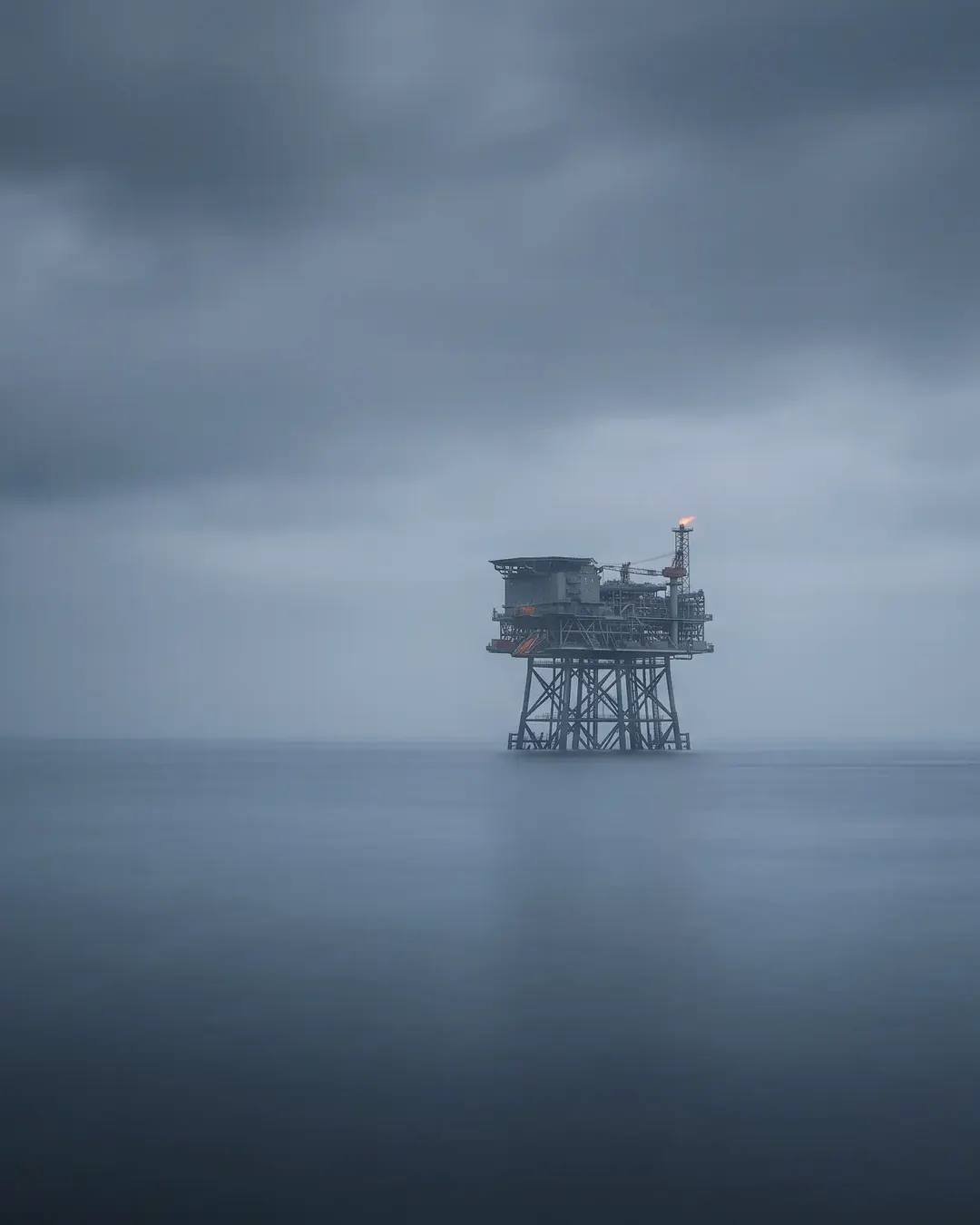
From jacket platforms and mooring chains to FPSO hulls, ship structures and sub-water bridge piers, TCR carries the integrity scope from splash zone to seabed for India’s offshore operators, shipyards and ports, with materials testing, weld qualification, NDT and underwater ROV inspection.
Key takeaways
- 8 asset groups, from offshore production topsides to sub-water bridges, and 7 families of damage mechanism are covered below.
- Offshore structures are reported against API RP 2A-WSD (22nd ed.), ISO 19902 and DNV-OS-C101; the full standards matrix is below.
- Marquee work includes NDT, source inspection and structural integrity on the ONGC offshore export trunkline since 1998, and ROV inspection of more than 400 bridges under the BMC underwater programme from March 2026.
Overview
India’s defence and merchant shipyards, Mazagon Dock, Cochin Shipyard, Garden Reach, Goa Shipyard and Hindustan Shipyard, and the ports of Adani, JNPT, Mumbai, Visakhapatnam and Kandla draw on TCR for materials, weld qualification and structural inspection.
- Failures investigated: jacket and topside structures, risers, mooring chains, subsea pipelines, FPSO hulls and ship structures.
- Mechanisms: splash-zone and seawater corrosion, corrosion fatigue, pitting and crevice attack, cavitation, and weld and HAZ cracking.
- Submerged assets: underwater robotic and ROV inspection.
Industry Context
Marine and offshore assets live on survey cycles. Classification societies mandate special surveys on five-year cycles, offshore structures face underwater inspection in lieu of dry-docking, and every extension of a vessel or platform beyond design life must be argued with measured data, not opinion.
- Offshore upstream operators: ONGC at Bombay High, Reliance at KG-D6, Cairn at Ravva and Bombay Western, and Vedanta, carrying offshore platform structural integrity work.
- Shipyards: Cochin Shipyard, Mazagon Dock Shipbuilders, Garden Reach Shipbuilders and Engineers, Goa Shipyard and Hindustan Shipyard, carrying naval and merchant vessel materials testing and welding qualification.
- Ports and marine terminals: Mumbai Port Trust, Adani Ports, JNPT, Visakhapatnam, Chennai, Kandla and Mundra, carrying jetty pile, mooring dolphin and breakwater inspection.
- LNG re-gas terminals: Petronet Dahej, Adani-Total Dhamra and Hazira, bringing low-temperature material testing, with fracture toughness down to -65 °C.
- Coastal infrastructure: CIDCO and the Mumbai Coastal Road Project, bringing sub-water bridge-pier inspection and structural testing.
As fleets and offshore infrastructure in Indian and Gulf waters age, that evidence burden grows. TCR serves it with hull and weld NDT, corrosion evaluation to marine coating standards, underwater robotic inspection through the Planys alliance, and the TCR Arabia robotic field record on submerged and difficult-access structures, backed by a laboratory that can qualify steel, welds, and coatings to DNV, API, and class requirements.
TCR works as the laboratory and structural-integrity partner for jacket structures, jetty piles, mooring dolphins, refrigerated tanks and offshore export pipework; it is not a rotating-equipment field service contractor.
Plant Sections We Inspect
| Cluster | Equipment |
|---|---|
| Offshore Production Topsides | Process train (see Oil and Gas Upstream), riser and J-tube, separator skid, gas dehydration, produced-water treatment |
| Offshore Jacket Structure | Jacket leg, brace, conductor guide, riser clamp, anode bracket, mudmat, pile sleeve |
| Subsea Pipeline | Export trunkline, inter-field flowline, manifold tie-in, riser-base tie-in, J-tube assembly |
| Jetty and Marine Terminal | Steel pile (tubular), concrete pile, mooring dolphin, fender system, jetty deck slab, expansion joint |
| Naval and Merchant Shipyard | Hull plate, structural bulkhead, deck plate, weld qualification, welder qualification, propeller shaft fastener |
| Refrigerated Storage | LNG full-containment double-wall double-integrity tank (the same scope as refrigerated ammonia tanks, see Fertilisers); LPG semi-refrigerated; bunkering loading-arm tie-in |
| Submarine and Naval Defence | Submarine pressure hull (visual, NDT, material qualification scope where authorised) |
| Sub-Water Bridge | Bridge pier and abutment (see Infrastructure); ROV inspection under the BMC programme from March 2026 covering 400+ bridges |
Damage Mechanisms We Investigate
| Category | Mechanisms |
|---|---|
| Marine corrosion | Splash-zone corrosion on jacket structures and jetty piles; submerged-zone corrosion (general, pitting, crevice); atmospheric-zone corrosion above splash; chloride-induced pitting on stainless steel; galvanic corrosion at dissimilar-metal joints |
| Cathodic protection | Sacrificial-anode depletion; impressed-current TR-unit failure; coating breakdown; AC interference at jetty platform |
| Cracking | Stress corrosion cracking on stainless steel in chloride service; sulphide stress cracking in sour offshore production; hydrogen embrittlement on high-strength bolts |
| Fatigue | Wave-induced fatigue on jacket bracing; vortex-induced vibration on free-spanning subsea pipeline; cyclic loading on mooring chain |
| Refrigerated | Brittle fracture below ductile-to-brittle transition temperature; thermal-cycling fatigue on cryogenic piping; coating breakdown under refrigeration |
| Composite | Delamination, fibre-matrix debonding, hydrolytic ageing on FRP/GRP pipe and tank; ageing of polymer sealing materials per NORSOK M-710 |
| Naval-specific | Acoustic-stealth coating qualification; hull-plate weld defect; submarine pressure-hull qualification scope |
Standards Coverage Matrix
- Offshore Structures
- API RP 2A-WSD (planning, designing, and constructing fixed offshore platforms, 22nd ed.); ISO 19902 (offshore structures); DNV-OS-C101.
- Subsea Pipelines
- DNV-ST-F101 (submarine pipeline systems, 2021 ed., formerly DNV-OS-F101); API RP 1111 (design, construction, operation, and maintenance of offshore hydrocarbon pipelines); DNV-RP-F101 (corroded pipelines).
- Cathodic Protection (Offshore)
- DNV-RP-B401 (cathodic protection of offshore structures, 2021 update); NACE SP0176 (corrosion control of submerged areas of permanently installed steel offshore structures); ISO 15589-2 (cathodic protection of offshore pipelines).
- LNG and Cryogenic
- API 625 (tank systems for refrigerated liquefied gas storage); EN 14620 (site-built, vertical, cylindrical, flat-bottomed steel tanks for the storage of refrigerated, liquefied gases); ASME B31.5 (refrigeration piping); ASTM E1820 sub-zero CTOD to -65 °C.
- Naval and Shipyard
- NAVSEA / Indian Navy IS specifications; CWB (Canadian Welding Bureau); ABS, Lloyd's Register, Bureau Veritas, DNV class-society rules; IACS Common Structural Rules.
- Composite and Polymer
- NORSOK M-710 Rev. 3 (qualification of non-metallic sealing, sealing-related, and load-bearing materials for sour service); ASTM D2992 (FRP/GRP pipe, hydrostatic design basis); ISO 14692 (GRP piping); BS 7159 (chemical plant in glass-reinforced plastic).
- Welding
- ASME Section IX 2023; AWS D1.1 (structural welding code, 2025); AWS D1.5 (bridge welding); IIW guidelines.
- FFS / ECA
- API 579-1/ASME FFS-1 4th ed. (2021); BS 7910; API 1104 Annex A.
- Materials
- ASTM A572 / A588 (high-strength low-alloy structural steel); ASTM A36 (general-purpose carbon steel); API 5L (line pipe); ASTM A537 Class 1 / 2 (carbon steel pressure-vessel plates for moderate and lower-temperature service); ASTM A353 / A553 (9% nickel for cryogenic service).
Service Applications Across the TCR Continuum
Marine and offshore assets live under classification society discipline: Indian Register of Shipping, DNV, American Bureau of Shipping, and Lloyd's Register rules set the survey calendar, and every intervention must produce class-acceptable evidence.
The recurring problem set is hull steel wastage and ballast tank coating breakdown, weld quality in newbuilding and repair, corrosion fatigue at structural details, mooring chain and wire rope degradation, and the splash-zone corrosion that no coating fully survives. Dry-dock windows are the industry's turnaround equivalent, priced by the day; procurement risk sits in plate, section, and consumable quality at the yard. TCR Engineering and TCR Advanced serve the five-stage Trusted Relationship Model (see Why TCR) for shipyards, owners, offshore operators, and the naval and defence ecosystem.
- Stage One, Sourcing and Procurement
- Shipbuilding plate, sections, castings, and forgings are tested to classification society requirements: tensile, impact, and bend testing, chemical analysis, and metallurgical evaluation, alongside weld consumable evaluation and coating system testing. Vendor audits, sample picking, and loading supervision cover outfitting equipment, anchors, and chain, and fastener and rigging components are qualified before installation.
- Stage Two, Construction and Commissioning
- At the yard, TCR provides newbuilding weld inspection: radiography, ultrasonic, magnetic particle, and penetrant testing to class rules, welder certification and procedure qualification per ASME Boiler and Pressure Vessel Code Section IX and AWS D1.1 as applicable, positive material identification on alloy systems, and the baseline thickness and weld records that follow the vessel or platform through its class life.
- Stage Three, In-Service
- In service, TCR supports underwater inspection in lieu of dry-docking through the Planys submersible remotely operated vehicle alliance (see ROV Underwater), thickness gauging campaigns, thermography of machinery and electrical systems, and corrosion monitoring of ballast and cargo spaces, with condition data structured for class survey credit.
- Stage Four, Shutdown and Turnaround
- In dry dock and during offshore shutdowns, TCR delivers hull thickness surveys, weld repair inspection, tank and void space examination, heat exchanger and cooler tube inspection, in-situ metallographic replication on high temperature exhaust and boiler components, and non-destructive testing of cranes, davits, and lifting appliances, sized to the docking window.
- Stage Five, Continuum
- Engineering closes the cycle: fatigue assessment and Engineering Critical Assessment of structural details and girth welds, fitness for service per API 579-1/ASME FFS-1 on offshore process equipment, failure analysis of propulsion, mooring, and structural components, remaining life assessment of ageing offshore assets, and life extension studies that let a platform or vessel trade beyond its original design life on evidence.
Named Clients
- India Offshore Operators
- ONGC (Bombay High, offshore export trunkline, ONGC QAD Sr. No. 01 since 1998), Oil India Limited, Reliance Industries (KG-D6 offshore tie-in), Cairn Oil and Gas (Bombay Western, Ravva offshore), Vedanta.
- Indian Shipyards and Naval
- Cochin Shipyard Limited, Mazagon Dock Shipbuilders Limited, Garden Reach Shipbuilders and Engineers, Goa Shipyard, Hindustan Shipyard, Indian Navy (CQAE empanelment).
- Indian Marine and Port Infrastructure
- Mumbai Port Trust, Adani Ports and Special Economic Zone, JNPT, Visakhapatnam Port Authority, Chennai Port, Kandla Port, Mundra Port; Mumbai Coastal Road Project; CIDCO eMTL Maharashtra empanelment.
- LNG and Cryogenic
- Petronet LNG (Dahej re-gas), Adani-Total Dhamra LNG, Hazira LNG, Indian Strategic Petroleum Reserves Limited (underground storage at Mangalore, Padur and Visakhapatnam).
- International
- Saudi Aramco (Master Gas System packages), ADNOC offshore, PDO offshore, KOC offshore, Petrokemya KSA.
- Class Societies (vendor-side relationships)
- American Bureau of Shipping (ABS), Lloyd's Register, DNV, Bureau Veritas (also a peer in testing and inspection, engaged through vendor empanelment).
- Equipment OEMs and Subsea
- Cameron International (subsea wellhead equipment), NOV Inc., Schlumberger Subsea, TechnipFMC, Saipem.
Marquee Projects
The marine and offshore record covers the Mumbai Coastal Road project, the BMC robotic underwater bridge programme across more than 400 bridges, and the ONGC offshore export trunkline. Project, service anchor and year follow.
| Project | Service Anchor | Year |
|---|---|---|
| Mumbai Coastal Road Project | Civil testing, sub-water bridge-pier and abutment inspection, marine-grade coating, rebar coupler | Continuous |
| BMC March 2026 robotic underwater bridge programme | 400+ bridges, AI-assisted underwater inspection | March 2026 onward |
| ONGC offshore export trunkline | Long-tenure NDT, source inspection, structural integrity (since 1998) | Continuous |
Non-metallic sealing and sealing-related components for subsea service are qualified to NORSOK M-710, with rapid gas decompression and ageing resistance assessed for offshore duty. High-tensile strand for marine and coastal prestressed structures is tested per IS 14268 and ASTM A416, including stress-corrosion and 2 million-cycle fatigue.
Submersible ROV inspection with SONAR silt assessment and an ultrasonic gimbal covers sub-water structures and basins.
Related insights
7 published insights on this site carry the Marine & Offshore tag. The 6 most recent are below.
-
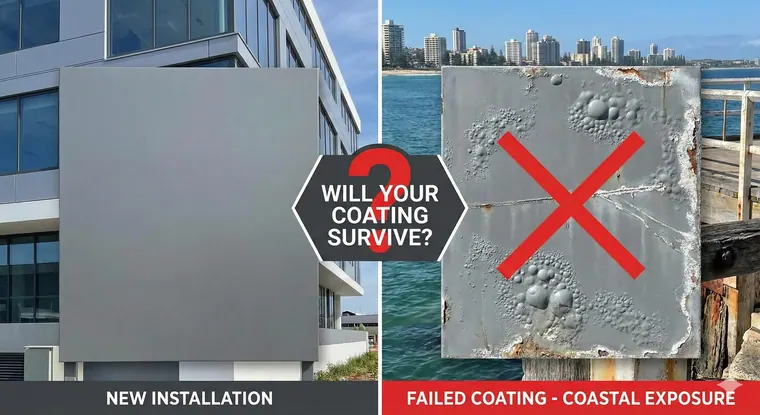
Why Your Aluminium Powder Coating Needs an Acetic Acid Salt Spray (AASS) Test for 720 Hours
TCR Engineering offers NABL-approved AASS testing for 720 hours on aluminium powder coatings, ensuring durability in harsh coastal environments.
-
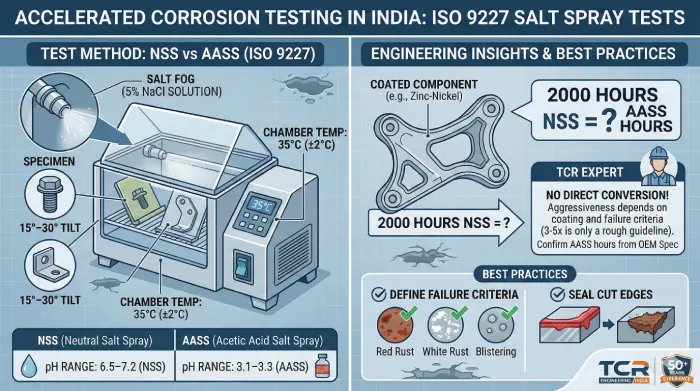
Accelerated Corrosion Testing in India: What Engineers Need to Know About ISO 9227 Salt Spray Tests
TCR Engineering explains ISO 9227 salt spray testing, NSS vs AASS differences, and what Indian engineers must know before testing corrosion resistance.
-
NORSOK M-710 Sour Gas Corrosion Testing for Composites and Polymers
NORSOK M-710 corrosion testing for composites and polymers: how the standard works, what labs must provide, and where most programmes go wrong.
-
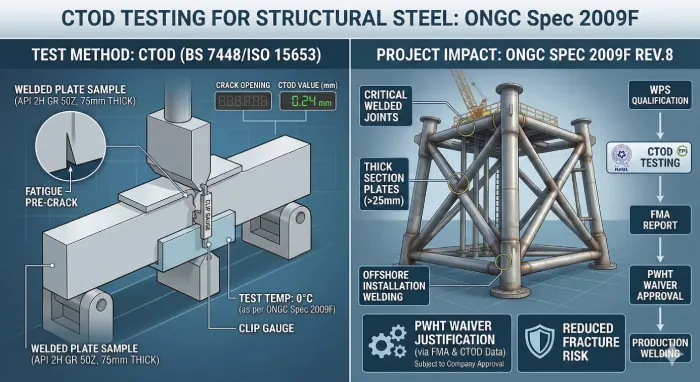
CTOD Testing for Structural Steel as per ONGC Spec 2009F
TCR Engineering explains CTOD testing requirements for structural steel under ONGC Spec 2009F Rev.8, including FMA, specimen prep, and accreditation.
-
ONGC Specification Testing: Your Complete Guide to Mechanical, Corrosion, and CTOD Testing
TCR Engineering conducts comprehensive ONGC specification testing including mechanical properties, corrosion resistance, and CTOD evaluation.
-
The Unseen Battle: Why Grout Fatigue Testing is Critical for Our Infrastructure's Future
Grout fatigue testing reveals how materials endure cyclic loads in bridges, wind turbines & offshore structures. TCR leads India in this field.
Frequently asked questions
Which shipyards and ports does TCR serve?
India's defence and merchant shipyards, Mazagon Dock, Cochin Shipyard, Garden Reach, Goa Shipyard and Hindustan Shipyard, draw on TCR for materials, weld qualification and structural inspection, alongside port infrastructure at Mumbai Port Trust, Adani Ports, JNPT, Visakhapatnam, Chennai, Kandla and Mundra.
Can TCR inspect underwater structures?
Yes. Underwater inspection in lieu of dry-docking runs through the Planys submersible ROV alliance, with SONAR silt assessment and an ultrasonic gimbal for sub-water structures and basins. The BMC programme from March 2026 covers AI-assisted robotic underwater inspection of 400-plus bridges.
What offshore standards does TCR test against?
Offshore structures run per API RP 2A-WSD and ISO 19902, subsea pipelines per DNV-ST-F101 and API RP 1111, cathodic protection per DNV-RP-B401 and NACE SP0176, LNG and cryogenic storage per API 625 and EN 14620, and fitness for service per API 579-1/ASME FFS-1 and BS 7910.
Does TCR qualify non-metallic materials for subsea service?
Yes. Non-metallic sealing and sealing-related components are qualified to NORSOK M-710 Rev. 3 with rapid gas decompression and ageing resistance assessed for offshore duty, alongside FRP and GRP piping per ASTM D2992 and ISO 14692, and polymer sealing ageing for sour exposure.
Can TCR test materials for LNG service?
Down to -65 °C. The laboratory tests 9 percent nickel steel to ASTM A353 and A553 and pressure-vessel plate to ASTM A537, and runs sub-zero CTOD per ASTM E1820 down to -65 °C, the limit of its two cold chambers, for LNG re-gas terminals at Petronet Dahej, Adani-Total Dhamra and Hazira. Fracture toughness at the LNG service temperature of about -162 °C is outside that range.