
Services · Asset Integrity and Engineering Consulting
Fitness for Service (FFS) per API 579-1/ASME FFS-1
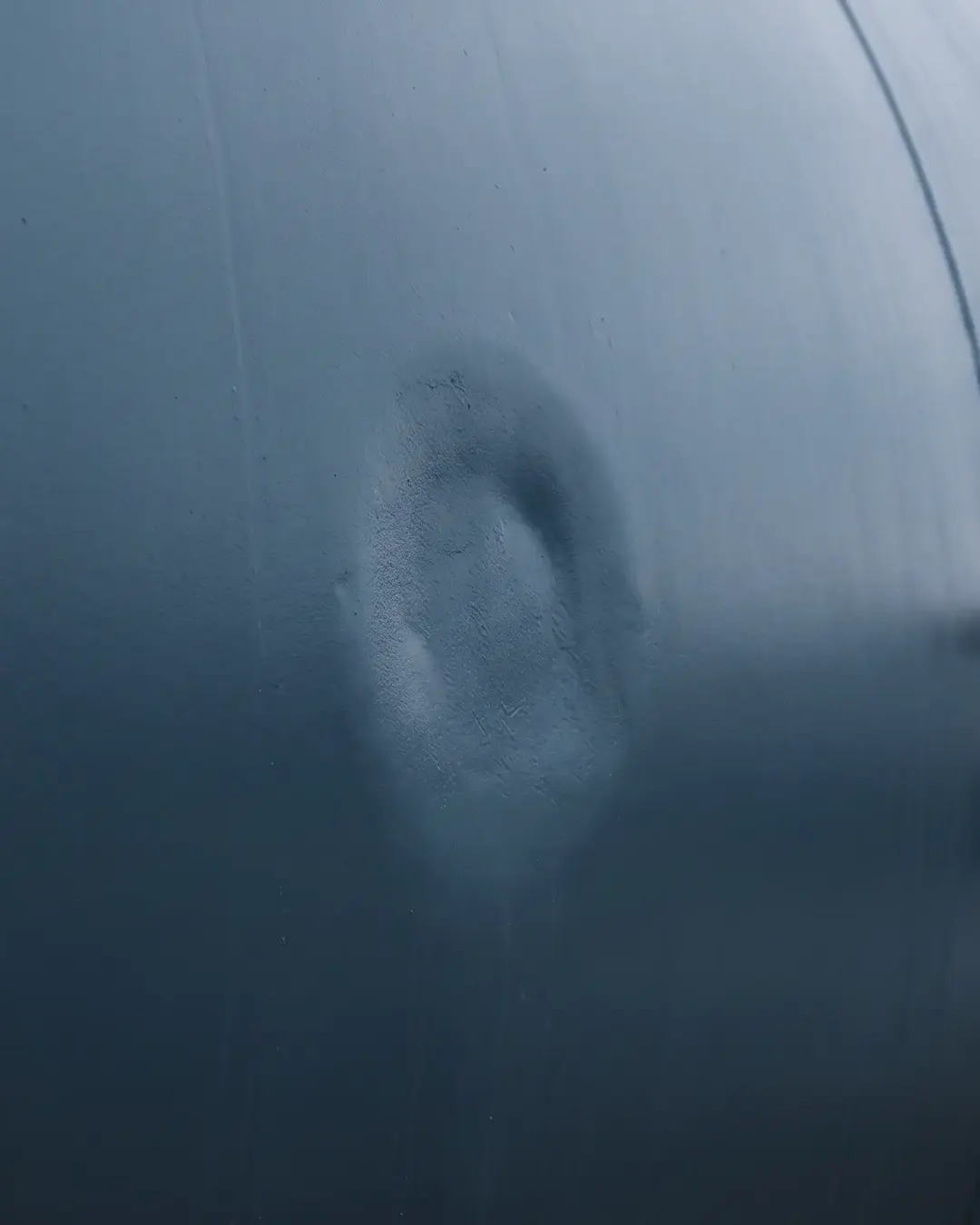
HMEL Bathinda isomerisation reactor 503-R-001 saw 710 degrees Celsius for one minute in March 2012. In-situ replication at 60 locations, hardness mapping, TOFD, and AUBT certified it fit for service, and it ran to 2019 without crack growth.
Request a Quote
In brief
TCR Engineering Services Pvt. Ltd., a NABL ISO/IEC 17025:2017 accredited laboratory in Navi Mumbai, delivers Fitness for Service assessment per API 579-1/ASME FFS-1 and BS 7910 for pressure vessels, piping and storage tanks. Damage-mechanism identification is anchored in API RP 571, and assessments run to Level 3 with fracture mechanics and finite element analysis. More than 350 Fitness for Service engagements have been delivered to API 579-1/ASME FFS-1.
What a Fitness for Service assessment evaluates
TCR undertakes Fitness for Service (FFS) assessment to Levels 2 and 3 of BS 7910 and API 579-1. The fracture mechanics methodology behind it is applied across industries, from nuclear pressure vessels to high-consequence items in exploration, refining, petrochemicals and construction.
Process plant equipment exposed to corrosive environments or elevated temperatures degrades with time. As pressure vessels, piping and storage tanks age, the operator must decide whether each can keep operating safely and reliably, without injury to personnel or the public, environmental damage or an unplanned shutdown. Fitness for Service assessment makes that decision on established engineering principles.
Fitness for service assessment is a multidisciplinary engineering analysis that ensures all process and plant equipment such as pressure vessels, piping, and tanks operate safely and reliably for the desired period of operation and until the next turnaround or planned shutdown occurs in the future. API 579-1/ASME FFS-1 provides the general procedure for assessing fitness for service. This assessment procedure evaluates the remaining strength of the equipment in its current state, which may have degraded from its original condition. Common degradation mechanisms include corrosion, localised corrosion, pitting and crevice corrosion, hydrogen attack, embrittlement, fatigue, high-temperature creep and mechanical distortion. The standard sets out methods for evaluating the strength and remaining service life of equipment carrying these types of degradation.
Common reasons for assessing the fitness for service of equipment:
- Discovery of a flaw such as a locally thin area (LTA) or crack
- Failure to meet current design standards
- Plans to operate under more severe conditions than originally expected
Outcome of Fitness for Service Assessment
- Decision to Run, Alter, Repair, Monitor, or Replace the Equipment
- Guidance on Inspection Interval for the Equipment
Fitness for Service Assessment uses Analytical Methods to Evaluate Flaws, Damage and Material Ageing Based On:
- Stress Analysis may be performed using Standard Handbook or Design Code Formulas or by means of Finite Element Analysis (FEA). With modern computer technology, the use of FEA is quite common.
- Fitness for Service Assessment requires both knowledge of past operating conditions and a forecast of future operating conditions, which come from the plant's operations personnel.
- Non-Destructive Examination (NDE): NDE is used to locate, size and characterise flaws
- Material Properties: The material properties include information on material damage mechanisms and behaviour in the service environment, especially on the effects of corrosion and temperature
When is fitness-for-service used instead of replacement?
Fitness for service is used when equipment has degraded but the cost and downtime of replacement have not yet been justified by evidence. API 579-1/ASME FFS-1 converts that judgement into a calculation: it evaluates the remaining strength of the component in its current damaged condition and returns a defensible decision to run, re-rate, repair, monitor or replace, together with the inspection interval that follows from it.
Replacement is a decision made without a number. FFS is the same decision made with one. The distinction matters most when the equipment is long-lead, when the shutdown window is the binding constraint rather than the capital, or when a regulator, an insurer or a client will later ask on what basis the equipment was kept in service.
FFS is the right instrument when:
- A flaw has been found in service: a locally thin area, a crack-like flaw, pitting, a blister, a dent or a lamination.
- The equipment no longer meets the design standard it would be built to today, but was compliant when built.
- The plant intends to operate at a higher pressure, temperature or throughput than the original design case.
- An excursion has occurred and the question is whether the material is still the material the design assumed.
- The component is long-lead or bespoke, and a replacement decision taken without evidence buys downtime that the evidence might have avoided.
Replacement is the right answer when the assessment says so. An FFS assessment that ends in "replace" is not a failed assessment. It is a replacement decision that will survive an audit and an insurance review, which an engineering judgement call will not.
What an FFS assessment returns:
- A run, re-rate, repair, monitor or replace decision on the component as it stands.
- The remaining life on which that decision rests.
- The inspection interval and the monitoring the decision is conditional on.
- The documentation trail that lets the owner-user defend the decision later.
What is the difference between a Level 1, Level 2 and Level 3 API 579 assessment?
API 579-1/ASME FFS-1 provides three assessment levels, and each successive level reduces conservatism while increasing the data, the analysis and the expertise required. Level 1 is a screening calculation, Level 2 is a detailed calculation, and Level 3 is a numerical analysis, usually finite element analysis or fracture mechanics.
Equipment that fails Level 1 is not condemned; it moves up a level. Choosing the level is a commercial decision as much as a technical one: a Level 1 screen that passes is the cheapest defensible answer available, and a Level 3 analysis on a component that would have passed Level 2 spends money that buys nothing.
| Level 1 | Level 2 | Level 3 | |
|---|---|---|---|
| What it is | Conservative screening criteria and screening curves | A detailed evaluation producing a more precise result than Level 1 | The most detailed evaluation, using numerical techniques |
| Inspection data it needs | A minimum amount of inspection or component information | Broadly the same inspection data as Level 1, with more detailed calculation | Detailed inspection data, material properties and operating history |
| Analysis method | Tabulated criteria and screening curves | Closed-form and code calculation, remaining strength factor | Finite element analysis, fracture mechanics, Failure Assessment Diagram, creep analysis |
| Who performs it | Plant inspection or engineering staff | A plant engineer, or a specialist experienced in FFS | An engineering specialist experienced in FFS assessments |
| Conservatism | Highest. Passing is conclusive, failing is not | Reduced | Lowest. Unnecessary conservatism is removed rather than assumed |
| What a fail means | Escalate to Level 2, not condemn | Escalate to Level 3, or repair, re-rate or replace | The decision is final on the evidence available |
| TCR role | ASNT Level III inspection engineer and site in-charge | Mechanical and design engineer, with the metallurgical engineer on damage mechanism | Mechanical and design engineer on FEA and fracture mechanics, with laboratory support |
The level definitions above are the standard's own framing: Level 1 procedures provide conservative screening criteria usable with a minimum amount of inspection or component information, a Level 2 assessment provides a more detailed evaluation producing results more precise than Level 1, and Level 3 provides the most detailed evaluation of the three.
How is fitness-for-service different from a remaining life assessment?
A fitness for service assessment answers whether the equipment is safe to operate in the condition it is in today. A remaining life assessment answers how long it will stay that way.
The two run together more often than not: FFS sets the acceptance, RLA sets the interval, and the same inspection campaign feeds both. Where the damage is time-dependent, creep and fatigue above all, the two are inseparable, because the acceptance criterion itself moves with accumulated damage. TCR has completed 750+ remaining life assessment studies across all asset classes. See Remaining Life Assessment (RLA).
What does an FFS assessment need from the plant before it starts?
An FFS assessment needs the past and the future of the equipment, not only its present condition. API 579-1/ASME FFS-1 requires design and construction data, the operating history including any excursion, the inspection data that locates and sizes the flaw, and the material properties that govern behaviour in the service environment.
It also requires a stated forecast of future operating conditions, which only the operator can supply. Where the data does not exist, TCR generates it: the laboratory holds 1,483 NABL scope items, and the field teams take the replicas, the hardness maps and the ultrasonic sizing that the calculation then consumes. Missing original material certificates are the most common gap, and they are closed by testing rather than by assumption.
Bring what you have:
- Design and construction data: code of construction, drawings, material specifications, original certificates.
- Operating history: pressure and temperature records, cycles, upsets and excursions with dates and durations.
- Inspection data: the flaw, located, sized and characterised, with the method stated.
- Material properties: original certificates where they exist, and the service environment.
- Future intent: the operating case the equipment is being assessed against, and the date of the next planned shutdown.
What damage types does API 579-1/ASME FFS-1 cover?
API 579-1/ASME FFS-1 is organised into 14 parts; Parts 3 to 14 cover twelve damage types, each with three assessment levels:
| Part | Damage Type |
|---|---|
| 3 | Brittle fracture |
| 4 | General metal loss |
| 5 | Local metal loss |
| 6 | Pitting corrosion |
| 7 | Hydrogen blisters and HIC and SOHIC |
| 8 | Weld misalignment and shell distortions |
| 9 | Crack-like flaws |
| 10 | High-temperature components in the creep range |
| 11 | Fire damage |
| 12 | Dents, gouges and dent-gouge combinations |
| 13 | Laminations |
| 14 | Fatigue damage |
How is each part of API 579-1 organised?
Each damage part of API 579-1/ASME FFS-1, from Part 3 to Part 14, is written to the same eight headings, so a TCR assessment of any damage type moves through the same order and ends in a documented run, repair or replace decision.
- 01 Flaw and damage-mechanism identification.
- 02 Applicability and limitations of the procedure.
- 03 Data requirements (design, operating, inspection, materials).
- 04 Assessment techniques and acceptance criteria.
- 05 Remaining life evaluation.
- 06 Remediation.
- 07 In-service monitoring.
- 08 Documentation.
Who performs a fitness for service assessment at TCR?
The TCR FFS service has a defined five-role team:
| Role | Responsibility |
|---|---|
| Metallurgical engineer | Damage mechanism identification, materials review, replica reading |
| Mechanical and design engineer | API 579 calculation, FEA, design review |
| ASNT Level III inspection engineer | NDT plan, witnessing, sentencing |
| Site in-charge | Onsite execution, client interface, scope discipline |
| Certified NDT technicians | UT, PAUT, TOFD, MT, PT, replica acquisition |
Anchor Case Study 1: HMEL Bathinda Isomerisation Reactor 503-R-001
After a March 2012 temperature excursion, a full damage-mechanism workup, field evidence and a laboratory simulation with welded coupons certified the reactor fit for service.
- The excursion, March 2012: a peak of 710 degrees Celsius for 1 minute, and 44 minutes above 700 degrees Celsius.
- Damage-mechanism workup: full, including high-temperature hydrogen attack against the Nelson curve, API 941.
- Field evidence: in-situ replication at 60 locations, plus hardness mapping.
- Ultrasonics: TOFD and Automated Ultrasonic Backscatter Technique.
- Outcome: monitored through 2019 with no crack growth, no shutdown and no replacement.
Anchor Case Study 2: 18,000 MT Refrigerated Liquid Ammonia Tank
A Leak-Before-Break fracture mechanics study kept a 1983 refrigerated ammonia tank in service.
- Asset: an 18,000 MT refrigerated liquid ammonia tank, constructed 1983.
- Design code: API 620 Appendix R, 1978.
- Materials: A-537 Class 1 inner shell, IS-226 outer shell.
- Method: a Leak-Before-Break fracture mechanics study on a Failure Assessment Diagram framework.
- Outcome: rolling regulatory and operator engagement keeping the tank in service.
Related services and industries
- Asset Integrity Services and Engineering Consulting
- Remaining Life Assessment
- In-Situ Metallography
- Engineering Critical Assessment
- Failure Analysis
- Fire Damage Assessment
- Storage Tank Inspection and Audit per API 653
- ARTiS Reformer Tube Inspection
- Refining and Petrochemicals
- Fertilisers
- Power Generation
Fitness-for-service on video
Documents
Download the reference documents for this page. Every file is hosted on this domain and is also listed in the site document library.
Related insights
2 published insights on this site bear directly on Fitness-for-Service. They are below; the full index carries all 92 Asset Integrity insights.
-
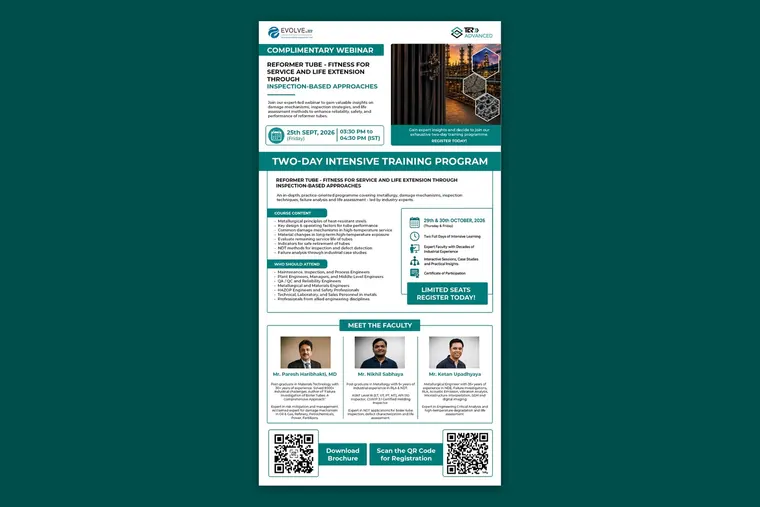
Reformer tube fitness for service: Evolve by TCR opens a complimentary webinar on 25 September 2026
Watch the complete recording of the 25 September 2026 webinar, and see the two-day intensive programme in Vadodara on 29 and 30 October. Both address…
-
Workshop on Fitness for Service by Paresh Haribhakti
This workshop on FFS benefit plant engineers to understand the various damage mechanisms involved in failure of plant equipment

Frequently asked questions
What is a Fitness for Service assessment?
A Fitness for Service assessment is a multidisciplinary engineering analysis per API 579-1/ASME FFS-1 and BS 7910 that evaluates whether degraded equipment such as pressure vessels, piping and storage tanks can operate safely and reliably until the next turnaround or planned shutdown, using stress analysis, NDE findings and material properties.
When is an FFS assessment needed?
Common triggers are discovery of a flaw such as a locally thin area or crack, failure to meet current design standards, or plans to operate under more severe conditions than originally expected. The outcome is a documented decision to run, alter, repair, monitor or replace the equipment, with guidance on its inspection interval.
What damage types does API 579-1 cover?
Parts 3 to 14 cover twelve damage types: brittle fracture, general and local metal loss, pitting corrosion, hydrogen blisters with HIC and SOHIC, weld misalignment and shell distortion, crack-like flaws, high-temperature creep, fire damage, dents and gouges, laminations, and fatigue damage, each with three assessment levels.
Who performs the assessment at TCR?
A defined five-role team: a metallurgical engineer for damage-mechanism identification, a mechanical and design engineer for API 579 calculation and FEA, an ASNT Level III inspection engineer for the NDT plan, a site in-charge for onsite execution, and certified NDT technicians for UT, PAUT, TOFD, MT, PT and replica acquisition.
When is fitness-for-service used instead of replacement?
Fitness for service is used when equipment has degraded but replacement has not yet been justified by evidence, and it returns a run, re-rate, repair, monitor or replace decision based on the remaining strength of the component in its current condition. TCR Engineering has completed 350+ such assessments to API 579-1/ASME FFS-1.
What is the difference between a Level 1, Level 2 and Level 3 API 579 assessment?
Level 1 applies conservative screening criteria using a minimum of inspection information and can be run by plant inspection or engineering staff. Level 2 is a more detailed evaluation producing a more precise result, and Level 3 is the most detailed evaluation, using finite element analysis and fracture mechanics, performed by an engineering specialist experienced in FFS. Each successive level reduces conservatism and increases the data and expertise required.
What does TCR need before an FFS assessment starts?
Design and construction data, operating history including any excursion, inspection data that locates and sizes the flaw, material properties, and a stated forecast of future operating conditions. Where original material certificates are missing, TCR closes the gap by testing against its 1,483 NABL scope items rather than by assumption.
Is an Engineering Critical Assessment the same as a fitness for service assessment?
An Engineering Critical Assessment is the fracture-mechanics branch of fitness for service, applied mainly to weld flaws: it sets the flaw size a weld can tolerate, typically to BS 7910 or API 1104 Annex A. TCR Engineering Services Pvt. Ltd. delivers both, with 350+ fitness for service engagements completed to API 579-1/ASME FFS-1.
Who carries out fitness for service assessments in India?
TCR Engineering Services Pvt. Ltd., a NABL ISO/IEC 17025:2017 accredited laboratory in Navi Mumbai (certificate NABLT0726MH18640), has delivered 350+ fitness for service engagements to API 579-1/ASME FFS-1 for refining, petrochemical, fertiliser and power plants in India and the GCC, with the laboratory testing, in-situ replication and Level 3 analysis under one team.