
Services · Civil and Infrastructure Testing
Rebar Scanning and Cover Meter Survey per BS 1881-204
Cover is the only thing between the reinforcement and the weather, and it can be read without opening the concrete.
Request a QuoteIn brief
TCR Engineering, Navi Mumbai, provides rebar scanning by electromagnetic cover meter on reinforced concrete structures, following BS 1881-204 : 1988 with a Proceq Profometer PM8000. The survey locates reinforcement, measures cover, maps bar spacing and estimates bar diameter without breaking out the concrete, and the cover is read against IS 456. Cover meter readings are reported outside the NABL scope.
What a Cover Meter Survey Establishes
Concrete cover is the distance from the concrete face to the nearest reinforcement, and it is the whole of the protection the bar has against carbonation, chloride ingress and fire. A cover meter survey reads that distance, and the position of the steel behind it, without cutting the member.
- Cover depth: the distance from the surface to the nearest bar, measured over a grid rather than at a single point.
- Reinforcement location: the position of bars, marked on the face, before any coring, cutting or anchoring.
- Bar spacing: the reinforcement arrangement mapped across the member and compared with the drawing.
- Estimated bar diameter: an estimate, reported as one. Diameter estimation carries materially more uncertainty than cover depth and depends on spacing, congestion and the assumed bar type, so it is reported with its conditions and confirmed by exposure where the decision turns on it.
Both ends of the range matter. Cover below the design value leaves the bar exposed to the environment sooner than the design life assumed. Cover well above it reduces the effective depth of the section and moves the crack pattern, so a survey reports the distribution rather than a single worst reading.
How Electromagnetic Cover Measurement Works
The instrument works by electromagnetic induction. A probe generates a field at the concrete surface; embedded steel distorts that field, and the instrument resolves the distortion into a distance and a position. Nothing is cut, nothing is cored and the member stays in service while it is surveyed.
- Instrument: a Proceq Profometer PM8000, used in line-scan and area-scan modes over a marked grid.
- Method reference: BS 1881-204 : 1988, the recommendations on the use of electromagnetic covermeters, which remains the current British Standard for the technique.
- Limits of the method: closely spaced bars, a second layer of reinforcement, and ferromagnetic material such as tie wire, embedded conduit or steel fibres all influence the reading, and the survey records where they were present.
- Confirmation: where a reading governs an acceptance decision, it is confirmed by a local break-out or a drilled check at an agreed number of points.
Reading the Result Against IS 456

A cover reading is a measurement, not a verdict. It becomes a finding when it is read against the nominal cover the structure was designed for, which IS 456 : 2000 sets by exposure condition in Table 16 and which fire resistance can raise through Table 16A.
| Exposure condition (IS 456) | Minimum nominal cover |
|---|---|
| Mild | 20 mm |
| Moderate | 30 mm |
| Severe | 45 mm |
| Very severe | 50 mm |
| Extreme | 75 mm |
Three qualifications travel with that table and belong on any report that cites it. The nominal cover specified for a member is the greatest of the durability requirement, the fire resistance requirement and the diameter of the bar itself. For main reinforcement up to 12 mm in mild exposure the value may be reduced by 5 mm. And IS 456 allows a construction tolerance on nominal cover of +10 mm and 0 mm, so a reading below the nominal value is a non-conformity while a reading 8 mm above it is not.
Where Cover Surveys Are Used
Cover is checked at two quite different moments: before the concrete has proved anything, as construction quality control, and long after, when a structure is being assessed and nobody wants to damage it.
- New construction: verification of reinforcement placement and cover as part of the quality-control regime, before or after concreting.
- Existing buildings: structural inspection and maintenance assessment, including structural audit work.
- Bridges and infrastructure: condition assessment where damaging the concrete is not an option.
- Water-retaining and marine structures: durability investigation where reinforcement corrosion is the governing mechanism.
- Forensic investigation: where cracking, spalling or rust staining is already visible and the question is whether cover was the cause.
Where the Cover Survey Sits in a Wider Assessment
A cover meter answers where the steel is and how deep it sits. It does not say whether that steel is corroding, how far the carbonation front has travelled, or whether the concrete around it is sound. Those are separate measurements, and a condition assessment normally runs them together on the same grid.
- Half-cell potential, ASTM C876-22b and IS 516 (Part 5 / Sec 2): likelihood of active corrosion in the bar the cover meter has just located.
- Carbonation depth, BS EN 14630 and IS 516 (Part 5 / Sec 3): how far the protective alkalinity has been lost, measured against the cover that remains.
- Rebound hammer, IS 516 (Part 5/Sec 4):2020: surface hardness and uniformity across the member.
- Ultrasonic pulse velocity, IS 516 (Part 5 / Sec 1): homogeneity of the section, and voids or honeycombing behind the face.
- Ground-penetrating radar: deeper layers, embedded services and pavement profiling, on the GPR and UPV page.
The first four companion site tests are within the NABL site scope of TCR Engineering's civil and infrastructure testing laboratory under certificate NABLT0726MH18640. Cover meter measurement to BS 1881-204 is not on that scope and is reported outside it, which is stated on the report rather than left to be inferred.
A cover survey is normally commissioned as part of a structural audit under Section 353B of the Mumbai Municipal Corporation Act 1888, on the structural audit page, or as part of the bridge inspection programme.
Related insights
1 published insight on this site bears directly on Rebar Cover Meter. It is below; the full index carries all 44 Civil & Structural Testing insights.
-
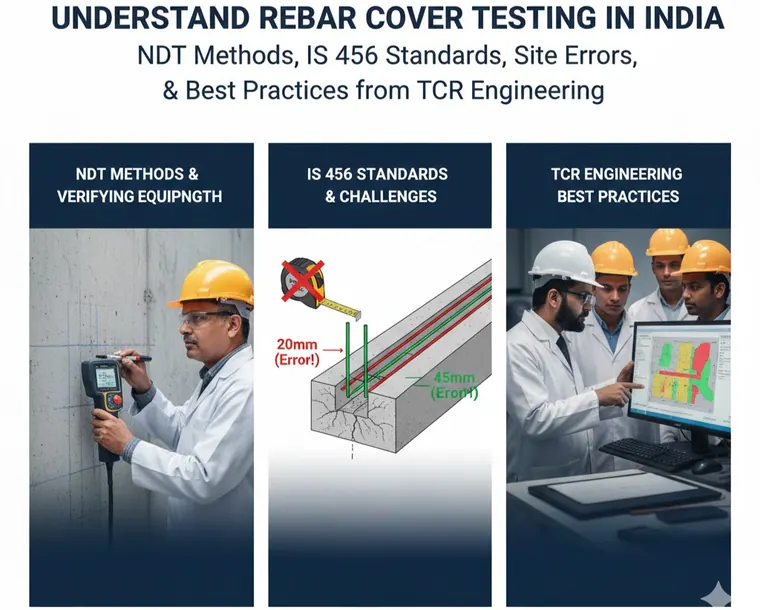
Rebar Cover Testing in India: Why Getting It Right the First Time Matters
Rebar cover testing is critical to structural safety. Learn how expert NDT teams in India assess cover, avoid common errors, and protect RCC structures.
Read all 44 Civil & Structural Testing insights →All insights →
Frequently asked questions
Which standard governs cover meter testing?
BS 1881-204 : 1988, the recommendations on the use of electromagnetic covermeters, which is the current British Standard for the technique. The cover values the readings are judged against come from IS 456 : 2000 Table 16 and, where fire resistance governs, Table 16A.
How accurate is the estimated bar diameter?
Less accurate than the cover depth, and it is reported as an estimate. Diameter estimation depends on bar spacing, congestion, a second reinforcement layer and the assumed bar type. Where an acceptance decision turns on diameter, it is confirmed by exposing the bar at agreed points.
What cover does IS 456 require?
Twenty millimetres for mild exposure, 30 mm for moderate, 45 mm for severe, 50 mm for very severe and 75 mm for extreme, and never less than the diameter of the bar. IS 456 allows a construction tolerance of +10 mm and 0 mm on the nominal value.
Does the structure have to be taken out of service?
No. The survey is entirely non-destructive and is run from the accessible face, so the member stays in service. Access, surface preparation and a marked grid are the only site requirements.
Is cover meter measurement within TCR's NABL scope?
No. TCR Engineering's NABL certificate NABLT0726MH18640 covers 1,483 test items including a site scope for carbonation, half-cell potential, rebound hammer and ultrasonic pulse velocity on reinforced concrete. Cover meter measurement to BS 1881-204 is not among them and is reported outside the scope, which is stated on the report.
Can a cover survey tell you whether the reinforcement is corroding?
Not on its own. It gives the position and the depth of the bar. Half-cell potential mapping to ASTM C876-22b gives the likelihood of active corrosion, and carbonation depth to BS EN 14630 gives how much of the cover is still protective. The three are normally run on one grid.
What is rebar scanning, and when is ground-penetrating radar used instead?
Rebar scanning locates reinforcement in hardened concrete and measures its cover without cutting the member. TCR Engineering uses an electromagnetic cover meter to BS 1881-204 for bar position, cover depth and spacing near the surface, and ground-penetrating radar where deeper layers, embedded services or pavement layers have to be mapped.