
Industries
Fertilisers
Reformer Tube Integrity and Ammonia Plant Life Extension
Reformer tubes at Dangote in Nigeria, 120 critical items assessed for remaining life at PIC Kuwait, risk-based inspection on 51 equipment at Chambal: the ammonia-urea integrity file runs through this bench.
Request a QuoteIn brief
TCR inspects and assesses ammonia, urea and phosphate plants from the primary reformer to the ammonia converter, the urea synthesis loop and refrigerated ammonia storage: ARTiS reformer-tube inspection with built-in Level 3 fitness for service, a 15-year metallurgical rate contract with QAFCO in Qatar running since 2011, and risk-based inspection of ammonia storage tanks at IFFCO, RCF, Chambal and Paradeep Phosphates.
Key takeaways
- 7 plant sections, from the ammonia front end to utilities, and 9 families of damage mechanism are covered below.
- Damage and failure analysis is reported against API RP 571 and ASM Handbook Vol. 11A with Casale, Snamprogetti, Stamicarbon and Toyo licensor guidance, and reformer tubes are assessed per API 579-1 Part 10. The full standards matrix is below.
- 17 marquee engagements are documented on this page, among them the in-service RBI of three 10,000 MT ammonia tanks at Paradeep Phosphates that extended the second internal inspection interval by five years under EFMA guidance.
Overview
Indian ammonia-urea producers, among them IFFCO, RCF, NFL, GNFC, GSFC, KRIBHCO, FACT, Chambal and Paradeep Phosphates, run their integrity work through TCR, as does QAFCO in Qatar in a relationship now into its second decade.
- Equipment covered: the reformer section (radiant and catalyst tubes, pigtails, manifolds), the ammonia converter, ISR, RGC and the urea synthesis loop, plus ammonia storage tanks.
- Mechanisms: creep, carburisation, nitriding, metal dusting, erosion-corrosion, cavitation, intergranular corrosion and carbamate corrosion.
- Reformer tubes: ARTiS inspection with built-in fitness for service.
Industry Context
Urea is a policy commodity, and plant reliability is a disclosed financial variable. India produced a record 314 lakh MT of urea in FY24, six new plants added 76.2 lakh MT of capacity, and the FY26 fertiliser subsidy was revised upward during the year.
- Production and policy: India produced a record 314 lakh MT of urea in FY24, six new plants added 76.2 lakh MT of capacity, and fertiliser subsidy was revised upward in FY26.
- Why reliability is financial: rating agencies track each producer's urea-train shutdowns plant by plant, and investor calls quantify energy-efficiency gains of even three percent, because a reformer outage moves earnings directly.
- Indian fleet: more than 30 large-scale ammonia-urea complexes, an ageing public-sector base (RCF, NFL, GNFC, GSFC, FACT, KRIBHCO, IFFCO), and revival capacity through HURL.
- GCC pool: QAFCO in Qatar, SAFCO and Maaden Phosphate in Saudi Arabia, OMIFCO and Salalah Methanol in Oman, and PIC Kuwait.
Reformer tube life is therefore a balance-sheet question, not a technical detail. TCR answers it with ARTiS, the group's own reformer tube inspection system with built-in Level 3 FFS, more than 100 reformer-tube campaigns and a named reference list across the Indian, Gulf, African and Southeast Asian fertiliser fleet.
Revival capacity comes from the three HURL plants at Sindri, Gorakhpur and Barauni and from Talcher and Ramagundam (Gorakhpur and Barauni already in commercial operation, Talcher commissioning under way), and private-sector capacity from CFCL (Chambal), DFPCL (Deepak) and Matix. Fertiliser plant downtime translates directly into shortages of agricultural inputs, which keeps integrity engineering in continuous demand.
The GCC operators listed above are served by TCR Arabia, the joint venture, and TCR Advanced. In North and West Africa, TCR Advanced leads with ARTiS at OCP in Morocco and at Indorama Eleme, Notore Chemical Industries Plc and Dangote in Nigeria.
Five trends shape the workload: green-ammonia capacity coming online (electrolyser-fed ammonia synthesis loops, about 12 announced projects in India alone); ammonia as a marine fuel under IMO 2030+ pathways; an ageing Indian plant base driving RLA, KBA and FFS at scale; ammonia storage-tank integrity (the leak-before-break study capability and RBI on ten tanks); and catalyst improvement cycles, which set the cadence of in-situ metallography and reformer-tube assessment.
Green ammonia (electrolyser-fed) extends API 941 high-temperature hydrogen attack assessment into front-end synthesis sections that will run on hydrogen from PEM and alkaline electrolysers; the corrosion testing laboratory and the ARTiS reformer programme carry over directly. Blue ammonia (ammonia plus CCUS) introduces amine-system corrosion qualification at scale. Ammonia as marine fuel brings refrigerated-ammonia tank integrity, including the leak-before-break study TCR has run on an 18,000 MT tank, into bunkering and marine-fuel storage. Ammonia for power co-firing brings combustion-side material qualification, shared with TCR's power generation work. CCUS at fertiliser plants draws on materials testing, asset integrity engineering and inspection manpower together.
India's National Green Hydrogen Mission target of 5 MMTPA of green hydrogen by 2030 implies green-ammonia capacity across the 12-plus announced projects, much of it beside operating plant whose remaining life and fitness for service then decide the integrity programme. Behind the record sit published work with ASM International and a bench of senior consultants.
Plant Sections We Inspect
| Cluster | Equipment |
|---|---|
| Ammonia Plant (Front End) | Desulphuriser (HDS, ZnO absorber); Primary Reformer (radiant tubes, catalyst tubes, headers, pigtails, manifolds); Secondary Reformer; Process Gas Boiler (Waste Heat Boiler / WHRB); HT Shift converter; LT Shift converter; CO2 Removal (Benfield, MDEA, aMDEA); Methanator |
| Ammonia Synthesis Loop | Synthesis gas compressor; ammonia converter (radial-flow basket internals); ammonia separator; ammonia accumulator; let-down drum; refrigeration system |
| Urea Plant | Reactor (Casale, Snamprogetti, Stamicarbon, Toyo licensor variants); Stripper; HP decomposer; LP decomposer; Carbamate condenser; HP scrubber; Ammonia preheater; Plunger pumps; Granulator; Prilling tower; UFC-85 unit |
| Phosphoric Acid Plant | Wet-process phosphoric acid (DH or HH process); Reactor; Filter; Evaporator (vacuum); Sulphuric acid plant supporting feedstock; SO2 / SO3 converter |
| NPK / DAP | Pre-neutraliser; Granulator; Dryer; Cooler; Coating drum; Bagging |
| Ammonia Storage | Atmospheric (refrigerated) at minus 33 °C; pressurised (semi-refrigerated); double-wall double-integrity with secondary containment |
| Utilities | Steam generation (waste-heat plus auxiliary boiler), cooling-water systems, instrument air, demineralised water, nitrogen, fuel gas |
Damage Mechanisms We Investigate
| Equipment | Mechanisms |
|---|---|
| Primary Reformer (highest-risk) | Creep on radiant tubes (HK40, HP-Mod, HP-Nb, microalloyed; creep damage classed from replicas on the Neubauer scale); diametric growth; carburisation; nitriding; metal dusting; cyclic thermal fatigue; pigtail and manifold creep and weld cracking; outlet header decarburisation |
| Secondary Reformer / WHRB | Carburisation, oxidation, creep, refractory degradation, leaking ferrules, ferritic-to-austenitic dissimilar-metal weld failure, corrosion under deposit |
| Ammonia Synthesis | Hydrogen attack per API 941 (HTHA on lower-temperature converter shells); nitriding on inner basket; creep on basket internals |
| Urea Reactor and Stripper | Active passivation breakdown (oxygen injection control); pitting; SCC on 316L UG variants; corrosion of stainless cladding; carbamate corrosion; mechanical erosion at stripper distributor; bimetallic crack at carbon steel-stainless interface |
| Ammonia Storage Tanks | Stress corrosion cracking on carbon steel under wet-ammonia conditions, assessed by leak-before-break and FFS; hydrogen-induced cracking; coating breakdown; settlement-induced shell distortion; refrigeration cycle thermal fatigue |
| Process Gas Boiler / WHRB | Creep, fireside corrosion, water-side scale build-up, tube-to-tubesheet weld cracking |
| CO2 Removal | Amine SCC on lean-amine piping (300-series stainless), carbon steel corrosion under amine, foaming-induced erosion |
| Phosphoric Acid Plant | Wet-acid corrosion (carbon steel, stainless 904L, alloy 28, alloy C-276), erosion-corrosion at agitator and pump suction |
| NPK / DAP | Acid-vapour corrosion on granulator scrubber, ammonia leak corrosion |
Standards Coverage Matrix
- Damage and Failure Analysis
- API RP 571; ASM Handbook Vol. 11A; Casale, Snamprogetti, Stamicarbon, Toyo licensor inspection guidance.
- Inspection and Integrity
- API 510, 570, 653; API RP 572, 574, 575; API 941 HTHA; API 530 (fired-heater tube design and inspection); API 936 (refractory); ASME PCC-2.
- RBI / KBA
- API 580 / 581 4th ed. (January 2025); API RP 584 IOW 2nd ed. (December 2021). EFMA (European Fertiliser Manufacturers Association) Guidance for Inspection of Atmospheric Refrigerated Ammonia Storage Tanks (applied at Paradeep Phosphates in the in-service RBI that extended the second internal inspection interval from 20 to 25 years).
- Reformer Tube Inspection
- API 530 Annex A (estimation of remaining tube life); ASTM A608 (centrifugally cast); ASTM A351 / A608 (carburised reformer tubes); the ARTiS scan-and-FFS workflow per API 579-1 Part 10.
- Material Specifications
- ASTM A608 HP-Mod Nb, HK40, HK45 (centrifugally cast reformer tubes); ASTM A335 / A213 (chrome-moly piping and tubes); ASTM A516 / A537 Class 1 (refrigerated ammonia tank shells, the 18,000 MT case); IS 226 (outer shell on the 18,000 MT case).
- Welding
- ASME Section IX 2023; API 1104; API 582; AWS D1.1.
- Renewable / Green Ammonia (Emerging)
- API 941 in expanded H2 service; ASTM B898 (reactive and refractory metal clad plate, including titanium-clad); ISO 19840 (dry film thickness of protective coatings on rough surfaces).
Service Applications Across the TCR Continuum
In an ammonia-urea complex the integrity agenda concentrates on the reformer.
Primary reformer tubes in HP-modified and micro-alloyed centrifugally cast grades run at the edge of their creep limit, where a 10 to 20 degree Celsius overshoot in tube metal temperature cuts life substantially; around them sit carburisation, nitriding of the ammonia converter, intergranular corrosion of austenitic internals, erosion-corrosion in the urea synthesis loop, and stress corrosion in refrigerated ammonia storage. During shutdown and turnaround, reformer tube inspection is the critical path activity, and every day of the window is priced in lost urea production. In procurement, the risk is the quality of catalyst tube castings, welded pigtails and manifolds, and high pressure exchanger components. TCR Engineering and TCR Advanced serve all five stages of the Trusted Relationship Model (see Why TCR).
- Stage One, Sourcing and Procurement
- TCR qualifies reformer tube castings, pigtail material, and high pressure equipment through chemical analysis, mechanical testing, and microstructural evaluation of procurement samples, runs factory audits and original equipment manufacturer qualification at casting foundries and fabricators, and supervises raw material inspection and loading. Weld consumables for dissimilar and high-alloy joints, including Incoloy 800H and Alloy 617 class materials, are evaluated before they reach the site.
- Stage Two, Construction and Commissioning
- During plant construction, revamp, and reformer re-tubing, TCR provides baseline non-destructive testing, radiography and phased array ultrasonic testing on manifold and pigtail welds, welder certification and procedure qualification per ASME Boiler and Pressure Vessel Code Section IX, post-weld heat treatment, positive material identification across the alloy population, and the baseline diameter, thickness, and attenuation data set for the new tube fleet, so that later creep-strain readings have a true zero.
- Stage Three, In-Service
- On-stream, TCR supports operating discipline on the reformer: pyrometry correlation and thermography for tube skin temperature and hotspot detection, pressure-differential trending as an indicator of catalyst degradation, remote visual inspection, and integrity operating windows per API RP 584 on the reformer, converter, and synthesis loop. TCR Advanced builds risk-based inspection plans per API RP 580 and API RP 581 across the complex, with damage-mechanism mapping specific to reforming, shift, and synthesis service.
- Stage Four, Shutdown and Turnaround
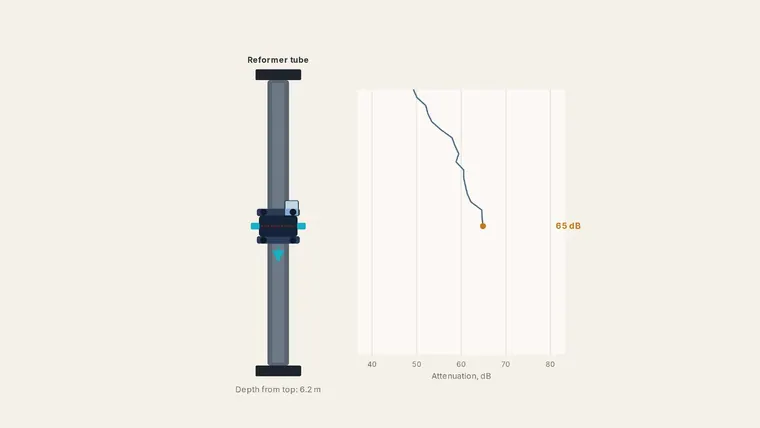
- In the turnaround, ARTiS (see ARTiS) delivers the full reformer scan, ultrasonic attenuation, diameter at 0.1 metre intervals, and bowing on every tube, supported by in-situ metallographic replication and hardness at selected elevations, manual thickness, diameter, and magnetic permeability at platform level, and inspection of pigtails, manifolds, waste heat boiler and reformed gas cooler tubes, high pressure exchangers, and refrigerated ammonia tanks. Turnaround inspection manpower is deployed to hold the critical path.
- Stage Five, Continuum
- The reformer data feeds a Level 3 fitness for service assessment per API 579-1/ASME FFS-1 with accumulated creep damage per tube, effective tube metal temperature, the retirement date at the 0.8 life fraction, and remaining life tube by tube, the 'when to retire tubes' answer that plans the re-tubing budget. Alongside sit failure analysis of tube, converter, and exchanger components, remaining life assessment of refrigerated ammonia storage, fire damage assessment, and contract research on green and blue ammonia materials questions that feeds the next investment cycle.
Named Clients
The fertiliser client base falls into four groups: Indian producers, GCC operators, international plants, and the equipment OEMs and process licensors behind them.
- India
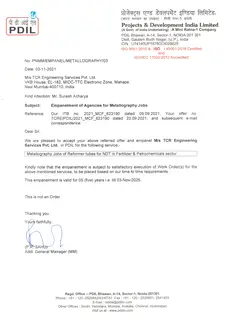
- Served by TCR Engineering and TCR Advanced: IFFCO (Kalol, Kandla, Paradeep, Aonla, Phulpur), KRIBHCO Hazira, GNFC Bharuch (RLA of TDI-II reformer tubes), GSFC Vadodara, NFL (Nangal, Bathinda, Panipat, Vijaipur), RCFL Trombay (2 double-wall double-integrity ammonia tanks), DCM Shriram, HURL (Sindri, Gorakhpur, Barauni), Deepak Fertilisers and Petrochemicals Corporation (DFPCL Taloja), CFCL Chambal Fertilisers Kota (GP-I RBI with AiOM, December 2025), Coromandel International, FACT, Paradeep Phosphates (3 ammonia tanks), Madras Fertilizers, SPIC, Nagarjuna Fertilizers (idle-plant restart), Matix Fertilisers (idle-plant restart), Heavy Water Projects.
- GCC
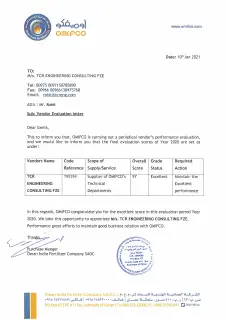
- QAFCO Qatar (15-year metallurgical rate contract, 8-year RLA partnership), SAFCO KSA (Saudi Arabian Fertilizer Company), Maaden Phosphate KSA, OMIFCO Oman (Vendor Evaluation 97/100 Grade Excellent), Salalah Methanol Oman, PIC Kuwait (RLA of 120 items of critical equipment in the ammonia and urea plant, delivered through NBTC, 2024).
- International
- Indorama Eleme Petrochemicals Nigeria (long-term rate contract), Notore Chemical Nigeria (idle-plant restart engagement), Dangote Fertiliser Nigeria (ARTiS plus tail-tube reformer life extension 2023), JIFCO Jordan (RFET and videoscopy of WHRB tubes 2025), Algerian Oman Fertiliser (a reference through TCR consultant Ashok Kumar Srivastava).
- Equipment OEMs and Process Licensors
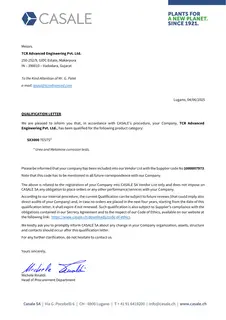
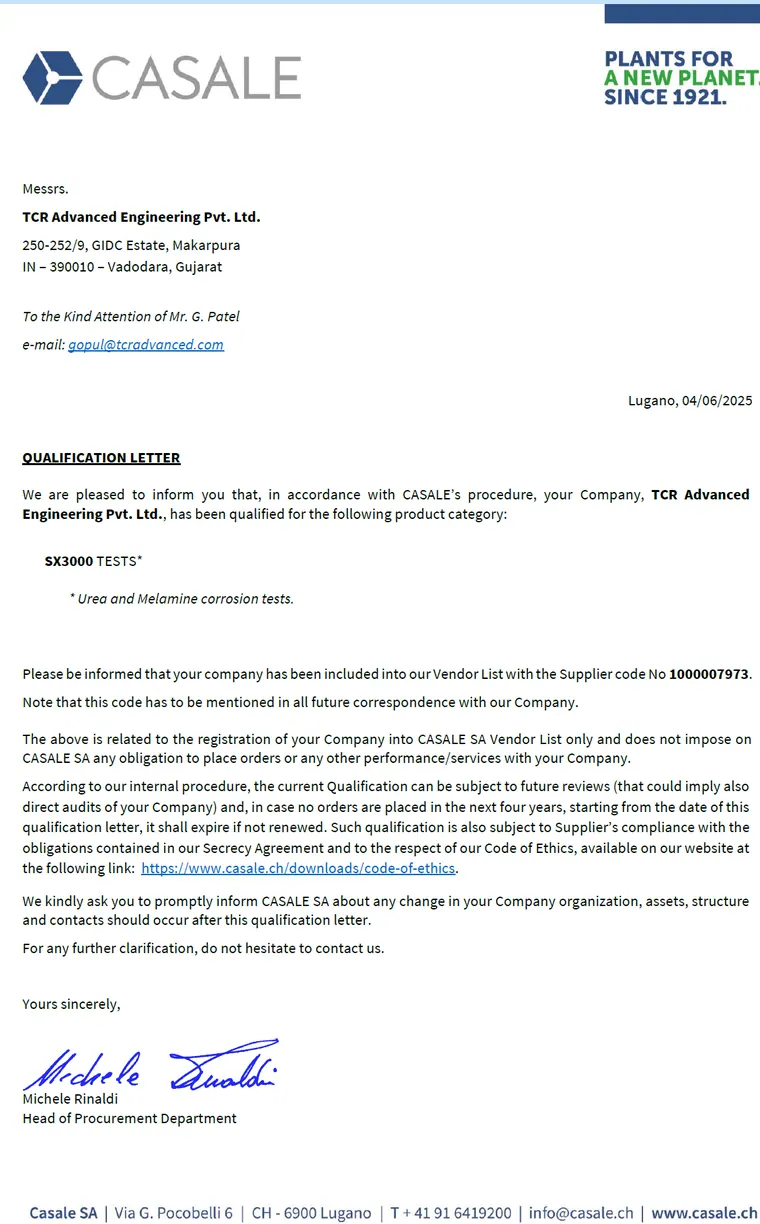
- Casale SA (Switzerland) SX3000 Vendor Code 1000007973 June 2025 (urea and melamine licensor); Snamprogetti, Stamicarbon, Toyo (urea licensors); Topsoe (catalyst), Johnson Matthey, Clariant (catalyst); KBR, ThyssenKrupp Industrial Solutions, MAIRE Tecnimont (ammonia licensors).
In fertilisers, the AiOM asset-integrity platform is referenced at Chambal Fertilisers, where the G-1 deployment covers 51 items of equipment, and the idle-plant restart practice has returned mothballed fertiliser assets to service at Matix Fertilisers and Nagarjuna Fertilizers. The broader India fertiliser client base includes Rashtriya Chemicals and Fertilizers, Hindustan Urvarak and Rasayan, KRIBHCO, and Ramagundam Fertilizers and Chemicals.
Marquee Projects
Three engagements anchor the fertiliser record: risk-based inspection with AiOM implementation across 51 items of equipment at Chambal Fertilisers, a fifteen-year metallurgical rate contract with QAFCO in Qatar, and ARTiS reformer-tube inspection with tail-tube assessment for Dangote in Nigeria. Project, service anchor and year follow.
| Project | Service Anchor | Year |
|---|---|---|
| Chambal Fertilisers G-1 plant, Ammonia-I Plant Areas 02 and 05 | RBI per API 580/581 plus AiOM® software implementation for 51 items of equipment (pressure vessels, towers, heat exchangers, connecting piping) | December 2025 |
| QAFCO Qatar | 15-year metallurgical rate contract across multiple ammonia and urea trains; Trains 5 and 6 at 2,200 MTPD ammonia plus 3,800 MTPD urea plus 3,850 MTPD granulation each plus UFC-85 unit at 85 MTPD | 2011 to date |
| QAFCO Qatar | 8-year RLA partnership | Continuous |
| QAFCO Training engagement | Scorecard 92.88/100 Grade A | Multiple |
| Dangote Fertiliser, Nigeria | ARTiS plus tail-tube inspection for reformer life extension | 2023 |
| Emirates Steel Industries, Abu Dhabi | ARTiS reformer tube inspection, DRP1 and DRP2 | 2025 |
| JIFCO, Jordan | RFET and videoscopy of WHRB tubes | 2025 |
| PIC, Kuwait (NBTC delivery) | RLA of 120 items of critical equipment in the ammonia and urea plant | 2024 |
| Indorama Eleme Petrochemicals, Nigeria | Long-term rate contract for metallurgical and inspection services | Continuous |
| 18,000 MT Refrigerated Liquid Ammonia Tank | API 620 Appendix R, A-537 Class 1 / IS 226, leak-before-break fracture mechanics study | Multiple |
| Ammonia Tank RBI: CFCL Kota, DFPCL Taloja, Paradeep Phosphates (3 tanks), IFFCO Kandla, IFFCO Kalol (2 tanks), RCF Trombay (2 DWDI) | RBI per API 580/581, FFS-supported decisions | Multiple |
| Paradeep Phosphates Limited (Adventz Group), 3 ammonia storage tanks 10,000 MT each | In-service RBI per EFMA / API 580 guidelines with EFMA risk matrix; 5-year extension of 2nd internal inspection | July 2025 onward |
| GNFC TDI-II reformer | RLA on reformer tubes | Multiple |
| OMIFCO, Oman | Vendor Evaluation 97/100 Grade Excellent | Multiple |
| Notore Chemical, Nigeria | Idle-plant restart engagement | Multiple |
| Baiji Refinery, Iraq | Idle-plant restart engagement | Multiple |
| Godrej Industries / Matix Fertilisers / Nagarjuna Fertilizers / Heavy Water Projects | Idle-plant restart engagements | Multiple |
Documents
Download the reference documents for this page. Every file is hosted on this domain and is also listed in the site document library.
Related insights
10 published insights on this site carry the Fertilisers tag. The 6 most recent are below.
-
Reformer tube fitness for service: Evolve by TCR opens a complimentary webinar on 25 September 2026
Watch the complete recording of the 25 September 2026 webinar, and see the two-day intensive programme in Vadodara on 29 and 30 October. Both address…
-
ARTiS comes to Japan: answering when a reformer tube comes out, not whether it is damaged
TCR Engineering and TCR Advanced are taking ARTiS, the automated reformer tube inspection system, into Japan with Chugai Technos Corporation of…
-
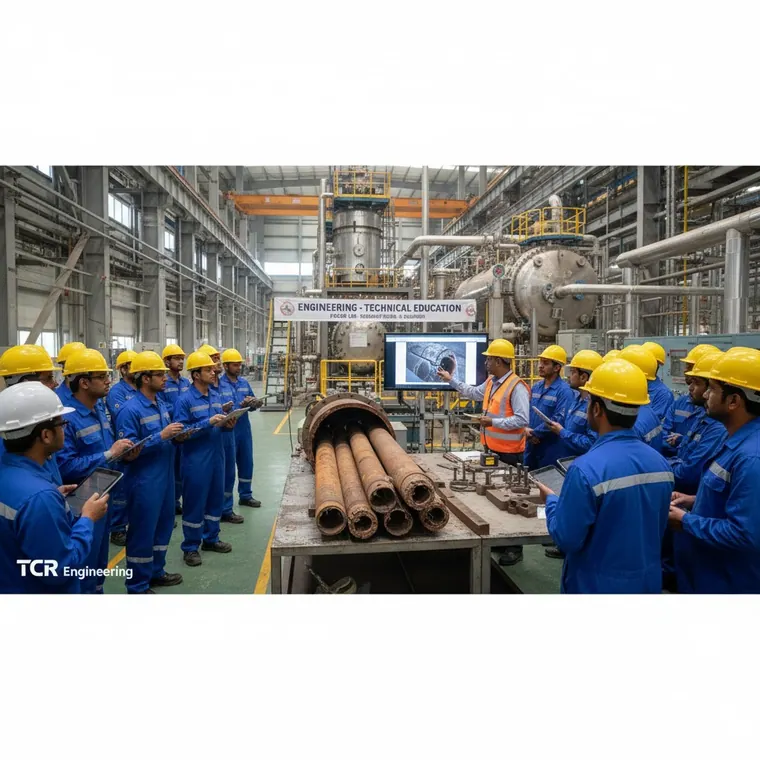
TCR's Specialised Training Programmes: Elevating Fertiliser Industry Excellence Through Expert-Led Technical Education
TCR Advanced Engineering delivers customised technical training for fertiliser plants, from FFS to welding metallurgy, building safer, more reliable operations.
-
TCR Advanced at The Fertilizer Show (USA)
TCR Advanced Engineering exhibits at The Fertilizer Show 2026, demonstrating asset integrity and reliability solutions for a smarter fertiliser industry
-
TCR Advanced qualified by Casale
TCR Advanced is now qualified by Casale SA for SX3000 corrosion tests, bringing Swiss-trusted precision to India's engineering frontlines.
-
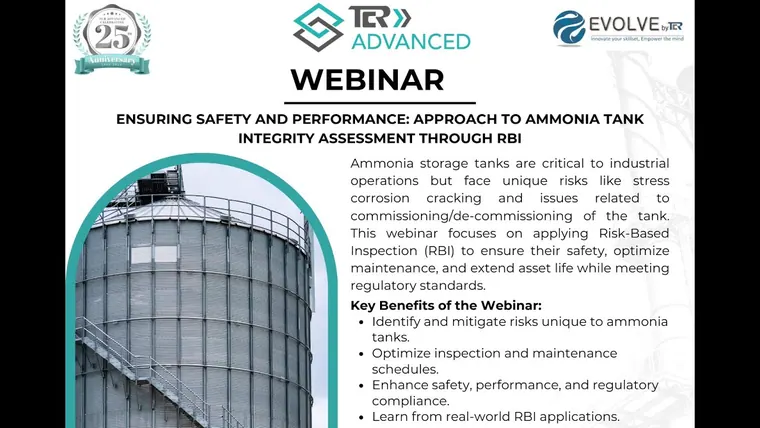
Ammonia Tank Integrity Using Risk-Based Inspection (RBI)
Optimise ammonia tank integrity with TCR's Risk-Based Inspection (RBI). Enhance safety, reduce downtime, and improve operational efficiency


Frequently asked questions
What is ARTiS reformer tube inspection?
ARTiS is the group's own reformer tube inspection system with built-in Level 3 Fitness-for-Service per API 579-1. It records ultrasonic attenuation, diameter at 0.1 metre intervals and bowing on every tube, and delivers accumulated creep damage, effective tube metal temperature and a retirement date per tube, across 80+ inspections.
How long has TCR worked with QAFCO?
Since 2011. QAFCO Qatar runs a 15-year metallurgical rate contract across multiple ammonia and urea trains, including Trains 5 and 6 at 2,200 MTPD ammonia and 3,800 MTPD urea each, alongside an 8-year remaining-life-assessment partnership and a training engagement scored 92.88 out of 100.
Can TCR assess refrigerated ammonia storage tanks?
Yes. The record covers ammonia tank RBI per API 580/581 at CFCL Kota, DFPCL Taloja, Paradeep Phosphates, IFFCO Kandla and Kalol, and RCF Trombay, an 18,000 MT tank leak-before-break fracture mechanics study per API 620 Appendix R, and a 5-year inspection-interval extension at Paradeep Phosphates under EFMA guidance.
Which international fertiliser plants has TCR served?
Dangote Fertiliser in Nigeria took ARTiS with tail-tube assessment for reformer life extension in 2023, JIFCO Jordan took RFET and videoscopy of WHRB tubes in 2025, PIC Kuwait ran an RLA of 120 critical equipment in 2024, and OMIFCO Oman scored TCR 97 out of 100, Grade Excellent.
Can TCR restart idle fertiliser plants?
Yes. The idle-plant restart practice has returned mothballed fertiliser assets to service at Matix Fertilisers and Nagarjuna Fertilizers, with further restart engagements at Notore Chemical in Nigeria and Heavy Water Projects, covering condition assessment, remaining life and recommissioning verification.