
Industries
Chemical and Specialty Chemicals
Finite Element Analysis and Fitness-for-Service
When a chemical reactor bulges or a column corrodes past its design margin, the file lands here: finite element analysis for Sulzer Chemtech in Bahrain, life assessment of 124 items at Gujarat Fluorochemicals, and API 579-1 work for Aarti, SRF and UPL.
Request a QuoteIn brief
TCR inspects, tests and assesses chemical plant equipment from chlor-alkali cells to utilities, and has completed 20 verified Fitness-for-Service engagements per API 579-1 across speciality, agrochemical, fluorochemical and bulk-chemical plants.
Key takeaways
- 10 plant sections, from chlor-alkali to utilities, and the damage mechanisms of 10 equipment groups are covered below.
- Damage and failure analysis is reported against API RP 571 and ASM Handbook Vol. 11A; the full standards matrix is below.
- 11 marquee engagements are documented on this page, among them the finite element analysis of bulged reactors for Sulzer Chemtech in Bahrain and the life assessment of 124 equipment items at Gujarat Fluorochemicals.
Overview
Chemical plants account for 20 of the group’s verified API 579-1 Fitness-for-Service engagements, more than any other sector, across speciality, agrochemical, fluorochemical and bulk-chemical plants, for Aarti Industries, SRF, Atul, UPL, Tata Chemicals and GACL, with international scope at BASF, Huntsman and Casale.
- Equipment: glass-lined and alloy reactors, distillation columns, acid plants and chlor-alkali cells.
- Failures investigated: leaks, runaway reactions and corrosion failures.
- Mechanisms: chloride, caustic, amine and polythionic acid stress corrosion cracking, HF and acid-dew-point corrosion, glass-lining cracking, intergranular attack and weld decay, corrosion under insulation, and fatigue.
- Assessment: Fitness-for-Service on degraded pressure boundaries.
Industry Context
Chemical plants concentrate risk: aggressive chemistries, high temperatures, and pressure equipment in continuous service, frequently inside dense industrial corridors such as Dahej, Ankleshwar, and the Bharuch belt where TCR maintains a dedicated division. A single integrity failure in this sector is rarely a maintenance line item; it is a production loss, an insurance claim, and a regulatory event at once.
- Sector scale and growth: India is the world’s sixth-largest and Asia’s third-largest chemical producer, growing through the Production Linked Incentive scheme on bulk chemicals and the China Plus One supply-chain reorganisation, which drive new-plant capex with integrity-engineering scope from front-end design through commissioning.
- Capex pipeline: speciality chemicals (Aarti Industries, SRF, Atul, UPL, Tagros, Anupam Rasayan, Vinati Organics), agrochemicals (UPL, Coromandel International, PI Industries, Bayer CropScience, Sumitomo Chemical India), pharmaceutical API and intermediates, dyes and pigments, and fluorochemicals.
- Integrated complexes: Reliance Jamnagar, IOCL Paradip, BPCL Bina, GAIL Pata, ONGC Mangalore, NRL Numaligarh and HMEL Bathinda, where TCR’s work includes risk-based inspection of the duplex air-fin coolers in the BPCL Bina hydrocracker and Fitness-for-Service on the HMEL Bathinda isomerisation reactor and VGO unit.
- Bench depth: 20 of the group’s 48 verified Fitness-for-Service engagements are in chemical plants, delivered by the Fitness-for-Service bench at TCR Advanced.
- Emerging scope: bio-based chemicals and bio-refining (lactic acid, succinic acid, bio-ethylene, furfural), which bring new corrosion mechanisms on bio-feedstock streams; green hydrogen from chlor-alkali by-product, which brings hydrogen storage and pressure-vessel scope; and carbon capture, which brings amine-system corrosion qualification.
The inspection answer has to combine chemistry with metallurgy, which is TCR’s home ground: corrosion and sour-service testing to NACE and ASTM programmes, HIC and SCC qualification of construction materials, in-situ metallography on reactors and piping, Fitness-for-Service assessment, and root cause failure analysis when a chemistry-metallurgy interaction does find a weak point.
Plant Sections We Inspect
| Cluster | Equipment |
|---|---|
| Chlor-alkali | Membrane-cell electrolyser, brine purification, chlorine compressor, hydrogen storage, hypochlorite production, caustic concentrator, salt cake / glauber salt purification |
| Speciality and Agrochemicals | Glass-lined reactor, Hastelloy reactor, jacketed crystalliser, distillation column (vacuum and atmospheric), thin-film evaporator, scraped-surface evaporator, centrifugal filter, dryer (spray, fluid-bed) |
| Polymers and Resins | Tubular and autoclave reactor (polyethylene), loop reactor (polypropylene), MEG (mono-ethylene glycol) reactor, PTA reactor, polyester polymerisation reactor |
| Aromatics | Reformer column complex, aromatics extraction, paraxylene crystalliser, benzene-toluene-xylene splitter |
| Methanol and Melamine | Methanol synthesis reactor, melamine reactor (Casale licensor), CO2 compression train |
| Fluorochemicals | HF reactor (highly corrosive service), refrigerant production train, fluoropolymer reactor |
| Acids | Sulphuric acid plant; nitric acid plant; phosphoric acid plant; HCl recovery; HNO3 concentrator |
| Pharmaceuticals API | Glass-lined reactor, jacketed reactor, crystalliser, dryer, sterile vessel; CIP / SIP system |
| Dyes and Pigments | Sulphonation reactor, diazotisation vessel, coupling reactor; effluent treatment |
| Utilities | Steam generation, demineralised water, cooling water, instrument air, nitrogen, fuel gas |
Damage Mechanisms We Investigate
| Equipment | Mechanisms |
|---|---|
| Chlor-alkali | Hypochlorite-induced corrosion on titanium and 316L; chloride SCC on stainless steels; H2 embrittlement; mercury-cell decommissioning hazards |
| Glass-lined reactor | Glass-lining cracking and spalling; substrate corrosion under failed lining; thermal-cycling fatigue |
| Hastelloy / nickel alloy reactor | Pitting and crevice corrosion; intergranular corrosion; weld decay (sensitisation in 300-series); high-temperature embrittlement |
| Distillation column | Tray and packing corrosion; condenser corrosion; reboiler tube corrosion; vacuum-system air ingress corrosion |
| Polymer reactor | Coke deposition; hot-spot corrosion; agitator-shaft fatigue; thermal-shock cracking on jackets |
| Aromatics | High-temperature corrosion; naphthenic acid where co-located |
| Methanol / Melamine | High-temperature creep on methanol synthesis reactor; carbamate corrosion; HF corrosion (where adjacent) |
| Fluorochemicals | HF-induced corrosion on Inconel and Monel; thermal-stress cracking |
| Acid plants | Acid-dew-point corrosion in sulphuric acid plants; nitric-acid corrosion at concentrator; HCl corrosion on graphite and tantalum equipment |
| Cross-cutting | Stress corrosion cracking (chloride, caustic, ammonia, amine, polythionic acid); HIC and SOHIC in sour-service co-located piping; corrosion under insulation (CUI); microbiologically influenced corrosion (MIC); fatigue at vibrating piping |
Standards Coverage Matrix
- Damage and Failure Analysis
- API RP 571; ASM Handbook Vol. 11A.
- Inspection
- API 510, 570, 653; API RP 572, 574, 575; ASME PCC-2.
- RBI / KBA
- API 580 / 581 4th ed. (January 2025); API RP 584 IOW 2nd ed. (December 2021).
- FFS
- API 579-1/ASME FFS-1 4th ed. (2021); BS 7910.
- Material Specifications
- ASTM A516 / A537 (carbon steel pressure-vessel plates); ASTM A240 (chromium and chromium-nickel stainless steel plates); ASTM B575 (Hastelloy C-22, C-276); ASTM B127 (Monel); ASTM B168 and B443 (Inconel 600 and 625 plate); ASTM B265 (titanium); ASTM B564 (nickel-alloy forgings); ASTM A312 (welded and seamless austenitic stainless-steel pipes); IS 6911 (Indian stainless-steel plate spec).
- Welding
- ASME Section IX 2023; AWS D1.1 2025; AWS D1.6 (stainless-steel structural welding); API 582; ISO 15614 series.
- Corrosion Testing
- NACE TM0177-2024 Methods A through D (SSC); NACE TM0284 (HIC); NACE MR0103 (refining); NACE MR0175 / ISO 15156; ASTM A262 Practices A through F (intergranular for stainless); ASTM G28 (intergranular); ASTM G48 (pitting); ASTM G36 (SCC in boiling magnesium chloride); ASTM G44 (alternate immersion); ASTM B117 (salt spray).
- Coating
- ASTM D3359, D4541, D7091, B117; ISO 2808, 4624, 12944.
Service Applications Across the TCR Continuum
Chemical and speciality chemical plants run the widest materials palette in industry: glass-lined steel, high-alloy austenitics and duplex grades, nickel alloys, titanium, graphite, and fibre-reinforced plastic, often within a single unit.
The problem set follows: chloride stress corrosion cracking of stainless steels, dew-point acid corrosion in flue and vent systems, microbiologically influenced corrosion in cooling water circuits, selective leaching, erosion-corrosion in slurry service, and the degradation of non-metallic linings and FRP scrubbers that no thickness gauge sees. Shutdowns are frequent but short, batch campaigns tolerate little slippage, and procurement risk concentrates in exotic alloy verification and gasket, lining, and polymer quality. TCR Engineering and TCR Advanced serve all five stages of the Trusted Relationship Model (see Why TCR) across organic, inorganic, agrochemical, and speciality operations.
- Stage One, Sourcing and Procurement
- Alloy verification by positive material identification and optical emission spectrometry protects the exotic-material supply chain, supported by intergranular corrosion testing per ASTM A262 and ASTM G28, pitting and crevice testing per ASTM G48, chloride stress corrosion cracking per ASTM G36, polymer, rubber, and FRP/GRP testing, gasket and lining material evaluation, and vendor audits with sample picking on reactors, columns, and exchangers.
- Stage Two, Construction and Commissioning
- During plant construction and unit addition, TCR provides baseline non-destructive testing, welder certification and procedure qualification per ASME Boiler and Pressure Vessel Code Section IX including high-alloy and dissimilar joints, radiography and phased array ultrasonic testing, post-weld heat treatment, positive material identification across the alloy population, and holiday testing of linings, delivering the baseline record for the unit.
- Stage Three, In-Service
- In operation, TCR runs corrosion mapping and thickness monitoring on columns, reactors, and piping, thermography of reactors and electrical systems, remote visual inspection of confined equipment, and risk-based inspection planning per API RP 580 and API RP 581 through the Knowledge-Based Audit method, with integrity operating windows per API RP 584 tuned to process chemistry excursions rather than calendar intervals.
- Stage Four, Shutdown and Turnaround
- In the shutdown, TCR inspects reactors, glass-lined equipment, columns, and exchanger bundles, runs in-situ metallographic replication on high-temperature components, tank inspection per API 653, boiler condition assessment on captive utilities, and magnetic particle and penetrant testing on nozzles and agitator components, with turnaround inspection manpower matched to short, dense windows.
- Stage Five, Continuum
- The engineering stage delivers failure analysis across metallic and non-metallic components, including microbiologically influenced corrosion, selective leaching, and stress corrosion cracking investigations, Fitness-for-Service per API 579-1/ASME FFS-1, remaining life assessment of captive boilers and ageing units, fire damage assessment, and the contract research and custom test rigs, autoclaves and simulated-environment apparatus, that answer the process questions standard methods cannot.
Named Clients
The chemical-processing client base runs across seven groups: Indian speciality chemicals, bulk chemicals, agrochemicals, pharmaceutical API and intermediates, polymers and petrochemicals, international operators, and the EPC contractors and process licensors that build and license these plants. Each group and its named organisations follow.
- India Speciality Chemicals
- Aarti Industries (Mumbai, Vapi, Jhagadia), SRF (Bhiwadi, Dahej, Bharuch), Atul (Atul, Ankleshwar), UPL (Ankleshwar, Halol), Tagros Chemicals, Anupam Rasayan, Vinati Organics, Galaxy Surfactants, Hindustan Petroleum.
- India Bulk Chemicals
- Tata Chemicals, Gujarat Alkalies and Chemicals Limited (GACL; Vadodara, Dahej), Aditya Birla Chemicals, DCM Shriram, Grasim Industries, Reliance Industries (Jamnagar petrochemicals), Indian Oil Corporation (Paradip Petrochemical Complex), GAIL Pata, ONGC Mangalore Petrochemicals.
- India Agrochemicals
- UPL, Coromandel International, PI Industries, Bayer CropScience, Sumitomo Chemical India, Heranba Industries, Sharda Cropchem.
- India Pharmaceuticals (API and intermediates)
- Aurobindo Pharma, Dr. Reddy's Laboratories, Lupin, Cipla, Sun Pharmaceutical, Zydus Lifesciences, Torrent Pharma, Glenmark.
- India Polymers and Petrochemicals
- Reliance Industries, IOCL Paradip, GAIL Pata, ONGC Mangalore, HMEL Bathinda, BPCL Bina, IFFCO (urea-melamine).
- International
- BASF (Mannheim, Ludwigshafen, India operations), Huntsman, Casale SA Switzerland (urea and melamine licensor), Bayer (Germany operations).
- EPC and Process Licensors
- Larsen and Toubro Heavy Engineering; Tata Projects; Toyo Engineering India; Technip Energies; ThyssenKrupp Industrial Solutions; Casale SA SX3000 Vendor Code 1000007973; Topsoe.
Representative India chemical-processing clients include Sulzer Pumps India, Elliott Ebara Turbomachinery, and Godrej and Boyce, with work across corrosion testing, metallography and failure analysis.
Marquee Projects
The chemical record rests on 20 verified Fitness-for-Service engagements, more than any other sector among the group’s 48, alongside risk-based inspection at BPCL Bina and reactor Fitness-for-Service at HMEL Bathinda. The table below gives each project, the service delivered and the year.
| Project | Service Anchor | Year |
|---|---|---|
| 20 verified chemical-plant FFS engagements | FFS per API 579 across speciality, agrochemical, fluorochemical, and bulk chemical plants | Continuous |
| BPCL Bina | RBI of duplex AFC and piping in HCU | Multiple |
| HMEL Bathinda Isomerisation Reactor 503-R-001 | FFS of temperature excursion (peak 710 °C); certified fit-for-service; monitored through 2019 with no shutdown | 2012 to 2019 |
| HMEL Bathinda VGO Unit fire response | FFS of VGO reactor under API 579-1 Part 11 | 2024 |
| GACL Vadodara, Dahej | Chemical-plant materials testing, NDT, FFS | Continuous |
| Tata Chemicals | Materials testing across soda-ash, salt, and bromine plants | Continuous |
| Aarti Industries, SRF, Atul, UPL, Tagros | Speciality and agrochemical plant integrity | Continuous |
| BASF, Huntsman | International chemical-OEM source inspection and verification testing | Continuous |
| Gujarat Fluorochemicals Limited (GFL) Ranjitnagar plant | Theoretical life assessment of 124 equipment items from GA drawings and process parameters by a team of metallurgical, corrosion and design specialists, covering shells, dished ends and nozzles | June 2025 |
| Sulzer Chemtech Middle East W.L.L Bahrain | Finite element analysis of the bulged areas of reactors 59-V-104 and 59-V-105. Sulzer Chemtech is a Swiss process-equipment licensor specialising in mass-transfer and separation columns. | January 2026 |
| Indorama Eleme Petrochemicals Limited, Port Harcourt, Rivers, Nigeria | Condition assessment and NDT of olefins furnace tubes: 100 in-situ metallography replicas on SS304H, etched in aqua regia, and UCI hardness measurement | April 2025 |
Microbiologically influenced corrosion studies, refractory testing and failure analysis on FRP and GRP tanks carrying aggressive chemicals round out the speciality-chemical record, supported by a classical wet-chemistry bench for compositional certification.
Documents
Download the reference documents for this page. Every file is hosted on this domain and is also listed in the site document library.
Related insights
13 published insights on this site carry the Chemicals tag. The 6 most recent are below.
-
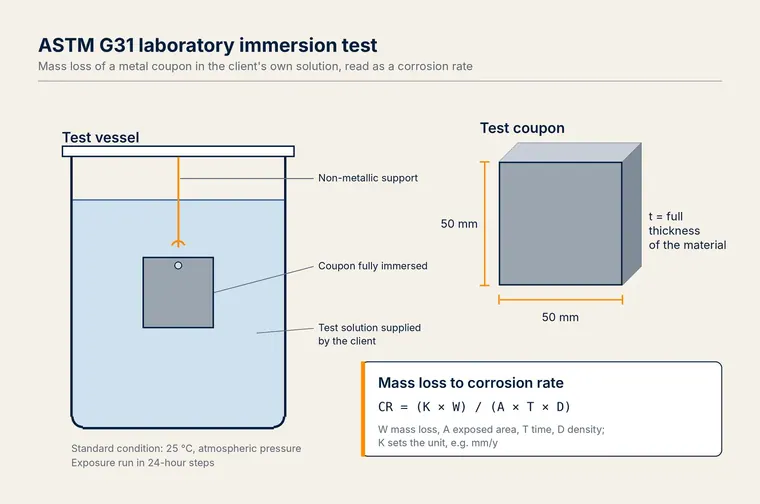
ASTM G31 immersion corrosion testing at Mahape: how a metal behaves in your own liquid
TCR Engineering's Mahape laboratory runs ASTM G31 laboratory immersion tests: a coupon of the client's metal, in the client's own solution, weighed…
-
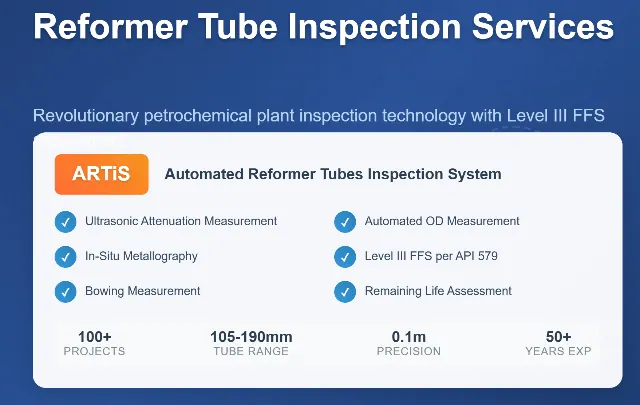
Reformer Tube Inspection Services Petrochemical: Why Your Plant's Future Depends on Getting This Right
ARTiS revolutionises reformer tube inspection with Level III FFS assessment per API 579, predicting failures months ahead of traditional methods.
-
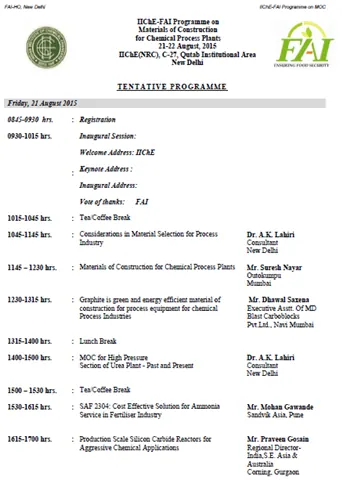
‘Materials of Construction for Chemical Process Plants’ at IIChE (NRC)
Mr. Paresh Haribhakti's paper was on Fitness for Service (FFS)
-
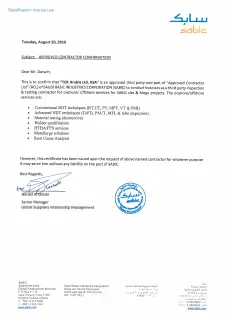
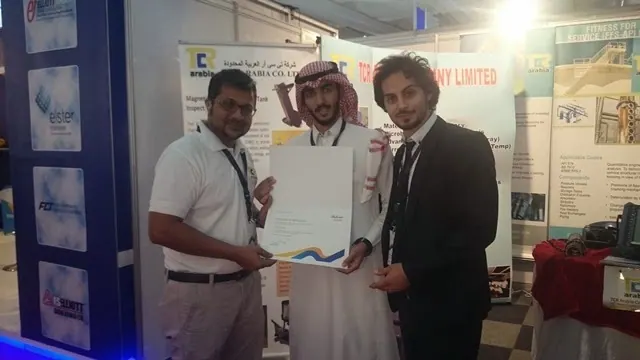
SABIC Technical Meeting (STM – II)
TCR Arabia participated in this event at Al-Jubail where the company got to meet all SABIC affiliates.
-
Seminar on Smooth Commissioning and Maiden Start-up of plants
Insight about the importance of metallurgy selection / assessment before commissioning of any plant.
-
Long term contract with CNCEC, Saudi Arabia
TCR Arabia signs contract with China National Chemical Engineering Company

Frequently asked questions
Can TCR run Fitness-for-Service assessments on chemical plant equipment?
Yes. Chemical plants account for 20 of the group's 48 verified Fitness-for-Service engagements per API 579-1/ASME FFS-1, more than any other sector, including the HMEL Bathinda isomerisation reactor temperature-excursion assessment and the Gujarat Fluorochemicals Ranjitnagar theoretical life assessment of 124 equipment items.
Which chemical companies does TCR serve?
Named clients include Aarti Industries, SRF, Atul, UPL, Tagros, Anupam Rasayan and Vinati Organics in speciality chemicals, Tata Chemicals, GACL, Aditya Birla Chemicals and Grasim in bulk chemicals, pharmaceutical API makers such as Dr. Reddy's and Cipla, and international buyers including BASF, Huntsman and Casale SA.
What corrosion testing does TCR run for chemical service?
The bench covers sulphide stress cracking per NACE TM0177 Methods A to D, HIC per NACE TM0284, intergranular corrosion per ASTM A262 and G28, pitting per ASTM G48, chloride stress corrosion cracking per ASTM G36, alternate immersion per ASTM G44 and salt spray per ASTM B117.
Can TCR test glass-lined and exotic alloy equipment?
Yes. TCR inspects glass-lined reactors for lining cracking, spalling and substrate corrosion, and verifies Hastelloy per ASTM B575, Monel per ASTM B127, Inconel per ASTM B168 and B443 and titanium per ASTM B265, with positive material identification protecting the exotic-alloy supply chain.
Has TCR delivered international chemical-plant engagements?
Yes. For Sulzer Chemtech Middle East in Bahrain, TCR ran a finite-element simulation of bulged reactors in January 2026, and at Indorama Eleme Petrochemicals in Nigeria the team delivered olefins furnace tube condition assessment with 100 in-situ metallography replicas in April 2025.