
Services · Asset Integrity and Engineering Consulting
Storage Tank Inspection and Audit per API 653
No single test tells you whether a tank can run to its next inspection. The audit puts the floor, the shell, the welds and the foundation into one answer, with a date on it.
Request a QuoteOverview
TCR Engineering Services Pvt. Ltd. performs API 653 tank inspection and audit of above-ground storage tanks in India and, through the TCR Arabia joint venture, in Saudi Arabia. API 653 tank inspectors compile visual, thickness, MFL floor, acoustic emission, robotic, weld, settlement and cathodic protection results into remaining life, the next inspection date and a repair or fitness-for-service decision.
What an API 653 Audit Answers
An owner does not commission a tank audit to collect test reports. The audit exists to answer three questions, and every test on this page earns its place by feeding one of them. A test that feeds none of them is not in the scope.
- Is the tank fit to run to its next inspection? Shell, floor and roof thickness against the minimums, corrosion rates, settlement and weld condition, evaluated as API 653 requires.
- What must be repaired before it returns to service, and to what standard? Plates, welds, nozzles and foundation, with the repair specified to API 653 and ASME PCC-2.
- When is the next inspection due, and in or out of service? The external, ultrasonic and internal inspection intervals API 653 sets, or an interval from a risk-based inspection programme where the owner runs one.
The Tests the Audit Compiles
Each test below is a service in its own right and has its own page. The audit decides which of them a given tank needs, in what order, and whether the tank is in or out of service when they are done. The table is the whole menu; a typical audit uses part of it.
| Test | What it covers | Tank status |
|---|---|---|
| External visual inspection to API 653 | Shell, roof, nozzles, appurtenances, foundation, drainage and grounding, against the API 653 checklist | In service |
| Internal visual inspection to API 653 | Floor, shell interior, roof structure, internal fittings and lining | Out of service |
| Shell and roof ultrasonic thickness (conventional NDT) | Remaining wall of each shell course and the roof plates, with the critical zone at the bottom of the lowest course | Either |
| Shell corrosion mapping and weld PAUT (advanced ultrasonics) | Area corrosion mapping of shell plates; volumetric examination of shell and roof welds | Either |
| Floor scanning by magnetic flux leakage (MFL) | The whole floor and annular plates, product side and soil side, proved up by UT | Out of service |
| Acoustic emission floor screening (AET) | Active corrosion and leaks across the floor, graded I to IV with a re-inspection interval | In service |
| Robotic in-service floor inspection | Ultrasonic thickness of the floor with the tank full, no entry or degassing | In service |
| Underwater ROV inspection | Water, fire-water and similar tanks inspected from inside, full | In service |
| Weld examination and leak testing (conventional NDT) | Vacuum box testing of floor welds; MT and PT of the shell-to-floor weld, nozzles and repairs; RT where weld quality must be shown | Out of service |
| Settlement, out-of-roundness and plumbness survey | Shell settlement around the circumference, out-of-roundness and verticality, for the API 653 settlement evaluation | Either |
| Coating inspection | External coating and internal lining condition and dry film thickness | Either |
| Cathodic protection survey | Whether the soil-side protection of the floor is working | In service |
| After a fire (fire damage assessment) | Heat-affected shell and roof plates, hardness and in-situ metallography | Out of service |
In Service or Out of Service
Opening a tank costs the product transfer, the cleaning, the waste disposal and the days it is not earning. The in-service tests exist so that the decision to open a tank is made on evidence, and so that a tank opened is opened for a reason the inspection already knows about.
| Route | Tests | What it decides |
|---|---|---|
| In service | External visual, shell UT and corrosion mapping, acoustic emission, robotic floor UT, CP survey, settlement survey | Whether the tank can run to the next planned outage, and which tanks and which sectors of a floor need opening first |
| Out of service | Internal visual, MFL floor scanning, floor and weld-margin UT, vacuum box, MT and PT, lining inspection | The repair scope before return to service, the remaining life of the floor and shell, and the next internal inspection date |
For a tank that cannot be taken out of service at all, the robotic route puts an ATEX and PESO certified partner rover on the floor with the product in place; the platforms, who owns them and the contract record are on the robotic tank inspection page.
How the Results Become a Decision
The value of the audit is in the compilation. Thickness from three methods, settlement from a survey and activity from acoustic emission only mean something once they are read against each other and against the tank's own history. That reading is where the audit report is written.
- Corrosion rate: from successive thickness readings at the same locations where the history exists; where it does not, the report says so and the interval is set conservatively.
- Remaining life: of each shell course and of the floor, against the minimum thickness the evaluation requires.
- Settlement: the survey evaluated for shell distortion and floor stress, as API 653 requires.
- Next inspection date: the external, ultrasonic and internal intervals, set from the rates found, or from a risk-based inspection programme where the owner runs one.
- Below the minimum: a repair to API 653 and ASME PCC-2, or a fitness-for-service assessment per API 579-1/ASME FFS-1 where replacing the plate is not the only defensible answer.
Refrigerated and Ammonia Tanks
Refrigerated liquefied gas tanks are built to API 620, and the damage mechanism that matters in ammonia service, stress corrosion cracking, is not one a thickness survey will find. The audit on these tanks leans on weld examination and on fracture mechanics rather than on wall loss.
- Reference: fitness-for-service of an 18,000 MT refrigerated liquid ammonia tank of 1978 design to API 620 Appendix R, using Leak-Before-Break fracture mechanics through a Failure Assessment Diagram to keep the tank in service.
- Interval setting: risk-based, because the governing damage mechanism is cracking, not thinning.
What the Audit Report Contains
One report, written so that the inspector who signs the tank back into service, and the engineer who plans the next outage, can each find their answer without reading the other's. Every figure carries the method, the instrument and the location it came from.
- The tank record: design code, dimensions, service, construction and repair history, and previous inspection findings.
- Each test's results, by method, with the areas not examined stated.
- Corrosion rates and remaining life for the shell courses and the floor.
- The settlement evaluation.
- The repair scope, prioritised, with the standard each repair is specified to.
- The next external, ultrasonic and internal inspection dates, and the basis for each.
- Where the answer is not repair, the fitness-for-service inputs and conclusion.
Who Performs It
The audit is led by API 653 tank inspectors, the same inspectors TCR supplies to plant turnarounds, and the tests are run by the NDT, robotics and asset integrity teams whose pages are linked above. Inside Saudi Arabia the work is delivered by TCR Arabia, the group's 60/40 joint venture in Dammam.
- Inspectors: API 653 tank inspectors, also deployed as turnaround inspection manpower.
- Codes: API 653, API 650, API 620, API RP 575, API 579-1/ASME FFS-1, ASME PCC-2 and EEMUA 159.
- Where: India and the GCC; inside Saudi Arabia through TCR Arabia Company Limited.
Related services and industries
Related insights
4 published insights on this site bear directly on Storage Tank Inspection and Audit. They are below; the full index carries all 92 Asset Integrity insights.
-
How TCR Advanced Ensures Storage Tank Integrity Through Comprehensive Condition Assessment
Expert insights on storage tank and silo condition assessment from TCR Advanced's MD Paresh Haribhakti, combining standards with innovation.
-
TCR's Inspection Strategies for Aboveground Storage Tanks
Tank integrity with advanced NDT solutions like AE, MFL, PAUT & robotic inspections, ensuring safety, compliance, and longevity
-
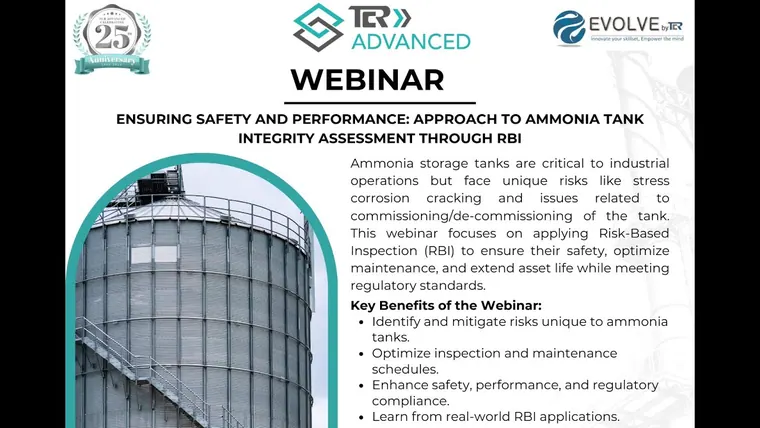
Ammonia Tank Integrity Using Risk-Based Inspection (RBI)
Optimise ammonia tank integrity with TCR's Risk-Based Inspection (RBI). Enhance safety, reduce downtime, and improve operational efficiency
-
Ammonia tanks Integrity management and inspection challenges
Providing insights to damage mechanisms associated with Ammonia tank and RBI to improve integrity

Frequently asked questions
What does an API 653 storage tank inspection include?
External and internal visual inspection against the API 653 checklist, ultrasonic thickness of the shell courses and roof, a floor examination by magnetic flux leakage with ultrasonic prove-up, weld examination and vacuum box testing, a settlement survey, and the evaluation of all of it into remaining life, a repair scope and the next inspection dates.
Can a storage tank be inspected without taking it out of service?
Partly. External visual inspection, shell ultrasonics, the settlement survey and the cathodic protection survey are done in service. Acoustic emission screens the floor for active corrosion and leaks, and a partner-delivered robotic rover measures floor thickness with the tank full. The in-service results decide whether and when the tank needs opening.
Which test finds soil-side corrosion on a tank floor?
Magnetic flux leakage floor scanning, run out of service, maps metal loss on both faces of each floor plate and distinguishes soil-side from product-side loss. In service, acoustic emission indicates whether the floor is actively corroding and robotic ultrasonics measure the remaining plate.
How is the next inspection date set?
From the corrosion rates the audit finds, applied to the external, ultrasonic and internal inspection intervals API 653 sets, or from a risk-based inspection programme where the owner runs one. Where no rate history exists the report says so and sets the interval conservatively.
What happens if part of the floor or shell is below minimum thickness?
The report specifies a repair to API 653 and ASME PCC-2, or, where replacing the plate is not the only defensible answer, a fitness-for-service assessment per API 579-1/ASME FFS-1 on the measured wall loss.
Does TCR inspect refrigerated ammonia storage tanks?
Yes. For API 620 refrigerated tanks the audit leans on weld examination and fracture mechanics, because stress corrosion cracking rather than thinning governs. TCR's reference is the fitness-for-service of an 18,000 MT refrigerated liquid ammonia tank of 1978 design, kept in service through a Leak-Before-Break assessment.
What is the difference between API 653 tank inspection and a tank integrity assessment?
An API 653 tank inspection collects the evidence: visual, thickness, floor, weld and settlement results against the code's checklist and minimum thicknesses. A tank integrity assessment reads that evidence into a decision on remaining life, repair scope, the next inspection date or a fitness-for-service assessment. TCR's audit delivers both in one report.