
Industries
Aerospace
NADCAP AC7101 Materials Testing and ISRO's Appreciation for Project ASLV
This bench has carried India's flight-critical materials work, from the Chandrayaan-3 rocket-motor casing hardware to a long-term naval materials contract with DRDO's NMRL.
Request a QuoteIn brief
TCR Engineering, Navi Mumbai, and TCR Advanced, Vadodara, are the first Indian group holding NADCAP AC7101 Materials Testing accreditation at two laboratories, alongside NABL ISO/IEC 17025:2017 (1,483 and 431 scope items). NADCAP covers the accredited mechanical testing, metallography, hardness and conductivity, and specimen machining checklists; fatigue, fracture toughness, corrosion, stress corrosion cracking and hydrogen embrittlement report under NABL. The full split, and what sits outside both, is stated below.
Key takeaways
- 9 plant sections, from structural alloys and fasteners to heat-treatment verification, and 8 families of damage mechanism are covered below.
- Two NADCAP AC7101 Materials Testing certificates: TCR Engineering, Navi Mumbai (PRI 29415245997) and TCR Advanced, Vadodara (PRI 29227245998), both valid to 31 May 2027, held alongside NABL ISO/IEC 17025:2017 at both laboratories (NABLT0726MH18640, 1,483 scope items; TC-6739, 431 scope items).
- Every standard on this page is placed by status: NADCAP accredited, NABL accredited, under the quality management system, tested to the customer’s specification, or on the roadmap. No aerospace prime approval is held as at August 2026.
- 9 marquee engagements are documented on this page, from the Chandrayaan-3 rocket-motor casing hardware to the long-term naval materials contract with DRDO’s NMRL.
- The full aerospace capability presentation can be downloaded from the Documents section below, and plays as a narrated video on this page.
Overview
| TCR serves ISRO, DRDO, NPCIL, HAL, MIDHANI and Bharat Forge, and holds NADCAP AC7101 Materials Testing accreditation. |
|---|
| Failures investigated: cracking, fastener failures and process escapes in 7xxx and 2xxx aluminium, titanium and nickel-base flight hardware, forgings and rocket-motor casings. TCR investigates stress corrosion cracking, hydrogen embrittlement, low- and high-cycle fatigue, fracture-toughness shortfalls, inclusion and grain-size non-conformities, and verifies heat treatment on samples from NADCAP-accredited heat treaters. |
| Marquee project: rocket-motor casing hardware for India’s Chandrayaan-3 moon landing mission, tested through Larsen and Toubro Defence for VSSC-ISRO with no non-conformity observed. |
|---|
NADCAP Scope and NABL Scope: What Each Covers
TCR holds two accreditations at each aerospace laboratory, and they cover different things. NADCAP AC7101 Materials Testing covers the accredited checklists for mechanical testing, metallography, hardness and conductivity, and specimen machining; the NADCAP symbol appears only on parameters inside those checklists. Fatigue, fracture toughness, stress corrosion cracking, hydrogen embrittlement, creep, chemistry and corrosion report under NABL ISO/IEC 17025:2017.
| Laboratory | NADCAP AC7101 Materials Testing | NABL ISO/IEC 17025:2017 |
|---|---|---|
| TCR Engineering, Navi Mumbai | PRI certificate 29415245997, valid to 31 May 2027 | Certificate NABLT0726MH18640, 1,483 scope items (1,383 laboratory and 100 site tests) |
| TCR Advanced, Vadodara | PRI certificate 29227245998, valid to 31 May 2027 | Certificate TC-6739, 431 scope items, valid 14 October 2025 to 13 October 2029 |
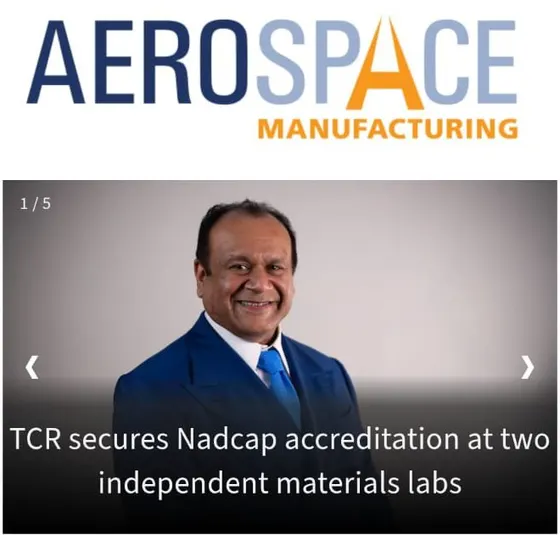
What NADCAP AC7101 covers
The accredited checklists are AC7101/3 (mechanical testing), AC7101/4 (metallography), AC7101/5 (hardness and conductivity) and AC7101/7 (specimen machining, code Z), under the general requirements of AC7101/1 and the proficiency-testing requirements of AC7101/14. Under them sit tensile, bend and impact testing; general microstructure, micro-hardness, carburisation and decarburisation depth, grain size, inclusion rating, replica microstructure, oxidation layer, case-depth profile, nitriding layer, IGA and IGO depth, alpha case on wrought titanium and macrostructure; and Rockwell, Brinell and Vickers hardness with electrical conductivity. TCR is the verification-testing partner for aerospace heat treaters and suppliers, not the heat treater: heat treatment and AMS 2750 pyrometry surveys are not performed here; they are verified here through heat treatment verification testing.
Specimen machining, accredited under code Z
The machine shop that cuts the test specimen sits inside the accredited scope (AC7101/7, code Z, standard specimen machining), so the coupon, the specimen and the result stay in one chain of custody. That matters most on titanium and nickel engine alloys: a coupon overheated or work-hardened during cutting can show a hardened surface layer or an altered microstructure, and a sound lot is then rejected while production waits. Low-stress machining keeps that heat and cold work out of the specimen, so the result describes the material, not the cutting.
What NABL ISO/IEC 17025 covers beyond it
Chemical analysis by OES, XRF and ICP; elevated-temperature tensile per ASTM E21 up to 1,100 °C; impact testing down to −196 °C; fatigue per ASTM E466, E606 and E647; fracture toughness per ASTM E399 and E1820 and CTOD per BS 7448 and ISO 15653, ambient to −65 °C; stress corrosion cracking per ASTM G47, G44, G34 and G67; hydrogen embrittlement per ASTM F519 and B577 with slow strain rate per ASTM G129; creep and stress rupture per ASTM E139 and E292; and corrosion per ASTM G48, A262, G28 and B117.
What runs under neither accreditation
Stated plainly, so no customer discovers a scope boundary after the report arrives. SEM and EDS fractography, retained austenite by X-ray diffraction and API 5L3 drop-weight tear run under the ISO/IEC 17025 quality management system, outside the accredited scope, and are reported without an accreditation symbol. ASTM E561 R-curve testing is not offered. ASTM F1624, NASM 1312, ASTM B565, interstitial gas analysis to ASTM E1409 and E1447, and composite testing to ASTM D3039, D6641, D3479 and D3518 are on the roadmap, not current offers. No aerospace prime approval (Boeing, Airbus, GE, Rolls-Royce) is held as at August 2026: prime specifications are tested to on request, and prime registration is on the roadmap below.
The aerospace test menu: 21 standing line items
Each line item is mapped to the NADCAP code it is reported under. A parameter inside the accredited code list carries the NADCAP symbol; anything outside it is reported under NABL. Coupon basis 300 mm × 300 mm. On-site testing on request.
| No. | Mechanical and electrical testing | NADCAP code |
|---|---|---|
| 1.01 | Tensile testing (AC7101/3) | A, B |
| 1.02 | Rockwell hardness, scale A, B or C (AC7101/5) | M2 |
| 1.03 | Brinell hardness, 3 indentations per location (AC7101/5) | M1 |
| 1.04 | Vickers hardness, 3 indentations per location (AC7101/5) | M3 |
| 1.05 | Bend testing (AC7101/3) | XN |
| 1.06 | Impact testing, set of three specimens (AC7101/3) | N |
| 3.01 | Electrical conductivity (AC7101/5) | M4 |
| No. | Metallography (AC7101/4) | NADCAP code |
|---|---|---|
| 2.01 | General microstructure examination with two photographs | L0 |
| 2.02 | Micro-hardness test, up to 10 indentations | L1 |
| 2.03 | Carburisation or decarburisation depth, microscopic method | L10 |
| 2.04 | Carburisation or decarburisation depth, hardness method | L10 |
| 2.05 | Grain size, comparison method | L11 |
| 2.06 | Grain size, intercept method | L11 |
| 2.07 | Inclusion rating, Method A | L0 ‡ |
| 2.08 | Replica microstructure analysis | L0 |
| 2.09 | Oxidation or corrosion layer measurement | L10 ‡ |
| 2.10 | Micro-hardness case-depth profile | L5 |
| 2.11 | Nitriding layer measurement | L5 ‡ |
| 2.12 | IGA and IGO depth measurement | L10 ‡ |
| 2.13 | Alpha case layer, wrought titanium | L8 |
| 2.14 | Macrostructure examination | L0 |
‡ Near-surface and inclusion parameters are reported with the NADCAP symbol only where the parameter falls inside the accredited code; otherwise under NABL.
Why an Independent NADCAP Bench in India Shortens Qualification
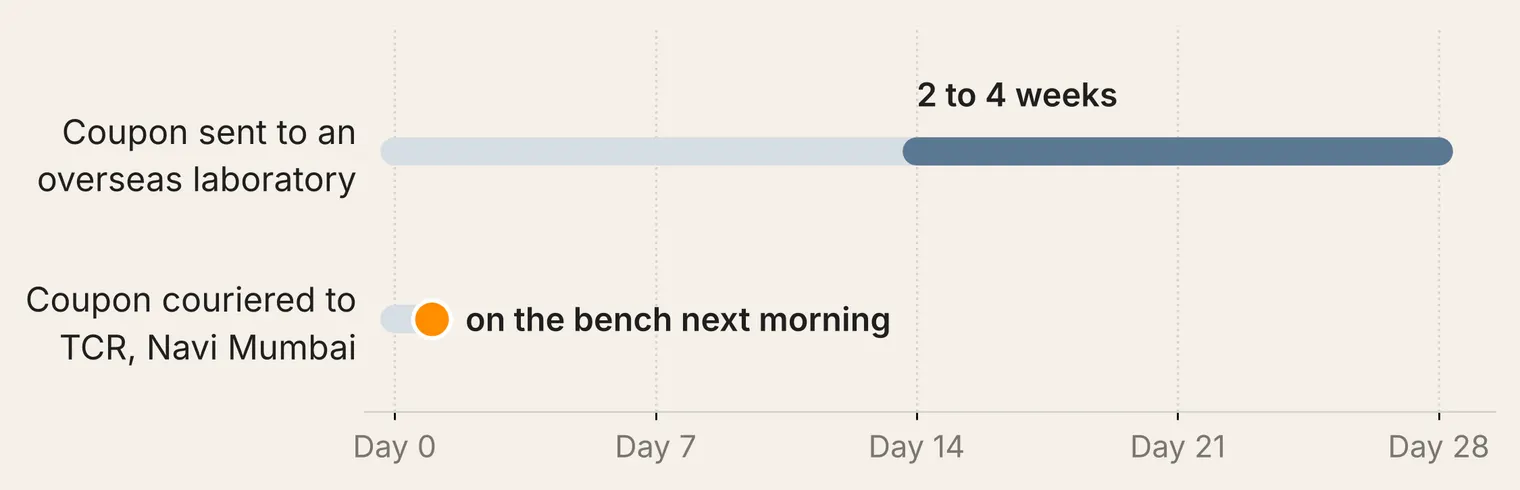
Both PRI certificates record TCR’s laboratory type as Independent: TCR heat treats nothing and makes no parts, so it has no stake in whether a lot passes. A qualification coupon flown abroad for verification typically spends two to four weeks in freight, customs and a laboratory queue; couriered to Navi Mumbai, it is on an accredited bench the next morning.
- Lab Type: Independent. Recorded on both PRI certificates, at Navi Mumbai and at Vadodara. TCR verifies the work of others and never processes the material it tests; AC7102 heat treating is not held and not pursued.
- One scope, two sites. The same AC7101 scope (/1, /3, /4, /5, /7 and /14) at both laboratories, in two states, so a programme can move between them without leaving the accredited scope, and either site is the other’s continuity plan.
- Beyond India. Samples already arrive from 15+ countries. TCR Arabia at Dammam, Jubail and Yanbu and the alliance partner in Doha can collect Gulf suppliers’ coupons, and NABL reports are accepted in 90+ economies under the ILAC MRA.
Route times are indicative ranges, not measurements: they vary with the origin, the carrier and the receiving laboratory's queue.
One Quality System, Two Registers: NABL and NADCAP Customers
TCR runs one ISO/IEC 17025 quality system for both kinds of aerospace customer, with the same people, instruments and calibration chain. What changes is the rule set and the report marking, and the job record decides which applies: the NABL mark with its ULR number, or the NADCAP symbol on parameters inside the accredited codes.
| Control | NABL ISO/IEC 17025:2017 customer | NADCAP AC7101 customer |
|---|---|---|
| Rules that govern | NABL 100, 160 and 216; ILAC P10 and G8 | AC7101 checklists, plus the customer’s specification and its test requirements |
| What a report carries | The NABL mark with its ULR number | The NADCAP symbol only on parameters inside the accredited codes; anything else reports under NABL |
| Work instruction | Controlled procedure per test method | Written from the customer’s specification and validated before the first lot |
| Job audit trail | Sample receipt to signed report | Full AC7101/1 job audit trail, raw coupon to report |
| Proficiency | NABL proficiency-testing schemes | AC7101/14 proficiency testing and internal round robins |
| Specimen machining | In-house machine shop | Accredited code Z (AC7101/7): one source, one chain of custody |
Industry Context
Indian aerospace has moved from promise to order book: HAL alone closed FY26 with a large order book, and every supplier behind those orders has to prove material conformance through accredited testing.
- Order book and budget: HAL’s FY26 revenue drew heavily on repair and overhaul, and the FY26 defence budget earmarked a substantial share for domestic procurement.
- Policy drivers: the Atmanirbhar Bharat framework on defence-vendor sourcing, the Defence Acquisition Procedure 2020 and its Indian-IDDM (Indigenously Designed, Developed and Manufactured) category, and the export thrust under the Strategic Partnership model.
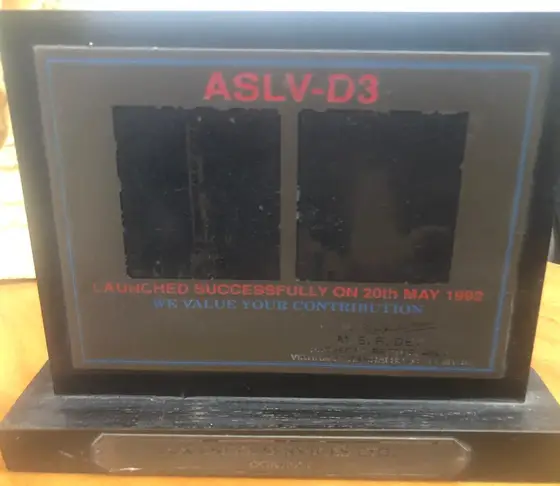
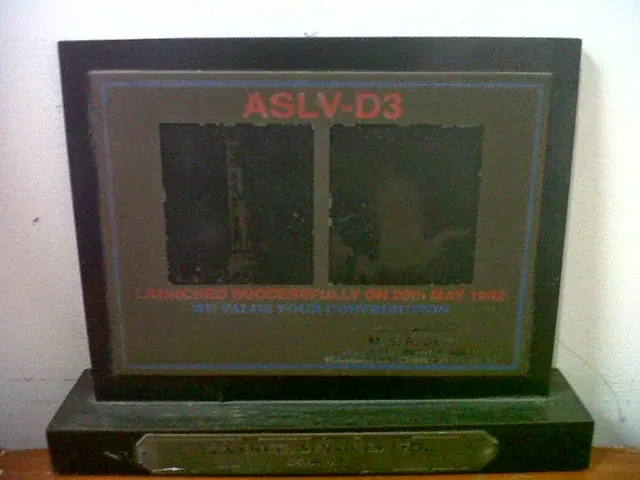
- Space programme: ISRO’s cadence of Chandrayaan-3, Aditya-L1, Gaganyaan, the LVM3 launch vehicle and the Reusable Launch Vehicle. TCR’s ISRO relationship runs back to Project ASLV, the Augmented Satellite Launch Vehicle, where the bench carried materials testing and earned ISRO’s written appreciation, and reaches lunar-mission hardware with the Chandrayaan-3 rocket-motor casing work.
- Buyer pool: the defence public-sector undertakings (HAL, BEL, BEML, BDL, MIDHANI) and Bharat Forge; DRDO and its laboratories (DMRL, DMSRDE, R&DE, and NMRL under a long-term contract); ISRO and its centres (VSSC, LPSC, SHAR, SAC); the atomic energy establishments (NPCIL, BARC); private aerospace manufacturers (Bharat Forge Aerospace, Tata Advanced Systems, Mahindra Aerostructures, Dynamatic Technologies); and HAL’s manufacturing divisions at Bangalore, Nashik and Koraput.
- Emerging scope: hydrogen-fuelled aviation, which extends the ASTM F519 hydrogen embrittlement bench (ASTM F1624 is on the roadmap); sustainable aviation fuel production at Indian refineries; eVTOL and urban air mobility, which bring battery-cell mica thermal-insulation testing; composite aerostructures, which bring ASTM D3039, D6641, D3479 and D3518 (composite testing is on TCR’s roadmap, not a current offer); and reusable launch vehicles (ISRO’s Reusable Launch Vehicle and the LVM3 evolution), which bring fatigue, CTOD and requalification of heritage hardware.
TCR serves that supply chain with NABL ISO/IEC 17025 accredited mechanical, chemical, metallurgical and fatigue testing, aerospace stress corrosion cracking programmes, and NADCAP AC7101 Materials Testing accreditation.
Commercial aviation demand
The civil side is growing alongside defence, and every heat-treated part an Indian supplier ships to an airframer has to prove conformance through accredited testing. The airframers' own published figures:
- New aircraft: Boeing’s Commercial Market Outlook (28 January 2026) projects nearly 3,300 new aircraft for India and South Asia by 2044.
- Fleet and MRO: Airbus (January 2026) expects the Indian commercial fleet to reach 2,250 aircraft by 2035, about triple today, and a large and growing Indian maintenance, repair and overhaul market.
- Sourcing: both airframers state that they already source a substantial volume of parts and services from India every year.
Plant Sections We Inspect
| Plant section | Equipment or material | What TCR verifies, and under which accreditation |
|---|---|---|
| Aerospace structural alloys | 7xxx series aluminium (7050, 7075, 7150, 7475 wrought and forged); 2xxx series aluminium (2024, 2090, 2099, 2219); titanium alloys (Ti-6Al-4V, Ti-6Al-2Sn-4Zr-2Mo, Ti-15-3, Ti-10-2-3); nickel-base superalloys (Inconel 718, 625, Waspaloy, Rene 95); maraging steel; PH stainless (15-5 PH, 17-4 PH, A286); high-strength low-alloy steel (300M, 4340, 4330V) | Tensile, hardness, conductivity, metallography (NADCAP); chemistry, fatigue, fracture toughness, SCC, exfoliation* |
| Aerospace fasteners | NAS series, MS series, AN series; titanium fasteners; high-strength bolts under MIL-DTL-spec | Hardness, case depth, decarburisation (NADCAP); wedge tensile, proof load, F519 hydrogen embrittlement, coating thickness* |
| Defence component | Forged shafts, gears, transmission housings, armour-grade rolled homogeneous armour (RHA) plate, naval-grade HSLA | Tensile, impact to −196 °C, hardness, grain size (NADCAP); Charpy, fracture toughness, UT, MT* |
| Rocket motor and launch | Solid-rocket-motor casing hardware (including the Chandrayaan-3 hardware), nozzle, igniter, propellant-grain interface, payload fairing structure | Tensile, metallography (NADCAP); fracture toughness, weld qualification, radiography, penetrant* |
| Satellite | Aluminium honeycomb panel, CFRP composite, optical-bench substrate (Invar 36) | Metallic substrates: tensile, chemistry, metallography; composite and honeycomb methods are roadmap scope, not current |
| Aero engine | Turbine disc, turbine blade, combustor liner, bearing component | Elevated-temperature tensile to 1,100 °C (NADCAP for ambient mechanicals); creep and stress rupture, ICP chemistry, IGC*; SEM fractography† |
| Naval | Submarine pressure-hull plate (HY-80, HY-100), surface-vessel hull plate (E36, EH36), naval-grade fastener | Tensile, impact, hardness (NADCAP); CTOD, fatigue, UT lamination survey, weld qualification* |
| Aircraft component | Landing-gear forging, wing-spar forging, fuselage frame | Hardness, grain size, decarburisation (NADCAP); fatigue, fracture toughness, SCC, macro-etch, UT* |
| Heat-treatment verification | Hardness, microstructure, grain size, case depth, mechanical properties on samples submitted by NADCAP-accredited heat treaters | Hardness, microstructure, grain size, case depth, alpha case, conductivity, mechanical properties (NADCAP); retained austenite by XRD† |
* NABL ISO/IEC 17025 accredited · † under the quality management system, outside accredited scope. Composite and honeycomb testing is roadmap scope, not current.
Damage Mechanisms We Investigate
| Category | Mechanism and the test that reproduces it | Status, verified |
|---|---|---|
| Aerospace SCC | Alternate immersion on 7xxx and 2xxx aluminium per ASTM G47 and G44; chloride SCC on stainless steel in boiling magnesium chloride per ASTM G36 | NABL* |
| Hydrogen embrittlement | Internal hydrogen embrittlement on plated and coated fasteners per ASTM F519 and B577; environmental hydrogen embrittlement by slow strain rate per ASTM G129 | NABL*; ASTM F1624 roadmap; API 20E to the specification on request |
| Fatigue | Low-cycle fatigue per ASTM E606; high-cycle fatigue per ASTM E466; fatigue crack growth rate per ASTM E647, with S-N and strain-life curves | NABL*; turbine-disc burst (spin) testing not offered |
| Fracture toughness | KIc per ASTM E399; JIc per ASTM E1820; CTOD per BS 7448 and ISO 15653, ambient to −65 °C | NABL* |
| Creep and thermal | Creep and stress rupture on turbine-disc and combustor-liner alloys per ASTM E139, E292 and ISO 204 | NABL*; thermal-mechanical fatigue not offered |
| Microstructural | Inclusion rating per ASTM E45, grain size per ASTM E112, decarburisation depth per ASTM E1077; retained austenite by X-ray diffraction | NADCAP (L10, L11) and NABL*; retained austenite† |
| Corrosion | Pitting per ASTM G48, intergranular per ASTM A262 and G28, salt spray per ASTM B117, exfoliation per ASTM G34; galvanic per ASTM G71 | NABL*; galvanic G71† |
| Heat-treatment verification | Hardness traverse, case-depth profiling per SAE J423 methods, microstructure characterisation against AMS 2750 and AMS-H-6875 acceptance criteria | NADCAP (L1, L5, L10, L11, M1 to M4) |
* NABL ISO/IEC 17025 accredited · † under the quality management system, outside accredited scope. Not offered today: turbine-disc burst (spin) testing and thermal-mechanical fatigue; ASTM F1624 is on the roadmap.
Standards Coverage Matrix
Every standard on this matrix is placed by verified status. Key: NADCAP = AC7101 accredited · NABL = ISO/IEC 17025 accredited · QMS = performed under the quality management system, outside accredited scope · Spec = tested to the specification on request · Roadmap = planned 2026-27.
| Matrix group | Standards | Status, verified against the PRI and NABL scopes |
|---|---|---|
| NADCAP and aerospace materials | ASTM E10, E18, E92, E384 (hardness); ASTM E112 (grain size); ASTM E45 (inclusion rating); ASTM E1077 (decarburisation depth); ASTM E407 (etching) | NADCAP (E45 and E407 via the L0 checklist report under NABL) |
| SAE AMS material specifications; SAE AMS 2750 pyrometry; SAE AMS-H-6875; SAE J423 (case-depth methods); MIL-DTL series | Spec: verification testing to the specification; TCR does not run heat treatment or pyrometry surveys | |
| Aerospace SCC | ASTM G47 and G44 (alternate immersion); ASTM G34 (exfoliation); ASTM G67 (NAMLT) | NABL |
| Hydrogen embrittlement | ASTM F519 (mechanical hydrogen embrittlement); ASTM B577; ASTM G129 (slow strain rate) | NABL |
| ASTM F1624 (incremental step-load); API 20E | Roadmap (F1624); Spec (API 20E) | |
| Aerospace prime specifications | Boeing BAC, Airbus AIPS, GE EM&S, Rolls-Royce RPS | Spec: tested to the prime’s method on request. No prime approval is held as at August 2026; registration is on the roadmap |
| Fatigue and fracture | ASTM E466, E606, E647, E399, E1820, E1290; BS 7448; ISO 12106, 12108, 12135, 12737, 15653 | NABL |
| API 5L3 (drop-weight tear) | QMS: performed under the management system; not on the NABL scope | |
| Composite | ASTM D3039, D6641, D3479, D3518 | Roadmap: not yet offered |
| Defence frameworks | JSS, Naval and Air Force material specifications; CEMILAC framework; CQAE empanelment | Spec: tested to the specification; CQAE empanelment held |
Service Applications Across the TCR Continuum
Aerospace does not run shutdowns; it runs qualification gates. The five-stage Continuum therefore adapts to the component lifecycle: material qualification, process verification, production surveillance, maintenance-repair-overhaul inspection, and failure analysis with life assessment.
The recurring problems are raw material pedigree in a supply chain where a mis-certified bar can ground a programme, heat treatment verification for aerospace heat treaters, hydrogen embrittlement and stress corrosion cracking of high-strength fasteners and landing gear steels, and fatigue as the governing failure mode of nearly everything that flies. TCR Advanced Engineering and TCR Engineering both own NADCAP AC7101 accreditation; together the group serves the aerospace, space, and defence ecosystem across this adapted lifecycle.
- Stage One, Material Qualification (Sourcing and Procurement)
- Raw material entering aerospace production is verified against AMS, ASTM, and programme specifications: tensile testing per ASTM E8/E8M including elevated temperature per ASTM E21, hardness, chemical analysis by optical emission spectrometry and X-ray fluorescence, microstructure and grain size per ASTM E112, inclusion rating per ASTM E45, and fastener testing, with vendor audits and sample picking on bar, plate, forging, and casting supply.
- Stage Two, Process Verification (Construction Equivalent)
- Manufacturing processes are qualified rather than constructed: heat treatment verification testing for aerospace heat treaters, the core of the NADCAP AC7101 verification scope, weld and braze procedure qualification, case depth and decarburisation measurement, residual stress determination by X-ray diffraction (under the quality management system, outside accredited scope), and coating and plating evaluation including ASTM F519 hydrogen embrittlement relief verification.
- Stage Three, Production Surveillance (In-Service Equivalent)
- Through the production run, TCR provides batch and lot conformance testing, periodic requalification of processes, stress corrosion cracking testing of aerospace alloys (see Corrosion & Sour Service), and third-party witness of acceptance testing, giving primes and their suppliers an independent laboratory signature on continuing conformance.
- Stage Four, Maintenance, Repair, and Overhaul (Shutdown Equivalent)
- For operators and maintenance-repair-overhaul shops, TCR supports component inspection during overhaul: non-destructive testing by penetrant, magnetic particle, ultrasonic, and radiographic methods, metallurgical evaluation of service-exposed parts, and hardness and conductivity verification after repair heat treatment.
- Stage Five, Failure Analysis and Life Assessment (Continuum)
- When a component fails or a life extension is contemplated, TCR delivers failure analysis with scanning electron microscopy fractography (SEM and EDS work runs under the quality management system, outside accredited scope), fatigue and fracture toughness testing per ASTM E466, ASTM E606, ASTM E399, and ASTM E1820 including sub-zero temperature programmes for defence and naval aviation work, and the materials research that supports indigenisation of aerospace components under Indian defence procurement preference.
Named Clients
TCR's aerospace and defence client base spans six groups: the ISRO space centres, DRDO and the atomic energy establishments, the defence public-sector undertakings, defence-adjacent EPC contractors and OEMs, private aerospace suppliers, and the empanelment frameworks that govern vendor evaluation. Each group and its named organisations follow.
- ISRO and Space
- ISRO (Indian Space Research Organisation), with written appreciation for Project ASLV; VSSC (Vikram Sarabhai Space Centre) for the Chandrayaan-3 rocket motor casing hardware engagement (delivered through the Larsen and Toubro Defence IC); LPSC (Liquid Propulsion Systems Centre); SHAR (Satish Dhawan Space Centre); SAC (Space Applications Centre).
- DRDO and Atomic Energy
- Defence Research and Development Organisation (DRDO) across multiple laboratories; DMRL (Defence Metallurgical Research Laboratory); DMSRDE; R&DE; NMRL (Naval Materials Research Laboratory; long-term contract); NPCIL (Nuclear Power Corporation of India Limited) for elevated-temperature tensile and pressure-boundary qualification; BARC (Bhabha Atomic Research Centre); Heavy Water Projects.
- Defence Public-Sector Undertakings
- HAL (Hindustan Aeronautics Limited; Bangalore, Nashik, Koraput, Lucknow); BEL (Bharat Electronics Limited); BEML; BDL (Bharat Dynamics Limited); MIDHANI (Mishra Dhatu Nigam Limited).
- Defence-Adjacent EPC and OEM
- Larsen and Toubro Defence IC (the Chandrayaan-3 rocket-motor casing hardware for VSSC-ISRO); Reliance Aerostructure; naval shipyards (Mazagon Dock, Garden Reach, Goa Shipyard, Cochin Shipyard, Hindustan Shipyard).
- Private Aerospace Suppliers
- SQuAD Forging (stress corrosion cracking of aerospace aluminium to ASTM G47 and G44); Bharat Forge (defence forging division and Bharat Forge Aerospace); Tata Advanced Systems Limited; Mahindra Aerostructures; Dynamatic Technologies; Walchandnagar Industries; Anand Group; Sansera Engineering; Arjas Steel.
- Empanelment
- CQAE (Centre for Quality Assurance for Electronics; defence vendor framework); CEMILAC framework reach where applicable.
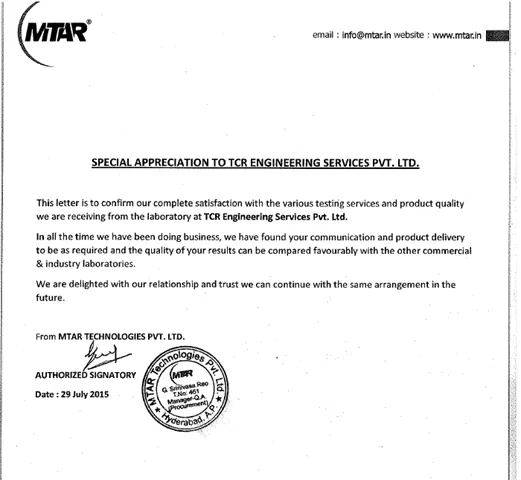
Further names in the aerospace and defence base are precision-component and forging suppliers to the space and defence programmes: MTAR Technologies, Sri Venkateswara Aerospace, Gemsons Precision Engineering, Shalco Industries, Bhukhanvala Industries, SE Forge and Bharat Aerospace Metals. The work runs to mechanical and metallurgical testing, fracture and fatigue testing, and qualification of flight- and mission-critical materials, and is the home of the NADCAP AC7101 Materials Testing programme.
Marquee Projects
| Project | Service Anchor | Year |
|---|---|---|
| Larsen and Toubro Defence IC for VSSC-ISRO | Rocket Motor Casing Hardware testing for the Chandrayaan-3 moon mission | 2023 |
| ISRO Project ASLV | Materials testing appreciation | Multiple |
| DRDO/NMRL | Long-term contract for naval materials testing | Continuous |
| NPCIL | Elevated-temperature tensile (300/500/800 °C protocol; approval renewed February 2026) | 2013 to 2026 |
| SQuAD Forging | Aerospace SCC ASTM G47/G44 on 7xxx and 2xxx aluminium | 2025 to 2026 |
| HAL Bangalore, Nashik, Koraput, Lucknow | Materials testing, NDT, source inspection | Continuous |
| MIDHANI Hyderabad | Special-alloy materials testing and certification | Continuous |
| Bharat Forge (defence and aerospace forging) | Forging-grade material testing, hardness verification, microstructural evaluation | Continuous |
| Tata Advanced Systems Limited | Aerospace component materials testing | Continuous |
Planned Enhancements
Six enhancements are planned for 2026-27, each a gap TCR found by auditing this page against its own certificates. Dates are intentions, not commitments; accreditation decisions rest with PRI and NABL.
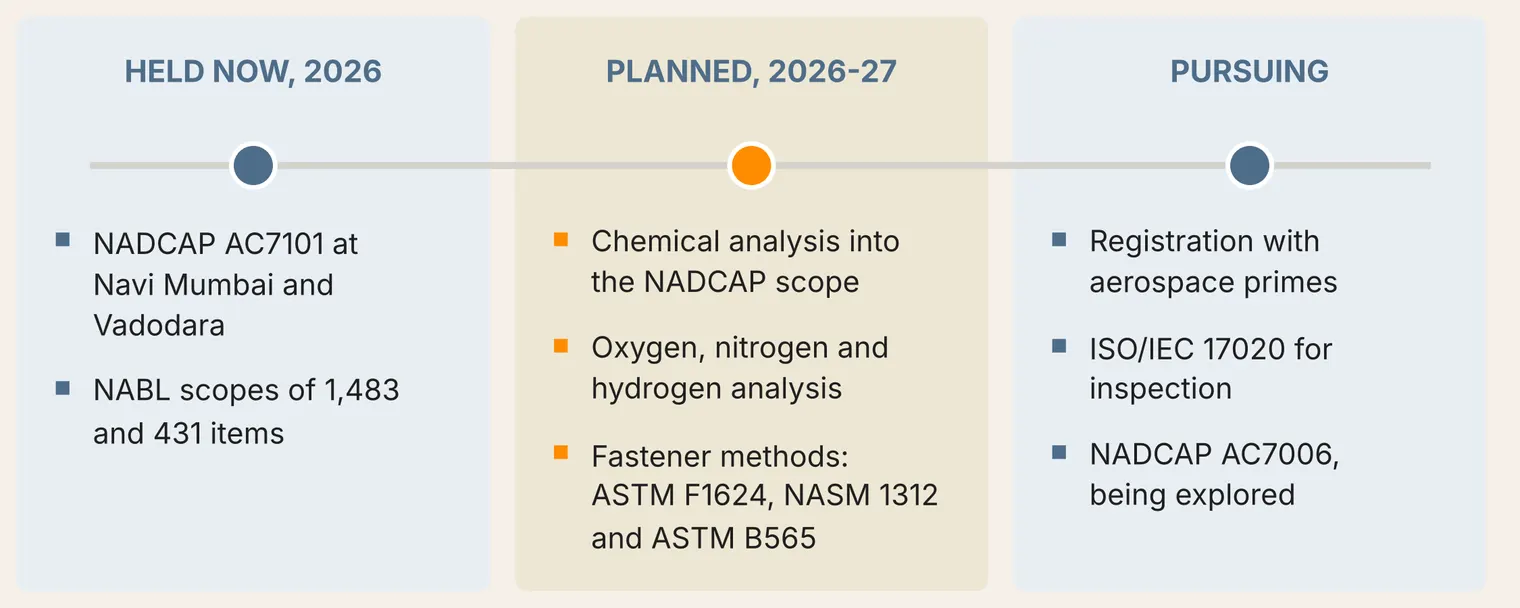
- Chemical analysis into the NADCAP scope. OES, ICP and combustion carbon and sulphur brought under AC7101, so composition and mechanical results travel under one aerospace accreditation.
- Interstitial gas analysis (LECO oxygen, nitrogen, hydrogen). ASTM E1409 and ASTM E1447 for titanium and superalloy melt verification and weld pickup.
- Fastener methods. ASTM F1624 incremental step-load hydrogen embrittlement, the NASM 1312 fastener test series, and ASTM B565 double shear of fasteners and rivets.
- ISO/IEC 17020 accreditation. Source inspection, witness and vendor audits under an inspection-body accreditation in their own right.
- NADCAP AC7006. Exploring the Nadcap laboratory accreditation programme aligned to ISO/IEC 17025, alongside the existing AC7101.
- Registration with aerospace primes. Supplier registration and approval with the primes whose specifications TCR already tests against. No prime approval is held as at August 2026.
Film digitisation is already a current service, to ASME Section V Article 2 and ASTM E1936, the practice aerospace primes cite, with 250,000+ films scanned for IOCL and GAIL pipeline projects.
Documents
Download the reference documents for this page. Every file is hosted on this domain and is also listed in the site document library.
The aerospace capability, narrated
The aerospace presentation carried by this page, as a narrated film: what NADCAP AC7101 covers and what NABL ISO/IEC 17025 covers at Navi Mumbai and Vadodara, the test menu, the standards coverage and the marquee programmes. The same material is downloadable as a PDF in the Documents section above.
Related insights
5 published insights on this site carry the Aerospace tag. The 5 most recent are below.
-
Make in India, Test in India: Building a Resilient Domestic Quality Assurance Ecosystem for Aerospace Forgings, Castings and Machining
On India's 79th Independence Day, a region-by-region map of the 51 Indian facilities holding NADCAP heat treating accreditation, and the case for…
-
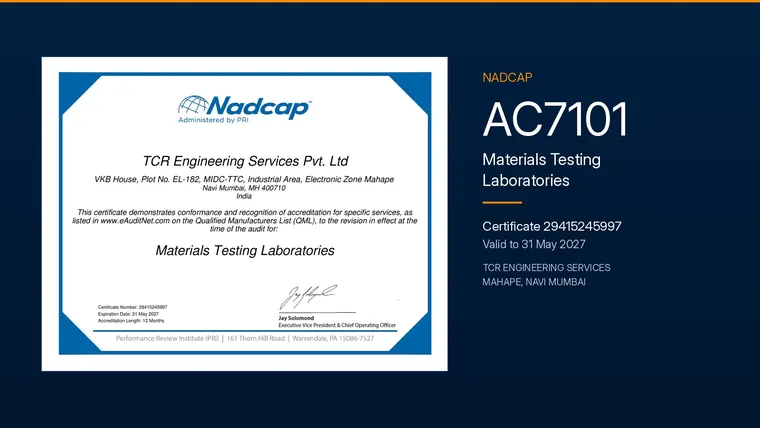
TCR becomes the first Indian group with two NADCAP AC7101 accredited laboratories: Navi Mumbai and Vadodara
NADCAP has accredited TCR Engineering at Navi Mumbai and TCR Advanced at Vadodara for Materials Testing Laboratories under AC7101. India has 51…
-
Stress Corrosion Cracking Testing of Aluminium Alloys: What ASTM G47 and G44 Mean for Aerospace Manufacturers in India
NABL-accredited ASTM G47 and G44 stress corrosion cracking testing for aerospace aluminium alloys at TCR Engineering, Navi Mumbai.
-
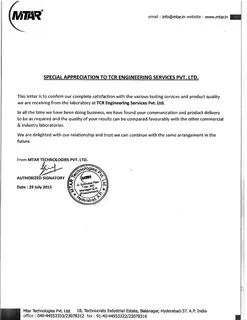
Appreciation letter from MTAR
TCR Engineering undertakes material testing at its lab in Mumbai for MTAR
-
TCR Celebrates the successful Mars Orbiter Mission
TCR contribution and award from ISRO for ASLV-D3 Rocket launched into space by India.
Frequently asked questions
Is TCR Engineering NADCAP accredited for aerospace materials testing?
Yes. TCR Engineering holds NADCAP AC7101 Materials Testing accreditation, awarded in 2026 under PRI certificate 29415245997 and valid to 31 May 2027. Within the group, TCR Advanced Engineering also holds NADCAP AC7101. TCR is the verification-testing partner for aerospace heat treaters and suppliers, not the heat treater.
Has TCR tested hardware for Indian space missions?
Yes. The rocket-motor casing hardware for the Chandrayaan-3 moon mission was tested through Larsen and Toubro Defence for VSSC-ISRO in 2023, with no non-conformity observed. The ISRO relationship runs back to Project ASLV, where TCR carried materials testing and earned ISRO's written appreciation.
What aerospace stress corrosion cracking and hydrogen embrittlement tests does TCR run?
Stress corrosion cracking on 7xxx and 2xxx aluminium runs per ASTM G47 alternate immersion and ASTM G44, with exfoliation corrosion per ASTM G34 and intergranular corrosion susceptibility per ASTM G67, all under NABL. Hydrogen embrittlement of plated and coated fasteners is tested per ASTM F519 and ASTM B577, with slow strain rate testing per ASTM G129. ASTM F1624 is on the roadmap; API 20E is tested to the customer’s specification on request.
Can TCR run fatigue and fracture toughness testing to aerospace standards?
Yes. The bench covers low-cycle fatigue per ASTM E606, high-cycle fatigue per ASTM E466, fatigue crack growth rate per ASTM E647, KIc per ASTM E399, JIc per ASTM E1820 and CTOD per BS 7448, including sub-zero temperature programmes for defence and naval aviation work.
Does TCR verify heat treatment for aerospace heat treaters?
Yes. Heat-treatment verification on samples from NADCAP-accredited heat treaters is core AC7101 scope: hardness traverse, microstructure, grain size per ASTM E112, case depth per SAE J423 methods and decarburisation depth per ASTM E1077, characterised against AMS 2750 and AMS-H-6875 acceptance criteria. Retained austenite is measured by X-ray diffraction under the quality management system, outside the accredited scope.
What is the difference between TCR’s NADCAP scope and its NABL scope?
NADCAP AC7101 covers the accredited checklists for mechanical testing (AC7101/3), metallography (AC7101/4), hardness and conductivity (AC7101/5) and specimen machining (AC7101/7, code Z); the NADCAP symbol appears only on parameters inside those checklists. The NABL ISO/IEC 17025:2017 scope is far wider: 1,483 items at Navi Mumbai and 431 at Vadodara, covering chemistry, fatigue, fracture toughness, stress corrosion cracking, hydrogen embrittlement, creep and corrosion. Work outside both, such as SEM fractography and retained austenite by XRD, runs under the quality management system and is reported without an accreditation symbol.
Is TCR approved by aerospace primes such as Boeing or Airbus?
No. No aerospace prime approval is held as at August 2026. TCR tests to prime specifications (Boeing BAC, Airbus AIPS, GE EM&S, Rolls-Royce RPS) on request, and registration with the primes is on the published roadmap.