

Services · Asset Integrity and Engineering Consulting
Risk-Based Inspection and Knowledge-Based Audit (KBA)
1,500+ boiler tube failure investigations, 400+ boiler remaining-life assignments, and IBR Well-Known Material Testing Laboratory recognition sit behind the audit. Chambal Fertilisers ran it across 51 items on the G-1 and Ammonia-I plants.
Request a Quote
In brief
TCR Engineering Services Pvt. Ltd., NABL ISO/IEC 17025:2017 accredited in Navi Mumbai, India, delivers risk-based inspection to API RP 580 and API RP 581 through its Knowledge-Based Audit. A multi-disciplinary panel reviews design, operating history, inspection findings and damage-mechanism susceptibility across boilers, heat exchangers, pressure vessels, reactors, piping and tanks.
KBA is not boiler-only. It applies to boilers, heat exchangers, pressure vessels, columns, reactors, reformer tubes, piping, and tanks. Boilers anchor the practice; they do not bound it.
Which standards govern risk-based inspection at TCR?
Risk-based inspection at TCR Engineering, part of its asset integrity and engineering consulting practice, works to API RP 580 and API RP 581, with the in-service inspection codes and integrity operating windows alongside. Representative engagement: Chambal Fertilisers G-1 and Ammonia-I plant, risk-based inspection with AiOM, TCR Advanced Engineering's asset integrity software, across 51 items.
- Risk-based inspection: API RP 580, 4th edition (2023), and API RP 581, 4th edition (January 2025).
- In-service inspection: API 510, API 570 and API 653.
- Integrity operating windows: API RP 584.
- Industry guidance: the Energy Institute Risk-Based Inspection Best Practice Guide.
What the Knowledge-Based Audit returns
A multi-disciplinary panel reviews equipment design, operating history, prior inspection findings, damage-mechanism susceptibility, and remaining-life curves, and issues a three-stream output:
| Stream | Action |
|---|---|
| Improve | Inspection interval revision, NDT method change, IOW tightening |
| Repair | Plug, weld overlay, sleeve, seal weld, partial replacement |
| Replace | Component replacement scheduled at next opportunity |
The evidence behind the audit
A Knowledge-Based Audit from TCR Engineering, Navi Mumbai, calibrates each risk judgement against documented failure histories rather than generic likelihood tables. The evidence behind it is the failure, remaining-life and microstructure record below, with the boiler-scope recognitions under the Indian Boiler Regulations that each TCR entity holds in its own right.
- 1,500+ boiler tube failure investigations.
- 400+ boiler RLA assignments.
- 100,000+ replicated microstructure reference database.
- IBR Well-Known Material Testing Laboratory recognition, with remnant life assessment recognition within the group held by TCR Advanced Engineering, Vadodara.
Where does the Knowledge-Based Audit apply?
TCR Engineering applies the Knowledge-Based Audit wherever pressure-boundary equipment ages in service: in power generation, refining, fertilisers, petrochemicals, chemical processing, steel and cross-country pipelines. Boilers anchor the practice rather than bound it, and the table names the units in each vertical that the audit covers.
| Vertical | KBA Application |
|---|---|
| Power generation | Sub-critical, supercritical and ultra-supercritical, CFBC, AFBC, HRSG, waste heat boilers, package boilers |
| Refining | FCCU, hydroprocessing, hydrocracker, alkylation, sulphur recovery |
| Fertilisers | Ammonia synthesis loop, urea reactor, primary and secondary reformer, granulation, prilling tower |
| Petrochemical | Olefins crackers, polymer reactors, aromatics, methanol, melamine |
| Chemical processing | Caustic-chlorine, agrochemical reactor trains, fine chemicals |
| Steel | Coke oven battery, blast furnace, BOF, continuous caster (refractory and pressure boundary scope) |
| Pipelines | Cross-country mainline, CGD, LNG terminal piping (cross-pillar with AiOM-CCP) |
What does a risk-based inspection to API RP 580 and API RP 581 establish?
A risk-based inspection to API RP 580 and API RP 581 establishes, for each equipment item, how likely it is to fail by its credible damage mechanisms and what that failure would mean for people, the environment and production. TCR Engineering then sets where, how and how often each item is inspected from its place in the risk ranking.
- Probability of failure: read from the active damage mechanisms, their rates and the inspection record the plant already holds.
- Consequence of failure: the safety, environmental and production outcome if the item loses containment.
- Risk ranking: every item placed on one probability and consequence scale, so inspection effort follows risk.
- Inspection plan: the method, coverage and interval for each item, set by its risk rather than by a fixed calendar.
- Integrity operating windows: the process limits, to API RP 584, within which the assumed damage rates stay valid.
API RP 580 sets out the elements a risk-based inspection programme must have; API RP 581 supplies the quantitative methodology for probability and consequence of failure. The Knowledge-Based Audit adds the multi-disciplinary panel and its improve, repair or replace output.
Knowledge-based inspection on video
Related insights
2 published insights on this site bear directly on Knowledge-Based Audit. They are below; the full index carries all 92 Asset Integrity insights.
-
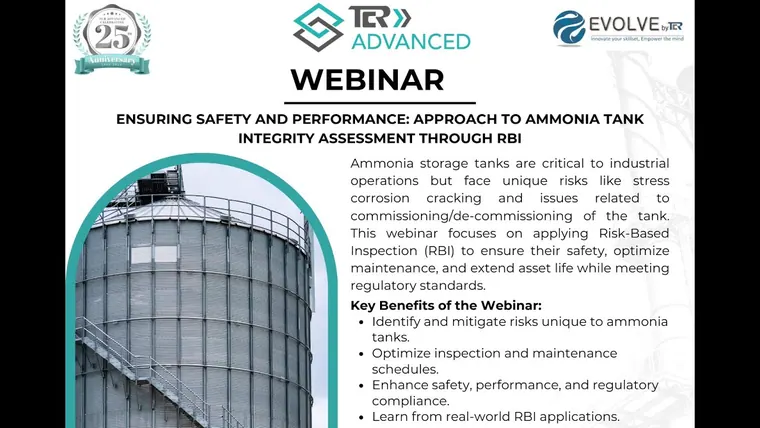
Ammonia Tank Integrity Using Risk-Based Inspection (RBI)
Optimise ammonia tank integrity with TCR's Risk-Based Inspection (RBI). Enhance safety, reduce downtime, and improve operational efficiency
-
Ammonia tanks Integrity management and inspection challenges
Providing insights to damage mechanisms associated with Ammonia tank and RBI to improve integrity
Frequently asked questions
What is a Knowledge-Based Audit?
A multi-disciplinary panel reviews equipment design, operating history, prior inspection findings, damage-mechanism susceptibility and remaining-life curves, then issues a three-stream output of improve, repair or replace, with revised inspection intervals and integrity operating windows.
Is KBA limited to boilers?
No. Boilers anchor the practice but do not bound it. KBA applies to boilers, heat exchangers, pressure vessels, columns, reactors, reformer tubes, piping and tanks, across power generation, refining, fertilisers, petrochemicals, chemical processing, steel plants and cross-country pipelines including city gas distribution and LNG terminal piping.
Which standards govern KBA?
API 580 and API 581 for risk-based inspection, API 510, API 570 and API 653 for in-service inspection, API RP 584 for integrity operating windows, and the Energy Institute Risk-Based Inspection Best Practice Guide. The boiler scope is backed by TCR Engineering's IBR Well-Known Material Testing Laboratory recognition, with remnant life assessment recognition within the group held by TCR Advanced Engineering, Vadodara.
What evidence base supports the audit?
The practice draws on 1,500+ boiler tube failure investigations, 400+ boiler Remaining Life Assessment assignments and a reference database of more than 100,000 replicated microstructures, so risk judgements are calibrated against documented failure histories rather than generic likelihood tables.
What is the difference between API RP 580 and API RP 581?
API RP 580, Elements of a Risk-Based Inspection Program, sets out what a risk-based inspection programme must contain and how it is managed. API RP 581, Risk-Based Inspection Methodology, gives the quantitative method for calculating probability and consequence of failure. TCR Engineering works to API RP 580, 4th edition (2023), and API RP 581, 4th edition (January 2025).
Is a Knowledge-Based Audit the same as risk-based inspection?
No. Risk-based inspection to API RP 580 and API RP 581 is the core of a Knowledge-Based Audit, but the audit goes further: a multi-disciplinary panel also reads equipment design, operating history and remaining-life curves, and issues an improve, repair or replace output with revised inspection intervals and integrity operating windows.