
Investors
A fifty-three-year operating record, under family ownership
Founded 1973. Woman-led since 2013. Four operating countries. No private-equity recapitalisation, no break-up of operating entities, no sale of the institutional database.
Investor overview
TCR Engineering Services Pvt. Ltd. is a family-owned materials testing, inspection and asset integrity group, founded 1973 in Mumbai, woman-led since 2013 and NABL ISO/IEC 17025:2017 accredited, serving 6,500+ clients from four operating countries through 750+ group employees, with joint ventures in Vadodara (TCR Advanced) and Dammam, Saudi Arabia (TCR Arabia), and alliances in Qatar, Japan and Malaysia.
The investment case
TCR Engineering is a fifty-three-year-old, family-owned testing, inspection and certification group operating in India, Saudi Arabia, Qatar and Kuwait from a NABL ISO/IEC 17025:2017 accredited base in Navi Mumbai, and reports on a single audited consolidated spine across all three operating entities.
- The business: a fifty-three-year-old, family-owned testing, inspection and certification group operating in India, Saudi Arabia, Qatar and Kuwait from a NABL ISO/IEC 17025:2017 accredited base in Navi Mumbai.
- The market: testing, inspection and certification is regulated, non-discretionary spend that tracks industrial investment almost one for one, and India is one of its fastest-growing markets. Sized under Where this industry is going.
- The position: non-destructive testing, materials testing, failure analysis, remaining-life assessment and regulatory submission sold as one integrated scope under a single accredited signature, which is harder to assemble than any one part and stickier to displace.
- The reporting: one consolidated financial spine across TCR Engineering, TCR Advanced and TCR Arabia, on statutory audited accounts, described under How the Board sees the business.
- The listed partner: GAS Arabian Services, Tadawul 4146, already reports publicly on the Saudi joint venture, in which it holds 40 percent.
Where this industry is going
The work itself is changing: away from routine commodity testing, toward remaining-life assessment, fitness-for-service, risk-based inspection and AI-assisted integrity. The houses that win the next decade will be integrated, accredited and data-rich, trusted at both ends of the transaction. TCR is built for that end of the market, not the volume end.
India is one of the fastest-growing markets in it. Mordor Intelligence projects the Indian TIC market to grow through 2030 (market-size estimates vary widely by definition, and this is one house's view). A large share of the work is still done in-house by asset owners, and that unconverted share, not the outsourced base, is the structural runway. The demand mix moves with it because industrial fleets are ageing faster than they are being replaced, and regulators are tightening what an owner must be able to prove.
Trade agreements remove tariffs but not conformity. Four now reach most of India's high-value export demand: the Economic Cooperation and Trade Agreement with Australia, in force since 29 December 2022 and being widened towards a full CECA; the Comprehensive Economic and Trade Agreement with the United Kingdom, in force since 15 July 2026; the free trade agreement with the European Union, whose negotiations concluded on 27 January 2026; and the interim reciprocal trade agreement framework with the United States, announced on 6 February 2026. A buyer in London, Rotterdam or Sydney who no longer pays duty on an Indian casting still asks for the chemistry, the mechanical properties and the restricted-substance content, on an accredited report. A result issued under NABL accreditation to ISO/IEC 17025:2017 is covered by the ILAC mutual recognition arrangement and is accepted in more than ninety economies without a retest on arrival.
Two engines drive TCR's position in that shift. In India, the industrial and infrastructure build-out, high-speed rail, the pipeline grid, coastal and metro civil work, and a domestic aerospace and defence supply chain that TCR can serve because it holds NADCAP AC7101 Materials Testing accreditation (PRI certificate 29415245997, valid to 31 May 2027). In the Gulf, Saudi Vision 2030 and its in-Kingdom localisation rules, served through TCR Arabia in Dammam, Jubail and Yanbu. Japan and Malaysia are served through named technology and surveying alliances rather than capital deployment, which is the group's deliberate pattern for reach without balance-sheet risk.
Aligned with the national quality mission
India's national quality mission is TCR's operating brief. Zero defect is not an attitude. It is a measurement, made in an accredited laboratory, traceable to national standards, and signed by someone accountable for it. That proof is our product.
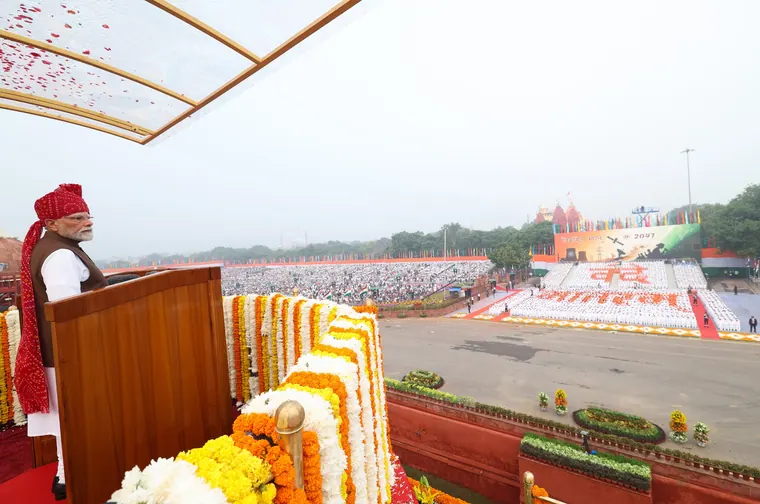
“Our zero-defect precision manufacturing should become our hallmark. I want to say to every manufacturer, every entrepreneur, every MSME, our identity in the global market should be based on credibility and quality. No compromise regarding quality and hence our mantra should be quality, quality, quality. This will become our global brand value.”
Prime Minister Narendra Modi, Red Fort, 80th Independence Day, 15 August 2026
The arithmetic behind that instruction is the market TCR sells into. India has set a target of raising manufacturing's share of GDP by 2047, and MSMEs carry a large share of its exports. Those exporters must now satisfy buyers who no longer pay a tariff but still demand conformity. A larger manufacturing economy needs testing capacity, accredited scope and qualified metallurgists in a quantity India does not yet have. TCR has been building that quality infrastructure since 1973, fifty-three years before it was named as a national mantra from the Red Fort.
The full argument, with the numbers and the four trade agreements set out in detail, is in Quality, Quality, Quality: The Prime Minister's Zero-Defect Mantra and What It Asks of Indian Manufacturing.
Financial metrics, measured like our lab work
We apply the laboratory's standards to our own accounts. Every figure the group manages by carries its status, audited, provisional or management accounts, never blurred, because a number without its tolerance is not a measurement.
EBITDA is computed one way, stated openly, and never mixed with adjusted bases in the same table. Receivables are measured in days sales outstanding and reported monthly, ageing included. The group maintains a continuous financial spine running back through nineteen audited years for each Indian entity, and to the founding of the Saudi joint venture, on statutory audited accounts. When we present a number to our Board, our bankers or a counterparty, its lineage runs unbroken from the accounting ledger to the page.
A firm that signs reports for a living cannot run two standards of honesty, one for its clients and a softer one for its own accounts. Transparency is the first word of the TCR tagline for that reason. It is a metrological commitment, not a marketing one, and it is a management-system property here rather than a claim.
How the Board sees the business
Each operating company closes its books monthly and reports through a financial command centre: an interactive dashboard carrying the entity's full audited history, the current year month by month, revenue by branch and service line, margins, collections, order intake, receivables ageing and utilisation, every figure traceable to source.
A one-page board report is produced from the same data spine every month, stating plainly what is working and what needs attention. Above the three companies sits a group command centre that aggregates the spine and lets the Board examine capital allocation, liquidity and value creation across the group on live assumptions.
The same discipline reaches every employee. The financial position is not a board-only document: a senior leader presents it, with the audit and accreditation outcomes and the client wins and losses, at a company-wide town hall every month, open to questions, with nothing filtered and nothing submitted in advance.
Group structure
The group operates through a parent laboratory in Navi Mumbai and two principal operating ventures, with a training academy and market-representation alliances extending reach across the GCC and Southeast Asia.
| Entity | Ownership | Headquarters | Role |
|---|---|---|---|
| TCR Engineering Services Pvt. Ltd. | Parent (100%) | Mahape, Navi Mumbai | Parent laboratory; materials testing, NDT, civil, pipeline RT, third-party inspection |
| TCR Arabia Company Limited | 60% TCR / 40% GAS Arabian Services (Tadawul: 4146) | King Abdulaziz Seaport Facility, Dammam, KSA | JV est. 2007; testing, NDT, asset integrity, training; branches in Dammam, Jubail, Yanbu |
| TCR Advanced Engineering Pvt. Ltd. | 50% TCR / 50% Haribhakti family | Makarpura GIDC, Vadodara | Asset integrity and engineering consulting, contract R&D |
| Evolve by TCR | TCR Advanced subsidiary | Vasna Road, Vadodara | Training academy, est. 2017 |
TCR Qatar is a market-representation alliance operated by BIEWU International Trading W.L.L., Doha. Japan is served through the alliance with Chugai Technos Corporation, Hiroshima, and Malaysia through the alliance with Approved Group International, Batu Caves, Selangor. Kuwait is a served operating country. None of the four is a subsidiary.
The group is listed on Crunchbase as TCR Engineering Services Pvt. Ltd., and its Legal Entity Identifier 335800LR5UPHQB6W5P18 is on the GLEIF register. Corporate particulars, including CIN U28920MH1973PTC016780, are filed with the Ministry of Corporate Affairs.
Family-Owned Continuity
Ownership is closed-loop. Family promoter holdings dominate, with strategic operating-partner presence at TCR Arabia (GAS Arabian Services, 40 percent of the KSA JV). There is no private-equity exit overhanging the business, no rotating-equipment field-services overlay that would dilute the static-equipment specialist line, and no sale of the institutional database. This page makes no representation about bank borrowing.
- Ownership: closed-loop, with family promoter holdings dominant.
- Strategic operating partner: GAS Arabian Services, 40 percent of the KSA joint venture.
- No private-equity exit overhanging the business.
- No rotating-equipment field-services overlay that would dilute the static-equipment specialism.
The business is built to keep producing technical work fifty years from now.
Related insights
One published insight on this site bears directly on the market TCR sells into and the credentials it sells on. It is below; the full archive is at Insights.
-
Quality, Quality, Quality: The Prime Minister's Zero-Defect Mantra and What It Asks of Indian Manufacturing
On 15 August 2026 the Prime Minister told every manufacturer, entrepreneur and MSME that India's identity in the global market must rest on…
Investor enquiries
Investor and institutional enquiries are handled by the President's office in Navi Mumbai at investor@tcreng.com. Write with your firm, mandate and area of interest, and the right member of the leadership team will respond.
Qualified investors receive access to a structured data room built from the same reporting spine described above.