
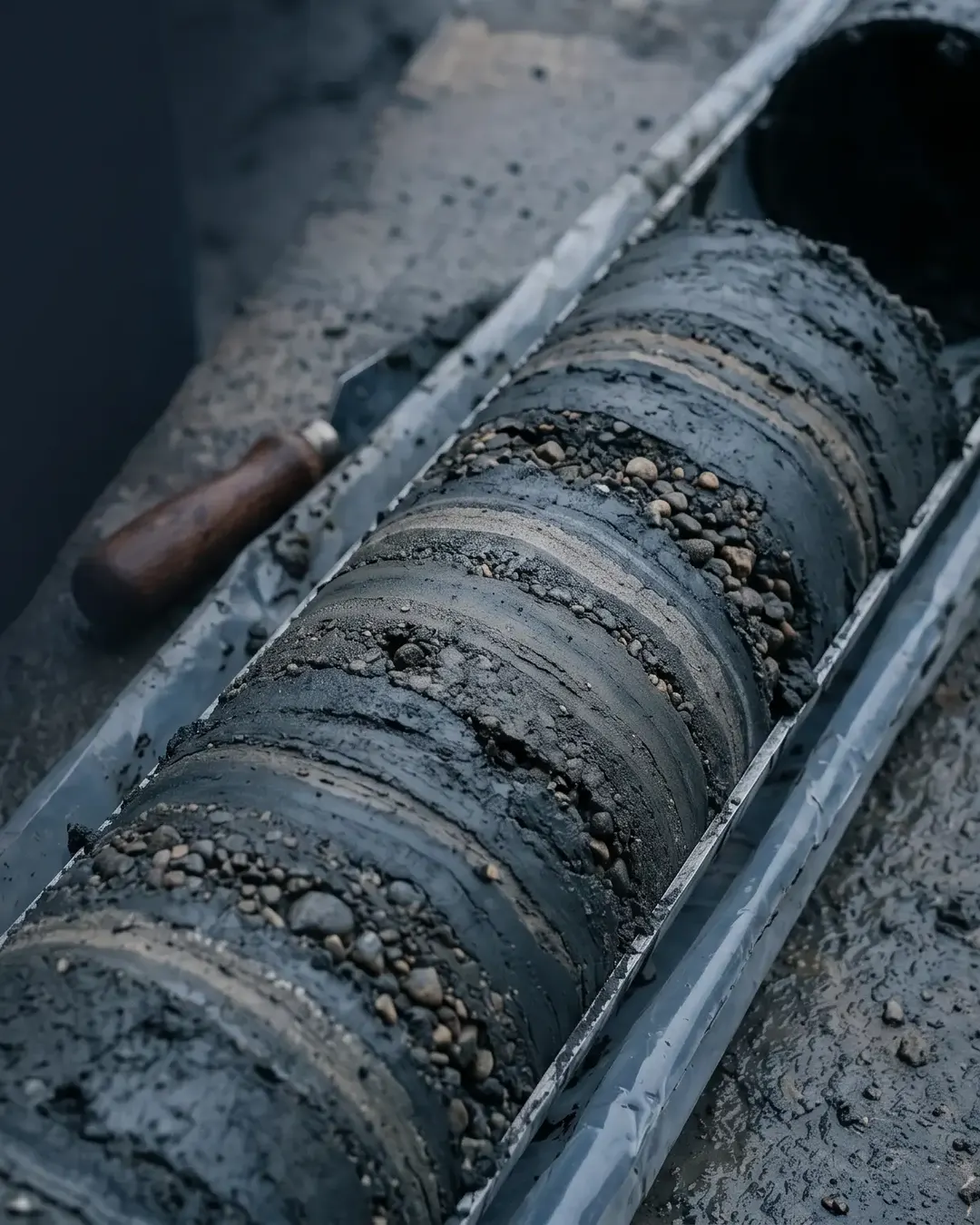
Services · Civil and Infrastructure Testing
Soil Testing Lab and Geotechnical Testing per IS 2720
Geotechnical acceptance runs on the IS 2720 series with IS 4332, cross-referenced to ASTM D1883 for CBR, ASTM D698 for Standard Proctor, ASTM D4318 for consistency limits, and AASHTO T89 and T180 where the project specification calls for them.
Request a Quote
In brief
TCR Engineering Services Pvt. Ltd. runs a soil testing lab in Navi Mumbai for construction projects across India: triaxial, direct shear, CBR, Proctor compaction, Atterberg limits and plate load tests to the IS 2720 series, ASTM and AASHTO. Soil chemistry (pH, organic matter, sulphate, chloride, calcium carbonate) is within NABL certificate NABLT0726MH18640; the mechanical tests are outside it.
The laboratory and field teams run triaxial, direct shear, California Bearing Ratio (CBR), Standard and Modified Proctor compaction, Atterberg limits, sieve and hydrometer particle-size analysis, plate load, in-situ density (sand replacement and core cutter) and unconfined compressive strength tests.
How TCR Tests Soil and Ground
TCR performs soil and geotechnical testing for construction and infrastructure projects across India: shear strength, bearing ratio, compaction, plasticity, particle size, in-situ density, and unconfined compressive strength.
- Shear strength: triaxial and direct shear.
- Subgrade strength: California Bearing Ratio.
- Compaction: Standard Proctor and Modified Proctor for the moisture-density relationship.
- Plasticity: Atterberg limits.
- Particle size: sieve analysis and hydrometer.
- Also covered: in-situ density and unconfined compressive strength.
The scope covers triaxial and direct shear for shear-strength parameters, California Bearing Ratio (CBR) for subgrade strength, Standard Proctor and Modified Proctor compaction for the moisture-density relationship, Atterberg limits for plasticity, sieve analysis and hydrometer for particle size, plate load testing, in-situ density by sand replacement and core cutter, and unconfined compressive strength.
Governing Standards
The geotechnical scope is governed by the IS 2720 series for methods of test for soils, alongside the ASTM and AASHTO designations below.
| Method | What it measures | Standard |
|---|---|---|
| California Bearing Ratio (CBR) | Subgrade and pavement bearing strength | IS 2720 series, ASTM D1883 |
| Standard and Modified Proctor compaction | Moisture-density relationship | ASTM D698, AASHTO T180 |
| Atterberg limits | Liquid and plastic limits, plasticity | ASTM D4318, AASHTO T89 |
| Triaxial and direct shear | Shear-strength parameters | IS 2720 series |
| Particle size (sieve and hydrometer) | Grain-size distribution | IS 2720 series |
| In-situ density (sand replacement, core cutter) | Field compaction control | IS 2720 series |
| Stabilised soil testing | Treated-soil performance | IS 4332 |
Where TCR Tests Ground Conditions
TCR's soil and geotechnical testing supports major infrastructure builds, including the Mumbai-Ahmedabad High Speed Rail packages under NHSRCL and the Larsen and Toubro Mumbai Metro.
- Mumbai-Ahmedabad High Speed Rail: the NHSRCL packages.
- Larsen and Toubro Mumbai Metro.
- Delivered together: soil testing alongside concrete, rebar coupler and structural NDT, so the ground investigation and the structural materials pass through one accredited laboratory.
On these projects, soil testing runs alongside concrete, rebar coupler, and structural NDT work, so the ground investigation and the structural materials pass through one accredited laboratory.
Which Soil Tests Does a Construction Project Need?
The foundation design and the project specification set the list, and a typical pre-construction set answers four questions: what the soil is, how strong it is, how well it compacts, and how aggressive it is to concrete and steel. At TCR Engineering, the soil chemistry and rock tests marked below carry NABL accreditation; the mechanical soil tests do not.
| Question | Tests | Standard | NABL certificate NABLT0726MH18640 |
|---|---|---|---|
| What the soil is | Particle size (sieve and hydrometer), Atterberg limits | IS 2720 series, ASTM D4318, AASHTO T89 | Not on the scope |
| How strong it is | Triaxial, direct shear, unconfined compressive strength of soil | IS 2720 series | Not on the scope |
| How it bears in the field | Plate load test | Named in the project specification | Not on the scope |
| How well it compacts | Standard and Modified Proctor, California Bearing Ratio, in-situ density (sand replacement, core cutter) | ASTM D698, AASHTO T180, ASTM D1883, IS 2720 series | Not on the scope |
| How aggressive it is to concrete and steel | pH, organic matter, total soluble sulphate, calcium carbonate, chloride | IS 2720 (Parts 26, 22, 27 and 23), BS 1377 (Part 3) | Within the scope |
| How strong the rock is at founding level | Unconfined compressive strength, porosity and water absorption of rock | IS 9143, IS 1124 | Within the scope |
Related insights
1 published insight on this site bears directly on Soil and Geotechnical. It is below; the full index carries all 43 Civil & Structural Testing insights.
-
Solid Foundation starts with accurate Soil Testing
Start your project right by ensuring the foundational soil is fully analysed and understood.
Read all 43 Civil & Structural Testing insights →All insights →
Frequently asked questions
What soil tests does TCR perform?
Triaxial, direct shear, California Bearing Ratio, Standard and Modified Proctor compaction, Atterberg limits, particle size, plate load, in-situ density, and unconfined compressive strength.
Which standards govern the CBR and Proctor tests?
The IS 2720 series, ASTM D1883 for CBR, ASTM D698 for Standard Proctor, and AASHTO T180.
How is in-situ density measured on site?
By the sand replacement and core cutter methods, for field compaction control.
Where has TCR done geotechnical testing?
On the Mumbai-Ahmedabad High Speed Rail packages under NHSRCL and the Larsen and Toubro Mumbai Metro, alongside concrete and rebar testing.
Which soil tests are within TCR's NABL scope?
The soil chemistry tests are within TCR Engineering's NABL certificate NABLT0726MH18640: pH, organic matter, total soluble sulphate and calcium carbonate content to IS 2720, and chloride content to BS 1377 (Part 3), with rock unconfined compressive strength to IS 9143. Triaxial, direct shear, CBR, Proctor, Atterberg limits and plate load tests are not on the scope.
Which soil tests are needed before construction?
The foundation design and the project specification set the list. A typical pre-construction set classifies the soil by particle size and Atterberg limits, measures its strength by triaxial, direct shear or plate load, sets compaction targets by Proctor and CBR, and checks sulphate, chloride and pH, which decide how aggressive the ground is to concrete and steel.