
Industries
Steel and Metals
In-Situ Metallography and Furnace Life Assessment
Blast-furnace relines are decided on condition data, not calendars. TCR reads that data in the plant: in-situ metallography on live equipment, failure analysis of rolls, bearings and furnace components, and remaining-life assessment of reheating furnaces.
Request a QuoteIn brief
TCR tests and certifies steel and inspects the plant that makes it. India’s integrated steel majors, among them Tata Steel, JSW, SAIL, RINL, Jindal Steel & Power and ArcelorMittal Nippon Steel, route incoming raw material and finished product certification through TCR’s classical wet-chemistry laboratory, while ARTiS inspects sponge-iron reformer tubes from Bhilai to Emirates Steel, Abu Dhabi.
Key takeaways
- 9 plant sections, from the coke oven battery to storage and handling, and 8 families of damage mechanism are covered below.
- Steel is tested to ASTM, EN, JIS and IS specifications, among them ASTM A36, A572 and A588 structural steels, A516 and A537 pressure-vessel plate, and A335 and A213 chrome-moly piping and tubes for captive power; the full standards matrix is below.
- 5 marquee engagements are documented on this page, among them ARTiS reformer tube inspection on DRP1 and DRP2 at Emirates Steel Industries, Abu Dhabi, in 2025.
Overview
A steel works needs two things from a laboratory: independent certification of what it buys and sells, and condition data on the furnaces, casters, mills, reformers and captive boilers that make the steel. TCR supplies both, and investigates the failures in between.
- Failures investigated: blast-furnace hearth and copper-plate cracking, coke-oven refractory failure, caster and mill-component fatigue, direct-reduction reformer-tube creep, and captive-boiler tube failures.
- Mechanisms: refractory wear, carburisation, nitriding, metal dusting, and bearing and roll fatigue, with ARTiS on sponge-iron reformer tubes and failure analysis to establish the root cause.
Industry Context
In steel, maintenance events are earnings events. Tata Steel's reline of the G blast furnace at Jamshedpur pulled India's crude steel output down about three percent quarter on quarter in Q4 FY25, and the Blast Furnace 6 reline in the Netherlands drove that region to an EBITDA loss on higher maintenance, spares and capex in FY25.
- Capacity path: from approximately 145 MTPA of installed crude-steel capacity in FY24 to 300 MTPA by 2030 to 2035 under the National Steel Policy.
- Projects in flight: Tata Steel (Kalinganagar Phase II, Meramandali), JSW Steel (Vijayanagar Phase II, Dolvi expansion), SAIL modernisation at Bhilai, Bokaro, Rourkela, Durgapur and IISCO Burnpur, ArcelorMittal Nippon Steel India (Hazira expansion to 15 MTPA), the Vedanta ESL Bokaro programme, and the Tata Steel and JSW Steel hydrogen-DRP demonstration projects.
- Three integrity-load drivers: blast-furnace and coke-oven assets, some now beyond 30 years of operating life; the Direct Reduction Plant sponge-iron route, whose reformer tubes are inspected with ARTiS as in fertiliser plants; and the captive power and waste-heat boilers inside the works, assessed with TCR's boiler RLA practice.
- Chemistry demand: every integrated producer certifies incoming iron ore, coke, limestone, dolomite and alloying additions, and outgoing HR coil, CR coil, plate, structural sections, special bar and wire rod, a large pool of classical wet-chemistry work that matches TCR's chemical analysis capacity.
- Green steel and new scope: hydrogen-based direct reduction brings API 941 high temperature hydrogen attack assessment to carbon and low-alloy steel equipment in hot hydrogen process-gas service; carbon capture on BOF flue gas brings amine-system corrosion qualification; electric arc furnace expansion brings refractory and shell qualification; solar PV at plant sites brings structural-steel testing of module-mounting structures; and hydrogen blending in coke-oven gas brings qualification of equipment prone to hydrogen attack.
Blast furnace campaign-life decisions rest on condition data: refractory state, shell integrity and the metallurgical health of hot equipment. TCR supplies it through in-situ metallography on live plant, failure analysis of rolls, bearings and furnace components, refractory and materials testing, and remaining life assessment of reheating furnaces and process equipment across integrated and secondary steel, a workload that will run for decades on the existing fleet alongside green-steel capex.
Plant Sections We Inspect
TCR inspects nine clusters of a steel works, from the coke oven battery and blast furnace through casting and rolling to the direct reduction plant, the captive power plant and storage and handling.
| Cluster | Equipment |
|---|---|
| Coke Oven Battery | Oven wall (silica refractory), regenerator, coke-side door, push-side door, ascension pipe, gas main, by-product plant (ammonia, tar, naphthalene, BTX) |
| Sinter Plant | Sinter strand, mixing drum, ignition furnace, cooler, dust-collection system |
| Blast Furnace | Hearth, bosh, stack, throat, hot-blast stove, bustle pipe, tuyere, copper plate, downcomer, gas-cleaning plant |
| Basic Oxygen Furnace | Vessel shell, refractory, lance, hood, off-gas duct, fume extraction |
| Continuous Casting | Mould, secondary cooling, segments, drive rollers, withdrawal-and-straightening unit, oscillator |
| Direct Reduction Plant (DRP) | Reformer, sponge-iron shaft furnace, briquetting machine, gas reforming, top-gas scrubber |
| Hot Rolling and Cold Rolling | Reheating furnace, walking-beam reheating furnace, descaling, roughing mill, finishing mill, runout table, coiler, pickling line, cold mill, annealing line |
| Captive Power Plant | Boiler, turbine, condenser, ESP, coal-handling plant |
| Storage and Handling | Crude-steel ladle, tundish, refractory bricks, copper conductor (electric arc furnace adjacent) |
Damage Mechanisms We Investigate
Damage in a steel works is set by the equipment: refractory wear in the coke oven, blast furnace and BOF, bearing and roll fatigue in the caster and mills, and creep and carburisation in DRP reformer tubes. Failure analysis establishes which mechanism acted.
| Equipment | Mechanisms |
|---|---|
| Coke oven | Refractory wear and spalling, oven-wall slump, ascension pipe corrosion, gas main fouling, by-product plant amine corrosion |
| Blast furnace | Hearth wear (the critical operating constraint), copper plate cracking, stove refractory degradation, downcomer cracking, gas-cleaning plant corrosion |
| BOF | Refractory wear, vessel-shell external corrosion, hood and off-gas duct erosion-corrosion |
| Continuous caster | Mould-copper-plate wear, segment bearing failure, oscillator drive-bearing fatigue, descaling-spray nozzle erosion |
| DRP reformer | Creep on radiant tubes (HK40, HP-Mod, HP-Nb), carburisation, nitriding, metal dusting, pigtail and manifold creep |
| Reheating furnace | Refractory degradation, skid-rail heat loss, recuperator fouling, scale formation on charge |
| Hot rolling | Roll bearing fatigue, mill-stand chock failure, roll-cooling spray erosion |
| Captive boiler | Boiler tube failure from waterside hydrogen damage under deposits; creep |
Standards Coverage Matrix
- Steel Materials
- ASTM A36 / A572 / A588 (structural); ASTM A516 / A537 (pressure-vessel plate); ASTM A335 / A213 (chrome-moly piping and tubes for captive power); ASTM A572 (high-strength low-alloy structural); IS 2062 (structural steel for general construction); IS 1786 (high-strength deformed steel bars and wires for concrete reinforcement, under TCR's BIS-accredited rebar testing capability); IS 1239 (steel tubes for structural and water purposes); IS 1875 (forging-grade carbon and alloy steel).
- Refractory
- ASTM C155 (insulating firebrick); ASTM C24 (refractory pyrometric cone equivalent); IS 8 (firebrick); IS 1528 (sampling and testing of refractory materials).
- Welding
- ASME Section IX 2023; AWS D1.1 2025 (structural welding code, steel); AWS D1.5 (bridge welding); IS 7318 (welder qualification to Indian standards); EN ISO 9606 series.
- FFS / RBI / RLA
- API 579-1/ASME FFS-1 4th ed. (2021); BS 7910; API 580 / 581 4th ed. (January 2025).
- Inspection Codes
- API 510, 570 and 653, where pressure-vessel, piping and tank scope is in play.
- Composition
- ASTM E1086, E415, E1019, E1479, E350-E353 series; IS 228 series; EN 10204 Type 2.2, 3.1, 3.2; SAE/ASTM Unified Numbering System (UNS) per the Casti Metals Red Book and Metals Black Book references; SAE ferrous and non-ferrous specifications.
Service Applications Across the TCR Continuum
A steel plant is simultaneously a producer and a heavy consumer of integrity services. On the production side, the plant certifies its own product, and TCR's role is independent verification: mechanical, chemical, and metallurgical testing of primary steels to ASTM, EN, JIS, and IS specifications.
On the asset side, the plant carries some of the harshest equipment duty in industry: blast furnace shells and stoves, basic oxygen furnace and electric arc furnace hoods, ladles and tundish structures, caster segments, reheating furnace tubes in creep service, rolling mill rolls and gearboxes, and direct reduced iron reformers running the same creep and carburisation mechanisms as fertiliser reformers. Shutdown windows are set by campaign life and relines; procurement risk sits in rolls, refractories, castings, and spares. TCR Engineering and TCR Advanced serve all five stages of TCR's Trusted Relationship Model (see Why TCR) for integrated, secondary, and direct reduction producers.
- Stage One, Sourcing and Procurement
- TCR qualifies rolls, castings, forgings, refractory anchor systems, and structural steel through mechanical, chemical, and metallurgical testing, runs vendor factory audits and original equipment manufacturer qualification for mill equipment, and verifies incoming ferroalloys, scrap-mix inputs, and consumables through the chemical analysis laboratory, with sample picking and loading supervision on high-value procurement.
- Stage Two, Construction and Commissioning
- During expansion projects, mill revamps, and furnace rebuilds, TCR provides baseline non-destructive testing on structural steel and pressure systems, welder certification and procedure qualification per ASME Boiler and Pressure Vessel Code Section IX and AWS D1.1, radiography and ultrasonic testing of critical welds, post-weld heat treatment, and positive material identification, so the rebuilt asset starts its campaign with a documented baseline.
- Stage Three, In-Service
- In operation, TCR deploys thermography of furnace shells, ladles, and torpedo cars for refractory hotspot detection, thickness monitoring of gas cleaning plant and ducting, remote visual inspection of stacks and confined spaces, and oxide scale and corrosion mapping on boiler and power block equipment in captive plants, with risk-based inspection planning per API RP 580 principles adapted to metallurgical plant equipment.
- Stage Four, Shutdown and Turnaround
- During relines, capital shutdowns, and mill stops, TCR inspects blast furnace shell welds, hood and lance systems, crane girders and structural members, reheating furnace tubes with in-situ metallographic replication, direct reduced iron reformer tubes with ARTiS (as deployed at Emirates Steel Industries on DRP1 and DRP2), and captive power boiler pressure parts, supported by turnaround inspection manpower.
- Stage Five, Continuum
- The engineering stage delivers failure analysis of rolls, gears, shafts, and furnace components, remaining life assessment of reheating furnaces, reformers, and captive boilers, fitness for service per API 579-1/ASME FFS-1 on pressure systems, structural stability assessment of ageing mill buildings and crane structures, and contract research including hydrogen-based direct reduced iron materials questions that carry the plant into low-carbon steelmaking.
Named Clients
The steel and metals client base spans six groups: the Indian integrated steel producers, the speciality steel makers, the captive power plants inside steel works, the steel forging and casting suppliers, international operators, and the EPC contractors and equipment OEMs that serve them. Each group and its named organisations follow.
- India Integrated Steel Producers
- Tata Steel (Jamshedpur, Kalinganagar, Meramandali, Tata Steel Long Products), JSW Steel (Vijayanagar, Dolvi, Salem, Salav), Steel Authority of India (Bhilai, Bokaro, Rourkela, Durgapur, IISCO Burnpur), Rashtriya Ispat Nigam Limited (Visakhapatnam Steel Plant), Jindal Steel and Power (Raigarh, Angul), ArcelorMittal Nippon Steel India (Hazira), Vedanta ESL (Bokaro), Jindal Saw (Hisar, Mundra), Welspun (Anjar), MAN Industries.
- India Speciality Steel
- Mukund Limited, Sunflag Iron and Steel, Mahindra Sanyo Special Steel, Jayaswal Neco, Usha Martin (wire rod and special bar).
- Captive Power within Steel
- Tata Steel captive 405 MW (Jamshedpur), JSW Steel captive across multiple sites, SAIL captive across all integrated plants, Vedanta Aluminium Jharsuguda 4 x 600 MW IPP.
- India Steel and Forging
- Bharat Forge, ArcelorMittal Nippon Steel India, Maharashtra Seamless, Investment and Precision Castings, Gala Precision Engineering, Dextra India and Azad Engineering, with work across mechanical testing, metallography, chemical analysis and failure analysis.
- International
- Emirates Steel Industries Abu Dhabi (DRP1 and DRP2 ARTiS, 2025), HADEED KSA, ALBA Bahrain, POSCO India.
- EPC and Equipment OEMs
- Larsen and Toubro, Tata Projects (the JSOL Coke Oven Battery 5 and 6 PWHT engagement; JSOL Blast Furnace 2 PWHT), Power Mech Projects, Danieli, SMS Group, Primetals Technologies.
Marquee Projects
The steel and metals record covers ARTiS reformer-tube inspection at Emirates Steel in Abu Dhabi, post-weld heat treatment on Tata Projects' JSOL coke oven batteries 5 and 6, and pipe-mill work at Jindal Saw, MAN Industries and Welspun. Project, service anchor and year follow.
| Project | Service Anchor | Year |
|---|---|---|
| Emirates Steel Industries, Abu Dhabi | ARTiS reformer tube inspection, DRP1 and DRP2 | 2025 |
| Tata Projects JSOL Coke Oven Battery 5 and 6 | PWHT engagement | 2023 to 2025 |
| Jindal Saw, MAN Industries, Welspun | Source inspection and material certification on line-pipe production | Continuous |
| Statue of Unity, Larsen and Toubro | Mechanical, chemical, metallurgical, NDT through construction | Construction era |
| Aditya Birla Hindalco Dahej | Crane FEA stress analysis | December 2024 |
ARTiS inspects sponge-iron and direct-reduction reformer tubes from Bhilai to Abu Dhabi, and Welspun Maxsteel at Alibaug is among the in-situ metallography clients.
Documents
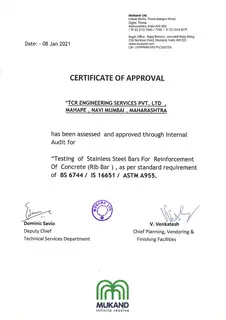
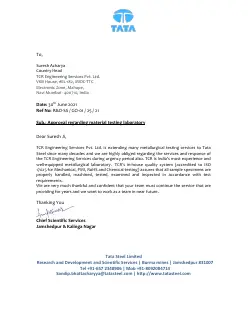
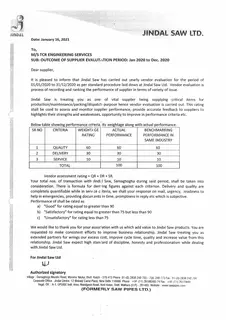
Download the reference documents for this page. Every file is hosted on this domain and is also listed in the site document library.
Related insights
13 published insights on this site carry the Steel & Metals tag. The 6 most recent are below.
-
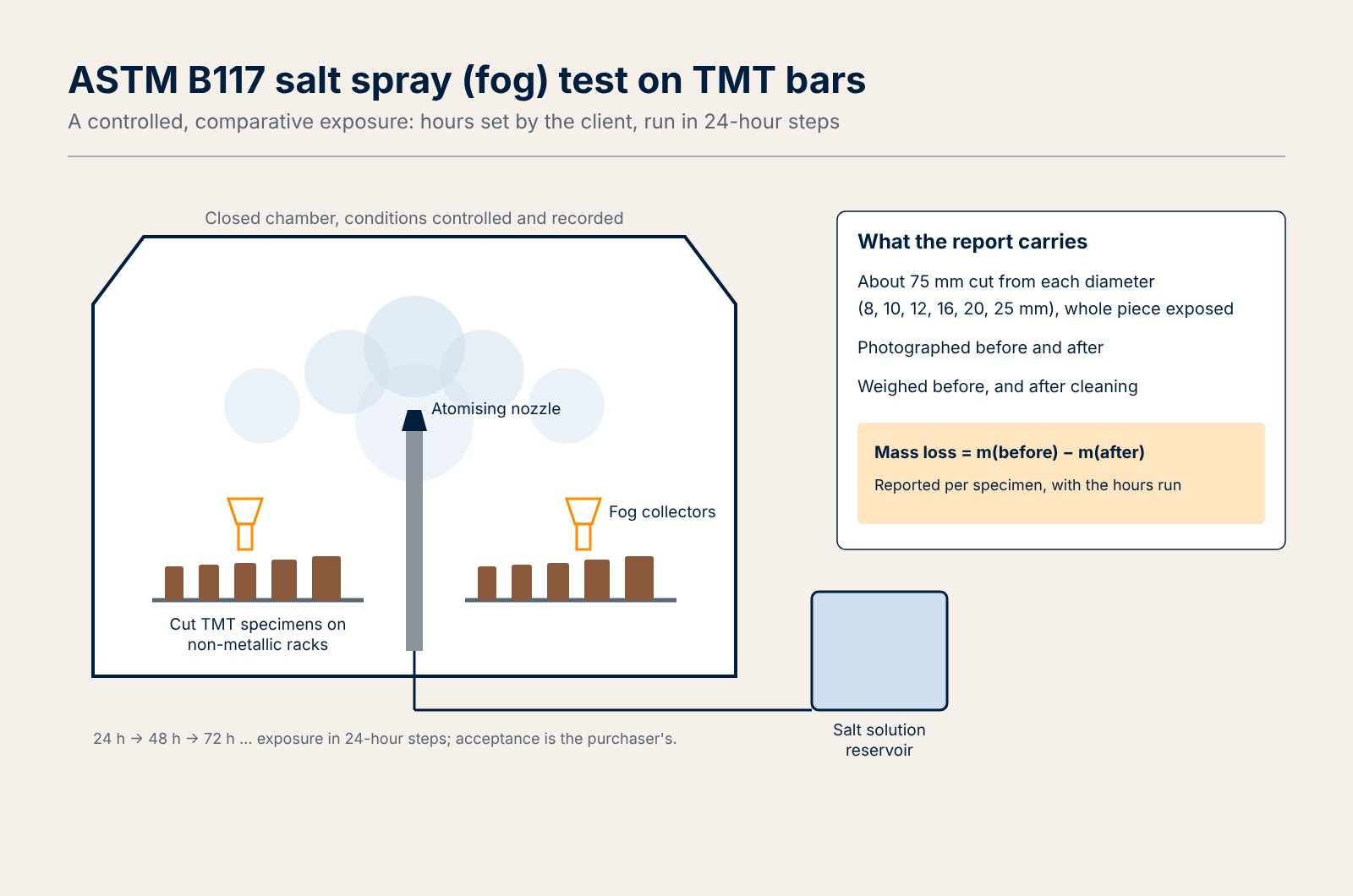
ASTM B117 salt spray testing of TMT bars at Mahape: what the test shows and what it does not
TCR Engineering's Mahape laboratory runs salt spray (fog) tests to ASTM B117 under NABL accreditation. Using a six-diameter TMT bar enquiry as the…
-
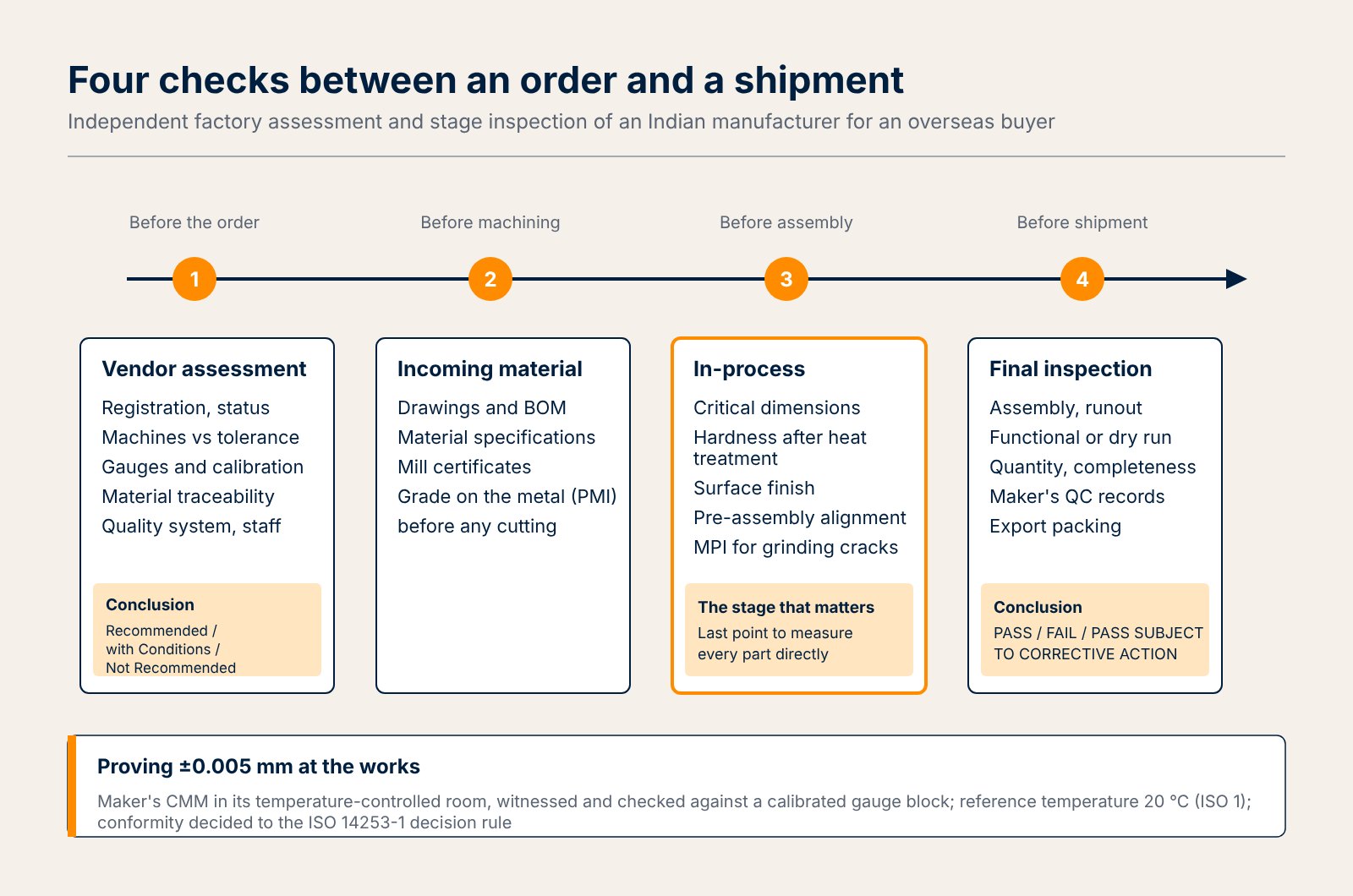
Factory assessment and audit of Indian manufacturers for international buyers: what to check, when, and with what
An international buyer placing an order with an Indian manufacturer needs four independent checks: a factory assessment before the order, incoming…
-
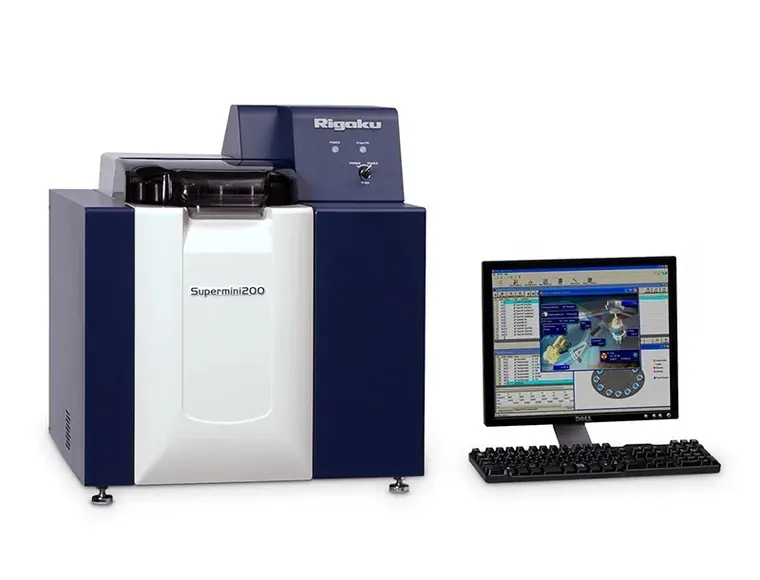
TCR commissions a WDXRF spectrometer for building materials, and what ASTM C114 demands of an XRF result
A wavelength-dispersive XRF spectrometer is now on the bench at Mahape for 195 building materials and alloys. What ASTM C114 demands before an XRF…
-
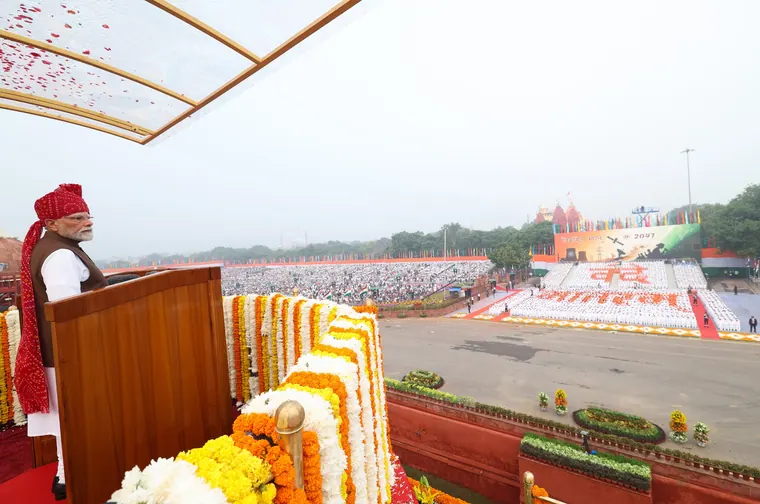
Quality, Quality, Quality: The Prime Minister's Zero-Defect Mantra and What It Asks of Indian Manufacturing
On 15 August 2026 the Prime Minister told every manufacturer, entrepreneur and MSME that India's identity in the global market must rest on…
-
Why Your Mill Certificate Isn't Enough: BS EN 10204 Type 3.2 Testing That Proves What You Are Actually Getting
BS EN 10204 Type 3.2 certification testing at TCR Engineering. Independent verification of tensile, hardness, and chemical analysis for materials.
-
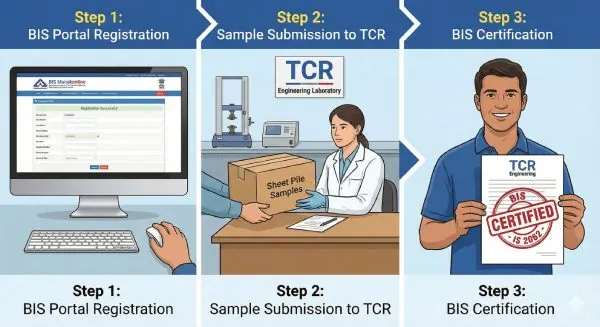
Getting Your BIS License for Sheet Piles? Here Is What Every Manufacturer Needs to Know
Sheet piles testing per IS 2062 for BIS certification requires Manakonline pre-registration. TCR Engineering guides manufacturers through the process.

Frequently asked questions
Does TCR certify steel products independently?
Yes. India's integrated steel majors certify incoming and finished product on TCR's wet-chemistry bench, with mechanical, chemical and metallurgical testing of primary steels to ASTM, EN, JIS and IS specifications.
Can TCR inspect steel plant equipment while it is in service?
Yes. In-situ metallography runs on live plant, alongside failure analysis of rolls, bearings and furnace components, refractory and materials testing, and RLA of reheating furnaces and process equipment.
Does TCR inspect sponge-iron and DRI reformer tubes?
Yes. ARTiS inspects sponge-iron and direct-reduction reformer tubes from Bhilai to Abu Dhabi. DRI reformers run the same creep and carburisation mechanisms as fertiliser reformers.
Which steel producers does TCR serve?
Tata Steel, JSW Steel, Steel Authority of India, Rashtriya Ispat Nigam, Jindal Steel and Power, ArcelorMittal Nippon Steel India, Vedanta ESL, Jindal Saw, Welspun and MAN Industries, across integrated, secondary and direct reduction producers.
What structural and rebar standards does TCR test to?
ASTM A36, A572, A588 and A516/A537 plate, ASTM A335/A213 chrome-moly tubes, IS 2062 structural steel, IS 1786 high-strength deformed bars under BIS-accredited rebar capability, IS 1239 tubes and IS 1875 forging-grade steels.