

Services · Materials Testing
Salt Spray Testing and Coating Evaluation
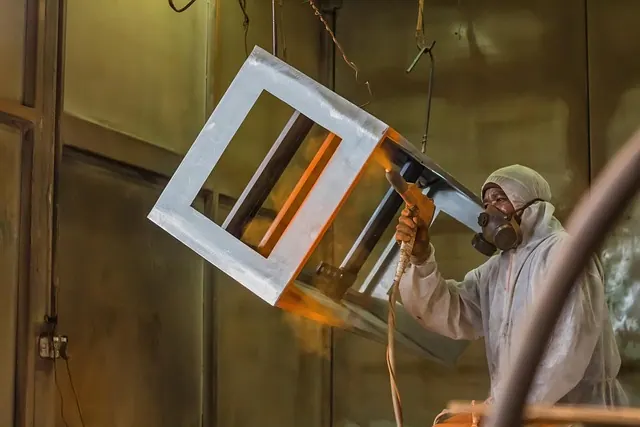
AMPP/NACE and BGas certified inspectors follow the coating through its full lifecycle, from surface preparation and primer to post-cure dry-film thickness verification, with the laboratory bench behind them for adhesion, disbondment and salt-spray evidence.
Request a Quote
In brief
TCR Engineering Services Pvt. Ltd. runs salt spray testing to ASTM B117 and ISO 9227, and evaluates paint and coating systems, at its Mahape laboratory in Navi Mumbai, India, which holds NABL certificate NABLT0726MH18640. AMPP/NACE and BGas certified inspectors cover the coating lifecycle in the field, and the laboratory adds adhesion, film thickness, cathodic disbondment and weathering tests.
Paint and coating evaluation for industrial, marine, and infrastructure coatings. Cross-cut adhesion (ASTM D3359), pull-off adhesion (ASTM D4541), coating thickness (ISO 2808, ASTM D7091), holiday detection, cathodic disbondment (ASTM G8), salt spray resistance, cyclic corrosion, abrasion resistance, UV accelerated weathering. SEM and EDS for galvanised coatings. FTIR and DSC for epoxy coatings. TGA for bituminous coatings. Evaluation of elastomeric coating performance under sour-service exposure (Shell-approved capability).
What does coating evaluation cover in the field and in the laboratory?
In the field, AMPP/NACE and BGas certified coating inspectors check each stage of the coating lifecycle (surface preparation, primer, intermediate coat, topcoat, holiday detection and post-cure DFT/WFT verification) to the standards in the table below. The laboratory evaluates coating systems in Materials Testing: ASTM D3359 cross-cut adhesion, ASTM D4541 pull-off, ISO 2808 / ASTM D7091 thickness, ASTM G8 cathodic disbondment and ASTM B117 salt spray.
| Field Capability | Standard |
|---|---|
| Surface preparation visual standard | SSPC-VIS 1, ISO 8501-1 |
| Anchor profile | ASTM D4417, ISO 8503 |
| Dust contamination | ISO 8502-3 |
| Soluble salt contamination | ISO 8502-6, ISO 8502-9 |
| Wet film thickness | ASTM D4414 |
| Dry film thickness | ASTM D7091, ISO 2808 |
| Holiday detection | NACE SP0188 |
| Adhesion (field) | ASTM D3359 (cross-cut), ASTM D4541 (pull-off) |
| Cure verification | DSC, FTIR, Persoz hardness |
The Shell-approved capability for elastomeric coating evaluation under sour-service exposure (see Corrosion & Sour Service) sits in the laboratory complement.
Reference: ISO 12944 corrosion-protection-by-coating series.
Standards: ASTM D3359 (adhesion), ASTM D4541 (pull-off adhesion), ASTM D7091 (dry-film thickness), ASTM D822 and D4587 (weathering), ASTM B117 (salt spray), ASTM G8 and G42 (cathodic disbondment). ISO 2808 (film thickness), ISO 4624 (pull-off), ISO 12944 (protective paint systems).
What does salt spray testing at TCR cover?
TCR Engineering runs salt spray testing at its Mahape laboratory in Navi Mumbai to ASTM B117 and ISO 9227, with acetic acid salt spray to IS 6910 and copper-accelerated acetic acid salt spray (CASS) to ASTM B368, all four on NABL certificate NABLT0726MH18640. The exposure hours and the acceptance criterion come from the product or coating specification the client names.
- What it shows: how a metallic or organic coating, or a plated part, holds up in a controlled corrosive fog, and whether its thickness and porosity are uniform enough to protect the substrate.
- What it does not show: a service life. ASTM B117 itself cautions that salt spray results used on their own have seldom been correlated with performance in natural environments, so the test is a comparative and conformity check against a specification.
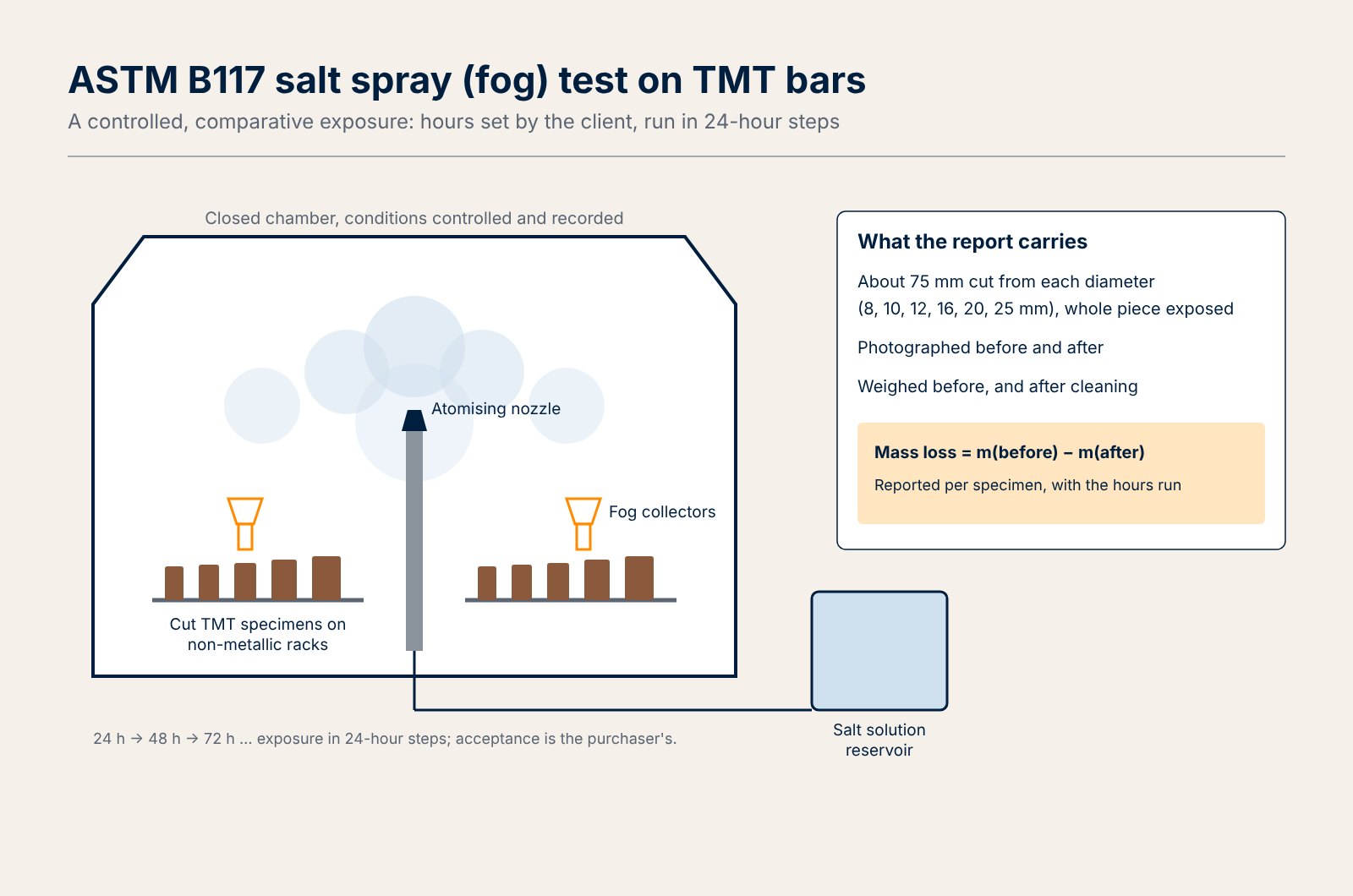
- What is tested: inorganic and organic coatings, plated and galvanised parts and TMT bars; several samples can be exposed together, depending on their size.
- What the report carries: photographs before and after exposure, the hours run, and the rating or mass loss the specification asks for.
- Alongside it: cathodic disbondment to ASTM G8 and G42, adhesion to ASTM D3359 and D4541, and UV weathering to ASTM D822 and D4587 on the same coating system.
Related services and industries
Related insights
6 published insights on this site bear directly on Coating Evaluation. They are below; the full index carries all 166 Materials Testing insights.
-
ASTM B117 salt spray testing of TMT bars at Mahape: what the test shows and what it does not
TCR Engineering's Mahape laboratory runs salt spray (fog) tests to ASTM B117 under NABL accreditation. Using a six-diameter TMT bar enquiry as the…
-
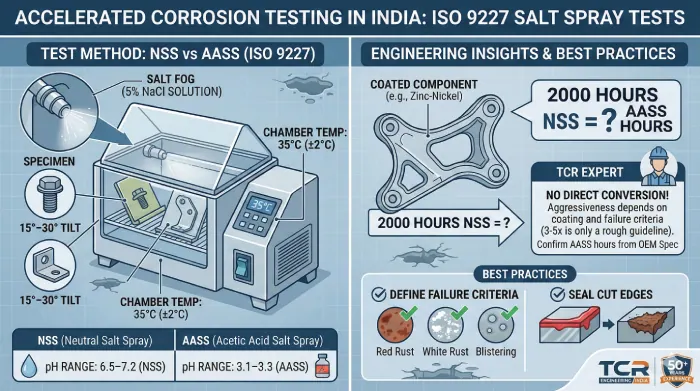
Accelerated Corrosion Testing in India: What Engineers Need to Know About ISO 9227 Salt Spray Tests
TCR Engineering explains ISO 9227 salt spray testing, NSS vs AASS differences, and what Indian engineers must know before testing corrosion resistance.
-
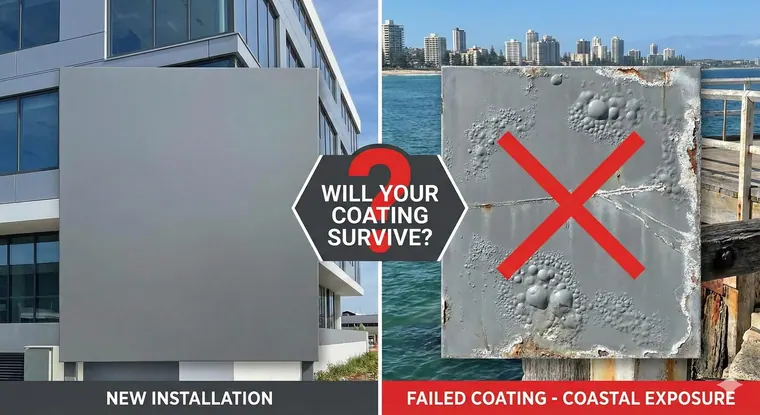
Why Your Aluminium Powder Coating Needs an Acetic Acid Salt Spray (AASS) Test for 720 Hours
TCR Engineering offers NABL-approved AASS testing for 720 hours on aluminium powder coatings, ensuring durability in harsh coastal environments.
-
ONGC Specification Testing: Your Complete Guide to Mechanical, Corrosion, and CTOD Testing
TCR Engineering conducts comprehensive ONGC specification testing including mechanical properties, corrosion resistance, and CTOD evaluation.
-
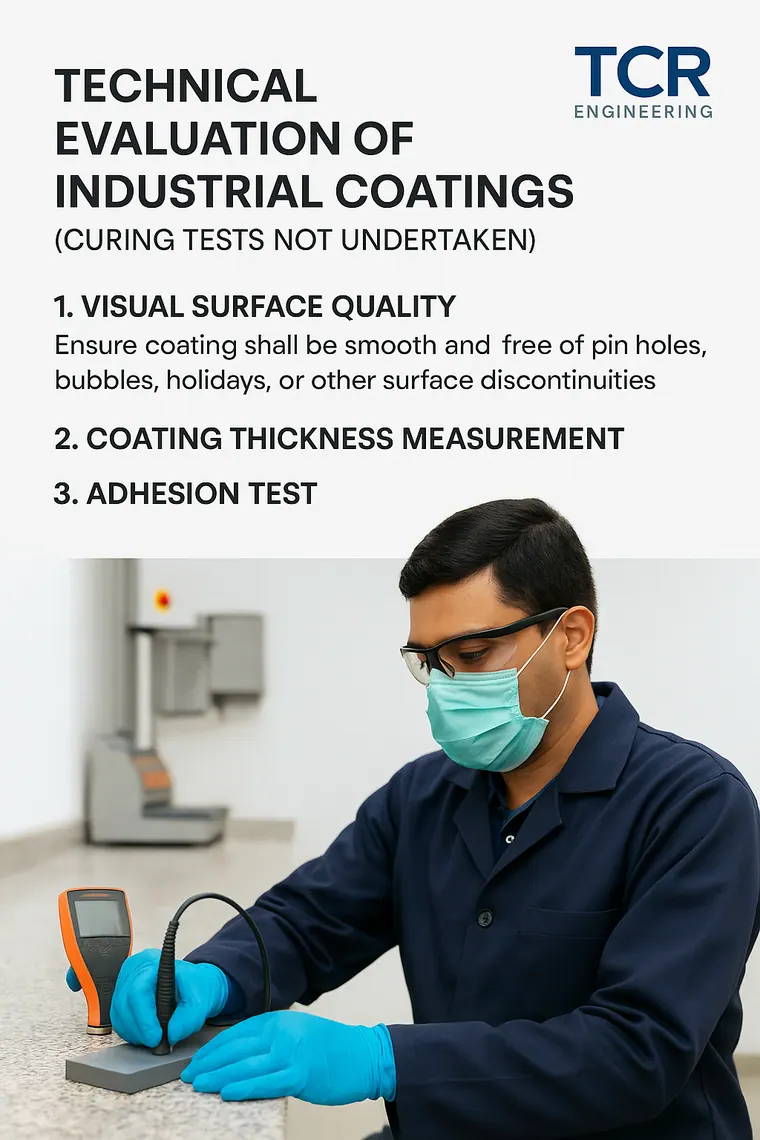
Evaluation of Industrial Coatings at TCR
TCR Engineering rigorously tests industrial coatings per ASTM & ISO standards to ensure adhesion, durability & surface integrity.
-
Ensuring Coating Durability
TCR Engineering conducts ISO 9227, ASTM B117 & ISO 2819 tests to ensure coating durability & adhesion.

Frequently asked questions
What field coating inspection does TCR provide?
AMPP/NACE certified and BGas certified inspectors cover the full coating lifecycle: surface preparation to SSPC-VIS 1 and ISO 8501-1, anchor profile per ASTM D4417 and ISO 8503, dust and soluble-salt contamination per ISO 8502, wet and dry film thickness, holiday detection per NACE SP0188, and field adhesion testing.
Which laboratory tests qualify a coating system?
The laboratory runs cross-cut adhesion per ASTM D3359, pull-off adhesion per ASTM D4541 and ISO 4624, film thickness per ISO 2808 and ASTM D7091, cathodic disbondment per ASTM G8 and G42, salt spray per ASTM B117, cyclic corrosion, abrasion resistance and UV accelerated weathering per ASTM D822 and D4587.
Can TCR characterise the coating material itself?
Yes. SEM and EDS examination supports galvanised coating evaluation, FTIR and DSC characterise epoxy coatings and verify cure, TGA covers bituminous coatings, and Persoz hardness supplements cure verification in the field. Elastomeric coating performance under sour-service exposure is evaluated alongside the corrosion and sour service laboratory.
Is salt spray testing at TCR NABL accredited?
Yes. Salt spray to ASTM B117 and ISO 9227, acetic acid salt spray to IS 6910 and CASS to ASTM B368 are on NABL certificate NABLT0726MH18640 at Mahape, Navi Mumbai, as is ASTM D4541 pull-off adhesion on paint coatings. Cross-cut adhesion, film thickness to ISO 2808 and ASTM D7091, cathodic disbondment and weathering are reported outside the accredited scope.
How long does a salt spray test run?
As long as the product or coating specification requires. The client names the exposure hours and the acceptance criterion, and TCR runs the test to them under ASTM B117, ISO 9227, IS 6910 or ASTM B368, with photographs before and after exposure. The completion date for the report is confirmed in the quotation.
What does a cathodic disbondment test show?
It shows how far a pipeline or structural coating lifts away from the steel around a deliberate holiday while the steel is held under cathodic protection. TCR runs it to ASTM G8, and to ASTM G42 at elevated temperature, on coated specimens, and reports it outside the NABL scope alongside the coating's adhesion and thickness results.