
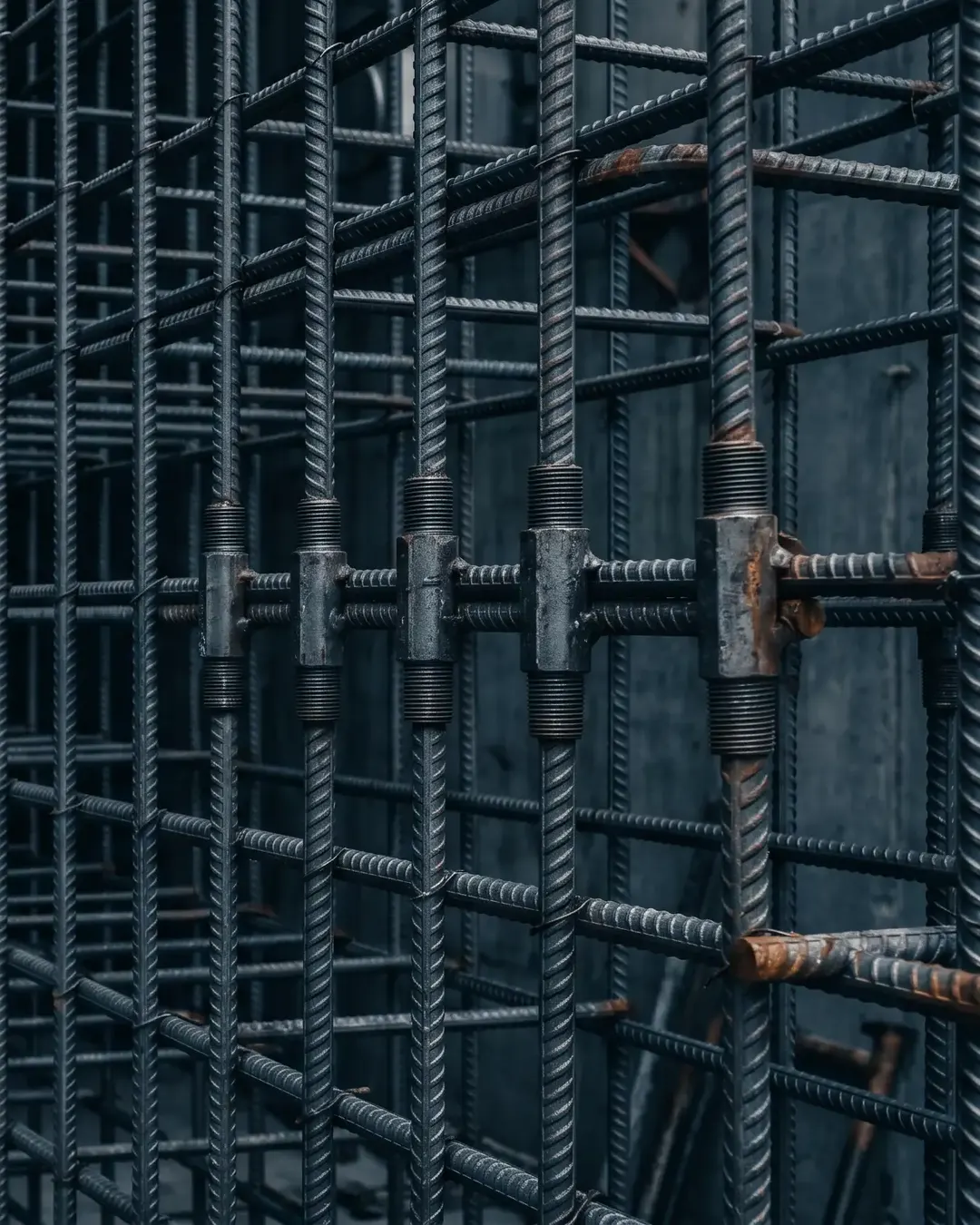
Services · Civil and Infrastructure Testing
Rebar Coupler Testing per IS 16172
Dextra, Afcons, the Mumbai Coastal Road Project, and Larsen and Toubro Mumbai Metro test their couplers here. The BIS-recognised civil scope also carries IS 1786 and IS 16651 reinforcement bar, IS 2062 structural steel, and IS 3589 pipe.
Request a Quote
In brief
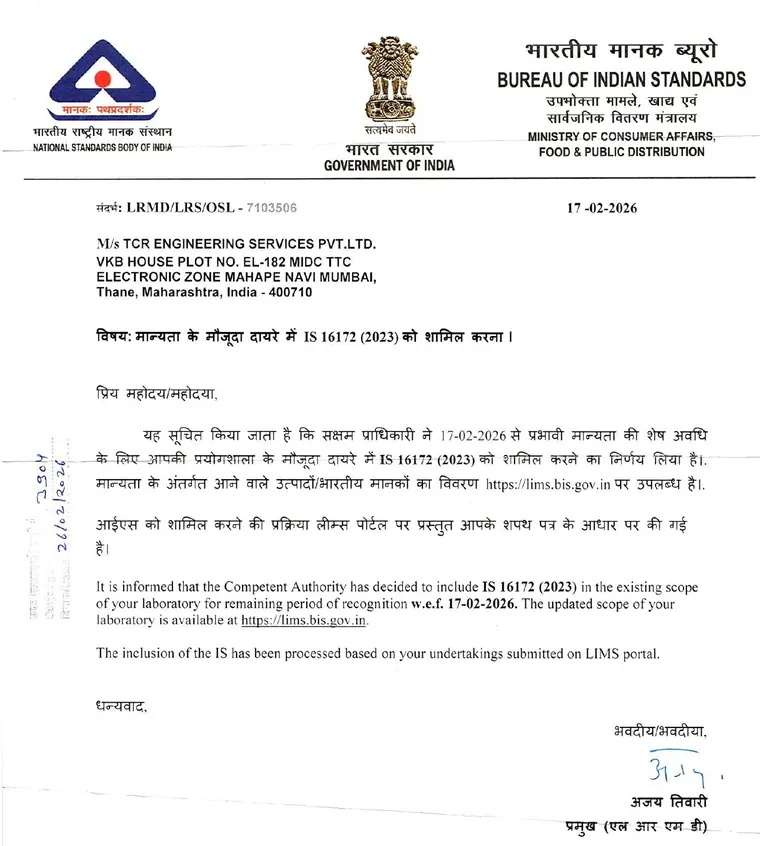
TCR Engineering, a NABL ISO/IEC 17025:2017 accredited civil testing laboratory (NABLT0726MH18640) in Navi Mumbai, is the first BIS-accredited commercial laboratory in India for IS 16172 rebar coupler testing, covering all diameters from 8 mm to 40 mm under BIS recognition LRMD/LRS/OSL-7103506. It also tests TMT rebar per IS 1786 and bond in reinforced concrete per IS 2770.
50+ coupler manufacturers have been guided through the ISI mark certification process for IS 16172; the BIS record and the renewal certificate are listed on quality and accreditation.
Which tests does TCR run on couplers, rebar and strand?
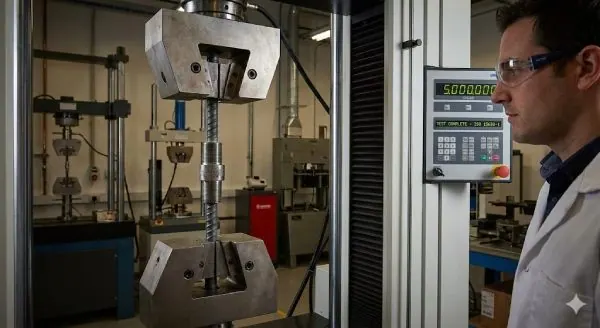
TCR Engineering tests rebar couplers to IS 16172 and the reinforcement around them at its Mahape laboratory in Navi Mumbai: coupler tension, slip, cyclic and fatigue tests, TMT rebar to IS 1786, bond by pull-out to IS 2770, HSFG bolts to IS 3757 and high-tensile strand to ASTM A416 and IS 14268 for high speed rail and bridges.
| Test | Standard |
|---|---|
| Coupler tension and uniform elongation | IS 16172 |
| Coupler low-cycle and high-cycle fatigue | IS 16172 |
| Coupler slip measurement | IS 16172 |
| Coupler cyclic tension-compression reversal | IS 16172 |
| TMT rebar tensile | IS 1786 |
| TMT rebar elongation, bend, re-bend | IS 1786 |
| Bond in reinforced concrete (Pull-out Test) | IS 2770-Part 1 |
| HSFG bolt | IS 3757 |
| HT strand for HSR and bridges | ASTM A416, IS 14268 |
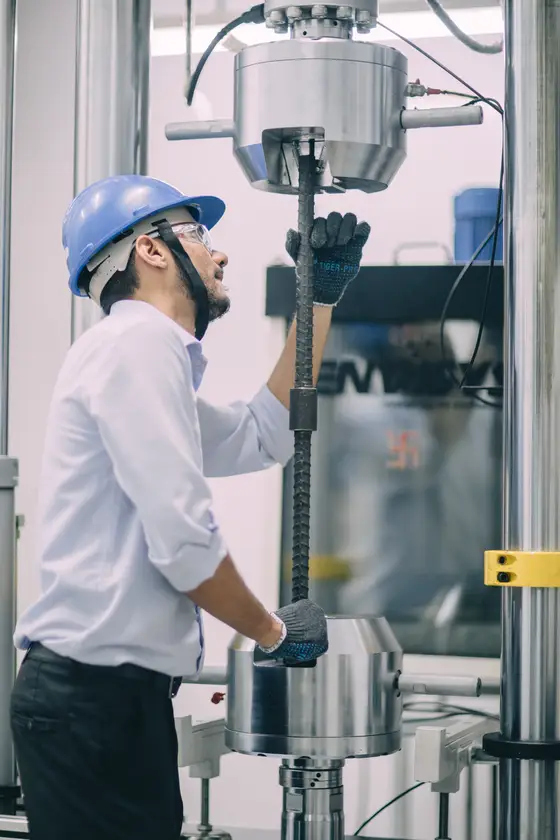
TCR is the first commercial laboratory in India accredited by BIS for the full IS 16172:2023 coupler scope: tensile strength, threaded-coupler disengagement, percentage elongation, slip, cyclic tensile, and low- and high-cycle fatigue. Its BIS-recognised civil scope also covers reinforcement bar, structural steel, carbon-steel sheet and pipe.
- The BIS first: the first commercial laboratory in India accredited by BIS for the full IS 16172:2023 coupler scope.
- Coupler scope: tensile strength, threaded-coupler disengagement, percentage elongation, slip, cyclic tensile, and low- and high-cycle fatigue.
- Reinforcement bar: IS 1786 and IS 16651.
- Structural steel and sheet: IS 2062, IS 513 and IS 1079.
- Pipe: IS 3589, water and sewage.
- Anchor clients: Dextra, Afcons, the Mumbai Coastal Road Project, and Larsen and Toubro Mumbai Metro.
What does the IS 16172 test programme actually run?
Four loading regimes on one splice, in a fixed order. Static tensile and slip run first on a static frame, then cyclic tensile, then low-cycle fatigue, then high-cycle fatigue on a dynamic frame. A coupler that passes the tensile test and fails the slip test has not been qualified.
| Test | Loading | What is reported |
|---|---|---|
| Static tensile | Monotonic to failure, on a static machine | Tensile strength of the assembly |
| Slip | Load and release, run before cyclic testing | Permanent extension after loading |
| Cyclic tensile | 100 cycles, 5 to 90 percent of yield stress | Static tensile strength retained |
| Low-cycle fatigue | 10,000 cycles of alternating tension and compression | Survival without failure |
| High-cycle fatigue | 2 million cycles, 30 MPa minimum and 130 to 350 MPa maximum, 3 to 10 Hz | Survival without failure, with the S-N curve |
- Range and grades: couplers from 8 mm to 40 mm, against rebar grades Fe 415, Fe 500 and Fe 550, in coupler materials EN8D and 45C8.
- Coupler types: parallel threaded, tapered threaded, compression, and grouted.
- Standards: IS 16172:2023 for mechanical splices of reinforcement bars, ASTM A1034 for mechanical splices, and ISO 15835-2 for coupler test methods, with the bar itself to IS 1786 and stainless reinforcement to IS 16651:2017.
- Equipment: static tensile and slip on a static machine; cyclic, low-cycle and high-cycle fatigue on closed-loop servo-hydraulic dynamic universal testing machines running 0.035 to 30 Hz.
Why is a mechanical splice tested harder than a lap?
Because it carries the full bar force through a manufactured joint rather than through bond over a lap length. Splices are specified where inelastic yielding is expected and where reinforcement congestion makes lapping impractical, which is where a joint that slips or fatigues is least tolerable.
Mechanical splicing joins two reinforcement bars end to end through a coupler. It reduces congestion at the concreting stage, shortens the construction sequence, and transfers load between bars more directly than a lap does. That advantage holds only if the bar, the thread and the coupler behave as one load path under reversal, which is what the cyclic and fatigue tests establish and what a static tensile test on its own cannot.
Coupler manufacturers tested include Dextra, Leviat, Kridhan, Vrudhhi Steel, Sanfield, Kamar Infra, Rajasthan Alloys, Beacon Infra, Steel Era, Kuber Infra Solution, Splicetek India, and Shrinidhi Innotech. End-project clients running TCR-tested couplers include NHSRCL, NHAI, Larsen and Toubro, Afcons Infrastructure, NCC, Tata Projects, K. Raheja Corp, Megha Engineering and Infrastructures, Oberoi Realty, KEC International, Shapoorji Pallonji, Ahluwalia Contracts, Dilip Buildcon, Ashoka Buildcon, and Lodha.
Which types of rebar coupler does TCR test?
TCR Engineering tests parallel threaded, tapered threaded, compression and grouted rebar couplers to IS 16172:2023 at its Mahape laboratory in Navi Mumbai, across every diameter from 8 mm to 40 mm. Each type is qualified as an assembly with the bar it joins, so the report covers the joint and not the coupler body alone.
| Coupler type | How it holds the bar | Tested to |
|---|---|---|
| Parallel threaded | A straight thread on the bar ends | IS 16172:2023 |
| Tapered threaded | A taper thread on the bar ends | IS 16172:2023 |
| Compression | A sleeve pressed onto the bar ends | IS 16172:2023 |
| Grouted | A sleeve filled with grout around the bar ends | IS 16172:2023 |
Rebar grades Fe 415, Fe 500 and Fe 550 and coupler materials EN8D and 45C8 are covered; the bar itself is tested to IS 1786. Product selection stays with the coupler manufacturer.
Related insights
4 published insights on this site bear directly on Rebar Couplers (IS 16172). They are below; the full index carries all 42 Civil & Structural Testing insights.
-
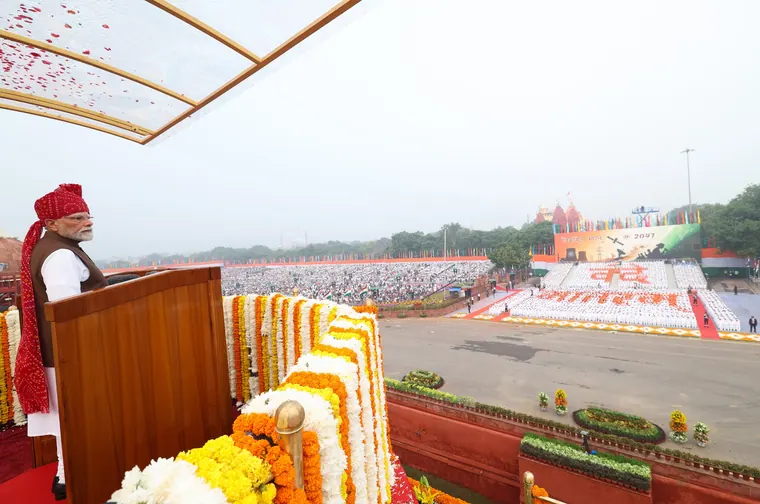
Quality, Quality, Quality: The Prime Minister's Zero-Defect Mantra and What It Asks of Indian Manufacturing
On 15 August 2026 the Prime Minister told every manufacturer, entrepreneur and MSME that India's identity in the global market must rest on…
-
TCR Engineering Becomes India's First Commercial Lab Accredited by BIS for IS 16172 Rebar Coupler Testing
TCR Engineering is India's first commercial lab with BIS accreditation for IS 16172 rebar coupler testing, full scope, all diameters.
-
Why 5 Million Cycles Matter: The Truth About Rebar Coupler Testing That Could Save Your Structure
Rebar coupler fatigue testing per ISO 15630-1 reveals durability over 5 million cycles. TCR's worldwide expertise validates critical connections.
-
TCR’s Role in Rebar Coupler Performance Testing
Redefining strength in every bridge, road, and building with advanced rebar testing.
Read all 42 Civil & Structural Testing insights →All insights →
Frequently asked questions
Is TCR Engineering BIS-accredited for rebar coupler testing?
Yes. TCR Engineering is the first BIS-accredited commercial laboratory in India for IS 16172 rebar coupler testing, covering all diameters from 8 mm to 40 mm (BIS reference LRMD/LRS/OSL-7103506). The coupler scope spans tensile strength, disengagement, elongation, slip, cyclic tensile and fatigue testing.
Which coupler tests does TCR perform under IS 16172?
The laboratory performs coupler tension and uniform elongation, slip measurement, cyclic tension-compression reversal, and low- and high-cycle fatigue under IS 16172. TMT rebar from the same splice assembly is tested for tensile, elongation, bend and re-bend properties per IS 1786, and bond by pull-out test per IS 2770 Part 1.
Does the BIS-recognised scope cover materials beyond couplers?
Yes. The BIS-recognised civil scope also covers reinforcement bar per IS 1786 and IS 16651, structural steel per IS 2062, carbon-steel sheet per IS 513 and IS 1079, and water and sewage pipe per IS 3589. High-tensile strand for high speed rail and bridges is tested per ASTM A416 and IS 14268.
Is TCR's BIS recognition for IS 16172 on public record?
Yes. TCR Engineering appears at serial 387 on the Bureau of Indian Standards Group-1 list of recognised laboratories, under OSL code 7103506 and reference LRMD/LRS/OSL-7103506, valid from 1 January 2024 to 31 December 2026. The recognition covers the full IS 16172:2023 coupler scope at the Mahape laboratory in Navi Mumbai.
Can TCR support ISI mark certification for rebar couplers?
Yes. TCR Engineering has guided 50+ coupler manufacturers through the ISI mark certification process for IS 16172. As the first BIS-accredited commercial laboratory in India for the full IS 16172:2023 coupler scope, it tests every diameter from 8 mm to 40 mm at its Mahape laboratory in Navi Mumbai and reports against the standard.
What does a manufacturer send for IS 16172 coupler testing?
Coupler assemblies made up with the bar they are meant for, each labelled with the coupler type, bar grade and diameter, together with the IS 16172 edition and the purpose of the test, ISI mark certification or project acceptance. Quantities are set out in TCR's Sample Size Requirements document, and the completion date is confirmed in the quotation.