
Services · Civil and Infrastructure Testing
Ground-Penetrating Radar (GPR) Survey and UPV Testing of Concrete
Nothing is cut and nothing is cored. Radar reads rebar position, embedded services, and pavement layer thickness through the surface, and pulse velocity reads homogeneity within the section, both under the IAEA-TCS-17 guidance for concrete NDT.
Request a Quote
In brief
TCR Engineering, Navi Mumbai, runs ground-penetrating radar (GPR) surveys and non-destructive testing of concrete for structures and pavements across India: GPR locates rebar, embedded utilities and pavement layers, and ultrasonic pulse velocity, rebound hammer and half-cell potential test the concrete itself. Those three are site tests on NABL certificate NABLT0726MH18640; GPR is reported outside it.
What a GPR Survey and UPV Establish
Ground-Penetrating Radar (GPR) locates reinforcement, maps embedded utilities, and profiles pavement layer thickness, while Ultrasonic Pulse Velocity (UPV) per IS 516 (Part 5/Sec 1):2018 assesses the homogeneity and quality of in-place concrete. Both methods are non-destructive, so the member stays in service while it is surveyed.
- Ground-Penetrating Radar: locates reinforcement, maps embedded utilities and profiles pavement layer thickness, giving a plan view of rebar layout and clear cover before any coring or cutting.
- Ultrasonic Pulse Velocity: IS 516 (Part 5/Sec 1):2018, assessing homogeneity and quality of in-place concrete; a grid of readings flags voids, honeycombing and cracking the eye cannot see.
- Both non-destructive: the member stays in service while it is surveyed.
- Guidance: the NDT-of-concrete guidance in IAEA-TCS-17.
TCR runs the subsurface suite under the NDT-of-concrete guidance in IAEA-TCS-17. GPR gives a plan view of rebar layout and clear cover before any coring or cutting, and UPV readings across a grid flag voids, honeycombing, and cracking that the eye cannot see. The two methods together build the evidence base for a condition assessment without breaking the surface.
Which Concrete NDT Tests Are on TCR's NABL Scope?
The non-destructive tests of concrete on TCR Engineering's NABL certificate NABLT0726MH18640 are ultrasonic pulse velocity, rebound hammer, half-cell potential and carbonation depth, all as site testing. Ground-penetrating radar, cover meter surveys and corrosion-rate measurement by linear polarisation resistance and macrocell current are carried out and reported outside the certificate.
| Method | Standard | NABL certificate NABLT0726MH18640 |
|---|---|---|
| Ultrasonic pulse velocity | IS 516 (Part 5/Sec 1):2018 | On the certificate (site testing) |
| Rebound hammer | IS 516 (Part 5/Sec 4):2020 | On the certificate (site testing) |
| Half-cell potential | ASTM C876-22b, IS 516 (Part 5/Sec 2) | On the certificate (site testing) |
| Carbonation depth | IS 516 (Part 5/Sec 3), BS EN 14630 | On the certificate (site testing) |
| Ground-penetrating radar | IAEA-TCS-17 guidance | Reported outside the certificate |
| Cover meter survey | BS 1881-204 | Reported outside the certificate |
| Linear polarisation resistance and macrocell current | Named in the project specification | Reported outside the certificate |
Governing Standards
The subsurface and NDT-of-concrete methods are governed by the Indian and ASTM designations below, with IAEA-TCS-17 as the overarching guidance for non-destructive testing of concrete.
| Method | What it measures | Standard |
|---|---|---|
| Ground-Penetrating Radar | Rebar location, embedded-utility mapping, pavement layer-thickness profiling | IAEA-TCS-17 (NDT of concrete guidance) |
| Ultrasonic Pulse Velocity | Concrete homogeneity and quality | IS 516 (Part 5/Sec 1):2018 |
| Rebound hammer | Surface hardness correlation | IS 516 (Part 5/Sec 4):2020 |
| Half-cell potential | Corrosion likelihood mapping | ASTM C876-22b |
Where the Suite Applies
The subsurface suite serves reinforced-concrete structures and pavements: rebar location and clear-cover verification before drilling or anchoring, embedded-utility detection ahead of demolition or coring, pavement layer-thickness profiling, and concrete-quality mapping on slabs, columns, beams, and bridge decks.
- Before drilling or anchoring: rebar location and clear-cover verification.
- Before demolition or coring: embedded-utility detection.
- Pavements: layer-thickness profiling.
- Concrete quality mapping: slabs, columns, beams and bridge decks.
- Where corrosion is suspected: half-cell potential per ASTM C876-22b for likelihood, with linear polarisation resistance and macrocell current for quantitative corrosion rate.
Cover meter surveys confirm the clear cover to reinforcement.
Where TCR Deploys It
The GPR and UPV methods are the field diagnostics behind two TCR civil programmes: the non-destructive evaluation stage of structural audits under Section 353B of the Mumbai Municipal Corporation Act 1888, and the 500+ bridge inspection book of work across India.
- Structural audits under Section 353B: the non-destructive evaluation stage.
- Bridge inspection: the 500-plus bridge book of work across India.
- Within a bridge inspection: UPV per IS 516 (Part 5/Sec 1):2018 for homogeneity, rebound hammer for surface hardness correlation, half-cell potential per ASTM C876-22b for corrosion likelihood, alongside drone and submersible ROV imaging.
Related insights
3 published insights on this site bear directly on GPR, UPV and Subsurface. They are below; the full index carries all 42 Civil & Structural Testing insights.
-
Concrete NDT: Which Test Answers Which Question, and What Each One Cannot Tell You
Rebound hammer, UPV, half-cell, carbonation and cover meter each answer one question about a concrete structure. The useful skill is knowing what…
-
Structural Testing of Retaining Wall and Raft
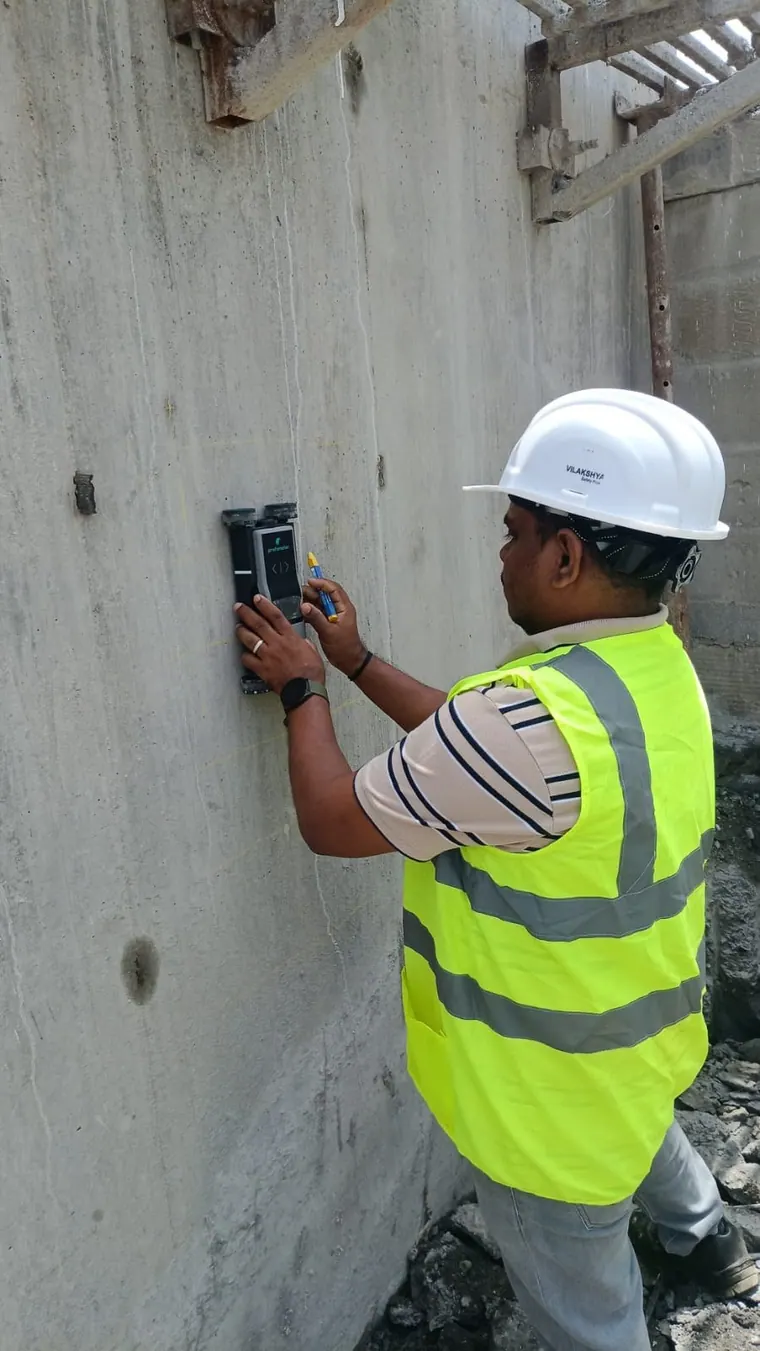
TCR supports client with structural testing of existing retaining wall and raft using UPV, rebound hammer, core tests, and audit reporting.
-
Ultrasonic Pulse Velocity (UPV) Testing: Enhancing Civil Infrastructure Assessment
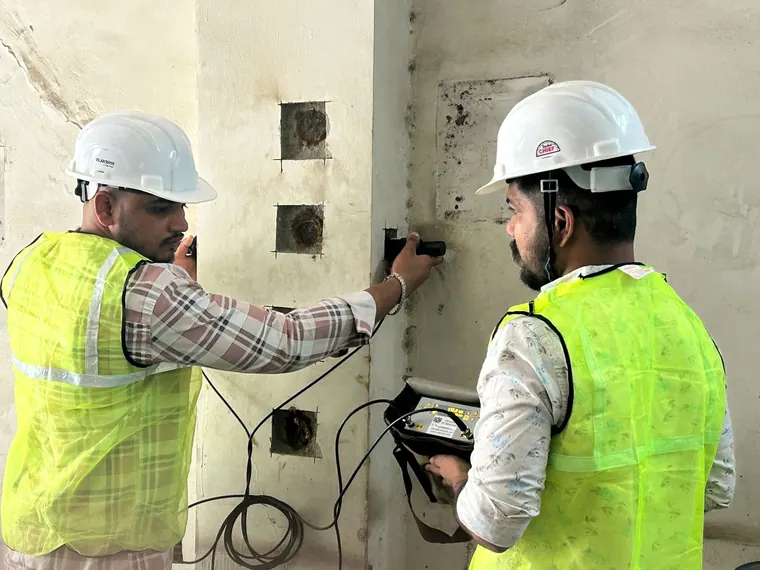
Ensure concrete integrity with UPV testing! TCR Engineering offers precise, non-destructive evaluations to detect cracks, voids, and flaws i
Read all 42 Civil & Structural Testing insights →All insights →
Frequently asked questions
What does Ground-Penetrating Radar detect in concrete?
GPR locates reinforcement, maps embedded utilities, and profiles pavement layer thickness, without cutting or coring the member.
Which standard governs Ultrasonic Pulse Velocity testing?
UPV is run to IS 516 (Part 5/Sec 1):2018 for concrete homogeneity, under the NDT-of-concrete guidance in IAEA-TCS-17.
Can these methods indicate corrosion?
Half-cell potential per ASTM C876-22b maps corrosion likelihood, and linear polarisation resistance and macrocell current measurement add quantitative corrosion-rate data.
Where does subsurface testing fit in a structural audit?
It forms Part B, the non-destructive evaluation stage, of a structural audit under Section 353B, and it also supports the 500+ bridge inspection programme.
Is a GPR survey covered by TCR's NABL accreditation?
No. Ground-penetrating radar is not on TCR Engineering's NABL certificate NABLT0726MH18640, so a GPR survey is reported outside the NABL scope. The concrete NDT that usually runs with it, ultrasonic pulse velocity, rebound hammer, half-cell potential and carbonation depth, is on the certificate as site testing and is reported under it.