

Services · Materials Testing
Metals and Materials Testing Laboratory, NADCAP AC7101 and NABL Accredited
Mechanical, chemical, corrosion, metallurgical, fatigue, fracture-toughness and creep testing, reported under one accredited signature.
Request a QuoteWhat is TCR's materials testing laboratory?
TCR Engineering Services Pvt. Ltd. runs a metals and materials testing laboratory at Mahape, Navi Mumbai, India. It tests metals, alloys, welds, castings, forgings, polymers and composites, and reports each result under NABL ISO/IEC 17025:2017 accreditation (NABLT0726MH18640), with NADCAP AC7101 Materials Testing for aerospace work and acceptance in 90+ economies under the ILAC MRA.
- Accreditations: NADCAP AC7101 and NABL ISO/IEC 17025:2017.
- Laboratories: Navi Mumbai (NABLT0726MH18640, 1,483 scope items) and Bhubaneswar (TC-15993).
- Disciplines: mechanical, chemical, corrosion, metallurgical, fatigue and fracture testing.
- Not on this page: concrete, cement, soil and building materials, which the civil testing laboratory at the same Mahape site tests under the same NABL certificate.
- Service lines: twenty, from mechanical and physical testing to residual stress determination by X-ray diffraction.
- Governing standards: ASTM E8/E8M-22, ASTM E23, ASTM A255, IS 2770, ASTM E228 and ASTM E289 among them, with each service page carrying its full standards block.
- Checking a report: the line-by-line NABL scope is on quality and accreditation, and every report's own marks can be checked on Verify a TCR report.
TCR Engineering is the first BIS-accredited commercial laboratory in India for IS 16172 rebar coupler testing, all diameters 8 mm to 40 mm.
Key takeaways
- 20 specialised service lines under this pillar, from Mechanical and Physical Testing to Machine Shop and Specimen Preparation.
- Governing standards across the pillar include ASTM E8/E8M-22, ASTM E23, ASTM A255, IS 2770, ASTM E228, ASTM E289; each service page carries its full standards basis.
- Published technical insights tagged to this pillar are listed below, newest first.
Materials testing in numbers
1,483 NABL Scope Items
6 Creep Frames to 1,100 °C
15+ Sample-Origin Countries
90+ ILAC MRA Economies
Capabilities and governing standards
TCR Engineering's Mahape laboratory in Navi Mumbai tests metals and non-metallics across twenty service lines, each reported against its governing ASTM, ISO, BS, IS, NACE or API standard under NABL certificate NABLT0726MH18640 for the methods within its scope. Each linked page carries the method detail, scope and acceptance criteria.
| Service | Governing standards |
|---|---|
| Mechanical and Physical Testing | ASTM E8/E8M-22, ASTM E23, ASTM A255, IS 2770, ASTM E228, ASTM E289, ASTM E831 |
| Chemical Analysis Laboratory | ASTM E1086, ASTM E415, ASTM E1019, ASTM E1479, ASTM E350, IS 228 |
| Corrosion Testing and Sour Gas Service | NACE MR0175, ISO 15156, NACE MR0103, NACE TM0177, NACE TM0284, NACE TM0316, ISO 15653 |
| Hydrogen Induced Disbonding | ASTM G146-24 |
| Hydrogen Embrittlement Testing | ISO 11114-4:2017, ASTM F519, ASTM B577, ISO 2626, IS 6243 |
| Fatigue and Fracture Toughness Testing | ASTM E1820, ASTM E399, ASTM E647, ASTM E466, ISO 14587, API 1104 |
| CTOD Testing per BS 7448, ISO 12135 and ASTM E1820 | BS 7448 Parts 1 to 4, ISO 15653, ISO 12135, BS 8571, ASTM E1820 |
| Metallurgical Evaluation | ASTM E112, ASTM E45, ASTM A247, IS 1865, IS 6396, ASTM E562, ASTM B487 |
| Creep and Stress Rupture Testing | ASTM E139, ASTM E292, IS 3407, ISO 204, API 530, API 579, ASTM E328 |
| Composite, Plastic, Rubber, and FRP/GRP Testing | ASTM D638, ASTM D790, ASTM D695, ASTM D256, ASTM D2240, ISO 527, ISO 178 |
| FTIR Analysis of GRE Pipe | ASTM E168 |
| Glass Transition Temperature by DSC | ASTM E1356 |
| Coating Evaluation and Inspection | ASTM D3359, ASTM D4541, ISO 2808, ASTM D7091, ASTM G8, ASTM B117, ISO 8501-1 |
| Welder Certification and Procedure Qualification | ASME Section IX, AWS D1.1, AWS D1.5, API 1104, IS 7318, EN ISO 9606, AWS D1.2 |
| Heat Treatment Verification Testing | ASTM E18, ASTM E10, ASTM E92, ASTM E384, ASTM E112, ASTM E407, ASTM E45 |
| TMT Rebar Testing per IS 1786 | IS 1786, IS 16651, IS 2770; couplers to IS 16172, ASTM A1034 and ISO 15835-2 under rebar coupler testing |
| RoHS Compliance Testing | IEC 62321 |
| Oil Analysis Ferrography | See service page |
| Residual Stress Determination by X-Ray Diffraction | ASTM E2860 |
| Machine Shop and Specimen Preparation | Specimen geometries of ASTM E8/E8M, ISO 6892, ASTM E23, ISO 148, ASTM E466 and ASTM E606 |
The foundation service
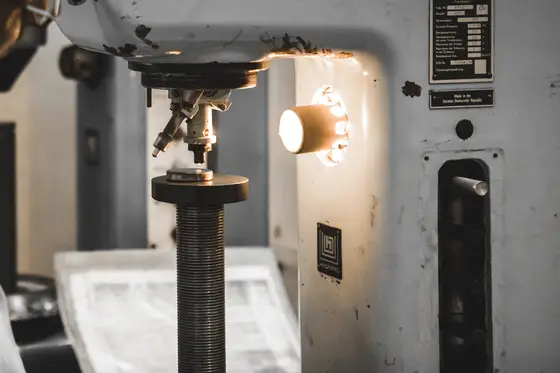
Materials testing is the foundation service. Every other pillar at TCR rests on the test result. The Mahape laboratory in Navi Mumbai alone handles 3,000+ samples per month across mechanical, chemical, corrosion, metallurgical, and specialised methods. The TCR Eastern facility is at Bhubaneswar.
- Throughput: the Mahape laboratory in Navi Mumbai handles more than 3,000 samples a month.
- Second facility: TCR Eastern at Bhubaneswar.
- Specimen preparation: a dedicated in-house machine shop prepares metallic and non-metallic specimens.
- Properties evaluated: tensile, compression, impact, weldability, fatigue and bend.
- Special service: elevated-temperature tensile testing, with proof stress determined by electronic extensometer.
- New block: heat treatment verification testing, built around the NADCAP AC7101 accreditation awarded in 2026.
TCR's mechanical testing service has a dedicated in-house machine shop that prepares metallic and non-metallic specimens for tensile, compression, impact, weldability, fatigue and bend testing.
Electronic extensometers give a precise determination of proof stress, and elevated-temperature tensile testing is a special service. Tests run to ASTM, BS, IS, DIN or client-specified standards.
Tensile tests establish the strength and characteristics of a material, with proof stress read by electronic extensometer. Elevated-temperature tensile tests run from 80 °C to 1,100 °C. Impact testing covers Izod and Charpy, at room temperature and at sub-zero temperatures down to -196 °C. TCR's Navi Mumbai laboratory also runs hydrostatic pressure tests on pipes.
A new Heat Treatment Verification Testing block built around the NADCAP AC7101 Materials Testing accreditation, awarded 2026.
Twenty testing services
The materials testing pillar carries twenty services, each on its own page with the governing standards, NABL coverage, case evidence and a quote form: from routine mechanical testing to sour-service corrosion, fracture toughness, creep and residual stress measurement.
- Count: twenty services, each on its own page.
- Each page carries: the governing standards, NABL coverage, case evidence and a quote form.
- Range: from routine mechanical testing to sour-service corrosion, fracture toughness, creep and residual stress measurement.
-
Mechanical Testing of Metals, Fasteners and Welds
Tension, hardness, bend and impact testing for plant, project and trade acceptance.
-
Chemical Analysis and Alloy Verification
Composition and grade confirmation by OES, XRF and wet chemistry.
-
Corrosion and Sour-Service Testing per NACE TM0177 and TM0284
HIC and SSC testing for sour hydrocarbon service. PDO and OQGN approved; sour-service projects executed for Shell.
-
Fatigue and Fracture Toughness Testing per ASTM E1820 and E647
CTOD, J-integral, KIc, fatigue crack growth and S-N fatigue for pipelines, rail, aerospace and offshore.
-
CTOD Testing per BS 7448, ISO 12135 and ASTM E1820
Crack tip opening displacement on weld metal, heat-affected zone and plate: room temperature, sub-zero to -65 °C on specimens 7.5 mm to 90 mm thick, and after H2S pre-charging, all on the NABL scope.
-
Metallurgical Evaluation and Microstructure Analysis
Microstructure, grain size and inclusion rating behind every failure investigation.
-
Creep and Stress Rupture Testing to 1,100 °C per ASTM E139
Six frames, 50 kN, durations to 100,000 hours, for boiler, reformer and heater alloys.
-
Composites and Polymer Testing
Mechanical and physical characterisation of non-metallic and composite materials.
-
Coating Evaluation and Testing
Protective coating assessment for pipelines, structures and process equipment.
-
Welder and Welding Procedure Qualification
Qualification testing of welders and procedures for fabrication and construction codes.
-
Heat Treatment Verification Testing
Verification testing of heat-treated components. TCR is the verification-testing partner, not the heat treater.
-
TMT Rebar Testing per IS 1786
Tensile, bend and re-bend, and composition testing of TMT bar to IS 1786; rebar couplers to IS 16172 are tested on the civil testing side.
-
RoHS Compliance Testing
Restricted-substance screening for electronics and manufactured goods.
-
Oil Analysis and Ferrography
Lubricant condition and wear-debris analysis for rotating equipment.
-
Residual Stress Measurement by X-Ray Diffraction
Non-destructive residual stress determination on welds and machined components.
-
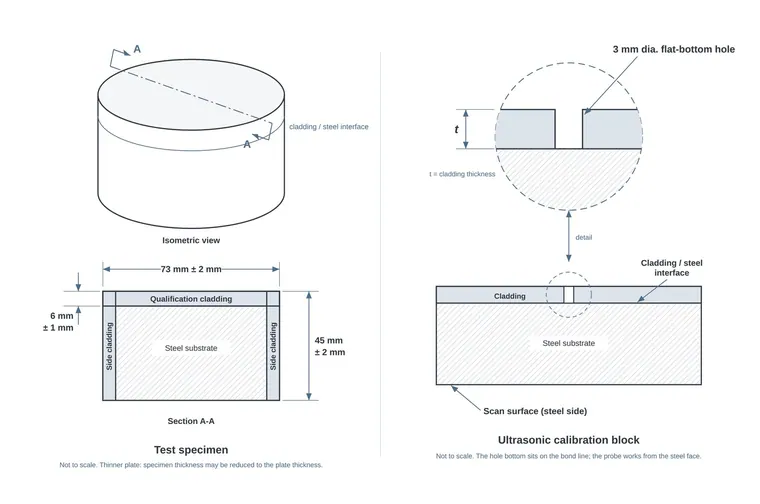
Hydrogen Induced Disbonding Testing per ASTM G146
Bond integrity of stainless weld overlay and clad steel for refinery high-pressure hydrogen service. Specimens supplied to the drawing, or machined at TCR.
-
Hydrogen Embrittlement Testing per ISO 11114-4 and ASTM F519
Steel for Type I hydrogen cylinders to ISO 11114-4, plated parts by sustained load to ASTM F519, and copper to ASTM B577.
-
FTIR Analysis of GRE Pipe per ASTM E168
Infrared spectra of the epoxy in glass reinforced epoxy pipe, for resin identity, batch comparison and cure. 50 x 50 mm minimum sample.
-
Glass Transition Temperature by DSC per ASTM E1356
Tg onset and midpoint by differential scanning calorimetry, including dried water-based acrylic emulsion films.
-
Machine Shop and Specimen Preparation
Specimens turned, milled, ground and wire-cut in-house to the dimensions and finish the test method demands, under the same accreditation as the test.
Weld procedure and welder qualification coupons are tested here. The work around them, WPS preparation and review, PQR, and the witnessing, certification and endorsement of welder tests, sits with welding inspection under inspection services.
Case evidence
Materials testing at TCR anchors named, dated engagements: CTOD programmes for Saudi Aramco's Jafurah gas compression plants, elevated-temperature tensile approval from NPCIL, and long-duration creep rupture of SUPER 304H boiler tube material to BHEL specification.
- Saudi Aramco: CTOD programmes for the Jafurah gas compression plants.
- NPCIL: elevated-temperature tensile approval.
- BHEL: long-duration creep rupture of SUPER 304H boiler tube material to specification.
-
Jafurah Gas Compression Plants ECA
Engineering Critical Assessment of 42-inch girth welds for PWIS Package-1, per API 1104 Annex A Option 2, with six CTOD tests per pipeline.
-
Elevated-Temperature Tensile Approval
NPCIL approval for elevated-temperature tensile testing, adding nuclear-sector acceptance to the laboratory's approval record.
-
Creep Rupture of SUPER 304H (UNS S30432)
Creep rupture testing of SUPER 304H boiler tube material per BHEL specification, IBR requirements, ASTM E139 and BS EN ISO 204.
Standards we test to
Every test is reported against its governing standard, cited in full on the service page: ASTM mechanical and fracture methods, NACE sour-service methods, Indian Standards for construction materials, and ISO equivalents where clients specify them.
- ASTM E8/E8M
- ASTM E23
- ASTM E139
- ASTM E1820
- ASTM E399
- ASTM E647
- ASTM E466
- ASTM E606
- ASTM E112
- ASTM E45
- ASTM E415
- ASTM E407
- ASTM E488
- NACE TM0177
- NACE TM0284
- BS 7448
- ISO 12135
- ISO 15653
- BS EN ISO 204
- IS 16172
- EN 13674
- IRS:T-29
Which accreditation should a metal testing laboratory hold, and how is a TCR report checked?
A metal testing laboratory should hold NABL ISO/IEC 17025:2017 accreditation for the methods it reports, and NADCAP AC7101 as well where parts enter the aerospace supply chain. TCR Engineering's Mahape laboratory in Navi Mumbai holds both, and every report it issues can be checked against the certificate, the published scope and the marks printed on the report itself.
| Credential | Reference | What it covers | Where to check it |
|---|---|---|---|
| NABL ISO/IEC 17025:2017, Mahape | NABLT0726MH18640, 3 March 2026 to 2 March 2030 | 1,483 scope items: 1,383 laboratory and 100 site | The line-by-line scope on quality and accreditation |
| NADCAP AC7101 Materials Testing | PRI certificate 29415245997, valid to 31 May 2027 | Aerospace materials testing parameters inside the AC7101 checklists; anything outside them reports under NABL | The NADCAP AC7101 press kit |
| NABL ISO/IEC 17025:2017, TCR Eastern | TC-15993, 30 April 2025 to 29 April 2029 | 409 scope items at Bhubaneswar | The Bhubaneswar laboratory page |
| ILAC MRA, through NABL | NABL is an ILAC MRA signatory | Reports accepted in 90+ economies | Quality and accreditation |
| The report itself | ULR, T.C. number, page bar code and QR codes | Proof that the copy in hand is the report TCR issued | Verify a TCR report |
Find your answer
Which test do I need?
Answer three questions: the equipment or material, what you are seeing or must prove, and the governing code if you know it. The selector returns one to three TCR services, each with its standard, what to send and a quote request already filled in for that service.
Documents
Download the reference documents for this page. Every file is hosted on this domain and is also listed in the site document library.
Related insights
166 published insights on this site carry the Materials Testing tag. The 6 most recent are below.
-
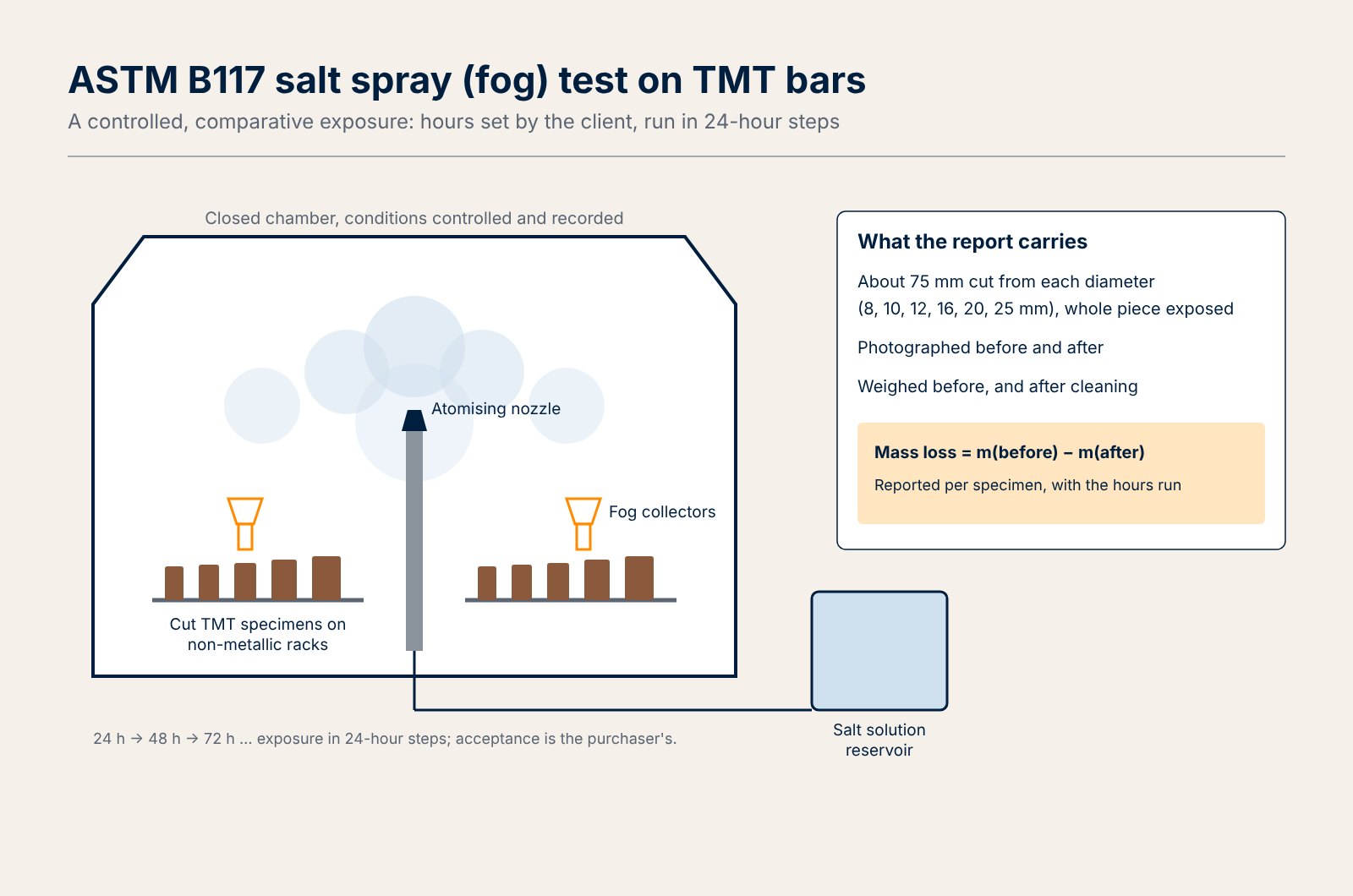
ASTM B117 salt spray testing of TMT bars at Mahape: what the test shows and what it does not
TCR Engineering's Mahape laboratory runs salt spray (fog) tests to ASTM B117 under NABL accreditation. Using a six-diameter TMT bar enquiry as the…
-
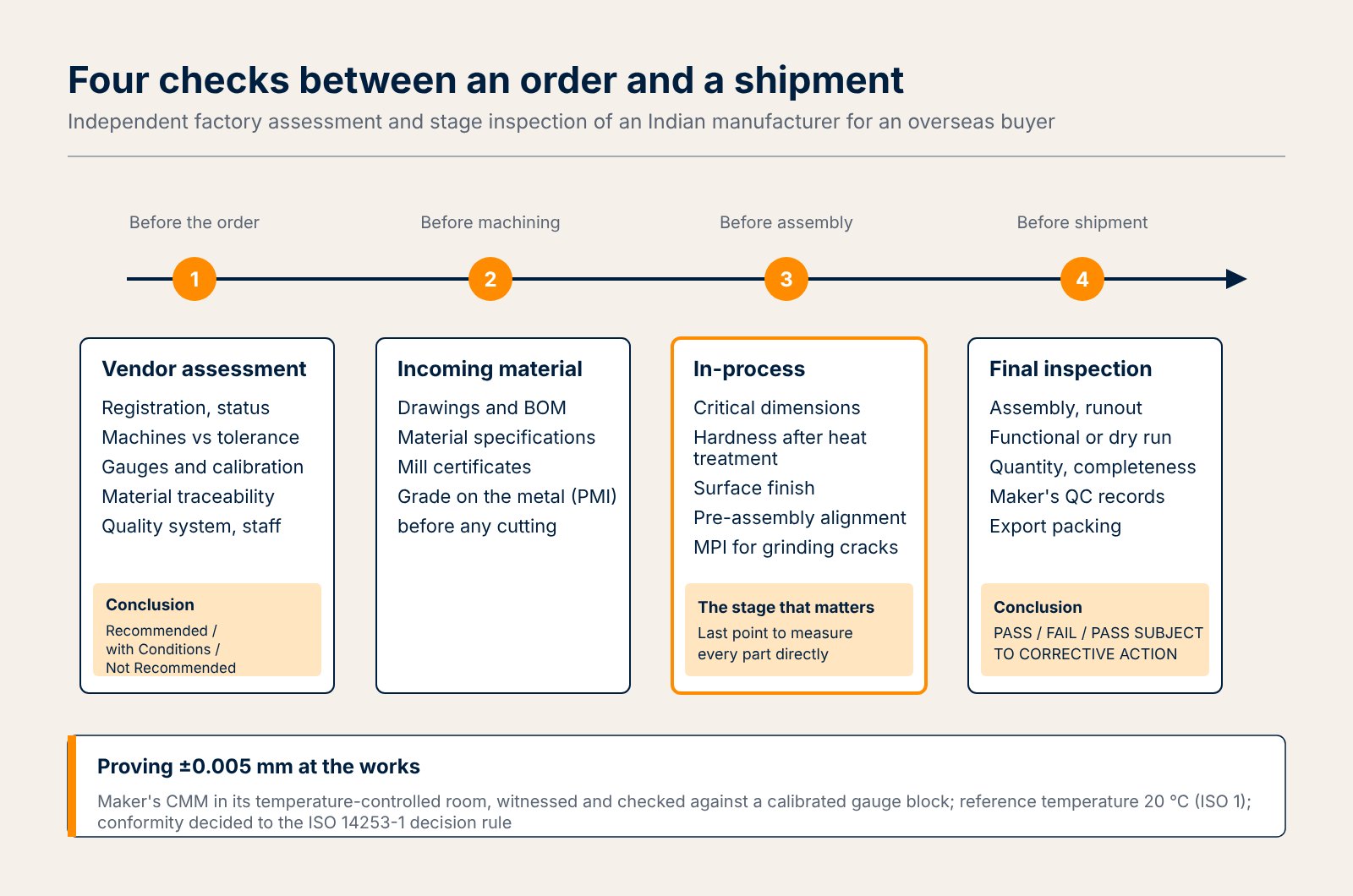
Factory assessment and audit of Indian manufacturers for international buyers: what to check, when, and with what
An international buyer placing an order with an Indian manufacturer needs four independent checks: a factory assessment before the order, incoming…
-
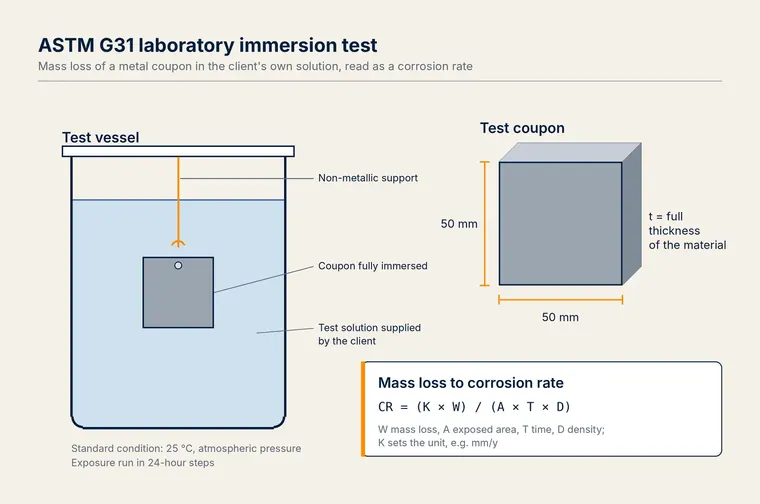
ASTM G31 immersion corrosion testing at Mahape: how a metal behaves in your own liquid
TCR Engineering's Mahape laboratory runs ASTM G31 laboratory immersion tests: a coupon of the client's metal, in the client's own solution, weighed…
-
One NACE method, four pass marks: sour service testing to Saudi Aramco, ADNOC, QatarEnergy and PDO specifications
A plate with an average crack length ratio of 12 per cent passes API 5L and PDO and fails Saudi Aramco. The NACE method is the same in all three; the…
-
Rebuilding a 13Cr valve seat on a WCB body: the qualification is an overlay, and E410 is the wrong filler
A request for a WPS to rebuild scored 13Cr gate valve seats looks routine. It is two decisions most repair shops get wrong: the build-up is qualified…
-
Hydrogen induced disbonding testing to ASTM G146 opens at Mahape, and why the overlay fails on the way down
TCR Engineering's Mahape laboratory is taking client specimens for hydrogen induced disbonding testing to ASTM G146. What the test reproduces, why…
Frequently asked questions
Is TCR Engineering NABL accredited for materials testing?
Yes. The Mahape laboratory in Navi Mumbai holds NABL ISO/IEC 17025:2017 accreditation (NABLT0726MH18640) across 1,483 scope items, 1,383 laboratory tests and 100 site tests, spanning mechanical, chemical, corrosion, metallurgical, fatigue, fracture-toughness and creep testing. Reports are accepted in 90+ economies under the ILAC MRA.
Is TCR NADCAP accredited for aerospace materials testing?
Yes. TCR Engineering is NADCAP AC7101 Materials Testing accredited (2026), PRI certificate 29415245997, valid to 31 May 2027. The scope is AC7101 only: TCR is the verification-testing partner, not the heat treater. Aerospace testing clients include HAL, MTAR Technologies and Vikram Sarabhai Space Centre.
What standards does TCR test to for mechanical and fracture testing?
Core methods include ASTM E8/E8M tensile, E23 impact, E139 creep, E399 and E1820 fracture toughness, E647 fatigue crack growth, E466 and E606 fatigue, BS 7448, ISO 12135 and ISO 15653, plus NACE TM0177 and TM0284 for sour service. Every report cites the governing standard in full.
Can TCR run creep and stress rupture tests?
Yes. TCR Engineering operates six creep frames to 1,100 °C at 50 kN with test durations to 100,000 hours in Navi Mumbai, including creep rupture of SUPER 304H (UNS S30432) boiler tube material per BHEL specification, IBR requirements, ASTM E139 and BS EN ISO 204.
Does TCR test for sour service (HIC and SSC) per NACE?
Yes. HIC and SSC testing per NACE TM0177 and TM0284 for sour hydrocarbon service is a core service of the materials testing pillar. TCR is PDO and OQGN approved for this work and has executed sour-service projects for Shell.
How many samples does TCR's laboratory handle each month?
The Mahape laboratory in Navi Mumbai handles 3,000+ samples per month across mechanical, chemical, corrosion, metallurgical and specialised methods, with samples received from 15+ countries and a dedicated in-house machine shop for specimen preparation. TCR Eastern at Bhubaneswar (NABL TC-15993) adds a second accredited facility.
Which accreditation should a metal testing laboratory hold, NABL or NADCAP?
Both, where the parts are for aerospace. NABL ISO/IEC 17025:2017 accreditation covers the method and the competence behind each result, and NADCAP AC7101 is the aerospace supply chain accreditation for materials testing. TCR Engineering's Mahape laboratory in Navi Mumbai holds NABL certificate NABLT0726MH18640 and NADCAP AC7101 PRI certificate 29415245997, valid to 31 May 2027.
How can I check that a TCR materials test report is genuine?
Every TCR report carries its own marks: the ULR, the T.C. number, a page bar code and QR codes to the digital copy and to the NABL record. The Verify a report page on tcreng.com explains how to read each one, and the line-by-line scope of NABL certificate NABLT0726MH18640 is published on the quality page.
Does TCR's materials testing laboratory test concrete and building materials?
Concrete, cement, aggregates, soil and building materials are tested by TCR Engineering's civil testing laboratory, at the same Mahape site in Navi Mumbai and under the same NABL certificate NABLT0726MH18640. The materials testing pillar covers metals, alloys, welds, polymers and composites, and IS 16172 rebar couplers are tested on the civil side.