
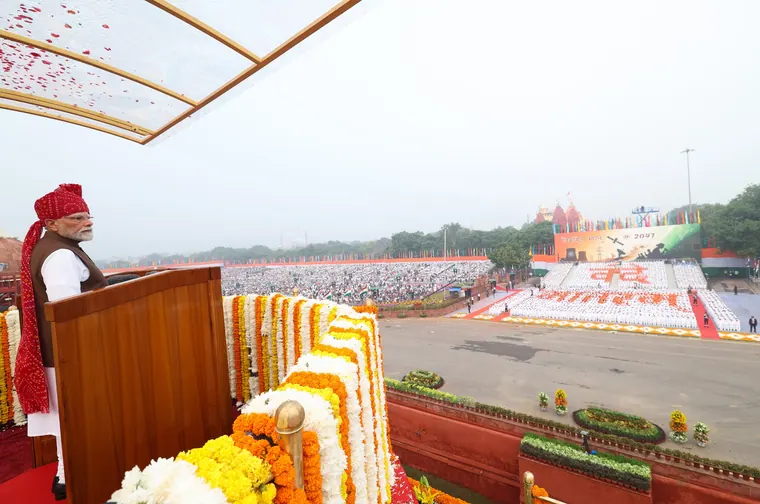
From the ramparts of the Red Fort on 15 August 2026, India's 80th Independence Day, the Prime Minister made quality the condition of the country's manufacturing ambition rather than a footnote to it. TCR Engineering Services, a NABL ISO/IEC 17025:2017 accredited laboratory at Mahape, Navi Mumbai, has produced the evidence behind that kind of claim since 1973.
- The Prime Minister's words: "Our zero-defect precision manufacturing should become our hallmark ... our mantra should be quality, quality, quality. This will become our global brand value."
- Indian manufacturing is 17.5 per cent of GDP today and the stated target is 25 per cent by 2047, against a 3.2 per cent share of world manufacturing output
- MSMEs account for 31.1 per cent of GDP, 35.4 per cent of manufacturing output and 48.58 per cent of exports
- TCR Engineering holds NABL accreditation NABLT0726MH18640 with 1,483 scope items, NADCAP AC7101, IBR Well-Known Material Testing Laboratory status and BIS recognition for IS 16172 rebar coupler testing
What the Prime Minister actually said
The passage came in the manufacturing section of the address, immediately after the call for complete domestic value chains from small components to finished products. In the official English rendering published by the Press Information Bureau, it reads:
Quality, quality, quality.
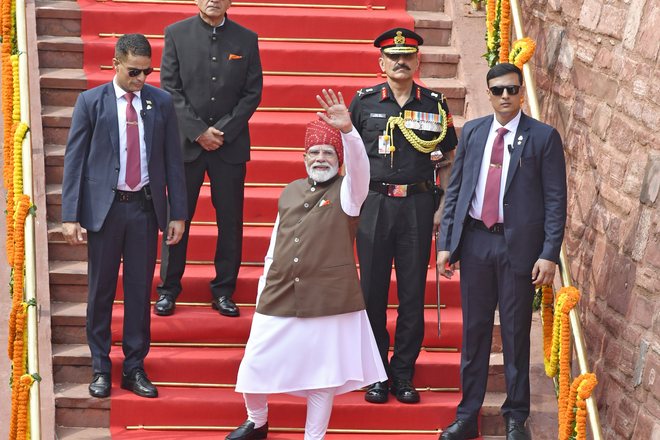
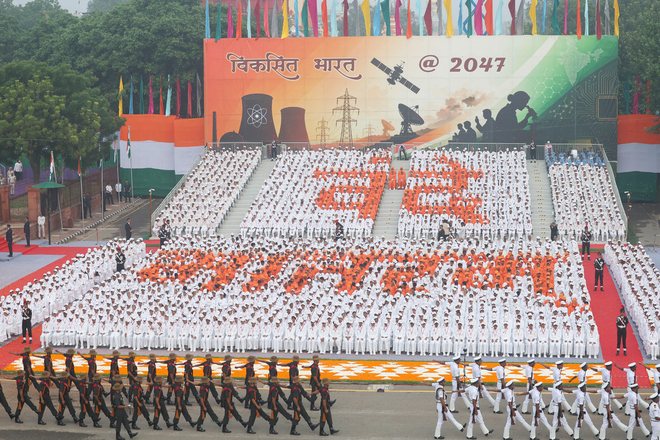
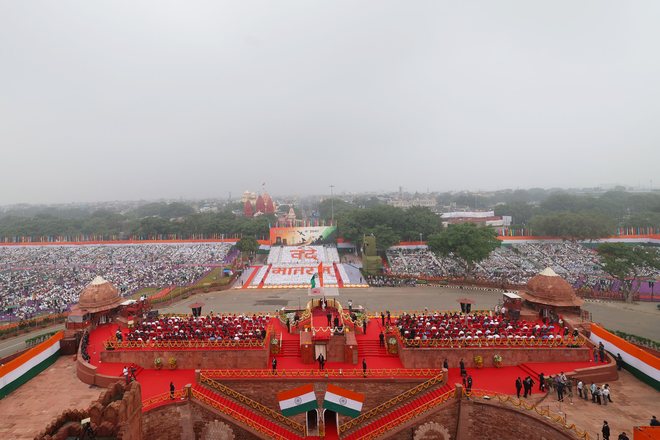

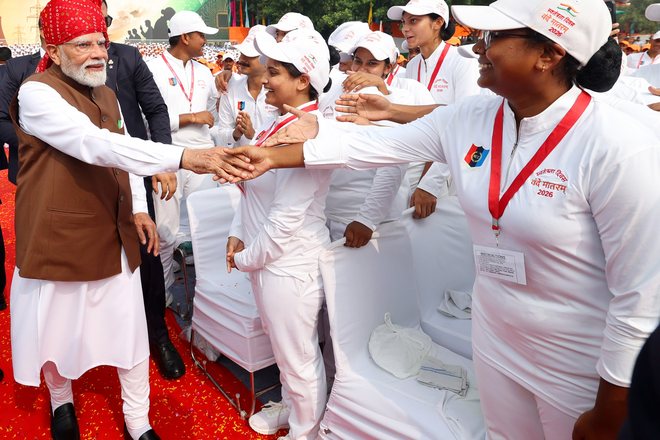
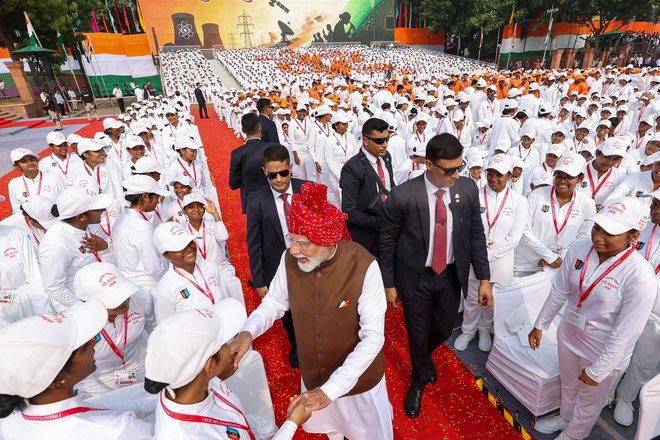
“Our zero-defect precision manufacturing should become our hallmark. I want to say to every manufacturer, every entrepreneur, every MSME, our identity in the global market should be based on credibility and quality. No compromise regarding quality and hence our mantra should be quality, quality, quality. This will become our global brand value.”
Five uses of the word quality in four sentences, one of them addressed by name to the MSME. Around it sat the demand that Indian factories meet "global standards in terms of cost, quality and scale", and the Sapta Dhara framework for 2047, whose first of seven streams is manufacturing power.
Read it in full at the source. The complete English text of the address is published verbatim by the Press Information Bureau, Government of India, and the address is carried on the Prime Minister's Office site. Every word quoted on this page is taken from the PIB rendering and nothing in it has been paraphrased.
Zero defect is not an attitude. It is a measurement.
A factory cannot resolve to be defect-free the way a person resolves to wake early. Zero defect is a claim about physical properties, and a claim about physical properties is settled by a number: a yield strength in MPa, a case depth in mm, a grain size to ASTM E112, a chloride content in ppm, a compressive strength at 28 days. Every one of those numbers carries units, a method, a calibration chain back to a national standard, and an uncertainty. Strip any of those away and what remains is an opinion with a decimal point in it.
This is why the Prime Minister's second word matters as much as the first. Credibility is not something a manufacturer can assert about its own output. It is conferred by a third party whose competence has itself been audited, which is what accreditation to ISO/IEC 17025 exists to establish. India's laboratory accreditation body, NABL, is a signatory to the ILAC mutual recognition arrangement, so a report issued under that accreditation is accepted by buyers, insurers and regulators in more than ninety economies. That arrangement is the mechanism by which "quality" stops being a domestic adjective and becomes an export credential.
Where Indian manufacturing is going, in numbers
The gap between the ambition and the present position is the whole of the argument.
| Measure | Position | Source |
|---|---|---|
| Manufacturing share of India's GDP | 17.5 per cent | NITI Aayog, 13 August 2026 |
| Target share | 25 per cent by 2047 | NITI Aayog, twelve priority sectors |
| India's share of global manufacturing output | 3.2 per cent, against China's 32 per cent | NITI Aayog |
| National Manufacturing Mission targets | 25 per cent of GDP by 2035, 143 million jobs, USD 1.2 trillion of merchandise exports | Ministry of Commerce and Industry |
| Merchandise exports, FY 2025-26 | USD 441.78 billion, up 0.93 per cent | Ministry of Commerce, 15 April 2026 |
| Services exports, FY 2025-26 | USD 418.31 billion, up 7.94 per cent | Ministry of Commerce |
| Manufacturing GVA growth, FY 2025-26 | 7.72 per cent in Q1, 9.13 per cent in Q2 | Ministry of Commerce and Industry |
Read the first and the last rows together. Manufacturing output is growing at better than 7 per cent while merchandise exports grew under 1 per cent. India is making more and selling abroad at about the same rate as before. Volume alone does not move that number. What moves it is a buyer in Rotterdam, Houston or Jubail accepting an Indian test report without asking for the batch to be retested on arrival.
The MSME is where the mantra will be won or lost
The Prime Minister named the MSME directly, and the numbers explain why. As of June 2026 the sector accounted for 31.1 per cent of GDP, 35.4 per cent of manufacturing output and 48.58 per cent of exports, with 8.7 crore Udyam registrations and 38.9 crore people employed. Almost half of what India sells to the world leaves a small or medium enterprise.
Those firms are also the ones for whom a testing regime is hardest to carry. A jobbing foundry in Rajkot, a forge shop in Ludhiana, a pipe mill in Ahmedabad and a fastener unit in Chennai each face the same arithmetic: an accredited laboratory of their own is unaffordable, and a rejected consignment is unsurvivable. The answer that has worked for five decades is a shared laboratory. TCR Engineering serves a large part of the Mumbai metals trade through the collection centre at Bharat Metal Exchange, whose members and those of MASSMA together number more than 4,800 firms, and which lets a trader or a small manufacturer buy exactly the test a customer has asked for and nothing else.
What "quality" means, product family by product family
"Zero defect" reads as an abstraction until it is written as a test on a specific product. This is the actual content of the mantra across steel and metals, construction and infrastructure, and it is ordinary materials testing work.
| What is made | The property that decides acceptance | Where it is tested |
|---|---|---|
| Castings | Chemistry, soundness, mechanical properties, freedom from shrinkage and porosity | Chemical analysis, mechanical testing, radiography |
| Forgings | Grain flow, tensile and impact at temperature, decarburisation, ultrasonic soundness | Metallurgical evaluation, heat treatment verification |
| Plates and sheets | Through-thickness properties, formability, HIC resistance for sour service | Corrosion and sour service testing to NACE TM0284 |
| Pipes and tubes | Weld integrity, girth weld quality, fracture toughness, coating adhesion | Non-destructive testing, fatigue and fracture toughness |
| TMT rebar and couplers | Yield and tensile, elongation, bend and rebend, coupler performance to IS 16172 | Rebar couplers, BIS |
| Concrete and aggregates | Compressive strength, chloride and sulphate content, durability | Concrete, cement and aggregates |
| Structural steelwork | Weld procedure and welder qualification, dimensional and coating conformity | Third party inspection |
None of this is exotic. It is the ordinary daily traffic of an accredited laboratory, and it is the difference between a component that a prime contractor accepts and one that comes back.
"A small part of our contribution to the nation"

"When my father started this company his purpose was to serve the Indian marketplace. He was deeply committed to the nation, and our belief has never changed: the work takes the nation forward. We enjoy what we do, and at the back of our minds we know that whatever we do carries a small part of our contribution to the country. When somebody in the Middle East, in Europe or in America looks at an engineering product out of India and appreciates it, we are glad to have had a small role to play."
Rohit Bafna is the second generation at TCR. The company was founded in 1973 by V.K. Bafna, a gold-medallist metallurgist, and has been led since 2013 by Neelam Bafna as Chairperson and Managing Director.

The credential stack is the argument
A commitment to quality that cannot be audited is a slogan. What follows is what TCR Engineering has put on the record instead, and every line of it is a document a customer can download and verify.
| Credential | Reference | Validity |
|---|---|---|
| NABL, ISO/IEC 17025:2017, 1,483 scope items (1,383 laboratory, 100 site) | NABLT0726MH18640 | 3 March 2026 to 2 March 2030 |
| NADCAP Materials Testing, AC7101 | PRI certificate 29415245997 | to 31 May 2027 |
| BIS recognition, IS 16172 rebar coupler testing, 8 mm to 40 mm | LRMD/LRS/OSL-7103506 | first commercial laboratory in India recognised for this scope |
| IBR Well-Known Material Testing Laboratory | Form XVI-H certificate 38, Serial MTL/15/019 | 19 April 2024 to 2 April 2029 |
| ISO 45001:2018 occupational health and safety | QRO certificate 3050260220154HS | to 19 February 2029 |
| AERB radiography licences, operation and storage | 23-IRLOP-893925 | current |
That stack is why operators outside India will take an Indian report at face value. Petroleum Development Oman and OQGN have approved TCR for NACE sour-service testing. Saudi Aramco carries the company under contract 6601000141 and named it in SAER-13115 as the provider of the internal RT crawler technology. NOV has approved it as a vendor. The reformer-tube inspection practice has worked at Dangote, Emirates Steel and JIFCO. None of those approvals were won on price, and each of them began with a laboratory report that an auditor could follow line by line.
"This is why we have committed so much to certification, whether it is NADCAP, NABL or ISO/IEC 17025, and to tightening and ordering our procedures. International majors such as PDO, OQGN, Saudi Aramco, NOV and Dangote need to be able to count on TCR to be their eyes and ears in India. That trust is built one report at a time."
Four trade agreements have opened the door. Quality decides who walks through it
Between December 2022 and February 2026 India settled or advanced four trade arrangements that between them reach most of its high-value export demand: the Economic Cooperation and Trade Agreement with Australia, in force since 29 December 2022 and now being widened towards a full Comprehensive Economic Cooperation Agreement; the Comprehensive Economic and Trade Agreement with the United Kingdom, in force since 15 July 2026; the free trade agreement with the European Union, whose negotiations concluded on 27 January 2026; and the framework for an interim reciprocal trade agreement with the United States, announced on 6 February 2026 and still being worked into a full bilateral agreement. TCR Engineering welcomes all four, and congratulates the government on getting them done. They are the right policy, and they have arrived at the moment Indian manufacturing can use them.
| Agreement | Status | What it changes for an Indian exporter | Source |
|---|---|---|---|
| India–Australia ECTA | In force 29 December 2022 | 96 per cent of Indian goods entered Australia tariff-free from day one, rising to 100 per cent of tariff lines by 1 January 2026. CECA negotiations continue. | Australian Department of Foreign Affairs and Trade |
| India–United Kingdom CETA | In force 15 July 2026 | 99 per cent of UK tariffs and 90 per cent of Indian tariffs liberalised. | UK Government |
| India–European Union FTA | Negotiations concluded 27 January 2026; entry into force follows ratification | Over 99 per cent of Indian exports gain preferential entry. Tariffs of up to 10 per cent on about USD 33 billion of exports fall to zero on entry into force. | Ministry of Commerce and Industry, 27 January 2026 |
| India–United States | Framework for an interim agreement announced 6 February 2026; the bilateral trade agreement is still under negotiation | The reciprocal tariff on Indian goods was cut from 25 per cent to 18 per cent. | The White House, February 2026 |
A tariff line is only half of an export. The other half is conformity, and conformity does not fall when a duty falls. A UK or European buyer who no longer pays duty on an Indian casting will still ask for the chemistry, the mechanical properties and the restricted-substance content, and will still expect them on a report from a laboratory whose competence somebody else has audited. That is the half of the door these agreements do not open for anybody. It is opened one test report at a time, and it is precisely where the Prime Minister's mantra lands.
RoHS: the second gate into Europe
For anything carrying an electrical or electronic component, the European market applies a chemistry limit as well as a tariff. Directive 2011/65/EU, RoHS, caps lead, mercury, hexavalent chromium, polybrominated biphenyls and polybrominated diphenyl ethers at 0.1 per cent by weight in any homogeneous material, and cadmium at 0.01 per cent. It is not a declaration exercise. It is a measurement on the material itself, and a consignment stopped at Rotterdam for a restricted substance costs more than the test that would have found it in Mumbai.
TCR Engineering undertakes RoHS testing to the IEC 62321 series: non-destructive screening by X-ray fluorescence to sort a goods-in lot quickly, then confirmation by inductively coupled plasma spectrometry wherever a screen reads high. An exporter to the European Union, and now to the United Kingdom under CETA, can therefore put a traceable number against every restricted substance before the container is sealed rather than after it lands.
What the MSME sector can do about it now
The work of getting export-ready is smaller than most small firms expect, and it is almost always cheaper than one rejected consignment. Five things carry most of the weight:
- Test to the buyer's standard, not to the nearest Indian equivalent. A European buyer asking for EN 10204 3.1 or 3.2 certification is asking for a specific document with a specific signatory, and a substitution is a rejection.
- Use an ILAC-recognised report. A result issued under NABL accreditation to ISO/IEC 17025:2017 is accepted in more than ninety economies without a retest on arrival. An unaccredited report is retested at the buyer's cost and the buyer remembers it.
- Screen for restricted substances before shipping, not after. RoHS for electricals and electronics, and REACH substances of very high concern where they apply.
- Qualify the process, not only the part. Welder and welding-procedure qualification, heat-treatment verification and coating conformity are what a prime contractor audits when it decides whether to keep buying.
- Keep the traceability chain intact. Heat number to test certificate to delivery note. It costs nothing during the order and it is unrecoverable afterwards.
A firm with fifteen people cannot carry an accredited laboratory, and it does not have to. That is what a shared laboratory is for, and it is what TCR Engineering has been for Indian manufacturers since 1973. In this we stand hand in hand with the companies of this country: the agreements are the government's work, the products are theirs, and the evidence is ours to produce.
The part of the country that people stand on
Export credibility is one half of it. The other half is domestic, and it is less forgiving. When TCR runs corrosion, fatigue or fracture toughness testing for Indian Railways or for a bridge contractor, the object being qualified will carry Indian men and women. More than 500 bridges have been inspected and over 1,200 structural audits completed. The company is empanelled with NHSRCL under VMAC No. 13 for the Mumbai-Ahmedabad High Speed Rail and has worked on all three civil packages since March 2024.
TCR is a company run by a woman. Neelam Bafna has been Chairperson and Managing Director since 2013, and civil testing is led by Parul Hariya as Department Head, so the part of the work that decides whether a home, a school or a bridge is safe is a woman-led department inside a woman-led company. That is a line of accountability rather than a statistic. A home is tested the way a home should be tested: from the concrete and the aggregate through to the rebar and the coupler that joins it. TCR Engineering was the first commercial laboratory in India recognised by the Bureau of Indian Standards for IS 16172 rebar coupler testing across all diameters from 8 mm to 40 mm, which is the joint that decides whether a reinforced frame behaves as designed. Union capital expenditure of ₹12.2 lakh crore in FY 2026-27 will become highways, corridors and housing. Every one of those structures is a quality claim made in advance of the people who will use it.
India's quality infrastructure is already being built
The regulatory scaffolding has moved faster than most manufacturers realise. About 23,000 Indian Standards are in force, the majority harmonised with ISO and IEC. As of March 2025 the Bureau of Indian Standards had 187 Quality Control Orders in effect covering 769 products under compulsory certification, and DPIIT's Transition Facilitation (Quality Control) Order of 25 June 2026 has since introduced a risk-based route to compliance for firms with a clean record.
Testing capacity has to grow with it. Independent estimates of the Indian testing, inspection and certification market for 2025 range from USD 12.8 billion to USD 18.9 billion, a spread wide enough to be its own comment on how loosely the sector is measured, with growth forecast in the region of 6 to 7 per cent a year. Whichever figure is nearer the truth, it is a fraction of what a 25 per cent manufacturing economy will require.
Recognised at home

Contribution to the nation is not only technical. The Central Board of Indirect Taxes and Customs, Ministry of Finance, has issued TCR Engineering Services Pvt. Ltd. a certificate of appreciation for prompt filing of returns and substantial payment of Goods and Services Tax, most recently for FY 2025-26, an award the company has received on more than one occasion. TCR has been an associate member of the Bombay Chamber of Commerce and Industry since 2006, membership BC/3150/A/2006, and is a registered seller on the Government e-Marketplace under Seller ID ENEQ200001820172, so public-sector buyers can procure accredited testing through the government's own channel.
To 2047
India will complete a hundred years of independence in 2047. A country that intends to lift manufacturing from 17.5 per cent of GDP to 25 per cent over that period, while raising its share of world manufacturing output from 3.2 per cent, is committing to a volume of qualification work that has no precedent here. Every furnace charge, every heat, every pour, every weld and every pile cap in that expansion is a measurement waiting to be made.
TCR Engineering thanks the Prime Minister for putting quality at the centre of the Independence Day address. It is the right diagnosis, and it is one this laboratory has been working on since 1973. The related Make in India, Test in India analysis sets out the same case for the aerospace supply chain. Whatever India builds for tomorrow, and whatever it builds for export, has to pass through testing first. That is where TCR comes in, and the company stands with the nation in doing it properly.