
In October 2015 TCR Advanced Engineering, the TCR group's asset integrity company at Vadodara, India, announced a two-day course on ammonia storage tank integrity management for 16 and 17 October 2015 in Vadodara. It covered damage mechanisms in ammonia tanks, risk-based inspection (RBI) of the tanks and the case for and against opening a low-temperature tank for inspection.
- Organiser: TCR Advanced Engineering, Vadodara, Gujarat
- Dates: 16 and 17 October 2015
- Topics: damage mechanisms, RBI and inspection planning for ammonia storage tanks
- Ammonia tank integrity work: undertaken by TCR Engineering, TCR Advanced Engineering and TCR Arabia, with external partners and associate firms
TCR Advanced (India) announced a two-day intensive course on "Ammonia tanks Integrity management and inspection challenges" for 16 and 17 October 2015 at Vadodara.
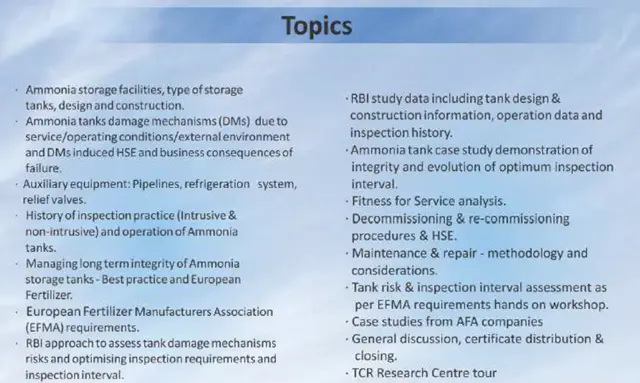
Opening a low temperature ammonia tank for inspection is critical call as it is compromise between a need for condition assessment of tank and the negative effects of thermal stress and ingress of oxygen. It is known fact that decommissioning and re-commissioning tends to increase the risk for SCC initiation. The failure of ammonia tanks can be catastrophic and disastrous leading to long term and short-term effects. Integrity of ammonia tank is therefore very crucial. The world has learned from mistakes from the past incidents. Increasing regulatory requirements imposes new challenges for integrity assessment of these tanks. Assessment of integrity of ammonia tank is therefore critical and calls for risk-based approach. RBI approach to structural integrity calculations helps in defining most appropriate inspection methods, Determination of tank monitoring requirements including internal and external inspection aspects and prevention or minimisation of a tank leak or failure.
Different storage tank applications have unique conditions that must be considered when evaluating the tanks. It is therefore very important that experienced and competent engineers and inspectors required for integrity assessment. This course primarily focuses in providing insights to damage mechanisms associated with Ammonia tank, application of RBI to improve integrity of tanks and a platform to discuss issues with practitioners in reliability engineering.
Awareness with RBI assessment can provide longer duration for inspection with increased confidence to maintaining Ammonia tanks. The course was announced as an update on current practice in ammonia tank integrity management.
FAQ
What did the 2015 ammonia tank integrity course cover?
The two-day course, announced by TCR Advanced Engineering for 16 and 17 October 2015 in Vadodara, covered damage mechanisms in ammonia storage tanks, risk-based inspection of the tanks, inspection planning, and the risk of stress corrosion cracking when a low-temperature tank is decommissioned and re-commissioned.
Why is opening a low-temperature ammonia tank for inspection a difficult decision?
Opening the tank gives a direct view of its condition, but warming and re-cooling add thermal stress and let oxygen in, and decommissioning and re-commissioning raise the risk of stress corrosion cracking. A risk-based inspection approach weighs that risk against the value of an internal inspection.
Who undertakes ammonia tank integrity work in the TCR group?
Ammonia tank integrity work is undertaken by TCR Engineering, TCR Advanced Engineering and TCR Arabia, with external partners and associate firms. Fitness-for-service assessments within that work are delivered and signed by TCR Arabia in Saudi Arabia and by TCR Advanced Engineering in India, each under its own name.