
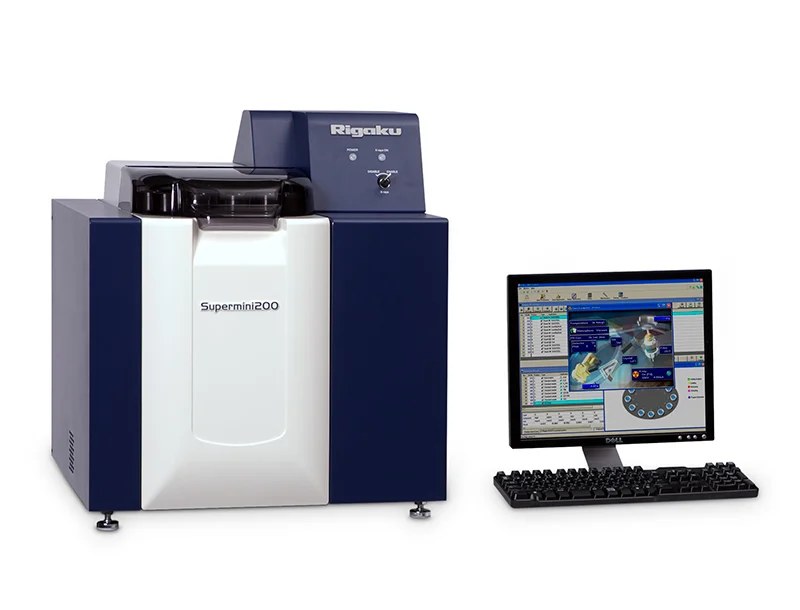
TCR Engineering has commissioned a Rigaku Supermini200 wavelength-dispersive XRF spectrometer at its Mahape laboratory in Navi Mumbai, for chemical analysis of cement, supplementary cementitious materials, refractories, ceramics, glass, ores and ferroalloys to IS 12803, ASTM C114 and ISO 29581-2. Those three methods are not yet on NABL certificate NABLT0726MH18640. The scope extension is the next step.
That last sentence is the one worth reading twice, and this article is mostly about why.
- Instrument: Rigaku Supermini200, benchtop sequential wavelength-dispersive X-ray fluorescence spectrometer, air-cooled 200 W palladium-target tube at 50 kV and 4 mA, three-position crystal changer, gas-flow proportional and scintillation detectors, 12-position sample turret.
- Materials: 195 named materials across 13 families, from cement clinker and fly ash to zircon sand, ceramic frit, container glass, chromite ore and ferrovanadium.
- Methods: IS 12803, ASTM C114 (rapid test method route), ISO 29581-2, with ASTM E1652 and ASTM C169 governing two of the material families in part.
- Sample preparation: fused bead or pressed pellet, both routes on site.
- Accreditation position today: building-material chemistry stays accredited under the wet-chemical methods already on certificate NABLT0726MH18640. XRF results on those materials are reported as non-accredited until NABL grants the extension.
- Location: Mahape, Navi Mumbai, on the chemical analysis bench.
Why building-material enquiries kept converting to wet chemistry
Until this month, every enquiry for the chemical composition of a cement, a fly ash, a slag or a refractory reached the same place: the classical wet chemistry bench, running IS 4032 for cement and IS 1727 for pozzolanic materials. Those are gravimetric and volumetric methods, and they are accurate. They are also slow, and the slowness is structural rather than a matter of effort.
A full oxide suite by gravimetry is a sequence, not a parallel operation. Silica is determined by double dehydration and weighing, the filtrate carries forward into the ammonium hydroxide group, calcium and magnesium come after that, and each stage has to reach constancy of weight before the next one begins. ASTM C114 spells out what constancy of weight means in practice: repeated ignition, cooling and reweighing until successive weighings agree. A single marginal result does not fail cleanly, it fails ambiguously, and the honest response to an ambiguous gravimetric result is to run it again. Two and three rounds on one sample were not unusual.
So the binding constraint on building-material chemistry at TCR was never analytical capability. It was elapsed time on one bench, and the fact that the bench could not tell you it was going to need a second round until it had finished the first.
The foreword to IS 12803:1989 says the same thing in the language of its own decade, and it is worth quoting because it is the reason the standard exists at all:
The conventional methods of chemical analysis, such as gravimetric and volumetric methods, which are generally practised, though accurate and precise, are time consuming, resulting in delay for necessary corrective actions.
What ASTM C114 actually demands before an XRF number can be used
Here is the part that most XRF marketing skips. ASTM C114 does not treat X-ray fluorescence as an approved method for cement. It treats it as a rapid test method, which is a defined category with an entry examination, and the examination is severe.
Clause 3.3 of C114 defines a test method as the specific procedures, reagents, supplies, equipment and instrument used in a consistent manner by one named laboratory. That definition has a consequence people miss: if a laboratory runs two instruments, even substantially identical ones, each counts as a separate test method and each must be qualified separately. The qualification is not a property of the model. It is a property of the machine, the preparation route, the calibration and the operator, in that building.
The qualification itself runs like this:
- Make single determinations for each analyte on at least seven certified reference materials, normally NIST hydraulic-cement SRMs or materials traceable to them.
- Complete two rounds on different days, repeating every step of sample preparation, not just the measurement.
- Compare the two rounds. When seven CRMs are used, at least six of the seven duplicate differences for any single analyte must fall inside the Table 1 limit, and the seventh must fall inside twice that limit.
- Compare each average against the certified concentration. At least six of the seven must fall inside the Table 1 limit against the certificate, and the seventh inside twice that limit.
- Curve fitting must be valid. A point-to-point saw-tooth fit is explicitly disallowed, and empirical inter-element corrections are capped at (N minus 3) divided by 2, where N is the number of standards.
Requalification is triggered by evidence, not by a calendar: if a reference-method result, a CCRL sample average, an NIST certificate value or a known secondary standard differs from the instrument by more than twice the Table 1 duplicate limit, the method must be requalified before it is used again for that constituent. Substantial repair or replacement of a critical component triggers it too.
There is also a reporting obligation that most laboratories forget. Under clause 3.3.4, a result obtained by a qualified rapid method and reported under a cement specification's manufacturer's-certification section must be marked as having been obtained by a rapid method, and the type of method must be named. An XRF result that does not say it is an XRF result is not compliant, however good the number is.
The acceptance bar, in numbers
Table 1 of C114 is where the argument stops being philosophical. A representative selection, in mass per cent:
| Analyte | Maximum difference between duplicates | Maximum difference of the average from the certified value | Best difference reported on a Supermini200 |
|---|---|---|---|
| SiO2 | 0.16 | 0.2 | 0.08 duplicate |
| CaO | 0.20 | 0.3 | 0.12 duplicate |
| Fe2O3 | 0.10 | 0.10 | 0.01 duplicate |
| MgO | 0.16 | 0.2 | 0.03 duplicate |
| Na2O | 0.03 | 0.05 | 0.005 duplicate |
Limits from ASTM C114 Table 1. The right-hand column is the maximum duplicate difference recorded in Rigaku's own qualification of a Supermini200 against C114-18, run on seven NIST SRMs (1881a, 1884a, 1885a, 1886a, 1887a, 1888a and 1889a), published as application note WDXRF1114. In that work every analyte cleared both columns, and the repeatability check on ten consecutive measurements of SRM 1889a returned standard deviations of 0.032 and 0.017 mass per cent on SiO2 across two separately pressed pellets.
So the trade is not accuracy for speed. On the analytes above, a properly calibrated WDXRF sits an order of magnitude inside the limit that C114 sets for a method admissible as a basis for acceptance or rejection of a cement.
An instrument qualified in Osaka is not an instrument qualified in Mahape
The paragraph above is the one that could be misread, so we will state the boundary ourselves rather than wait to be asked.
Rigaku's qualification was performed by Rigaku, on Rigaku's instrument, with Rigaku's grinding and pressing route, against the 2018 edition of C114. The current edition is C114-24. None of that transfers. What it establishes is that the instrument class is capable of clearing the bar, which is the correct question to settle before a purchase order and the wrong question to settle before a client report.
TCR's own qualification is the work now in front of the bench, and it is the same protocol: seven CRMs, two rounds on different days, every preparation step repeated, against the edition current at the time of qualification. Aarti Bhawari, Senior Chemist in Chemical Analysis, runs the instrument, working to the building-material bench headed by Parul Hariya, Head of Civil and Building Materials Testing. The chain above both of them ends with Neelam Bafna, Chairperson and Managing Director, who has led TCR since 2013.
"The instrument does not make the result true. Seven certified reference materials, two rounds on different days, and every duplicate inside the C114 limit is what makes it true, and that work is mine to do before a single client report carries an XRF number. I learnt to weigh before I learnt to measure, in a company Mrs. Neelam Bafna has run since 2013 and in a department Parul Hariya heads, and neither of them has ever asked me for a faster answer. They ask for one I can defend."
Where the accreditation boundary sits today, exactly
TCR Engineering's certificate NABLT0726MH18640 carries 1,483 accredited test methods over a 131-page annexure, valid 3 March 2026 to 2 March 2030 and last amended 10 July 2026. Anyone can read it: NABL publishes its own view of the certificate, and the full scope annexure sits on the quality and accreditations page.
Read against that annexure, the position is unambiguous:
- Accredited building-material chemistry runs on wet-chemical methods. Ordinary Portland cement is accredited for silica, alumina, ferric oxide, calcium oxide, magnesia, chloride, insoluble residue, loss on ignition and the lime saturation ratio under IS 4032, with sodium oxide and potassium oxide under IS 12813. Fly ash runs under IS 1727 and IS 3812 (Parts 1 and 2). GGBFS and Alcofine run under IS 4032. Mineral gypsum runs under IS 1288.
- XRF is already on the certificate, but only for alloys. The annexure carries 28 rows reading "Ferrous and Non-Ferrous alloys using XRF analyser" against ASTM E1476, covering nickel, niobium, tin, titanium, tungsten, chromium, lead, manganese, molybdenum and the rest of that set.
- IS 12803, ASTM C114 and ISO 29581-2 do not appear on the certificate. Neither does the word fluorescence anywhere in the building-material discipline.
Which means, in plain terms: until the scope extension is granted, a building-material result that has to carry the NABL symbol is produced by the wet-chemical method already on scope. XRF results on those materials are issued as measurements made to the named method, outside the accredited scope, and are labelled that way on the report. That is the same discipline applied on the civil testing side, where cover meter and GPR are performed and reported as non-accredited.
The commercial value of the instrument does not wait for the extension. Process control, incoming raw-material screening, mix-design iteration, supplier qualification and R&D formulation work do not need an accreditation symbol, and they are where the elapsed time actually hurts.
What XRF cannot do, and what still goes to the wet bench
Six boundaries, each of which comes from the standards rather than from caution.
- Loss on ignition is a mass measurement, not a spectrometric one. IS 12803 requires LOI to be determined per IS 4032 before a fused bead is prepared at all, because the bead is made on an ignited basis. LOI stays a muffle-furnace determination, and it is reported alongside the XRF suite rather than by it.
- Sulphate in a sulphide-bearing sample cannot come off a fused bead. ISO 29581-2 is explicit that SO3 cannot be determined directly from a fused bead where sulphide is present, both because of the unknown sulphide contribution and because sulphur can be volatilised during fusion. The wet-chemical reference route in ISO 29581-1 settles it.
- Carbon, boron and nitrogen are outside the method entirely. X-ray fluorescence cannot see below the light-element cut-off. Carbon and sulphur in metals stay with combustion analysis; carbon content in a magnesia-carbon refractory is a combustion determination, not an XRF one.
- ASTM E1652 needs three instruments, not one. The specification for MgO and Al2O3 insulator powders asks for 0.01 mass per cent sensitivity on MgO, Al2O3, CaO, SiO2 and ZrO2, which XRF meets comfortably, and 0.0001 mass per cent on boron, cadmium, sulphur, carbon and iron oxide, which it does not. That trace tier is ICP work, with sulphur and carbon by infrared. The instrument covers the majors; the specification is cleared by the combination.
- For soda-lime and borosilicate glass, the referee method is still wet chemistry. ASTM C169 is a set of gravimetric, photometric and titrimetric procedures, and it names the interference thresholds that matter: barium oxide above 2 per cent, phosphorus pentoxide above 0.2 per cent, and zinc, antimony or lead oxide above 0.05 per cent. XRF gives the routine composition. C169 settles a dispute.
- A disputed cement result goes back to IS 4032. The foreword to IS 12803 states it directly: in case of dispute or doubtful marginal values, the methods in IS 4032 are the referee method. ISO 29581-2 takes the same position in favour of ISO 29581-1.
None of this is a reason not to run XRF. It is the reason a laboratory keeps both benches, and TCR keeps a dedicated classical wet chemistry department for exactly this purpose.
The 13 material families, the governing method and what to send
Sample quantity is not a formality. Every one of the three standards sets it, and they agree closely: ASTM C114 requires a laboratory sample of at least 50 g, and at least 100 g where duplicate testing or additional determinations are wanted; IS 12803 takes about 100 g of the homogenised sample for analysis; ISO 29581-2 takes approximately 100 g by sample divider or quartering.
The analysis itself consumes far less. IS 12803 fills 15 to 20 g of ground powder into the pellet ring; the pressed-pellet route Rigaku documents uses 4 g of a 10:1 sample-to-binder mixture pressed into a 32 mm ring at 150 kN, read over a 30 mm analysis area. The other 80 g exists so that the sample can be split, re-ground and re-run without going back to you for more material. That is the whole reason for the number.
| Family | Items | Governing method | Prepared as | Send |
|---|---|---|---|---|
| Cement and cementitious materials | 20 | IS 12803, ASTM C114, ISO 29581-2 | Fused bead or pressed pellet | 100 g powder; 500 g if clinker or lump |
| Supplementary cementitious materials | 15 | IS 12803, ASTM C114, IS 1727 and IS 3812 for the accredited route | Fused bead or pressed pellet | 100 g powder; 500 g if granulated slag |
| MgO and refractories | 15 | ASTM E1652 for MgO and Al2O3 grades, ASTM C114 route for oxide majors | Fused bead | 500 g of brick or castable; 100 g if already powder |
| Limestone, lime and carbonates | 15 | ISO 29581-2 constituent-material route | Fused bead, with LOI by furnace | 100 g powder; 500 g if rock |
| Silica, sand and clay minerals | 20 | ISO 29581-2 constituent-material route | Fused bead | 200 g of sand or clay |
| Special minerals | 15 | ISO 29581-2 constituent-material route | Fused bead or pressed pellet | 100 g concentrate; 500 g if lump ore |
| Ceramics and tiles | 15 | ASTM C114 route for oxide majors | Fused bead | One full tile, or 250 g of body fragments |
| Glass | 12 | ASTM C169 as the referee method | Fused bead or pressed pellet | 100 g of cullet or fragments |
| Building materials | 13 | ASTM C114 route for oxide majors | Fused bead | 500 g of block, board, mortar or hardened concrete |
| Ferrous metals | 15 | ASTM E1476 for the accredited alloy route | Solid disc, machined face | Coupon within 44 mm diameter and 33 mm height, flat face 32 mm across |
| Non-ferrous metals | 15 | ASTM E1476 for the accredited alloy route | Solid disc, machined face | Coupon within 44 mm diameter and 33 mm height, flat face 32 mm across |
| Ores | 15 | ISO 29581-2 constituent-material route | Fused bead or pressed pellet | 100 g of fines; 1 kg of run-of-mine lump |
| Ferroalloys | 10 | ISO 29581-2 constituent-material route | Fused bead | 200 g of crushed alloy |
Two notes on that table. Drillings and turnings are not a WDXRF sample: metals are read as a solid disc with a machined face, and a bag of turnings goes to optical emission spectrometry and combustion analysis instead. And where a tile carries a glaze, body and glaze are different materials; say which one you want analysed, or send a full tile so that both can be taken.
The full material list
Cement and cementitious materials (20). OPC cement, PPC cement, PSC cement, sulphate resisting cement, white cement, low heat cement, rapid hardening cement, high alumina cement, cement clinker, cement raw mix, kiln feed, cement kiln dust, bypass dust, cement mill feed, limestone for cement, gypsum for cement, anhydrite, cement additive, limestone filler, blended cementitious material.
Supplementary cementitious materials (15). Fly ash, GGBS, silica fume, natural pozzolana, calcined clay, metakaolin, volcanic ash, rice husk ash, steel slag, blast furnace slag, BOF slag, copper slag, nickel slag, phosphorus slag, synthetic pozzolan.
MgO and refractories (15). Magnesium oxide, high purity MgO, caustic calcined magnesia, dead burned magnesia, fused magnesia, magnesite, magnesia brick, magnesia-carbon refractory, dolomite refractory, MgO-CaO refractory, high alumina refractory, silica refractory, fire clay refractory, basic refractory, refractory castable.
Limestone, lime and carbonates (15). Limestone, limestone powder, dolomite, calcite, calcium carbonate, quicklime, hydrated lime, magnesian lime, dolomitic lime, chalk, marble powder, aragonite, oyster shell powder, mineral filler, precipitated calcium carbonate.
Silica, sand and clay minerals (20). Silica sand, quartz, quartz powder, industrial sand, foundry sand, kaolin, china clay, bentonite, sodium bentonite, calcium bentonite, feldspar, potash feldspar, soda feldspar, mica, muscovite, phlogopite, talc, pyrophyllite, wollastonite, zeolite.
Special minerals (15). Zircon sand, zirconia, rutile, ilmenite, garnet, barite, fluorspar, celestite, alumina, activated alumina, chromite concentrate, manganese concentrate, iron concentrate, bauxite, laterite.
Ceramics and tiles (15). Ceramic tile, vitrified tile, glazed tile, wall tile, porcelain tile, ceramic raw material, ceramic body, ceramic frit, sanitaryware, earthenware, stoneware, porcelain, ceramic powder, ceramic glaze, ceramic filler.
Glass (12). Soda-lime glass, borosilicate glass, fluoride opal glass, container glass, flat glass, glass tube, fibreglass, lead glass, optical glass, glass cullet, glass raw material, laboratory glass.
Building materials (13). AAC block, concrete powder, dry mortar, tile adhesive, cementitious grout, plaster, paver block, concrete, cement board, fibre cement board, fly ash brick, clay brick, construction dry mix.
Ferrous metals (15). Carbon steel, mild steel, low-alloy steel, stainless steel 304, stainless steel 316, stainless steel 321, stainless steel 410, tool steel, high-speed steel, grey cast iron, ductile iron, alloy cast iron, chrome steel, bearing steel, spring steel.
Non-ferrous metals (15). Copper, brass, bronze, gunmetal, phosphor bronze, copper-nickel alloy, aluminium alloy, zinc alloy, magnesium alloy, nickel alloy, nickel-chromium alloy, nickel-molybdenum alloy, titanium alloy, cobalt alloy, lead alloy.
Ores (15). Iron ore, iron ore concentrate, pellet feed, manganese ore, chromite ore, chromite concentrate, bauxite ore, copper ore, zinc ore, lead ore, nickel ore, cobalt ore, ilmenite ore, rutile ore, zircon ore.
Ferroalloys (10). Ferrochrome, high-carbon ferrochrome, low-carbon ferrochrome, ferromanganese, silicomanganese, ferrosilicon, ferromolybdenum, ferrovanadium, ferrotitanium, ferroniobium.
Why a benchtop, and why this one
A laboratory buying an XRF for building materials chooses between energy-dispersive and wavelength-dispersive optics, and for cement chemistry the choice is made by two elements: sodium and magnesium.
Both sit at the light end, both are specification-bearing in cement, and both are where energy-dispersive resolution runs out. IS 12803 requires Na2O and K2O among its thirteen determinations. C114 sets the tightest limits in the whole of Table 1 on exactly these analytes: 0.03 mass per cent between duplicates on Na2O and K2O, against 0.20 on alumina. A method that is comfortable on calcium and iron and marginal on sodium fails the qualification on sodium.
Wavelength-dispersive optics disperse the fluorescent lines by crystal diffraction rather than by pulse-height analysis, which is what delivers the resolution at the light end and keeps typical cement analytes free of spectral overlap. The Supermini200 carries a three-position crystal changer with LiF(200) for the heavier lines, PET for silicon, aluminium, calcium, sulphur, potassium, phosphorus and chlorine, and a synthetic multilayer for magnesium and sodium.
The benchtop part matters for a different reason, and it is an operational one rather than an analytical one. The 200 W tube is air-cooled, so there is no chiller, no cooling-water loop and no second failure mode sitting between the sample and the answer. On a bench that already runs ICP, AAS, OES and combustion analysers, the instrument that does not need its own utility is the instrument that is available on the day the sample arrives.
What happens next
Three things, in order:
- Method validation and the C114 qualification programme, on TCR's instrument, with TCR's CRMs, over two rounds on different days, with the uncertainty budget built alongside it under ISO/IEC 17025.
- The NABL scope extension application for the XRF routes on building materials, adding IS 12803 and the C114 and ISO 29581-2 routes to certificate NABLT0726MH18640.
- Reporting discipline in the meantime. Every XRF result on a building material states the method, states that it was obtained by a rapid instrumental method, and states plainly that it sits outside the accredited scope until the extension is granted.
Send a sample, or ask what a specific material needs, through the chemical analysis page or the civil and building materials bench. The rest of the group's laboratories and addresses are on the locations page, and the accreditation position for every discipline is on quality and accreditations.
Continue reading
Frequently asked questions
Can XRF replace wet chemical analysis for cement testing?
Not as a referee method. ASTM C114 admits XRF as a rapid test method that may be used as a basis for acceptance once it has been qualified on seven certified reference materials over two rounds. IS 12803 is explicit that in case of dispute or doubtful marginal values, IS 4032 wet chemistry is the referee method.
Is TCR Engineering's XRF analysis of cement NABL accredited?
Not yet for building materials. Certificate NABLT0726MH18640 accredits cement, fly ash, GGBFS and gypsum chemistry under the wet-chemical methods IS 4032, IS 1727, IS 3812 and IS 12813. XRF is on the certificate for ferrous and non-ferrous alloys under ASTM E1476. The scope extension for IS 12803 and the ASTM C114 route is in progress.
How much sample is needed for XRF chemical analysis?
About 100 g of homogenised powder for cement and cementitious materials, which is what ASTM C114, IS 12803 and ISO 29581-2 each require. Lump materials such as clinker, rock or refractory brick need 500 g so that 100 g of representative powder survives crushing and splitting. Solid metals are read as a machined coupon.
What can XRF not measure in cement and building materials?
Loss on ignition, which is a furnace mass determination under IS 4032. Sulphate in a sulphide-bearing sample, which ISO 29581-2 sends to the wet-chemical reference method. Carbon, boron and nitrogen, which sit below the light-element limit. Trace boron and cadmium at 0.0001 per cent under ASTM E1652, which is ICP work.
How fast is XRF compared with wet chemical analysis of cement?
The measurement itself is minutes rather than days, and the saving compounds because a marginal result does not force a full re-run of a gravimetric sequence. Preparation still governs the schedule: grinding, pressing or fusion, and loss on ignition by furnace where the specification calls for it.
Which standards does TCR run XRF chemical analysis to?
IS 12803 for hydraulic cement and clinker, ASTM C114 for hydraulic cement under its rapid test method provisions, and ISO 29581-2 for cement and its constituent materials. ASTM E1652 governs magnesium oxide and aluminium oxide insulator grades, and ASTM C169 remains the referee method for soda-lime and borosilicate glass.