
Services · Materials Testing
Hydrogen Embrittlement Testing per ISO 11114‑4 and ASTM F519
A steel that passes every tensile and impact test in air can still crack at a fraction of its strength once hydrogen gets into it. The test that proves otherwise depends on where the hydrogen comes from: the gas in a cylinder, the plating bath, or the copper's own oxygen.
Request a Quote
Overview
TCR Engineering tests materials for hydrogen embrittlement at its Navi Mumbai laboratory: steels for seamless Type I high-pressure hydrogen cylinders per ISO 11114-4:2017, plated and coated high-strength steel by sustained load per ASTM F519, and copper per ASTM B577, ISO 2626 and IS 6243. The F519 and copper methods are inside NABL certificate NABLT0726MH18640.
Which hydrogen embrittlement test answers which question?
Hydrogen embrittlement is one mechanism reached by three different routes, and each route has its own test. Choosing the method by the source of the hydrogen, rather than by the material, is what keeps a qualification programme from proving the wrong thing.
| Where the hydrogen comes from | Product | Method | NABL scope |
|---|---|---|---|
| Pressurised hydrogen gas in service | Seamless steel cylinders for hydrogen, including Type I high-pressure cylinders | ISO 11114-4:2017, Methods A, B or C | Not on the scope; offered as a non-accredited test |
| Electroplating, pickling and coating during manufacture | High-strength steel parts and fasteners after plating or coating | ASTM F519 sustained load | On the scope |
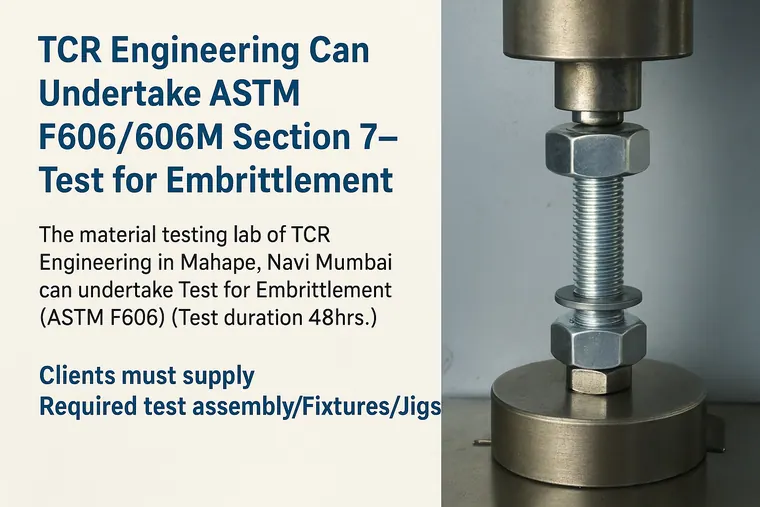
| Metallic coating of threaded fasteners | Zinc, cadmium and other metallic-coated externally threaded fasteners | ASTM F606/F606M Section 7 embrittlement test, 48 hours, on the customer's test assemblies and fixtures | Not on the scope; ASTM F606 proof load, tensile and wedge tensile are |
| Hydrogen reacting with oxygen in the metal | Copper and copper products | ASTM B577, ISO 2626, IS 6243 | On the scope |
| Wet hydrogen sulphide in service | Line pipe, plate, fittings and bolting for sour service | NACE TM0177, TM0284 and TM0316, on the corrosion and sour service page | On the scope |
ISO 11114-4 for Type I Hydrogen Cylinders
ISO 11114-4:2017 qualifies the steel of a seamless gas cylinder for hydrogen and other hydrogen-bearing embrittling gases. A Type I cylinder is all-metal, so the steel is the pressure boundary and nothing else stands between the gas and the crack. The standard offers three methods; the cylinder specification or the approving authority decides which one is run.
| Method | Specimen | What it measures |
|---|---|---|
| A, disc test | A thin flat disc machined from the cylinder and clamped at its rim | The disc is burst with hydrogen and with helium; the ratio of the two rupture pressures indicates how far hydrogen weakens the steel |
| B, fracture mechanics test | A pre-cracked compact tension specimen machined from the cylinder | A rising, stepped load in hydrogen gas, to find the stress intensity below which hydrogen-assisted cracking does not grow |
| C, constant-displacement test | A pre-cracked compact tension specimen loaded by a wedge (WOL) | A fixed crack-mouth displacement held in hydrogen, to show whether a crack grows from the applied stress intensity |
Specimens are machined from material taken from the cylinder in its final heat-treated condition, because the qualification belongs to the steel as it will be in service. TCR machines the specimens in its own machine shop; the method, the number of specimens and the acceptance basis are confirmed against the cylinder specification before a sample is cut.
ASTM F519: Plated and Coated High-Strength Steel
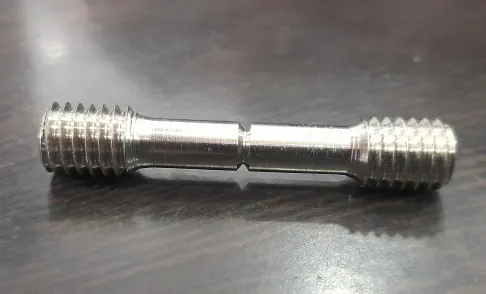
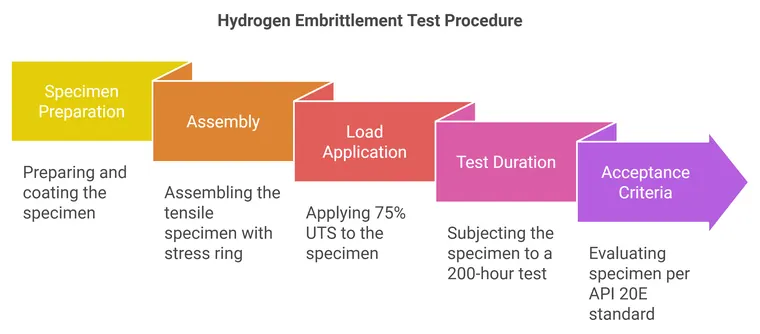
Electroplating and acid cleaning charge hydrogen into a high-strength part, and a plated fastener that is embrittled fails without warning under its own preload. ASTM F519 proves the plating process does not do that: notched specimens are plated with the production process and held under a sustained load for 200 hours.
- What it establishes: whether the production plating or coating process leaves high-strength steel open to hydrogen cracking under sustained tensile stress.
- Specimen: the Type 1a.1 notched round tensile specimen, with a reduced section 6.35 mm in diameter and at least 50.8 mm (2.00 in) between the M12 threaded grips, 150 mm overall, machined by TCR in its Mahape machine shop and plated or coated by the customer through the same line and process as production.
- Load basis: 75 per cent of the notched fracture strength (NFS), which the customer supplies in MPa with the notch area of each specimen.
- Pass criterion: no fracture over 200 hours, or longer where the customer's specification requires it; a fracture is reported with its time to failure.
Where a specimen fails, the fracture surface tells why. TCR offers fastener failure analysis with fractography and microscopy, as a separate scope, to separate hydrogen embrittlement from a notch, a heat-treatment or a material defect.
Copper and Copper Products
Oxygen-bearing copper annealed in a hydrogen atmosphere forms steam at the grain boundaries and loses its ductility, which matters for brazed and annealed conductors, tubes and fittings. Three methods sit on the accredited scope of TCR's materials testing laboratory for it.
- ASTM B577: detection of cuprous oxide, the hydrogen embrittlement susceptibility of copper.
- ISO 2626: the hydrogen embrittlement test for copper.
- IS 6243: the hydrogen embrittlement susceptibility test listed on TCR's NABL scope.
- Alongside: chemical analysis, tensile, elevated-temperature tensile and electrical conductivity tests in the same laboratory.
Where This Sits Against Sour Service Cracking
Sulphide stress cracking is hydrogen embrittlement driven by wet hydrogen sulphide, and hydrogen-induced cracking and disbonding are its relatives. They are qualified by their own methods and their own acceptance criteria, and they live on their own pages, so that a buyer qualifying line pipe for an operator's sour specification and a buyer qualifying a hydrogen cylinder each find the method they need.
| Question | Where it is answered |
|---|---|
| Will this line pipe or plate crack in wet H2S? | Corrosion and sour service testing: NACE TM0177, TM0284 and TM0316, to Saudi Aramco, ADNOC, PDO and OQGN specifications |
| Will this stainless overlay disbond after hydrogen service? | Hydrogen induced disbonding per ASTM G146 |
| How much toughness does the weld keep after hydrogen charging? | CTOD testing, with H2S pre-charging |
| Is this cylinder steel fit for hydrogen gas? | This page, ISO 11114-4 |
| Did this plating process embrittle the part? | This page, ASTM F519 |
Related insights
4 published insights on this site bear directly on Hydrogen Embrittlement. They are below; the full index carries all 167 Materials Testing insights.
-
ASTM F606 Embrittlement Testing for Coated Fasteners
TCR Engineering in Mahape now offers ASTM F606/606M Sec 7 testing for embrittlement in coated fasteners. Test duration: 48 hrs.
-
Hydrogen Embrittlement Testing at TCR
NABL-accredited TCR Engineering offers ASTM F519 hydrogen embrittlement testing to ensure material integrity across industries.
-
Hydrogen Embrittlement Test at TCR Engineering in India
TCR's materials testing lab undertakes Sustained Load Test (SLT) for electroplated materials, as per API 20E.
-
Hydrogen Embrittlement Test in India
TCR Engineering Services, a leading material testing lab in Mumbai conducts Test as per ASTM B577
Frequently asked questions
Can TCR test steel for Type I hydrogen cylinders to ISO 11114-4?
Yes. TCR Engineering undertakes ISO 11114-4:2017 hydrogen embrittlement testing of the seamless steel used for Type I high-pressure hydrogen cylinders, with specimens machined from the cylinder in its final condition. The method, A, B or C, is confirmed against the cylinder specification before a sample is cut.
Is ISO 11114-4 testing NABL accredited at TCR?
No. ISO 11114-4 is not on NABL certificate NABLT0726MH18640 and the report says so. ASTM F519, ASTM B577, ISO 2626 and IS 6243 hydrogen embrittlement tests are on the accredited scope.
What are the three ISO 11114-4 test methods?
Method A bursts a thin steel disc with hydrogen and with helium and compares the rupture pressures. Method B loads a pre-cracked compact tension specimen in rising steps in hydrogen. Method C holds a wedge-loaded, pre-cracked specimen at fixed displacement in hydrogen to see whether the crack grows.
What load and duration does ASTM F519 use?
Notched specimens plated with the production process are held at 75 per cent of their notched fracture strength for 200 hours in a stress ring. A specimen that carries the load for the full period without fracture passes. The customer supplies the notched fracture strength and the notch area.
Who prepares and plates the ASTM F519 specimens?
TCR machines the specimens in its Mahape machine shop: 6.35 mm notched gauge, at least 50.8 mm (2.00 in) between the M12 grips, and 150 mm overall length. The customer then plates or coats them through the same line and process as production, because the test qualifies the process.
Is sulphide stress cracking tested on this page?
No. Sulphide stress cracking is hydrogen embrittlement caused by wet hydrogen sulphide, qualified by NACE TM0177, TM0284 and TM0316 to operator specifications. That work is on the corrosion and sour service testing page.
How are coated fasteners tested for hydrogen embrittlement?
Two ways. ASTM F519 sustained load qualifies the plating or coating process on notched specimens and is on NABL certificate NABLT0726MH18640. The ASTM F606/F606M Section 7 embrittlement test runs on the customer's own coated fastener assemblies and fixtures and is reported outside the scope. A part that fails goes to fastener failure analysis.