
Services · Inspection Manpower and Third-Party Services
Welding Inspection Services per ASME Section IX and AWS D1.1
Most rejected welds were decided before the arc was struck: the wrong qualification type, a filler the base metal cannot be heat-treated for, or a welder qualified for a position the job does not use. Welding inspection starts at the procedure.
Request a Quote
Overview
TCR Engineering's welding inspection services cover welding procedure specifications prepared or reviewed, procedure and welder qualification tests witnessed to ASME Section IX, AWS D1.1 and API 1104, production welds inspected from fit-up to final visual, and records endorsed by an IIW-certified International Welding Specialist. Coupons are tested at its NABL accredited laboratory (NABLT0726MH18640) in Navi Mumbai.
Welding Inspection Services to ASME Section IX, AWS D1.1 and API 1104
Welding inspection at TCR, one of its inspection manpower and third-party services, covers the whole chain from the written procedure to the endorsed record. A buyer can take one link, such as a witnessed welder test, or the whole chain for a new product or a new site; the scope is fixed at enquiry against the code the project names.
| Service | What TCR does | What you receive |
|---|---|---|
| WPS preparation and review | Writes the welding procedure specification for the process, material and joint, or reviews the fabricator's draft against the code: essential and supplementary essential variables, filler, preheat, interpass and PWHT | A preliminary WPS ready to qualify, or a review with every finding referenced to its code clause |
| PQR qualification | Witnesses the welding of the procedure test coupon, records the actual parameters, and routes the coupon to the laboratory for the tests the code requires | The procedure qualification record and the qualified WPS |
| Welder qualification | Witnesses each welder's or welding operator's performance test in the position, process and thickness the work needs | A welder performance qualification record (WPQ) stating the range qualified |
| Testing | Mechanical, metallographic and non-destructive testing of the coupons at the NABL accredited laboratory; method detail is on welder and procedure qualification testing | Accredited test reports traceable to each coupon |
| Witnessing | Hold and witness points on the fabricator's inspection and test plan, at TCR's laboratory or at the works | A signed inspection record for each witnessed stage |
| Certification and endorsement | Review and endorsement of the WPS, PQR and WPQ by an IIW-certified International Welding Specialist, acting as the fabricator's external welding coordinator where the contract calls for one | Endorsed qualification records for the fabricator's quality file and the client's approval |
ASME Section IX and AWS D1.1: Getting the Qualification Type Right
The costliest welding errors are made on paper. A procedure qualified as the wrong weld type, or with a filler the base metal cannot be heat-treated for, passes its own tests and still fails the job. The first thing TCR checks on any enquiry is what the code calls the weld and what heat treatment the joint can take.
- Weld type decides the tests. Rebuilding a scored 13Cr valve seat is a hard-facing overlay under ASME Section IX QW-216, tested to QW-453 by penetrant, macro sections and hardness, not a groove weld with tensile and bend tests. The worked case is 13Cr valve seat rebuild on a WCB body.
- The heat treatment decides the filler. Plain E410 must be tempered at or above the lower critical temperature of a WCB carbon steel body; E410NiMo tempers at a lower temperature, which the carbon steel can take.
- The position decides the range. A welder tested in one position is qualified for the positions the code tabulates for that test, and no others. Fixed pipe tests such as 6G cover more than plate tests such as 4G; the record states the range, and the range is checked against the job before the welder starts.
- The code is fixed first. ASME Section IX, AWS D1.1, API 1104 and EN ISO 9606 qualify the same skill under different variables and ranges. The project specification names the code, and its edition, before a coupon is cut.
What a Welder Qualification Quotation Should Confirm
A welder test that is quoted loosely is witnessed loosely. Before TCR issues a welder qualification offer, it confirms each of the items below in writing, so the certificate the welder receives is the certificate the job needs, and the buyer can compare quotations line by line.
- The governing code and its edition, for example AWS D1.1/D1.1M or ASME Section IX.
- The test coupon: plate or pipe, material specification, thickness, and pipe size and schedule.
- The process, filler classification and position, for example SMAW, E7018, 4G overhead plate or 6G fixed pipe.
- The pass sequence to be recorded: root, hot pass, fill and cap.
- The examination and testing the code requires for that test: visual, then radiography or bend tests, or macro sections for fillet tests.
- The record issued: the welder performance qualification record, the test and NDT reports, and the qualification range covered.
- Photographs or video of the test, where the buyer asks for them for recruitment or audit.
- Who supplies the material and consumables, where the test is held, and the earliest test date.
- Coupon custody: who collects the coupons from site and by when, how long they are held after testing, and when they are returned.
- The certificate format, and any welder identity or job clearance card the owner's system uses.
- The quality dossier and when each part is due: calibration certificates, quality plan, inspection and test plan, HSE procedures and the quality organisation chart.
- Any owner approval the contract requires of the testing agency or its inspectors, such as Saudi Aramco's, and its validity.
Inspecting Production Welds, From Fit-Up to Final Visual
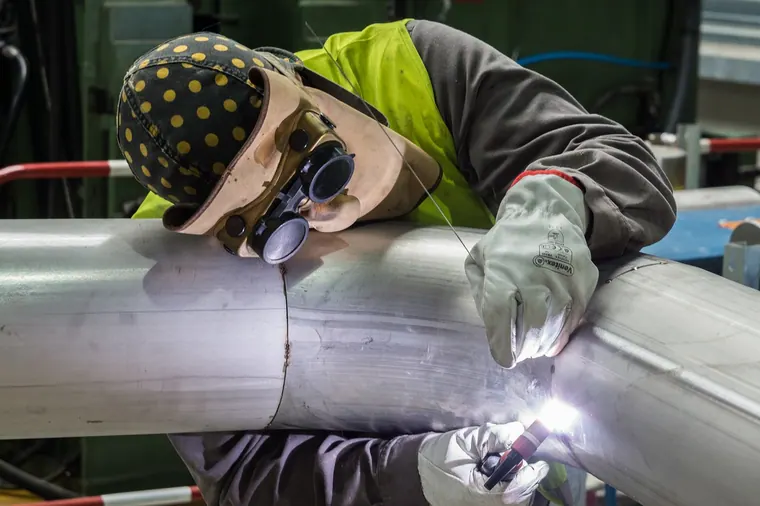
Once the procedure and the welders are qualified, the inspector's job is to prove that production follows them. A TCR welding inspector works to the fabricator's inspection and test plan and checks the work at three stages, each against the qualified WPS and the code's acceptance criteria.
| Stage | What the inspector checks |
|---|---|
| Before welding | The WPS in use is the qualified one; each welder's WPQ is valid for the process, position and range; consumables are identified against their certificates and stored as the WPS requires; joint preparation and fit-up are to the drawing; preheat is applied and measured; the set-up is safe, including arc radiation for people nearby |
| During welding | Current, voltage, travel and heat input against the WPS ranges; interpass temperature; the run sequence from root to cap; back-gouging and cleaning between runs |
| After welding | Visual examination of the finished weld against the acceptance criteria; post-weld heat treatment records against the WPS (PWHT); the NDT the code calls for, by qualified personnel (conventional NDT, advanced ultrasonics); and the records that close each weld |
The inspector carries the instruments the checks need: inspection mirrors, a safe lighting supply, weld gauges, rule and vernier, an ammeter and voltmeter for the welding parameters, and contact thermometers or temperature crayons for preheat and interpass. Where a test sample is needed, it goes to TCR's laboratory.
Where the Welds Are Tested
Inspecting a weld and testing a weld are two jobs. The coupons that a qualification or a production test produces are tested at TCR's NABL ISO/IEC 17025:2017 accredited laboratory (NABLT0726MH18640) in Navi Mumbai, and the test detail, coupon sizes and codes are on welder and procedure qualification testing.
- On the accredited scope for ASME Section IX: tensile (ultimate strength, yield and elongation), bend, macro-etch, fracture, peel and shear tests; and the fillet weld break test to AWS B4.0.
- Alongside: hardness, chemical analysis, Charpy V-notch impact and radiography of the coupon.
- For demanding service: CTOD fracture toughness of weld metal and heat-affected zone.
- When a weld has already failed: weld failure analysis.
- In Saudi Arabia: at TCR Arabia's IAS accredited laboratory in Dammam, the group's joint venture and a Saudi Aramco approved Welder Testing Agency; the testing agency chain, from witness to certificate, is on welder qualification.
Who Signs the Welding Work
Welding inspection is personal work: the record carries the name and the certificate of the person who witnessed it. TCR's welding engineering is led by an IIW-certified International Welding Specialist, and its welding inspectors hold at least one recognised inspection certification.
- Sachin Ram Bhadange, Welding Engineer, Welding Coordinator and welding educator and trainer: IIW-certified International Welding Specialist (IWS) and IIW-certified welding inspector (CWI-S).
- The inspection bench: inspectors certified under at least one of CSWIP, the American Welding Society or BGAS, or holding Level II to SNT-TC-1A in visual testing, competent in ASME BPVC Section IX, API 1104 and AWS D1.1.
- Welder training: training programmes for welders and guidance on procedures and work instructions, alongside the qualification work.
- Independence: TCR acts as an independent third party and does not claim ISO/IEC 17020 accreditation as an inspection body; the position is set out on third-party inspection.
Documents
Download the reference documents for this page. Every file is hosted on this domain and is also listed in the site document library.
Related insights
2 published insights on this site bear directly on Welding Inspection. They are below; the full index carries all 21 Inspection Manpower insights.
-
Weld and Braze Inspections Across India
Expert weld & braze inspections across India, with ASME IX-certified methods for defence & industrial components. Trusted by top sectors.
-
Welding Certification and Welder Qualification Services from TCR
Comprehensive welder certification and welding procedure qualification programme.

Frequently asked questions
What does TCR's welding inspection service cover?
WPS preparation and review, witnessing of procedure qualification (PQR) and welder qualification (WPQ) tests, testing of the coupons at TCR's NABL accredited laboratory, inspection of production welds from fit-up to final visual, and endorsement of the qualification records by an IIW-certified International Welding Specialist.
Which codes does TCR inspect and qualify welds to?
ASME Section IX, AWS D1.1 for structural steel, API 1104 for pipelines and EN ISO 9606, among others. The project specification names the code and its edition, and the qualification is fixed to it before a coupon is cut.
Where are the qualification coupons tested?
At TCR Engineering's NABL ISO/IEC 17025:2017 accredited laboratory (NABLT0726MH18640) in Navi Mumbai. ASME Section IX tensile, bend, macro, fracture, peel and shear tests and the AWS B4.0 fillet weld break test are on the accredited scope. Test detail is on the welder qualification page.
Can TCR write the WPS as well as inspect to it?
Yes. TCR writes the welding procedure specification for the process, material and joint, or reviews the fabricator's draft against the code, and then witnesses its qualification. Writing and witnessing are scoped separately where the client's quality plan needs them kept apart.
Is a valve seat rebuild qualified like a groove weld?
No. Rebuilding a hard-faced valve seat is a hard-facing overlay under ASME Section IX QW-216, tested to QW-453 by penetrant, macro sections and hardness, with no tensile or bend tests. The filler is chosen by the post-weld heat treatment the body casting can take.
Who endorses TCR's welding qualification records?
An IIW-certified International Welding Specialist, Sachin Ram Bhadange, who also holds an IIW welding inspector certification. Production weld inspection is carried out by inspectors certified under CSWIP, AWS or BGAS, or holding Level II to SNT-TC-1A in visual testing.
Does TCR's welding inspection include NDT of the welds?
Yes. After welding, the inspector examines the finished weld visually against the acceptance criteria and arranges the non-destructive testing the code calls for, such as radiography, ultrasonic, magnetic particle or penetrant testing, by personnel qualified to SNT-TC-1A. TCR's conventional NDT and advanced ultrasonics teams, including PAUT and TOFD, carry out that testing.