
Services · Civil and Infrastructure Testing
Manhole Cover and Gully Top Testing per BS EN 124, IS 1726 and IS 12592
A cover is tested twice: once in the laboratory, and every day afterwards by every wheel that crosses it. Only the laboratory test can be repeated.
Request a Quote
Overview
TCR Engineering tests manhole covers, gully tops and their frames at its Navi Mumbai laboratory: load bearing capacity, permanent set, tilt and deflection to BS EN 124-1 and BS EN 124-5, fatigue of composite tops up to 900 mm, and cast iron and precast concrete covers to IS 1726 and IS 12592. These tests are outside the NABL scope.
What Manhole Cover Testing Proves
A manhole cover or gully grating has to carry the wheel loads of its location, sit in its frame without rocking, and recover its shape after load. Testing proves those three things on the complete unit: the cover or grating seated in its own frame, supported the way it will be installed.
- Strength: the test load bearing capacity for the class the cover is sold as.
- Recovery: permanent set after loading, so the cover does not settle proud of or below its frame.
- Seating: the tilt test, for stability in the frame.
- Durability: fatigue under repeated load, for composite tops.
- Fit: dimensions checked against the drawing before any load is applied.
Load Classes and the Test Machine
BS EN 124 sorts covers and gratings into six load classes, A15, B125, C250, D400, E600 and F900, by the traffic of the place they are installed. The class sets the test load, and the machine must be able to exceed that load by a margin, so the tests run on a servo-hydraulic dynamic frame complying with EN ISO 7500-1.
| Classes | Load the machine must be able to apply |
|---|---|
| A15, B125, C250 and D400 | At least 25 per cent more than the class test load |
| E600 and F900 | At least 10 per cent more than the class test load |
The BS EN 124 Test Set
BS EN 124 is published in six parts. Part 1 sets the classes, the design principles and the test methods for every material. Parts 2 to 6 add the requirements for cast iron, steel or aluminium alloy, steel reinforced concrete, composite, and polypropylene, polyethylene or PVC-U tops.
| Test and clause | What it shows |
|---|---|
| Test load bearing capacity BS EN 124-1 Annex B | Strength under static load at the class test load |
| Permanent set BS EN 124-1 Annex A | Deformation left after the load is removed |
| Tilt test BS EN 124-1 Annex D | Stability and seating of the top in its frame |
| Deflection under load BS EN 124-5 | Displacement of a composite cover under its test load |
| Resistance to fatigue BS EN 124-5 | Behaviour of a composite top under repeated load |
Fatigue of Composite Gully and Manhole Tops
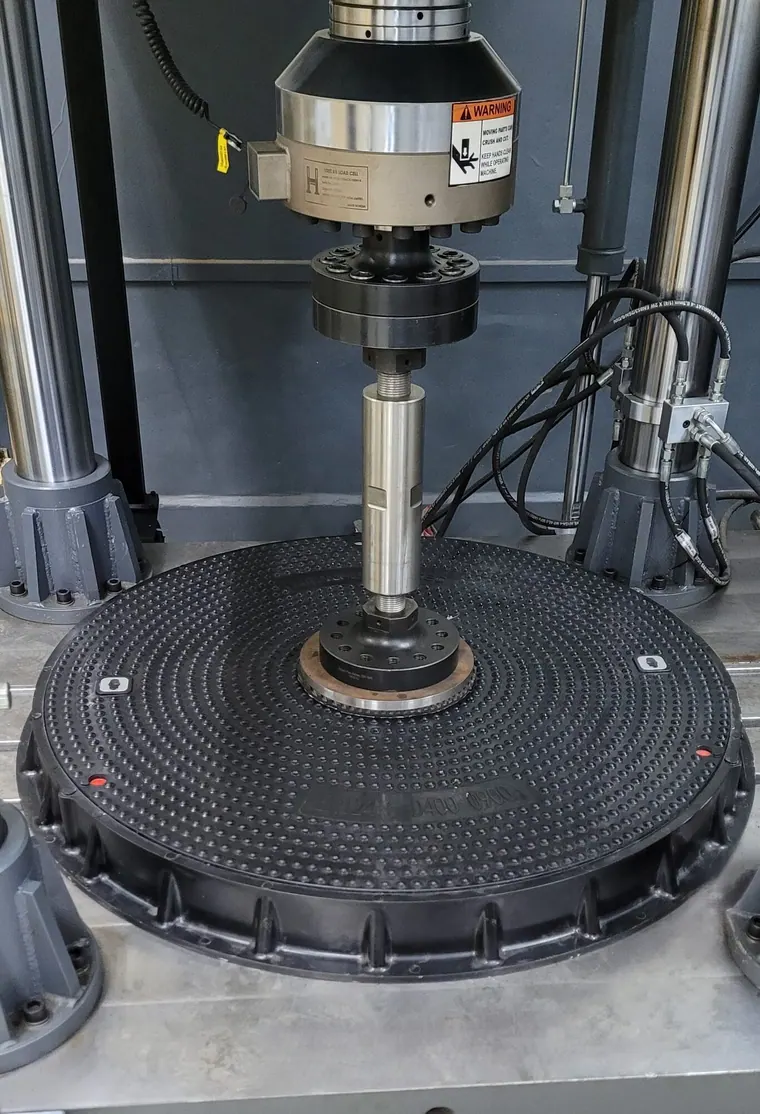
Composite tops can lose strength under repeated loading in a way cast iron does not, which is why BS EN 124-5 adds a fatigue test. TCR tests the complete unit, the cover or grating positioned in its frame and the frame supported as it will be installed, on tops up to 900 mm.
- Mode: compression to compression, at room temperature.
- Duration: up to 100,000 cycles or until fracture, whichever comes first.
- Shapes: rectangular, circular and triangular covers and gratings, including double and multiple triangular tops.
- From the customer: the fatigue test assembly, cover and frame, prepared as BS EN 124 Parts 1 and 5 require.
Indian Standards: IS 1726 and IS 12592
Indian specifications name their own cover standards: IS 1726 for cast iron manhole covers and frames, and IS 12592 for precast concrete manhole covers and frames. TCR tests covers to both, and to ASTM C478 where a project follows American practice for precast concrete manhole sections.
- Dimension test: shape, thickness and size checked with calibrated instruments, so the cover seats in its frame and cannot be lifted out of line.
- Load test: confirms that the cover carries the load of its designated class without failure, with its deflection recorded.
- Permanent set test: dimensions checked again after loading; a small permanent deformation is what a long service life looks like.
- Materials: cast iron, FRP and other composites, and precast concrete.
None of these tests is on NABL certificate NABLT0726MH18640, so manhole cover and gully top reports are issued outside the NABL scope, and the report says so. Concrete for precast covers can be tested separately by the same civil testing laboratory, as set out on the concrete, cement and aggregates page.
Which Standard Applies: IS 1726, IS 12592 or BS EN 124?
The cover's material and the specification it is bought against decide the standard. In India, cast iron covers are tested to IS 1726 and precast concrete covers to IS 12592; BS EN 124 applies where the specification is European or international, with Part 5 for composite tops. TCR tests to all three, outside the NABL scope.
| Standard | What it covers | Where it applies |
|---|---|---|
| IS 1726 | Cast iron manhole covers and frames | Indian specifications for cast iron covers |
| IS 12592 | Precast concrete manhole covers and frames | Indian specifications for precast concrete covers |
| BS EN 124 (Parts 1 to 6) | Gully tops and manhole tops of every material, in classes A15 to F900, with Part 5 for composite tops | European and international specifications, and composite tops |
Who Uses the Report
Cover testing is bought by the people who make covers, the people who specify them and the people who accept them on site. Each reads the same test against a different question: will this design pass, is this class right for this location, and is this batch what was ordered.
- Cover and grating manufacturers: type testing of a new design, batch checks, and evidence for compliance validation or a Kitemark file.
- Municipal corporations and utilities: acceptance of covers for roads, footways and storm-water drains.
- Infrastructure contractors: incoming inspection of a consignment before it is installed.
- Specifiers and consultants: confirmation that a product suits the location it is specified for.
Related insights
3 published insights on this site bear directly on Manhole Covers and Gully Tops. They are below; the full index carries all 44 Civil & Structural Testing insights.
-
EN 124-5 Testing for Manhole & Gully Tops
TCR Engineering in Navi Mumbai conducts EN 124-5 tests including load, deflection, tilt, fatigue (100,000 cycles), and permanent set for manhole covers.
-
Expertise in Precast Manhole Cover Testing
TCR ensures your manhole covers are built to perform, and built to last.
-
Fatigue Testing of Composite Gully & Manhole tops
TCR tests load-bearing capacity, impact resistance, chemical resistance, and fatigue durability per BS EN 124
Read all 44 Civil & Structural Testing insights →All insights →
Frequently asked questions
Which standard governs manhole cover testing?
BS EN 124, for gully tops and manhole tops in vehicular and pedestrian areas: Part 1 for the classes and test methods and Part 5 for composite tops. In India, IS 1726 covers cast iron manhole covers and frames, and IS 12592 precast concrete covers and frames.
What load classes does BS EN 124 cover?
Six classes, A15, B125, C250, D400, E600 and F900, chosen by where the cover will be installed. The test machine must apply at least 25 per cent more than the test load for A15 to D400, and at least 10 per cent more for E600 and F900.
How is a composite manhole top fatigue tested?
As a complete unit, the cover or grating seated in its frame and supported as installed, in compression to compression at room temperature, up to 100,000 cycles or until fracture. TCR tests tops up to 900 mm, and the customer supplies the fatigue test assembly.
Is manhole cover testing within TCR's NABL scope?
No. TCR Engineering's NABL certificate NABLT0726MH18640 covers 1,483 test items, and BS EN 124, IS 1726 and IS 12592 are not among them. These reports are issued outside the NABL scope and say so.
Does TCR certify manhole covers?
No. TCR is a testing laboratory, not a certification body. It runs the BS EN 124 and Indian Standard tests a manufacturer needs for compliance validation or a Kitemark file, and reports them against the class the cover claims.