
Services · Materials Testing
FTIR Analysis of GRE Pipe per ASTM E168
A GRE pipe is only as good as the resin that holds the glass together. FTIR reads that resin directly, from a piece of the wall the size of a coaster.
Request a Quote
Overview
TCR Engineering runs Fourier transform infrared (FTIR) spectroscopy on glass reinforced epoxy (GRE) pipe at its Mahape laboratory in Navi Mumbai, with the method based on ASTM E168, and reports the FTIR spectra. The minimum sample is 50 x 50 mm with the epoxy layers intact. FTIR is reported outside NABL certificate NABLT0726MH18640.
What FTIR Tells You About a GRE Pipe
A GRE pipe is glass fibre held in a cured epoxy matrix, and most of what decides its long-term behaviour sits in that matrix: which resin and curing agent were used, and how completely they reacted. FTIR records the infrared absorption spectrum of the resin, which is a fingerprint of its chemistry.
- Resin identity: the spectrum of a production pipe compared with the spectrum of the resin system the pipe was qualified with.
- Batch consistency: spectra from different lots, spools or suppliers set side by side.
- Cure state: the absorption of unreacted epoxy groups falls as the resin cures, so an under-cured wall reads differently from a fully cured one.
- Failure investigation: the chemistry of a liner, a joint adhesive or a degraded surface, as one line of evidence among the others a failure analysis draws on.
The Sample
FTIR on a GRE pipe needs a piece of the wall, not a scraping. The minimum is 50 x 50 mm, cut so that the epoxy layers are intact, because the liner, the structural wall and any external coat are different materials and the analysis has to know which one it is reading.
| Requirement | Detail |
|---|---|
| Minimum size | 50 x 50 mm, cut from the pipe wall |
| Condition | Epoxy layers intact: do not grind, sand or strip the liner or the outer surface |
| Identification | Mark the inner and outer surface, and the pipe, spool or batch the sample came from |
| For a comparison | Send a sample of the qualified or reference pipe with the sample under test, marked as the reference |
| Method basis | ASTM E168, the standard practices for general techniques of infrared quantitative analysis (E168-16, reapproved 2023) |
Tell us which layer the question is about. A liner that has been in contact with the product and the structural wall behind it can give different spectra, and both answers are useful only when they are labelled.
What the Report Carries
The deliverable is the FTIR spectrum itself, with enough on the report to let an engineer who was not in the room read it: what was sampled, which layer, and how the spectrum was taken.
- The FTIR spectra of the layers analysed.
- Sample identity, the layer or surface each spectrum was taken from, and its condition as received.
- Where a reference sample was supplied, the two spectra presented together.
- The method basis, ASTM E168.
- An accreditation statement: FTIR results are issued in a report separate from accredited results, as NABL policy requires for a test outside the scope.
Where FTIR Sits in the Polymer Laboratory
FTIR on GRE pipe is one bench in a polymer and composites laboratory that already qualifies FRP and GRP pipe mechanically, and characterises resins thermally. The two are usually needed together: a pipe that fails a hydrostatic test raises a chemistry question, and FTIR is where it is asked.
- Composite, plastic, rubber and FRP/GRP testing, including FRP/GRP pipe qualification for hydrostatic, axial-load and cyclic-pressure performance.
- Glass transition temperature by DSC, the thermal counterpart to FTIR for a cured resin.
- Coating evaluation, where FTIR and DSC also characterise epoxy coatings and verify their cure.
More in Materials Testing
No published insight on this site bears directly on FTIR on GRE Pipe yet. The 3 most recent Materials Testing articles are below instead, and the full index carries all 165.
-
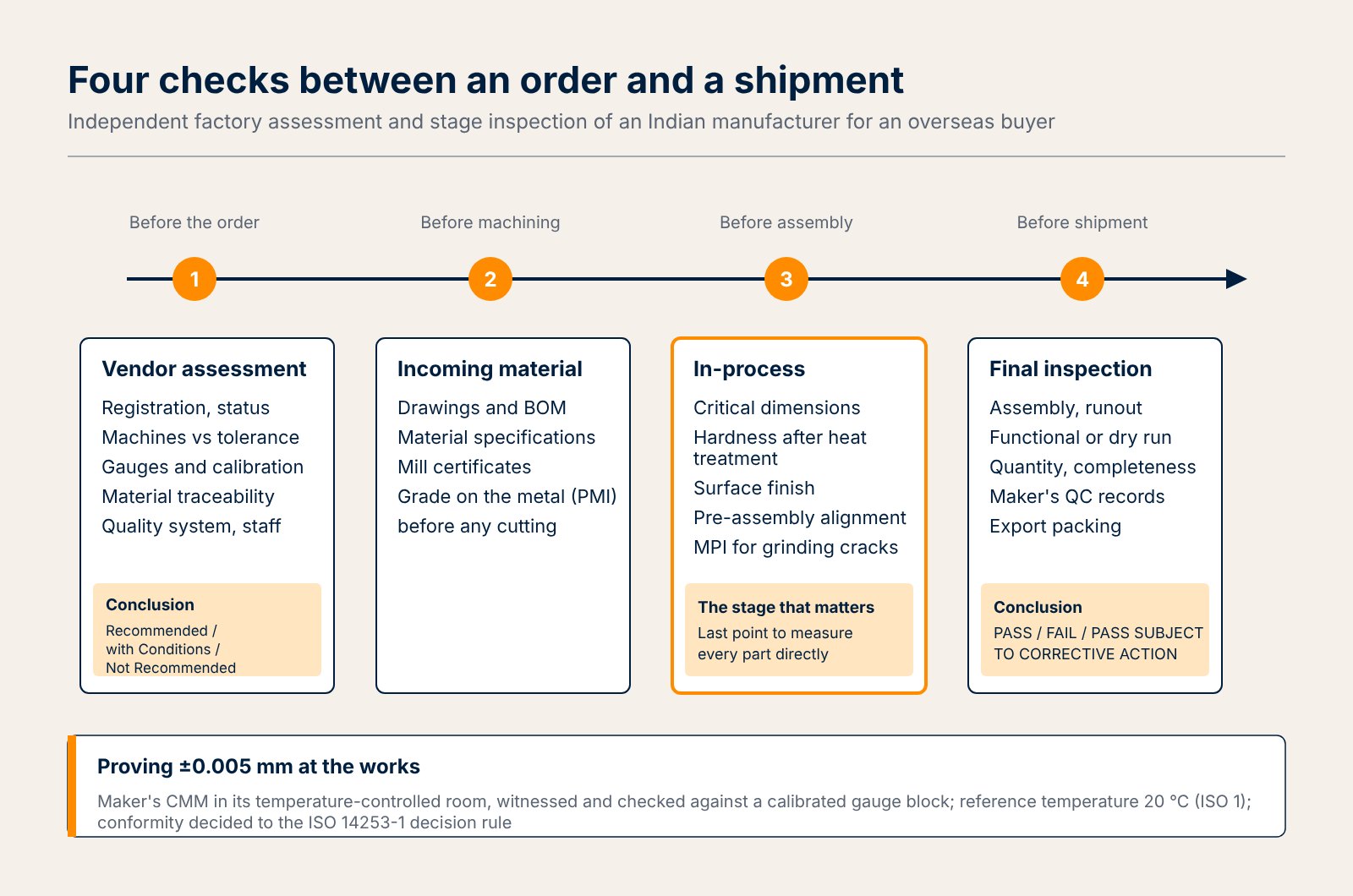
Factory assessment and audit of Indian manufacturers for international buyers: what to check, when, and with what
An international buyer placing an order with an Indian manufacturer needs four independent checks: a factory assessment before the order, incoming…
-
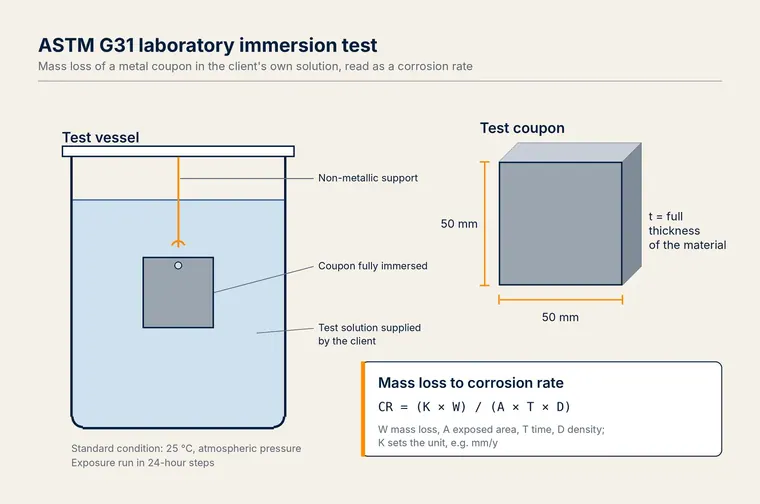
ASTM G31 immersion corrosion testing at Mahape: how a metal behaves in your own liquid
TCR Engineering's Mahape laboratory runs ASTM G31 laboratory immersion tests: a coupon of the client's metal, in the client's own solution, weighed…
-
One NACE method, four pass marks: sour service testing to Saudi Aramco, ADNOC, QatarEnergy and PDO specifications
A plate with an average crack length ratio of 12 per cent passes API 5L and PDO and fails Saudi Aramco. The NACE method is the same in all three; the…

Frequently asked questions
What does FTIR show on a GRE pipe?
FTIR records the infrared absorption spectrum of the epoxy resin in the pipe wall, a fingerprint of its chemistry. It is used to compare a production pipe with its qualified resin system, to compare batches, to check the state of cure and to support a failure investigation.
What sample size does TCR need for FTIR on GRE pipe?
A minimum of 50 x 50 mm cut from the pipe wall, with the epoxy layers intact. Do not grind or strip the liner or the outer surface, and mark the inner and outer faces so the report can say which layer each spectrum came from.
Which standard is the FTIR method based on?
ASTM E168, the standard practices for general techniques of infrared quantitative analysis. The current edition is E168-16, reapproved in 2023.
What does the FTIR report include?
The FTIR spectra of the layers analysed, the sample identity and the layer each spectrum was taken from, and, where a reference sample is supplied, the two spectra presented together for comparison.
Is FTIR within TCR's NABL scope?
No. TCR Engineering holds NABL certificate NABLT0726MH18640 with 1,483 accredited test items, and FTIR is not among them. FTIR results are issued in a separate report outside the accredited scope, and the report says so.