
Services · Materials Testing
Glass Transition Temperature by DSC per ASTM E1356
Tg is the temperature at which a hard polymer film turns soft. DSC finds it as a step in heat flow, and the report says exactly where the step starts.
Request a Quote
Overview
TCR Engineering measures the glass transition temperature (Tg) of polymers by differential scanning calorimetry (DSC) at its Mahape laboratory in Navi Mumbai, including water-based acrylic polymer emulsions tested as dried film or solid. The report gives the Tg onset and midpoint. DSC is reported outside NABL certificate NABLT0726MH18640.
What the Glass Transition Tells You
An amorphous polymer below its glass transition is hard and glassy; above it, it is soft and rubbery. The change happens over a range of temperature, not at a point, and DSC sees it as a step change in heat capacity. That is why a Tg is reported as more than one number.
- Tg onset: the temperature at which the transition begins, the one that matters when a film must stay hard up to a stated service temperature.
- Tg midpoint: the temperature half-way through the step, the value most often quoted as the polymer's Tg and the one to compare between formulations.
- The thermogram: the full heat-flow curve, so the breadth of the transition, and anything else in the scan, is on the record.
- Standard basis: ASTM E1356-25, which assigns glass transition temperatures by DSC for amorphous and partially crystalline materials.
Water-Based Acrylic Emulsions
An acrylic emulsion is tested as the polymer, not as the liquid: it is dried to a film or solid before it goes into the DSC pan. How it is dried matters, because water left in the film acts as a plasticiser and pulls the measured Tg down.
- Form: dried polymer film or solid, prepared by the client or by TCR from the emulsion.
- Drying and conditioning: agreed in writing before testing and stated on the report, so two results for the same emulsion can be compared on the same basis.
- What to tell us: the product, the grade and any Tg the specification or the technical data sheet quotes, so the scan range covers it.
Sample and Turnaround
The requirements are set so that the test can be repeated if a result needs confirming, and so that the drying step has enough material to work with.
| Requirement | Detail |
|---|---|
| Sample quantity | 100 g |
| Sample form | Dried polymer film or solid; emulsion accepted where TCR is to prepare the film |
| Results reported | Tg onset and Tg midpoint, with the DSC thermogram |
| Turnaround | 10 to 12 working days from receipt of the sample and payment at the laboratory |
Send the sample with the drying and conditioning procedure the client wants applied, or ask for it to be agreed before testing.
What the Report Carries
A Tg without its conditions is a number that cannot be compared, so the report carries the conditions as well as the result.
- Tg onset and Tg midpoint temperatures.
- The DSC thermogram.
- The sample as received, its form and the drying and conditioning applied.
- The standard basis, ASTM E1356.
- An accreditation statement: DSC results are issued in a report separate from accredited results, as NABL policy requires for a test outside the scope.
Where DSC Sits in the Polymer Laboratory
DSC is the thermal half of polymer characterisation at Mahape, beside FTIR for chemistry and the mechanical bench for performance.
- Composite, plastic, rubber and FRP/GRP testing, with DSC, TGA and FTIR on the same bench.
- FTIR analysis of GRE pipe, for resin identity and cure.
- Coating evaluation, where DSC verifies the cure of epoxy coatings.
More in Materials Testing
No published insight on this site bears directly on Tg by DSC yet. The 3 most recent Materials Testing articles are below instead, and the full index carries all 165.
-
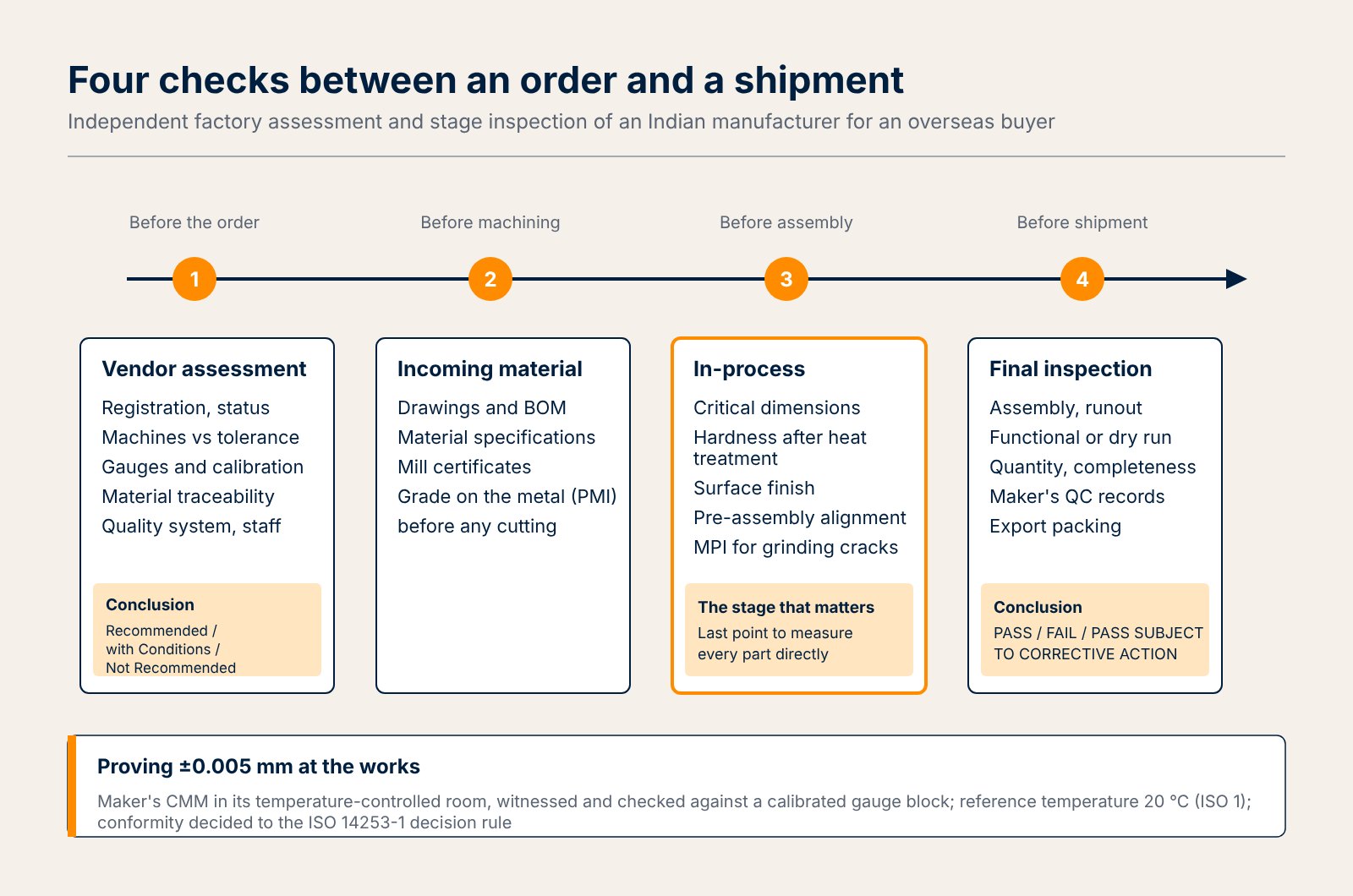
Factory assessment and audit of Indian manufacturers for international buyers: what to check, when, and with what
An international buyer placing an order with an Indian manufacturer needs four independent checks: a factory assessment before the order, incoming…
-
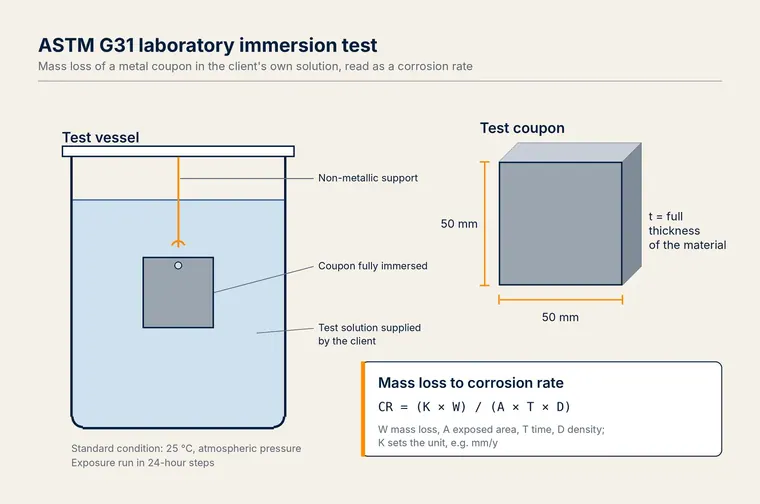
ASTM G31 immersion corrosion testing at Mahape: how a metal behaves in your own liquid
TCR Engineering's Mahape laboratory runs ASTM G31 laboratory immersion tests: a coupon of the client's metal, in the client's own solution, weighed…
-
One NACE method, four pass marks: sour service testing to Saudi Aramco, ADNOC, QatarEnergy and PDO specifications
A plate with an average crack length ratio of 12 per cent passes API 5L and PDO and fails Saudi Aramco. The NACE method is the same in all three; the…

Frequently asked questions
What does DSC measure for a polymer?
Differential scanning calorimetry measures heat flow into a sample as it is heated. At the glass transition the heat capacity steps up, and the temperatures at which that step begins and reaches its midpoint are reported as the Tg onset and the Tg midpoint.
Can TCR report both the Tg onset and the Tg midpoint?
Yes. The report gives the Tg onset and the Tg midpoint temperatures together with the DSC thermogram, so the breadth of the transition is on the record as well as the two values.
How should a water-based acrylic emulsion be submitted for DSC?
As a dried polymer film or solid, or as emulsion if TCR is to prepare the film. The drying and conditioning procedure is agreed in writing before testing and stated on the report, because residual water lowers the measured Tg.
How much sample does TCR need, and how long does DSC take?
100 g of sample. Results are issued in 10 to 12 working days from receipt of the sample and payment at the laboratory.
Is DSC within TCR's NABL scope?
No. TCR Engineering holds NABL certificate NABLT0726MH18640 with 1,483 accredited test items, and DSC is not among them. DSC results are issued in a separate report outside the accredited scope, and the report says so.