
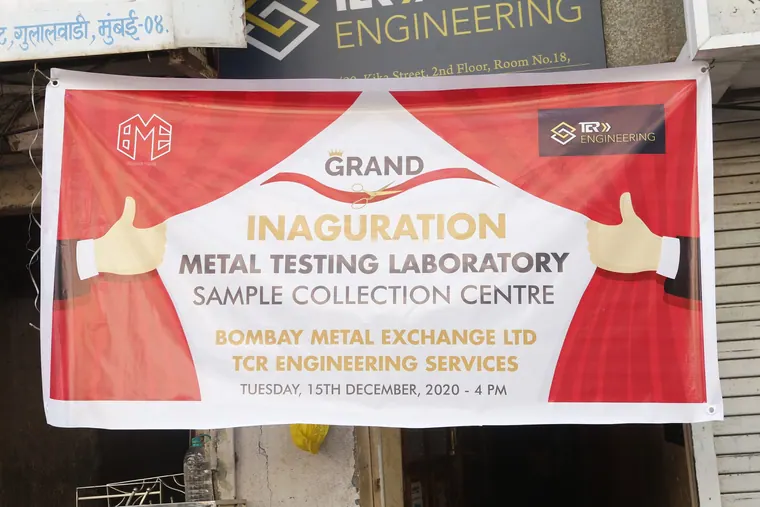
TCR Engineering and Bharat Metal Exchange Ltd (Formerly known as Bombay Metal Exchange Ltd.) run a sample collection centre inside BME House, 88/90 Kika Street, 2nd Floor, Room 18, Gulalwadi, Mumbai 400 004, in the middle of Asia's largest non-ferrous metals market. It serves over 3,000 BME members and over 1,800 members of MASSMA, the Metal and Stainless Steel Merchant's Association: traders, dealers, indenters, brokers, importers and manufacturers. Samples are collected in the market and tested at TCR's NABL ISO/IEC 17025:2017 accredited laboratory at Mahape in Navi Mumbai, certificate NABLT0726MH18640.
| What a member gets | Where it happens |
|---|---|
| Sample collection inside the market | BME House, Kika Street, Gulalwadi, Mumbai 400 004 |
| Consolidation of the day's samples | TCR's registered office, 35 Pragati Industrial Estate, N.M. Joshi Marg, Lower Parel, Mumbai 400 011 |
| Testing, technical review and signature | Mahape laboratory, NABL certificate NABLT0726MH18640, 1,483 accredited scope items |
| A named service team | A direct line into the TCR-BME desk rather than a general enquiry queue |
| Member rates | Held under the arrangement with the two associations, not published as a market price list |
A note on the name
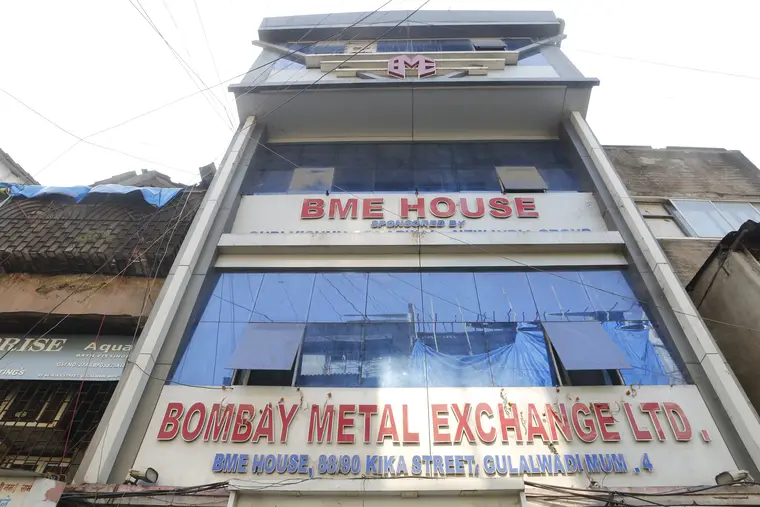
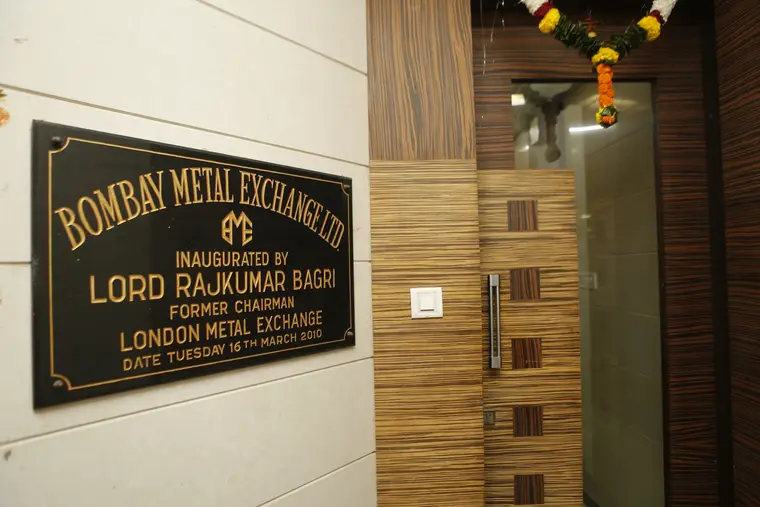
The exchange is now Bharat Metal Exchange Ltd (Formerly known as Bombay Metal Exchange Ltd.). The company, the membership, the building on Kika Street and the arrangement with TCR are unchanged; only the name has changed. Bharat Metal Exchange Limited was incorporated on 2 July 1955 and its mark carries the date 1933. Photographs and documents on this page date from the opening in December 2020 and carry the former name, which is why they are described that way.
How a sample gets from the market to the laboratory
The logistics are the point of the arrangement, because in this trade a consignment does not wait. TCR collects samples from the metal market area itself, so a trader does not lose a working day carrying a coupon to Navi Mumbai. Collected samples are logged and consolidated at TCR's Lower Parel hub, the company's registered office at 35 Pragati Industrial Estate on N.M. Joshi Marg. From there a daily transport run carries them to the Mahape laboratory, where the testing, the technical review and the signature all happen under one accreditation.
Three addresses, one chain of custody, and a sample that leaves Kika Street goes straight to an accredited laboratory. Nothing is subcontracted out of that chain. The collection centre is a collection centre and says so: accreditation is site-specific, the certificate that covers the work belongs to Mahape and not to BME House, and every address in the network is set out on the locations page.
What the association arrangement carries for members
The arrangement between TCR and the two associations is not a coupon. It is a standing commercial arrangement, held with BME and with MASSMA rather than with individual firms, and it carries four things.
- Member rates. BME and MASSMA members test at rates agreed under the association arrangement. Those rates sit with the associations and are quoted to members on enquiry. They are not published as a schedule to the open market, because the arrangement belongs to the membership and not to anyone who finds the page.
- A premium level of service. Priority handling on the market's routine work: grade verification, chemistry and positive material identification, where a consignment is waiting on a number rather than on a report narrative.
- Dedicated customer support. A named point of contact and the direct telephone lines of the TCR-BME desk, so a member speaks to the person who knows the consignment rather than to a switchboard. The desk is reachable on +91-9699210864, +91-9920011298, +91-9820008656 and +91-8779216510.
- Training, at TCR's cost. Seminars, laboratory visits and customised programmes for members and for the next generation entering their family firms. That is set out below, because it is the part of this association that will still matter in twenty years.
Why this association is worth having, for the trade
A metal trader carries a specific risk that a manufacturer does not. The material changes hands several times before it is used, the price is set on a grade, and the person selling it is usually relying on a document written by somebody else. When the grade is wrong, the loss lands on whoever cannot prove what they bought.
Independent testing moves that risk. Chemical analysis and positive material identification settle what an alloy actually is before a consignment is priced or shipped, rather than after a claim is raised. Mechanical testing answers a buyer, an insurer or a customs authority who wants more than composition. Metallurgical evaluation shows what a section has been through. RoHS screening matters the moment a consignment is destined for an export market that asks for it. Where a third party has to witness the sampling itself, third party inspection covers it.
None of that is unusual work. What is unusual is having it available from inside the market, at member rates, with a report carrying a NABL ISO/IEC 17025:2017 signature accepted in more than 90 economies under the ILAC mutual recognition arrangement. TCR is also a BSE and NSE approved assayer, which is the standing a settlement or a bank facility asks for. What the market sends and what comes back is set out on the metal trading and recycling page, and the stainless and carbon steel side on steel and metals.
"A trader is only as protected as the certificate in the file. The arrangement with the Bharat Metal Exchange and MASSMA exists so that getting a proper certificate is the easy option and not the expensive one. We collect in the market, we test at Mahape under our own accreditation, and the member speaks to the same team every time."
Training the next generation of BME and MASSMA members
TCR opens its laboratory, its technical library and its training facilities to BME and MASSMA members, and specifically to the young members and the next generation coming into the family businesses that make up both associations. The programmes are built around what a trader actually has to decide, not around a syllabus.
- Visits to the Mahape laboratory. Members and their successors see the instruments their consignments are tested on: the spectrometers, the universal testing machines, the metallography suite and the corrosion laboratory.
- The technical library. TCR has been building a materials engineering reference collection since 1973, alongside a failure investigation archive of more than 9,000 cases. Members are given access to it as a reference, not as a sales exercise.
- Customised training programmes. Sessions written for a particular association, a particular commodity or a particular problem the trade has run into that year, rather than an off-the-shelf course. Where a member wants a formal certification route instead, the group's training arm runs it: see training.
- How to read a test report. The subject that runs through all of it. A trader who cannot read a certificate is exposed twice, once to the consignment and once to the claim that follows it. Accreditation, scope, method and decision rule are taught together, because a number without a method and an uncertainty is not evidence.
The commercial logic is simple enough to state plainly. A market that can read a certificate commissions better tests, argues fewer claims and trades on tighter specifications. TCR has been part of this market since 1973 and expects to be part of it for the next fifty years, so raising the technical literacy of the people who will run these firms is a straightforwardly good investment.
The opening, in pictures
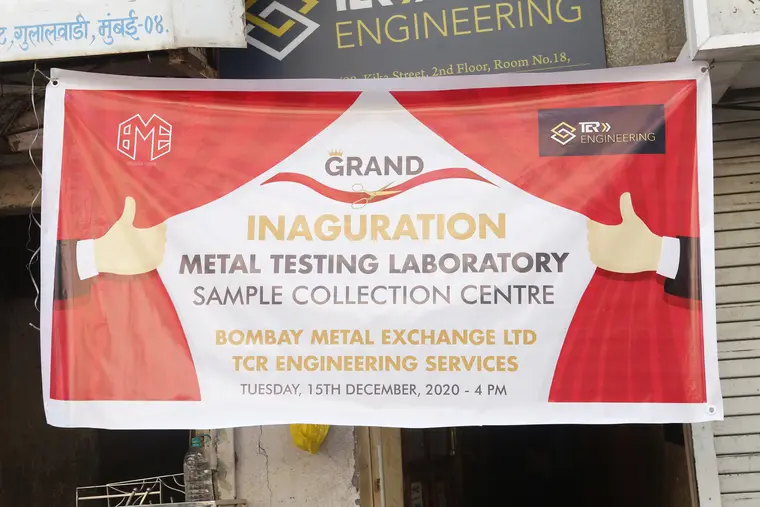
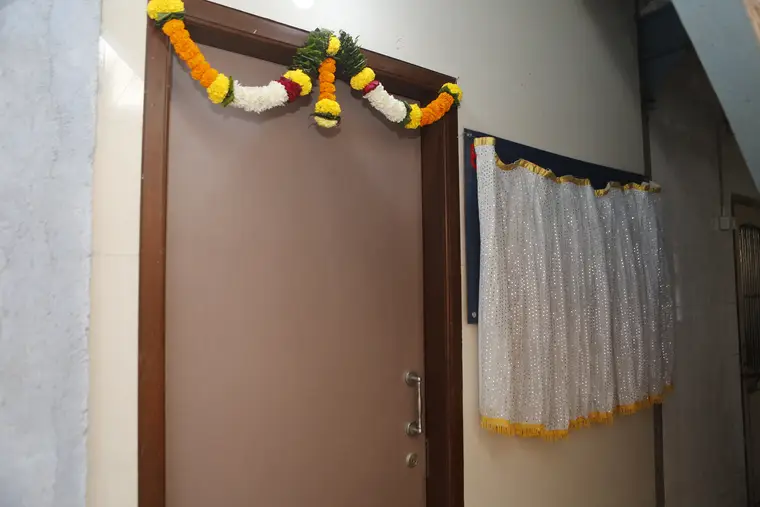
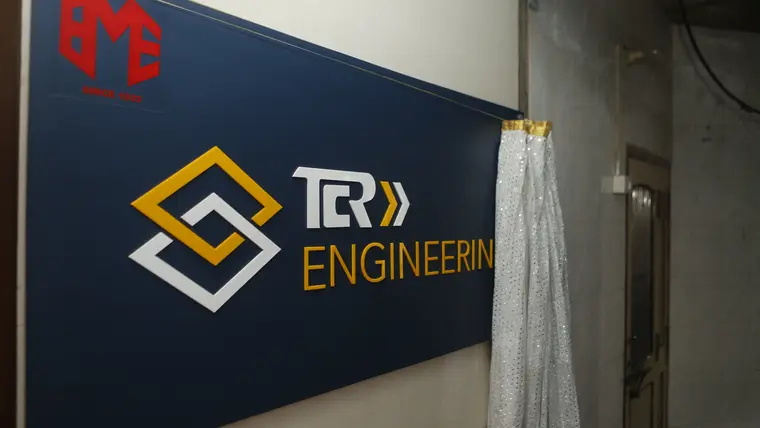
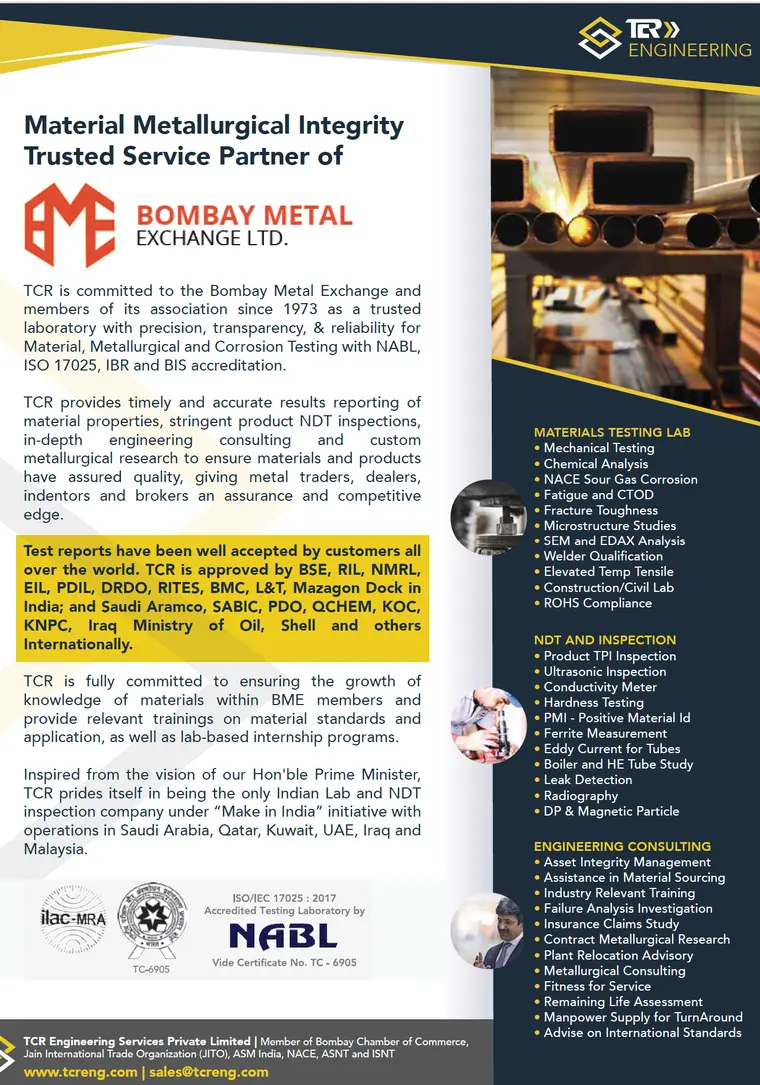
The centre was inaugurated on Tuesday 15 December 2020 at BME House. The images below are from that day and from the centre itself.

Where the company came from
TCR's foundations are in this market. Before there was a laboratory at Mahape, V.K. Bafna walked the metal market with a bag, collecting samples from traders who had no way of testing what they were buying and selling. That is how the company started in 1973, and a substantial share of the group's 6,500 clients trace back to these streets. The presence at BME House is not a satellite office opened for coverage. It is the address TCR came from, kept because the traders who made the company are still trading there. That history is on the about page, and the full detail of the centre is on the Mumbai Metal Market page.
Test reports from Mahape are accepted by BSE, Reliance Industries, NMRL, EIL, PDIL, DRDO, RITES, BMC, L&T and Mazagon Dock in India, and by Saudi Aramco, SABIC, PDO, QCHEM, KOC, KNPC and the Iraq Ministry of Oil internationally. The accreditations behind that are listed in full, and the certificates themselves are in the document library.
Continue reading
Frequently asked questions
Who can use the TCR-BME sample collection centre?
Members of Bharat Metal Exchange Ltd, formerly Bombay Metal Exchange Ltd, and members of MASSMA, the Metal and Stainless Steel Merchant's Association. Between them the two associations represent more than 4,800 member firms: traders, dealers, indenters, brokers, importers, exporters and manufacturers in non-ferrous, stainless and carbon steel.
Where is the centre and when is it open?
BME House, 88/90 Kika Street, 2nd Floor, Room 18, Gulalwadi, Mumbai 400 004. Office hours are Monday to Friday 09:00 to 17:30 and Saturday 09:00 to 13:00. Samples are accepted outside those hours by prior arrangement with the TCR-BME desk.
How does a sample reach the laboratory?
TCR collects samples in the metal market area. They are logged and consolidated at TCR's registered office at Lower Parel, and a daily transport run carries them to the accredited laboratory at Mahape in Navi Mumbai, where the testing, the technical review and the signature are performed under NABL certificate NABLT0726MH18640.
What rates do BME and MASSMA members get?
Member rates are held under the arrangement with the two associations and are quoted to members on enquiry. They are not published as a price schedule to the open market, because the arrangement belongs to the membership rather than to the trade at large.
What training does TCR provide to the associations?
Laboratory visits at Mahape, access to TCR's technical library and failure investigation archive, and customised programmes written for a particular association, commodity or problem. The programmes are aimed at young members and the next generation entering the family firms, and the standing subject is how to read a test report.
Is the collection centre itself an accredited laboratory?
No. Accreditation is site-specific. The centre at BME House receives, logs and forwards samples. The accreditation that covers the testing belongs to the Mahape laboratory, NABL certificate NABLT0726MH18640, which holds 1,483 accredited scope items.