
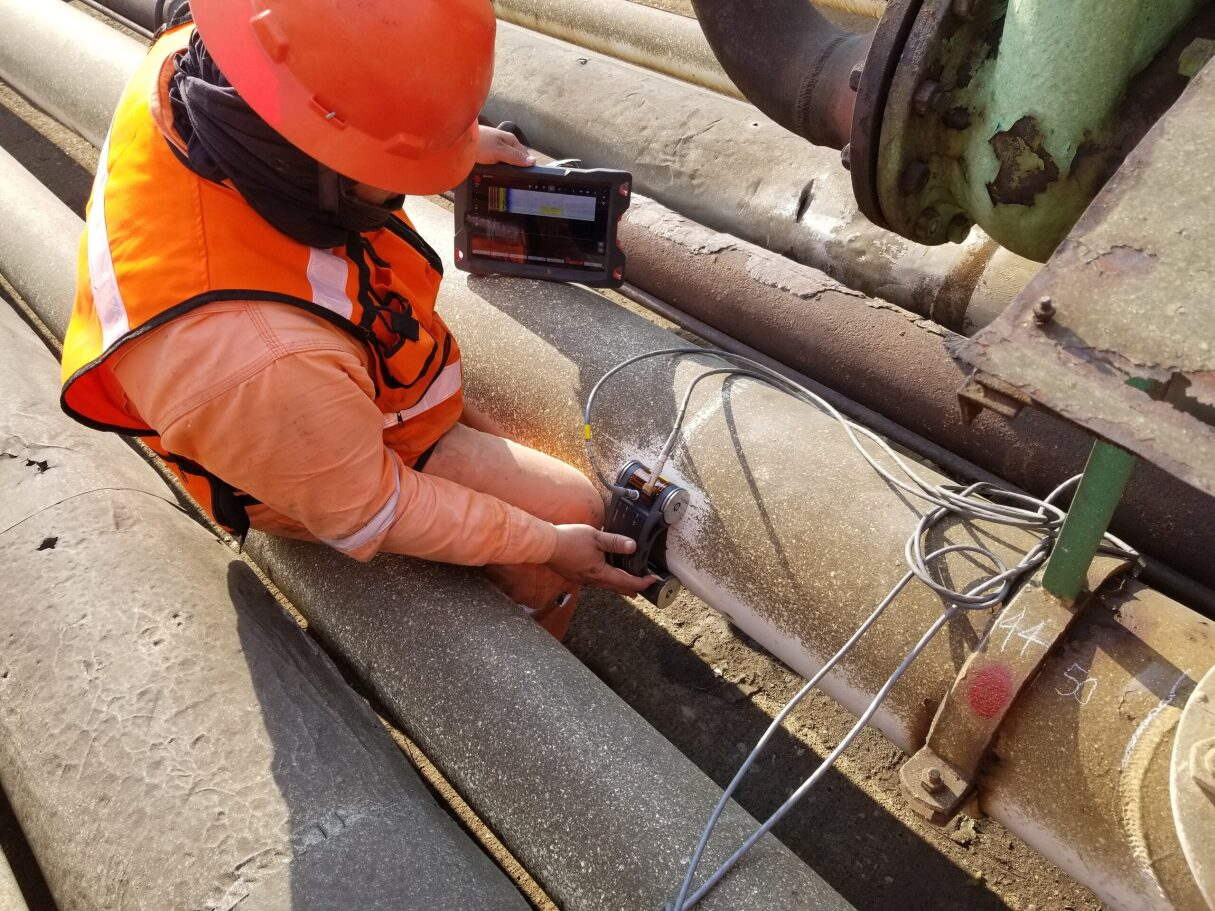
Short range ultrasonic testing (SRUT) sends guided ultrasonic waves a short distance from the probe to find corrosion and wall loss where a thickness gauge cannot reach, such as under pipe supports, clamps and other contact points. TCR Engineering performs SRUT in India, and TCR Arabia in Saudi Arabia, with engineers certified Level II and III to SNT-TC-1A.
- What it finds: localised corrosion, wall thinning and cracks in the zone next to the probe
- Where it is used: piping at supports, clamps and contact points, and tank annular plates
- Asset in service: the line or tank keeps operating during the test
- Personnel: Level II and III to SNT-TC-1A, under the employer's written practice
TCR Engineering specialises in delivering current-generation Non-Destructive Testing (NDT) solutions tailored to meet the unique challenges of modern industries. Short-Range Ultrasonic Testing (SRUT) is one of TCR's techniques for checking safety, reliability and operational efficiency in critical applications. This blog post examines the technical aspects, benefits, and standards associated with SRUT to explain its value.
Short-Range Ultrasonic Testing (SRUT) lets industries add a screening method to their inspection protocols and manage asset integrity without shutting the asset down. With TCR Engineering's teams in India and TCR Arabia's in Saudi Arabia, each inspection is planned to the asset and to the standards that apply.
What is Short-Range Ultrasonic Testing (SRUT)?
SRUT is an advanced NDT method specifically designed to detect corrosion, wall thinning, and other defects in areas where traditional inspection methods face limitations. Using guided ultrasonic waves, SRUT can assess metal loss and integrity over short distances without requiring direct access to the inspected area.
Applications of SRUT
- Tank Annular Plate Inspections in Service:
- SRUT enables the assessment of annular plates and rings beneath tank shells for corrosion and defects without the need for operational shutdowns.
- Its findings feed the API 653 inspection of the tank, which stays in operation during the test.
- Corrosion Under Pipe Support (CUPS) Inspections:
- SRUT detects metal loss under pipe supports, at the contact area a conventional thickness reading cannot reach.
- Where the support is insulated, the work sits within a corrosion under insulation programme such as NACE SP0198.
Key Benefits of SRUT
- Screening Inspections: SRUT screens the zone next to the probe for metal loss, so suspect areas can be selected for follow-up.
- In-Service Testing: Inspections can be conducted without halting operations, with the asset kept in service.
- Coverage from One Position: The technique screens a short length of the component from each probe position.
- Certified Engineers: TCR's engineers hold Level II and III certification to SNT-TC-1A, issued by the employer.
Technical Overview of SRUT
SRUT utilises guided waves, which are mechanical stress waves propagated along the surface of a structure. This technology focuses on:
- Short-range assessments, close to the probe.
- Detecting localised corrosion, cracks, and thinning in hard-to-reach areas.
- Findings reported for the API 650 and API 653 assessment of storage tanks.
Industry Standards and Compliance
At TCR Engineering, SRUT findings are reported against these standards:
- API Standards:
- API 650 (Welded Tanks for Oil Storage)
- API 653 (Tank Inspection, Repair, Alteration, and Reconstruction)
- ASNT Standards:
- Personnel qualifications are in line with ASNT SNT-TC-1A.
- NACE Standards:
- NACE SP0198 (Control of Corrosion Under Insulation and Fireproofing).
For more information or to schedule an SRUT consultation, contact TCR Engineering.
FAQ
What is SRUT in NDT?
SRUT, short range ultrasonic testing, is a guided wave ultrasonic method that screens a short length of a component from one probe position. It is used where the area of interest cannot be reached directly, such as the contact point under a pipe support, and it reports metal loss for follow-up assessment.
How does SRUT differ from long range ultrasonic testing (LRUT)?
LRUT sends guided waves along a long run of pipe from a single access point to screen it for corrosion. SRUT works over a short distance from the probe, so it suits localised problem areas such as pipe supports, clamps and contact points, where the damage sits in one small zone.
Can SRUT be done while the plant is running?
Yes. SRUT is applied from the accessible surface next to the area of interest, so the line or tank stays in service during the test. Where SRUT finds an indication, the owner decides the follow-up, such as a direct thickness check when the pipe is next lifted off its support.
Who performs SRUT in the TCR group?
TCR Engineering performs SRUT in India, and TCR Arabia, the Saudi joint venture, performs it in Saudi Arabia. The engineers are certified Level II and III to SNT-TC-1A under the employer's written practice, and some of them also hold PCN qualifications.