
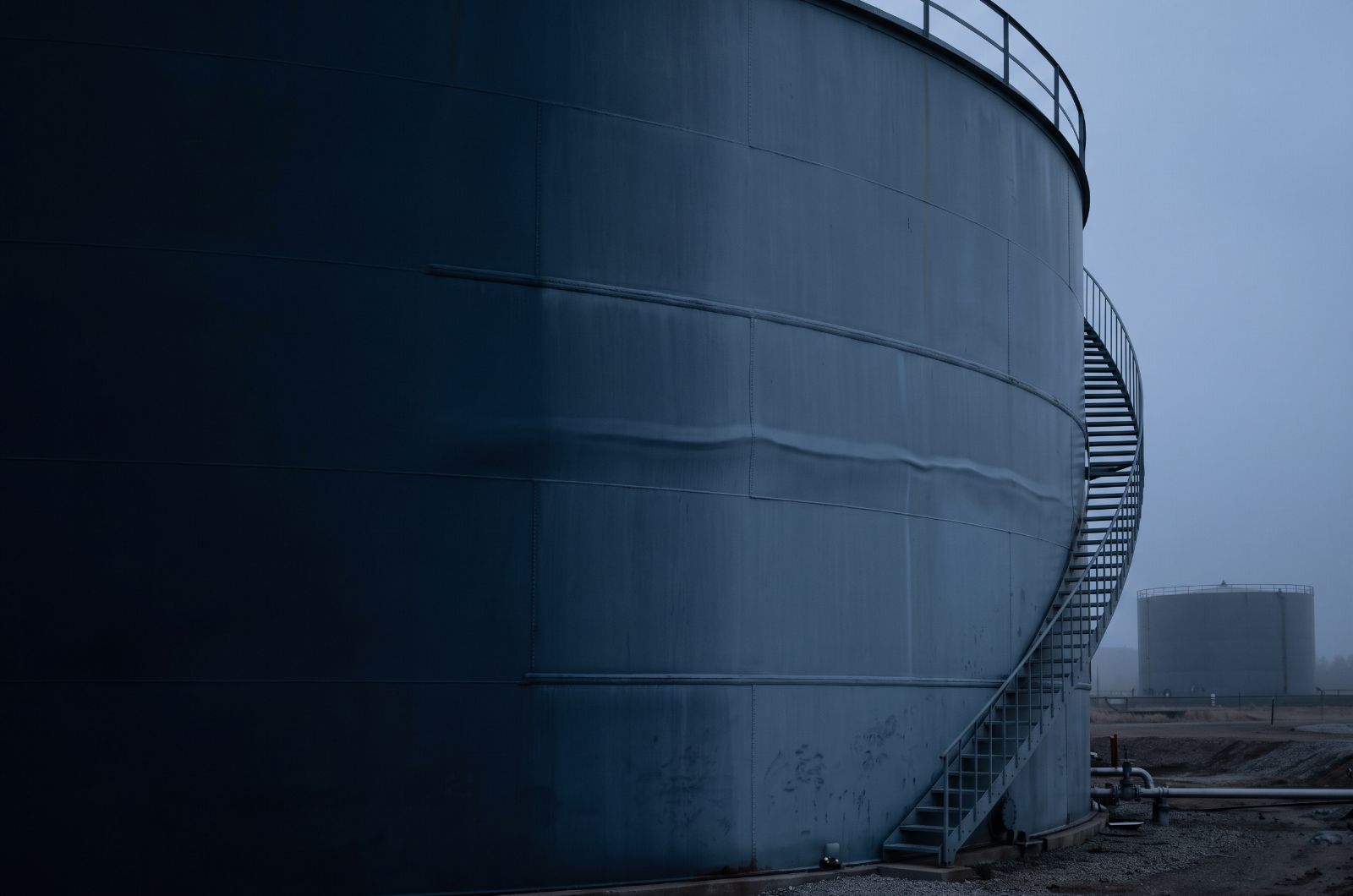
The TCR group, through TCR Engineering's NABL accredited laboratory in Navi Mumbai and TCR Advanced in Vadodara, assesses above-ground storage tanks in India for fitness for service to API 579-1/ASME FFS-1. Peaking and banding on a tank shell is a weld misalignment and shell distortion question, and a Level 2 assessment decides whether the tank stays in service.
- The enquiry: an oil marketing company's storage terminal in India, with severe shell distortion and significant peaking and banding at several locations, worst on the third shell course.
- What the owner asked for: peaking and banding assessment, circularity, verticality, and an API 579-1/ASME FFS-1 Level 2 assessment.
- Where it sits in the standard: API 579-1/ASME FFS-1 Part 8, Assessment of Weld Misalignment and Shell Distortions.
- What feeds it: measured shell geometry, a settlement survey to API 653, thickness, weld examination and material checks.
- What it returns: Fit for Service, Fit for Service with Restrictions, Fit for Service after Repairs, or Not Fit for Service, with assumptions and a reassessment interval.
- Record: 350+ Fitness for Service engagements to API 579-1/ASME FFS-1 and 750+ remaining life assessment studies.
Peaking and banding: a geometry finding, not yet a stress finding
Peaking is angular distortion of the shell at a vertical weld seam; banding is the same distortion at a horizontal seam. API 650 limits both, with roundness and plumbness, for a tank as built. Exceeding them in service is a geometry finding; whether it is a structural problem is a separate question.
The liquid head puts the shell into hoop tension, carried in a true cylinder as membrane stress spread evenly through the plate. Where plates meet at an angle, or the shell has moved in or out along a seam, the same hoop force acts with an offset, and the offset produces bending. That bending is highest at the plate surface at the weld, which is also where the weld toe concentrates stress and where fabrication flaws sit.
How much bending depends on things that can be measured: the depth and extent of the peak or band, the plate thickness there, the liquid head above it and the product density. So the eye overstates the problem: a distortion obvious from the ground may add little stress; a modest one on a thin plate under a full head may add a great deal.
The third course deserves no discount. Shell courses get thinner as they go up, each sized for the head it carries, so an upper course is not lightly loaded simply because it sees less liquid. Its distortion is assessed on its own thickness and its own head.
Why a visibly distorted tank is not automatically scrap
Replacing a shell course on appearance is a decision taken without a number; fitness for service takes it with one. Much of the peaking and banding on older tanks was put there during construction by weld shrinkage and fit-up, and may have been stable for decades. Some is newer, driven by foundation settlement, and may still be moving. The first may be acceptable for the life of the tank; the second may be acceptable today and not in five years. TCR's inspection strategies for aboveground storage tanks covers the inspection that finds it.
What Level 1 can settle, and why this distortion goes to Level 2
API 579-1/ASME FFS-1 provides three assessment levels, each reducing conservatism and needing more data, analysis and expertise.
| Level | What it is | What it can conclude for a distorted shell |
|---|---|---|
| Level 1 | Conservative screening with minimal data | Passing is conclusive. A shell well outside its construction tolerances will rarely pass, and failing is not a condemnation |
| Level 2 | Detailed evaluation by an engineer, on measured geometry, thickness and loading | Whether the bending the distortion adds, combined with hoop stress, is acceptable at a stated operating case |
| Level 3 | Numerical analysis on the measured geometry | The answer for geometry too irregular for Level 2, or where Level 2 does not pass |
The owner in this enquiry went straight to Level 2, which is the right call: a distortion visibly beyond construction tolerance has in effect already answered the Level 1 question. What remains is whether, with this geometry, thickness and product, the stress at the distorted welds is acceptable, and on what conditions. The Integrity Despite Defects podcast on FFS discusses how levels are chosen in practice.
Geometry and settlement: two surveys, two questions
The two surveys are specified together but answer different questions.
| Survey | What it measures | What it tells the assessment |
|---|---|---|
| Multi-station laser survey of the shell | Out-of-roundness by course, verticality, peaking and banding profiles, local distortion | The measured geometry the Level 2 evaluation needs |
| Settlement survey to API 653 | Uniform settlement, tilt and out-of-plane settlement around the perimeter | Whether the foundation is driving the distortion |
| Comparison with earlier records | Change since the last survey | Whether the distortion is stable or growing |
The settlement survey is evaluated as API 653 requires in its annex on tank bottom settlement. Uniform settlement and rigid tilt mainly affect connections, plumbness and roof clearances; out-of-plane settlement around the circumference forces the shell out of shape.
The point of having both is to establish cause. Distortion concentrated at the welds and matched to the plate layout points to fabrication. Distortion that follows the out-of-plane settlement pattern, with ovality growing towards the top of the shell, points to the foundation. The cause decides the remedy, shell repair or foundation work, and whether the distortion is stable. Stability can only be read from history: an earlier settlement survey or geometry record compared with the new one.
Thickness, product and fill history
The bending from distortion adds to the hoop stress, so every input to the hoop stress is an input to the verdict.
- Thickness at the distortion. The calculation uses the wall that is there, less the metal loss expected before the next inspection. Corrosion beside a peaked weld reduces the section exactly where bending is highest, so readings belong on the distortion and along the welds, not on a grid that misses them.
- Product and fill height. Hoop stress scales with product density and liquid height. A tank that fails at its design fill height may pass at a lower one, which is the usual form a restriction takes, so the real operating case belongs on the table at the start.
- Fill history. A tank is filled and emptied through its life, so the bending at a distorted weld is cyclic, and the weld toe at a peak is where a fatigue crack would be expected to start.
Two checks guard the assumptions. Weld examination by magnetic particle, liquid penetrant and ultrasonic methods, on the distorted seams and T-joints, looks for cracks. A crack changes the question from distortion under Part 8 to a crack-like flaw, which API 579-1 treats in Part 9. Alloy analysis, hardness and in-situ metallography confirm the plate is the material the calculation assumes, because the allowable stress depends on it.
On accreditation: magnetic particle and liquid penetrant examination to ASME Section V, ultrasonic examination of welds to ASME Section V and XRF alloy analysis to ASTM E1476 are on the site testing scope of NABL certificate NABLT0726MH18640, held by TCR Engineering at Mahape, and are reported under it where TCR Engineering carries them out. The geometry and settlement surveys, in-situ metallography and replica hardness are not, and are reported as standard site testing. The FFS assessment itself is engineering evaluation, not a laboratory test, and the report names the accreditation each result was taken under.
Four verdicts, and what each commits the owner to
The owner's scope asked for one of four verdicts, and each commits the owner to something different.
| Verdict | What it means | What the owner does next |
|---|---|---|
| Fit for Service | The distortion is acceptable at the assessed operating case | Returns the tank to service and reassesses at the stated interval |
| Fit for Service with Restrictions | Acceptable within stated limits: typically a lower maximum fill height, a product density limit, or monitoring of geometry and settlement | Writes the limits into the operating procedure and holds to them |
| Fit for Service after Repairs | Acceptable once specified repairs are made to a shell course, a weld or the foundation | Makes the repairs to API 653 and returns the tank to service on the repaired condition |
| Not Fit for Service | Cannot be shown acceptable at any useful operating case on the evidence available | Replaces the course or the tank, withdraws it, or where justified commissions Level 3 |
A lower maximum fill height that nobody enforces on the terminal floor is not a restriction, and an owner should know beforehand whether a restricted tank is still useful.
"A tank with visible peaking and banding is not automatically a tank for replacement. The distortion matters because it turns part of the hoop membrane stress into bending at the weld, and a tank is filled and emptied through its whole life. So the questions are measurable: how far the shell departs from its intended shape, whether that departure is fabrication history or settlement still moving, what wall is left at the weld, and whether the weld toes carry cracks. Answer those with measured data, and API 579-1 Part 8 gives the owner a verdict it can defend."
Paresh Haribhakti is Managing Director of TCR Advanced Engineering and Global Technical Consultant to the TCR group, working in failure investigation, remaining life assessment and fitness for service. His earlier views on tank condition assessment are in how TCR Advanced ensures storage tank integrity.
What the report should contain
The final report should carry:
- An executive summary with the verdict and any operating limits.
- The data reviewed, with gaps named.
- The methodology: the API 579-1/ASME FFS-1 part and level applied, and why.
- The measured inputs: geometry, settlement, thickness and weld results, each with location and method.
- The calculations and the evaluation against the API 579-1 criteria.
- Assumptions and limitations, stated plainly: product density, fill height, future metal loss, areas not examined.
- Recommendations for operation and repair, and a reassessment interval with the conditions that should bring it forward, such as new settlement or growth in the distortion.
The reassessment interval should follow from whether the distortion is stable, and say what to measure next time so the comparison is like for like, as in remaining life assessment.
What an owner should send
An enquiry should carry:
- The tank data sheet and drawings: design code, diameter, height, course thicknesses and materials, roof type, year built.
- Previous inspection reports and shell thickness records.
- Repair and modification history, with dates.
- Settlement history: earlier surveys and any foundation work.
- Previous integrity assessments, if any.
- The operating case: products, density and temperature, normal and maximum fill heights, and how often the tank is cycled.
- The distortion: where it is, photographs, and when it was first noticed.
- Access: whether the tank can be taken out of service, and the next planned outage. The programme is confirmed in the quotation.
Tank FFS work sits within TCR's storage tank inspection and audit and its wider asset integrity practice, serving refining and petrochemicals operators and oil marketing terminals. Accreditation is set out on the quality page.
Frequently asked questions
Does peaking and banding mean a storage tank must be replaced?
No. Peaking and banding are departures from the intended shell geometry. Whether they matter depends on the bending stress they add at the welds under the actual product, fill height and plate thickness. An API 579-1/ASME FFS-1 Level 2 assessment evaluates that stress and can return a verdict anywhere from fit for service to not fit for service.
Which part of API 579-1 covers peaking and banding on a tank shell?
Part 8 of API 579-1/ASME FFS-1, Assessment of Weld Misalignment and Shell Distortions, covers angular distortion at welds and out-of-roundness of the shell. If weld examination finds a crack at a distorted seam, the assessment also has to address a crack-like flaw, which the standard treats in Part 9.
Why does a distorted tank shell usually need a Level 2 assessment rather than Level 1?
A Level 1 assessment uses conservative screening criteria with minimal data, and a shell visibly beyond its construction tolerances rarely passes it. Failing Level 1 is not a condemnation. Level 2 uses measured geometry, thickness and loading to evaluate the stress the distortion adds, which is the answer the owner actually needs.
Why is a settlement survey part of a tank fitness for service assessment?
Out-of-plane settlement around the perimeter forces a tank shell out of shape. A settlement survey evaluated to API 653 shows whether the foundation is driving the distortion and, compared with earlier surveys, whether it is still moving. That decides whether the remedy is shell repair or foundation work, and it sets the reassessment interval.
What does a Fit for Service with Restrictions verdict usually mean for a storage tank?
It means the tank is acceptable only within stated operating limits, most often a lower maximum fill height, a limit on product density, or monitoring of shell geometry and settlement. The limits must be written into the terminal operating procedure and enforced until the tank is reassessed, or the verdict no longer holds.