
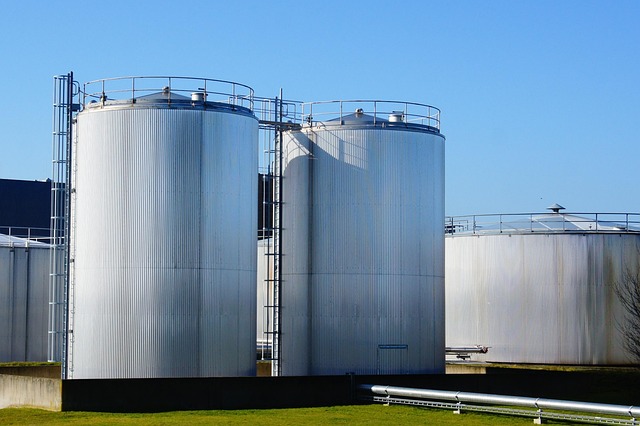
Acoustic emission testing of a storage tank listens for active corrosion and leaks on the floor while the tank stays in service. TCR Engineering provides it in India with Level II acoustic emission technicians from TCR Advanced Engineering, Vadodara, certified to SNT-TC-1A; TCR Advanced (NABL TC-6739) issues the report, and the method is reported outside the NABL scope.
- Tank floors, in service: examined to ISO 24489:2024 and graded I to IV, each grade with a recommended interval to the next examination
- Tank shells during filling: ASTM E1930/E1930M-25
- Pressure vessels: monitoring during hydrostatic testing to ASME Section V
- What it does not do: measure remaining plate thickness, which comes from ultrasonic or magnetic flux leakage scanning
In the demanding world of industrial asset integrity, Acoustic Emission Testing (AET) is the non-destructive testing method that hears damage while it is active. At TCR Engineering, we bring AET capabilities to help industries meet their safety requirements while optimising operational efficiency.
What is Acoustic Emission Testing?
Acoustic Emission Testing is a passive monitoring technique that detects transient elastic waves generated by the rapid release of energy from localised sources within materials. When structures experience stress, defects such as crack growth, corrosion, or material degradation emit characteristic acoustic signals that our advanced systems can detect and analyse in real-time.
Our Technology: A Multi-Channel Acoustic Emission System
TCR Engineering uses a multi-channel acoustic emission system, a versatile inspection platform for AET applications. It offers:
Key Features:
- Multi-channel capability: up to 38 parallel measurement channels in TCR's chassis
- High sensitivity detection: picks up the very small surface displacements that active damage produces
- Real-time monitoring: Active sources located while the examination runs
- Advanced signal processing: Digital filtering and feature extraction for defect characterisation
- Source location: locates the active zones within the structure
Technical Advantages:
- Dual-channel signal processors with programmable gain and application-specific filtering
- Duration-adapted transient recording for comprehensive waveform analysis
- Compliance with EN 13477 for equipment characterisation and verification
Where TCR Applies AET
TCR Engineering applies AET to these assets:
Above-Ground Storage Tanks
Our team carries out AET inspections on above-ground storage tanks, detecting:
- Corrosion progression
- Leak detection and localisation
- Structural integrity assessment
- Floor plate condition evaluation
Pressure Vessels
We provide comprehensive AET services for pressure vessels, including:
- Real-time crack monitoring during hydrostatic testing
- Integrity assessment under operational conditions
- Defect growth monitoring
- Safety-critical decision support
Expanding Capabilities
With our team of engineers and trained technicians, we are extending AET to additional applications such as LPG mounded bullets and other critical infrastructure components.
Advantages of Our Approach
Five properties shape how TCR uses AET on a tank or a vessel.
1. Characterised Equipment
The acoustic emission system is characterised and verified to EN 13477-1 and EN 13477-2 for detecting and monitoring defects in real time.
2. The Team
Our acoustic emission technicians are certified Level II to SNT-TC-1A and work to the examination plan agreed for each asset.
3. Real-Time Decision Making
Active sources are located while the examination runs, and each tank floor grade carries the interval to the next examination.
4. Fewer Shutdowns
AET monitors a structure in service, reducing the need for frequent shutdowns and manual inspections.
5. Hidden Damage Detection
Our technology can discover damage processes even at inaccessible locations within structures, where conventional inspection cannot reach.
Applications Across Industries
Our AET services are applicable across various sectors:
- Oil & Gas: Pipeline integrity, storage tank monitoring, pressure vessel assessment
- Chemical Processing: Reactor vessels, storage systems, piping networks
- Power Generation: Boiler systems, pressure vessels, cooling systems
- Manufacturing: Process equipment, pressure systems, structural components
Quality Assurance and Standards Compliance
TCR Engineering's AET services adhere to international standards including:
- EN 13477-1: Equipment description standards
- EN 13477-2: Verification of operating characteristics
- EN 13554: general principles of acoustic emission testing
- EN 14584: acoustic emission examination of metallic pressure equipment during proof testing
- ISO 24489:2024: acoustic emission examination of tank floors
- ASTM E1930/E1930M-25: tank shells during filling
The TCR Engineering Advantage
When you choose TCR Engineering for your AET needs, you benefit from:
- Technology: a current-generation multi-channel acoustic emission system
- Report: issued by TCR Advanced Engineering (NABL TC-6739)
- Personnel: Level II technicians certified to SNT-TC-1A
- Comprehensive Reporting: Detailed analysis and actionable recommendations
- Ongoing Support: Re-examination at the graded interval and technical assistance
Conclusion
As industries continue to prioritise safety, reliability, and operational efficiency, Acoustic Emission Testing represents a critical tool for proactive asset management. TCR Engineering combines a multi-channel acoustic emission system with Level II technicians for AET services.
Contact TCR Engineering to learn where AET can show that your storage tanks and pressure vessels are actively degrading.
FAQ
What does acoustic emission testing find in a storage tank, and what can it not find?
It finds active corrosion and active leaks on the tank floor while the tank is in service, located zone by zone and graded I to IV. It does not measure remaining plate thickness: that comes from magnetic flux leakage scanning and ultrasonic testing when the tank is opened, or from robotic ultrasonic scanning in service.
Does a tank have to be emptied for acoustic emission testing?
No. The tank stays in service, filled to at least 50 per cent of its safe fill height and preferably 90 per cent, isolated, and settled for 24 hours for heavy products or 12 hours for lighter ones before monitoring starts. Heaters and agitators are switched off so that the tank is quiet.
Which entity issues the acoustic emission report?
TCR Advanced Engineering, Vadodara, which holds NABL certificate TC-6739, issues the AET report; acoustic emission itself is reported outside the NABL scope. The examination follows ISO 24489:2024 for tank floors, ASTM E1930/E1930M-25 for tank shells during filling, or ASME Section V for pressure vessels.
What do acoustic emission grades I to IV mean for a tank floor?
Grade I means no active sources, with re-examination after four years. Grade II is low active corrosion, re-examined after two years. Grade III is medium active corrosion, re-examined after one year. Grade IV is leaks or high active corrosion, which needs a follow-up inspection at the first available opportunity.