
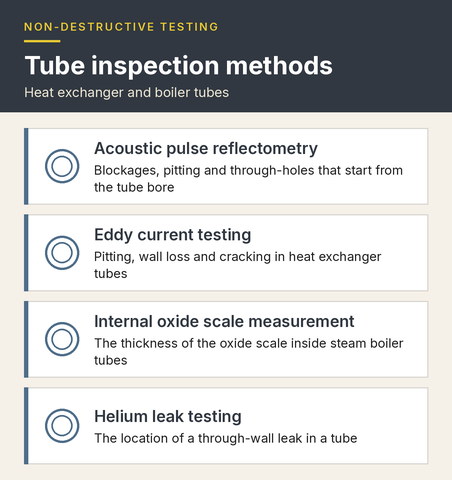
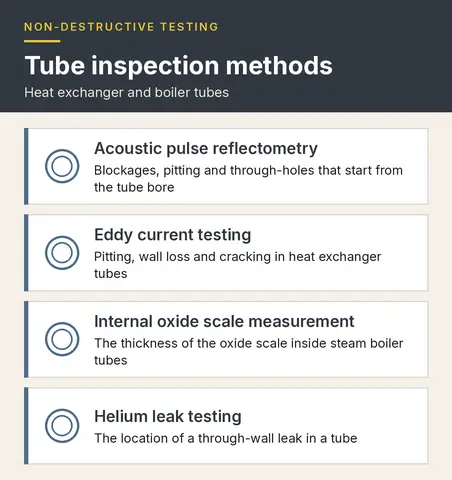
In 2012 TCR Advanced Engineering, the TCR group's asset integrity company at Vadodara, India, offered four NDT methods for heat exchanger and boiler tubes: acoustic pulse reflectometry, eddy current testing, internal oxide scale measurement and helium leak testing. Each method answers a different question about a tube bundle or a boiler tube, as the list below sets out.
- Acoustic pulse reflectometry: blockages, pitting and through-holes that start from the tube bore
- Eddy current testing: pitting, wall loss and cracking in heat exchanger tubes
- Internal oxide scale measurement: the thickness of the oxide scale inside steam boiler tubes
- Helium leak testing: the location of a through-wall leak in a tube
Undertaking acoustic pulse reflectometry, Eddy Current, Oxide Scale Measurement and Helium Leak Test by TCR Advanced.
FAQ
What does acoustic pulse reflectometry find in a tube?
Acoustic pulse reflectometry sends a sound pulse into a tube from its open end and reads the echoes that return. It finds blockages, pitting and through-holes that start from the tube bore, in tubes of any shape or material, but it does not detect cracks. Eddy current testing is used where cracking is the concern.
What does internal oxide scale measurement show?
It measures the thickness of the magnetite scale that grows on the inside of steam boiler tubes in service. A thicker scale insulates the tube, raises the tube metal temperature and shortens its creep life, so the reading is an input to remaining life assessment, which TCR Advanced Engineering delivers and signs.
How is a leaking tube located?
A tube already leaking in service is located by helium leak testing. Helium is introduced on one side of the tube sheet or bundle, and a mass spectrometer leak detector traces where the gas escapes, which points to the leaking tube for plugging or repair.