
TCR Engineering tests the performance of rebar couplers, the mechanical splices of reinforcement bars, at its laboratory in Mahape, Navi Mumbai, for projects across India. Its static tensile, slip and fatigue tests to IS 16172, ASTM A1034 and ISO 15835-2 are on its NABL scope (NABLT0726MH18640), and it is BIS-recognised for IS 16172 testing.
- IS 16172: static tensile, slip, cyclic tensile, low-cycle and high-cycle fatigue
- ASTM A1034/A1034M: static tensile, slip, cyclic tensile, high-cycle and axial force fatigue
- ISO 15835-2: tensile, slip, low-cycle and high-cycle fatigue
- BIS recognition: IS 16172 coupler testing, bar diameters 8 mm to 40 mm (LRMD/LRS/OSL-7103506)
- Laboratory: Mahape, Navi Mumbai
In modern construction, rebar couplers are widely used to connect reinforcing bars, enabling structures to achieve higher safety standards and efficiency. TCR Engineering Services, a materials testing laboratory at Mahape, Navi Mumbai, carries out performance evaluation of rebar couplers. Working with coupler manufacturers such as Dextra and Leviat and contractors such as Ashoka Buildcon, TCR checks whether projects, including those on National Highways and in Saudi Arabia, meet the applicable quality standards.
TCR Engineering's testing covers a wide range of rebar coupler evaluations as per the Bureau of Indian Standards (IS 16172). From static tensile, slip tests, and spectrochemical analysis to high-cycle fatigue testing of up to 2 million cycles, the laboratory tests couplers against the static and cyclic loads the standard sets. Coupler testing covers bar diameters from 8 mm to 40 mm, with additional mechanical testing for TMT bars up to 45 mm diameter.
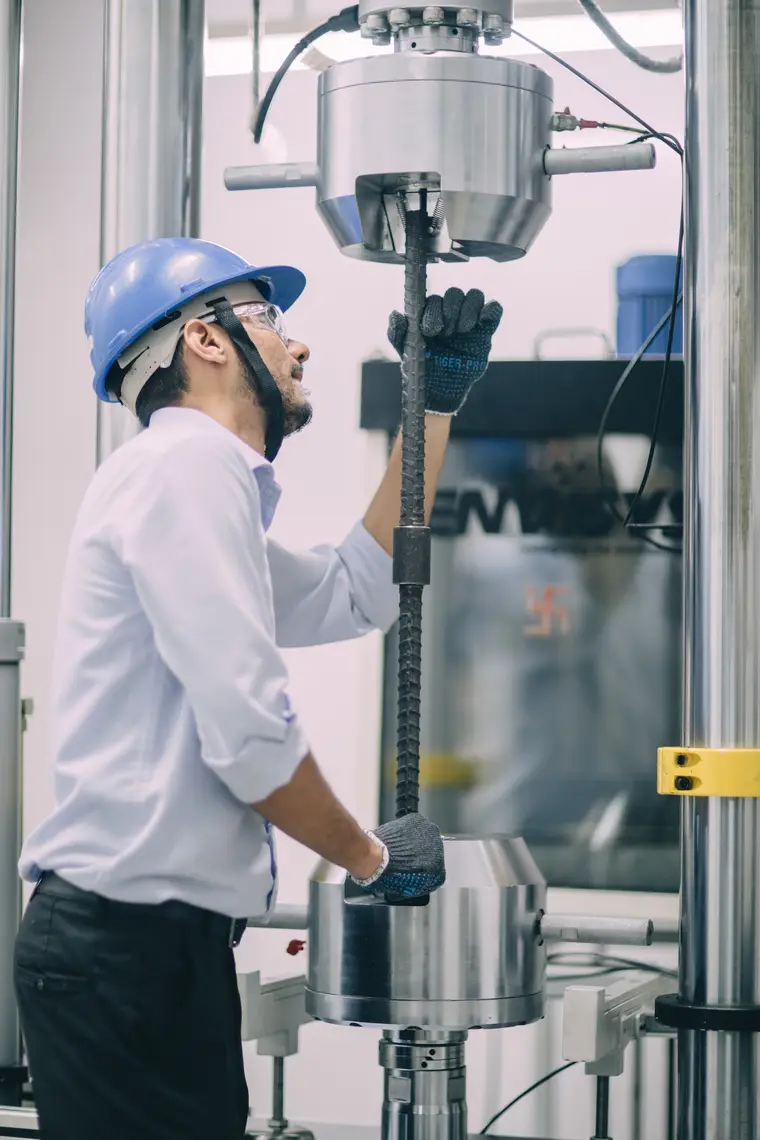
Fatigue tests run on closed-loop servo-hydraulic dynamic universal testing machines, with a frequency range of 0.035 to 30 Hz. TCR Engineering's NABL accreditation (ISO/IEC 17025:2017, certificate NABLT0726MH18640) covers coupler tests to ASTM A1034 and ISO 15835-2 as well as IS 16172.
The shift towards precast construction has raised demand for couplers, which reduce rebar congestion and improve site efficiency. TCR's test protocols assess compatibility and performance under both static and dynamic loading conditions, for the needs of modern infrastructure projects.
TCR Engineering, founded in Mumbai in 1973, tests splices, connections and joints against the applicable safety standards.
FAQ
Which rebar coupler tests does IS 16172 require?
IS 16172 covers static tensile strength and extension under load, slip, cyclic tensile, low-cycle fatigue and high-cycle fatigue of mechanical splices. TCR Engineering runs each of these at its Mahape laboratory in Navi Mumbai under its NABL scope, certificate NABLT0726MH18640, and under its BIS recognition for IS 16172 coupler testing.
How many cycles does the high-cycle fatigue test on couplers run to?
The high-cycle fatigue test on rebar couplers runs to 2 million cycles between the minimum and maximum stress the standard sets, and the result is reported with the S-N data. TCR Engineering runs it on closed-loop servo-hydraulic dynamic machines at Mahape, separate from the static frames used for tensile and slip tests.
Can TCR test couplers to ASTM A1034 or ISO 15835-2 for overseas projects?
Yes. Static tensile, slip, cyclic tensile and fatigue tests to ASTM A1034/A1034M, and tensile, slip and fatigue tests to ISO 15835-2, are on the NABL scope of TCR Engineering's Mahape laboratory in Navi Mumbai. NABL is a signatory to the ILAC Mutual Recognition Arrangement.