
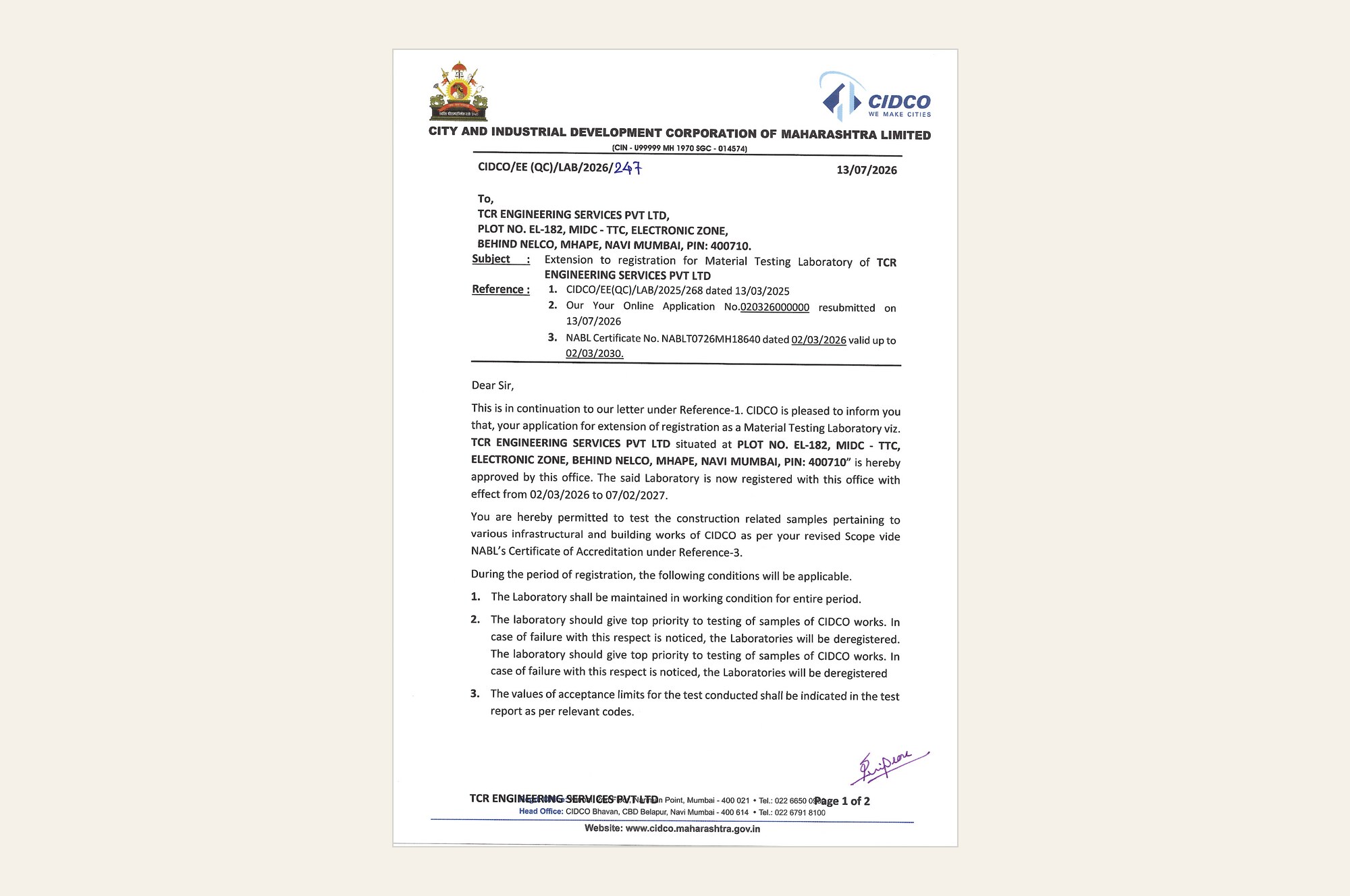
The City and Industrial Development Corporation of Maharashtra Limited has extended TCR Engineering Services Pvt. Ltd.'s registration as a material testing laboratory. The letter, reference CIDCO/EE (QC)/LAB/2026/247 dated 13 July 2026, permits TCR to test construction-related samples for CIDCO's infrastructural and building works from the NABL-accredited laboratory at Mahape, Navi Mumbai.
What the letter establishes:
- Registered entity: TCR Engineering Services Pvt. Ltd., Plot No. EL-182, MIDC-TTC Industrial Area, Electronic Zone, Behind NELCO, Mahape, Navi Mumbai 400 710
- CIDCO reference: CIDCO/EE (QC)/LAB/2026/247 dated 13 July 2026, signed by Sunil J. Deore, Executive Engineer (Quality Control), Raigad Bhavan, CBD Belapur
- Period of registration: 2 March 2026 to 7 February 2027
- Permitted work: testing of construction-related samples pertaining to CIDCO's various infrastructural and building works
- Basis of scope: NABL certificate NABLT0726MH18640, valid 3 March 2026 to 2 March 2030, carrying 1,483 accredited scope items across 1,383 laboratory and 100 site tests
- Applicable codes: relevant tender conditions, specifications, IS codes, BS codes, ASTM and MORTH, as the case may be

The one clause that carries the weight
The operative sentence is short. TCR is permitted to test construction-related samples for CIDCO works "as per your revised Scope vide NABL's Certificate of Accreditation", and condition 12 states that the certificate is valid for testing of materials as per the NABL approved scope only.
That is a scope-bound registration, not a general licence, and it is the right way round. It means the question a CIDCO contractor should ask is not whether TCR is registered. It is whether the specific parameter on the bill of quantities sits inside NABL certificate NABLT0726MH18640. The registration transmits the accreditation; it does not enlarge it.
The word "revised" is what changed in 2026. The current NABL certificate, issued 3 March 2026 and valid to 2 March 2030, carries a substantially wider building materials scope than the certificate it replaced. Accredited methods now run across cement to IS 4031, hardened concrete cubes, cores and beams to IS 516, coarse and fine aggregates to IS 2386, burnt clay bricks to IS 3495, autoclaved aerated concrete blocks to IS 6441, paving blocks to IS 15658, glazed and unglazed ceramic tiles to IS 13630, grout, ground granulated blast furnace slag, fly ash to IS 1727, and soil to IS 2720. Chloride and sulphate content in hardened concrete and aggregate, alkali aggregate reactivity to IS 2386 Part 7, and cement content to IS 516 Part 11 sit in the chemical scope alongside them.
For a CIDCO quality control officer, that matters in a specific way. A test that previously had to be reported as non-accredited, with the standard disclaimer, can now carry the NABL mark on the same report as everything else on the job.
Who CIDCO is, and why a laboratory registration with it is not routine
CIDCO was incorporated on 17 March 1970 as a wholly owned undertaking of the Government of Maharashtra and was given the status of New Town Development Authority, later widened by the state with Special Planning Authority powers. It was created for one purpose: to build a counter-magnet city across Thane creek so that Mumbai's population, industry and offices had somewhere to go. It then built Navi Mumbai, node by node, over five decades.
That history is the reason CIDCO's quality control conditions read the way they do. An organisation that has commissioned roads, water supply, drainage, bridges, railway stations and housing at that scale has learned where material failures come from. The thirteen conditions in the letter are a compressed record of it: the laboratory must be maintained in working condition for the entire period, CIDCO's visiting personnel must be allowed to witness testing, calibration certificates must be available for inspection, registers of tests conducted and results obtained must be maintained for the visiting CIDCO officer, and acceptance limits must be stated in the test report as per the relevant codes.
Condition 11 is newer in tone and is the one worth reading twice. The laboratory must intimate CIDCO within seven working days of any adverse action taken against it by NABL or any other government organisation, including suspension, debarment or cancellation of accreditation. Failure to notify may terminate the empanelment. CIDCO is treating a laboratory's accreditation status as a live condition of engagement rather than a certificate collected once at registration. That is a correct instinct and, from a laboratory's side, an entirely reasonable one to be held to.
CIDCO also holds 26 per cent of Navi Mumbai International Airport Limited, alongside Adani Airports Holdings Limited at 74 per cent. The airport began commercial operations on 25 December 2025.
Mumbai 3.0 is not one authority, and that is the planning point
"Third Mumbai" and "Mumbai 3.0" are shorthand for the urban region taking shape east and south of the Mumbai Trans Harbour Link, around the new airport. The planning structure behind the shorthand is worth stating precisely, because it determines which laboratory registration a contractor actually needs.
By notification dated 15 October 2024, the Government of Maharashtra appointed the Mumbai Metropolitan Region Development Authority as New Town Development Authority for 124 villages across Uran, Panvel and Pen tehsils in Raigad district. That designated area is named K. S. C. New Town and covers 323.44 square kilometres. MMRDA's own account states that the new town is being planned primarily on the framework of CIDCO's Navi Mumbai development model, and a government resolution dated 16 March 2026 approved the land acquisition and allocation policy for it. The stated economic aim behind the region is to carry MMR to a USD 300 billion economy by 2030.
CIDCO continues as the planning and development authority for Navi Mumbai itself and for the balance of the Navi Mumbai Airport Influence Notified Area, and it remains the client for its own infrastructural and building works. So the region that gets called Mumbai 3.0 is served by at least three approving bodies with their own laboratory registration regimes: CIDCO, MMRDA as NTDA, and the Brihanmumbai Municipal Corporation across the water in Greater Mumbai.
A testing laboratory that holds one of those three is useful on one class of project. TCR holds registrations with CIDCO and, since March 2026, with BMC. The BMC Roads Department registration under reference Dy.Ch.E./4469/Rds./Plg., dated 25 March 2026, covers permanent facility and site testing across chemical analysis, mechanical testing and non-destructive testing of construction materials. Read together, the two registrations mean a developer or EPC contractor working on both sides of the harbour submits reports from one laboratory, one quality system and one signature.
Proximity is a technical argument, not a convenience argument
TCR's laboratory is at Mahape in Navi Mumbai. CIDCO's Executive Engineer (Quality Control) sits at Raigad Bhavan, CBD Belapur, and CIDCO's head office is in the same node. Both are inside the city CIDCO built.
Distance matters in civil testing for reasons that are metrological rather than commercial. Concrete cube specimens have to reach the laboratory and enter curing under controlled conditions within the window the standard allows, and a specimen that has been sitting in a vehicle in May has a thermal history that no laboratory can undo. Site tests are worse. Ultrasonic pulse velocity and ground penetrating radar surveys, half-cell potential mapping and cover meter surveys, and core extraction all require a crew, an instrument set and a scaffold window that has to be taken when the site offers it. Condition 4 of the CIDCO letter adds a further constraint: a CIDCO representative may come to witness the test. Witness testing only works when the witness can get there.
Fifty-three years in Navi Mumbai and 1,200 structural audits across India is what sits behind the crews who do that work.
"Being ten minutes from CIDCO Bhavan is not a selling point on its own. It matters because a concrete cube has a clock on it and a site test has a witness who has to be able to attend. We are testing material for the city our own laboratory sits in, and the people signing our reports drive past these sites. That tends to concentrate the mind more than any quality manual does."
What the developers did next
Two long term rate contracts landed in the same window as the accreditation and registration work. Godrej Properties appointed TCR its third party civil testing partner for all Mumbai Zone projects on a three-year rate contract covering aluminium formwork, tiles and stones, concrete, AAC blocks and reinforcement steel. Kalpataru awarded a comparable long term rate contract shortly before it.
Two contracts of that shape, from two developers of that standing, close together, is not a coincidence. It is a market moving from project-level laboratory selection to portfolio-level consolidation, and the thing being consolidated is defensibility. A developer with a hundred sites does not want a hundred different laboratories' interpretations of IS 456. It wants one accredited scope, one set of acceptance criteria stated per the relevant code, and one laboratory whose registrations survive scrutiny at the Commencement Certificate and Occupation Certificate stage.
The catalogue behind the registration
The civil and structural testing pillar covers concrete, cement and aggregates, soil and geotechnical work, bitumen and road materials, building materials including tiles, AAC blocks and aluminium formwork, TMT rebar and reinforcement couplers, pavement evaluation, bridge inspection and structural audits under Section 353B of the Mumbai Municipal Corporation Act 1888. TCR is the first BIS-accredited commercial laboratory in India for IS 16172 rebar coupler testing across all diameters from 8 mm to 40 mm, and has inspected more than 500 bridges.
The work reaches both the infrastructure and construction verticals, which in this region are increasingly the same project seen from two ends. The earlier note on TCR's original CIDCO approval records how the empanelment started; this letter is its extension against a wider accredited scope.
Continue reading
Frequently asked questions
Is TCR Engineering a CIDCO approved material testing laboratory?
Yes. CIDCO extended TCR Engineering Services Pvt. Ltd.'s registration as a material testing laboratory by letter CIDCO/EE (QC)/LAB/2026/247 dated 13 July 2026. The registration runs from 2 March 2026 to 7 February 2027 and permits testing of construction-related samples for CIDCO's infrastructural and building works from the Mahape laboratory in Navi Mumbai.
What testing scope does the CIDCO registration cover?
The registration is bound to TCR's NABL scope. Condition 12 of the letter states the certificate is valid for testing of materials as per the NABL approved scope only. That scope is NABL certificate NABLT0726MH18640, valid 3 March 2026 to 2 March 2030, carrying 1,483 accredited items across 1,383 laboratory and 100 site tests.
Does TCR also hold BMC approval for construction material testing?
Yes. The Brihanmumbai Municipal Corporation, through the Deputy Chief Engineer (Roads) Planning, registered TCR Engineering as an approved material testing laboratory under reference Dy.Ch.E./4469/Rds./Plg. dated 25 March 2026. That registration covers permanent facility and site testing across chemical analysis, mechanical testing and non-destructive testing.
Which authority approves laboratories for Mumbai 3.0 projects?
It depends on the client. CIDCO registers laboratories for its own works in Navi Mumbai and the balance NAINA area. MMRDA was appointed New Town Development Authority for K. S. C. New Town, 124 villages across 323.44 square kilometres in Uran, Panvel and Pen, by notification dated 15 October 2024. BMC registers laboratories for Greater Mumbai works.
Which civil test methods can TCR report under the NABL mark?
The revised scope covers cement to IS 4031, hardened concrete cubes, cores and beams to IS 516, aggregates to IS 2386, burnt clay bricks to IS 3495, AAC blocks to IS 6441, paving blocks to IS 15658, ceramic tiles to IS 13630, fly ash to IS 1727 and soil to IS 2720, alongside chloride, sulphate and cement content determinations.
What conditions does CIDCO place on a registered laboratory?
Thirteen conditions apply. The laboratory must stay in working condition throughout, give priority to CIDCO samples, allow CIDCO personnel to witness testing, keep calibration certificates and test registers available for inspection, state acceptance limits in the report per the relevant codes, and notify CIDCO within seven working days of any adverse regulatory action against its accreditation.