
TCR Engineering creep rupture tests SUPER 304H (UNS S30432) austenitic stainless steel boiler tube to BHEL specifications at its Mahape laboratory in Navi Mumbai, India. The test runs on a constant-load creep frame to ASTM E139 and BS EN ISO 204, both on NABL certificate NABLT0726MH18640, and TCR Engineering is a CBB Well-Known Material Testing Laboratory.
- Material: SUPER 304H (UNS S30432) tube, tested without a notch
- Specification: BHEL, with ASTM E139 and BS EN ISO 204
- Laboratory: Mahape, Navi Mumbai, a CBB Well-Known Material Testing Laboratory
- Accreditation: NABL (NABLT0726MH18640)
TCR Engineering tests a range of high-temperature alloys. TCR Engineering is recognised by the Central Boilers Board as a Well-Known Material Testing Laboratory under the Indian Boiler Regulations (IBR), and tests boiler tube materials. Among our capabilities is the Creep Rupture Test for SUPER 304H (UNS S30432) grade materials, which is conducted to BHEL specifications, IBR requirements, ASTM E139, BS EN ISO 204, and other international standards. This test measures the material's behaviour under sustained stress at elevated temperature, for tube that goes into power plant and industrial boilers.
Key Features of the Creep Rupture Test as per BHEL and IBR
1. Material Details, as the BHEL specification sets them:
- Material Grade: Austenitic Stainless Steel (SUPER 304H, UNS S30432)
- Geometry: Hollow Circular Tube
- Size: 38.10 mm DIA x 5.4 mm THK x 300 mm LONG
- With/Without Notch: Without Notch
2. Test Parameters, as the BHEL specification sets them:
- Temperature: 705°C
- Minimum Rupture Stress: 105 MPa
- Duration: Minimum of 1,000 hours (test continues until material failure)
3. International Standards Followed:
- ASTM E139
- BS EN ISO 204
- BHEL Specifications
Test Objectives
The Creep Rupture Test is critical for assessing the long-term mechanical performance of materials used in high-temperature and high-pressure applications. Specifically, the test aims to:
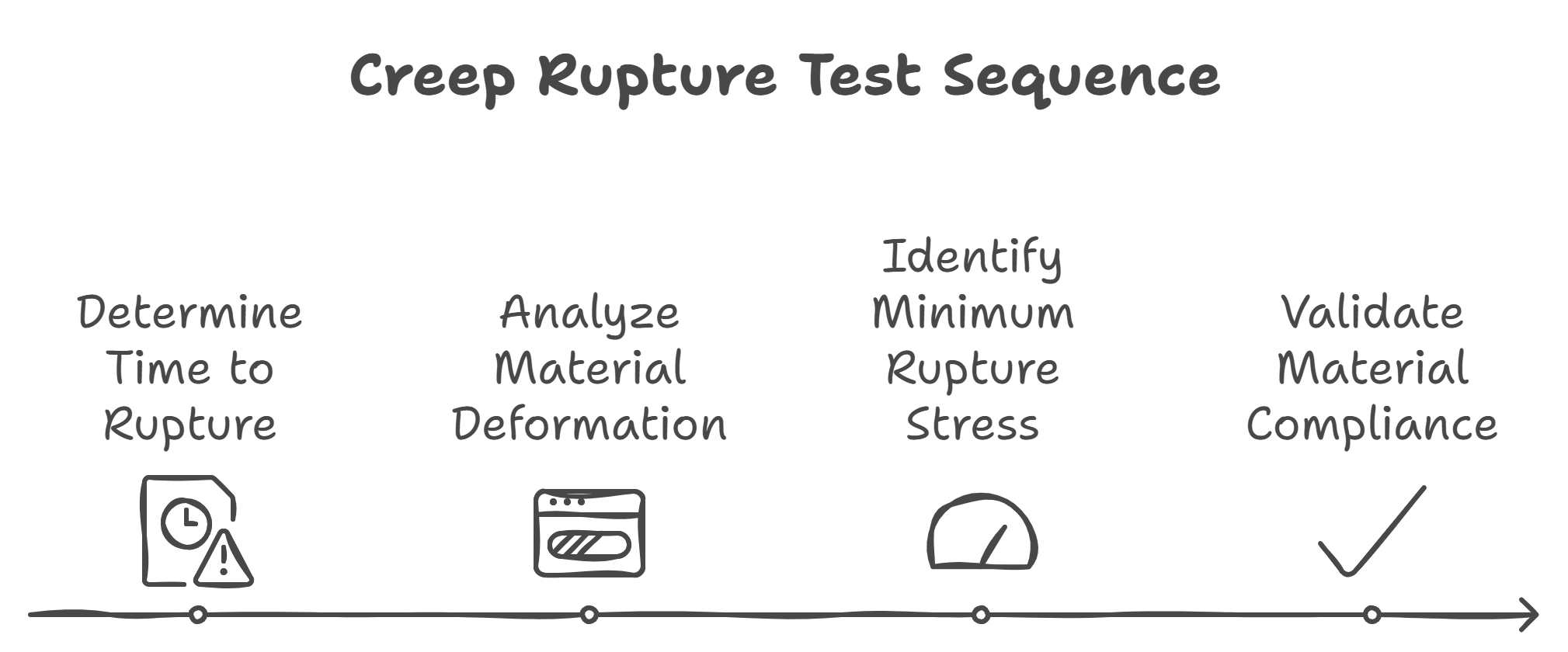
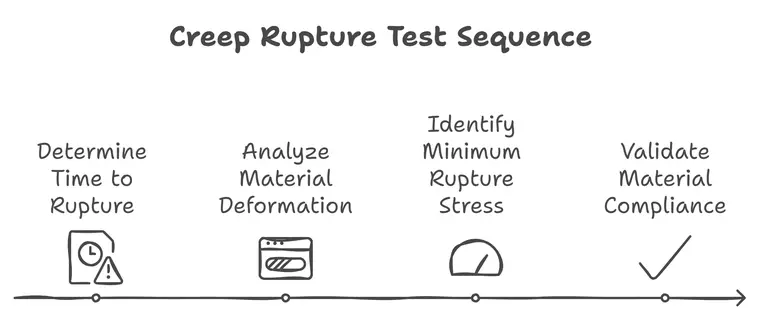
- Determine the time to rupture under a specified stress and temperature.
- Analyse material deformation over time under constant load.
- Identify the minimum rupture stress and check the material against the acceptance values of its specification.
TCR's Testing Laboratory
For the Creep Rupture Test of SUPER 304H, TCR Engineering's materials testing laboratory provides:
- Test setup: high-temperature furnaces with controlled temperature, on constant-load creep frames that hold the stress for the whole test.
- Specimen handling: the customer supplies the prepared and coated specimen; TCR Engineering fixtures it and runs the test.
- Reporting: rupture stress, total elongation and deformation, with photographs of the fractured surface and further metallurgical examination on request.
- Extended testing: beyond the 1,000 hours the BHEL specification sets, on customer request.
Required Customer Information
With the sample, TCR Engineering asks for the following details:
- Material specifications, including grade and geometry.
- Stress levels and temperature details.
- Any specific testing requirements or additional instructions.
Why Choose TCR Engineering?
- Experience: Materials testing and analysis since 1973.
- Accreditation and recognition: NABL (NABLT0726MH18640), and a CBB Well-Known Material Testing Laboratory.
- Power plant work: creep and stress rupture testing of boiler tube, steam pipe and turbine materials.
For a creep rupture test to a BHEL or other boiler tube specification, contact TCR Engineering.
The creep testing laboratory at TCR Engineering describes the frames, temperatures and standards behind this test.
FAQ
What is SUPER 304H?
SUPER 304H, UNS S30432, is an 18Cr-9Ni austenitic stainless steel with copper, niobium and nitrogen additions, made for high-temperature steam-service tubing in power generation. Its strength at high temperature over long periods is what a creep rupture test checks against the purchaser's specification before the tube is accepted.
Why is boiler tube creep rupture tested?
A superheater tube carries stress at high temperature for years, and creep is the damage mechanism that limits it. A creep rupture test checks that a tube lot reaches the time to rupture its specification requires at the stated stress and temperature; it qualifies the material and does not measure the life of a tube in service.
Which standards apply to this test?
The test followed the BHEL specification with ASTM E139 and BS EN ISO 204. Creep and stress rupture testing to ASTM E139, and creep rupture testing to ISO 204, are on NABL certificate NABLT0726MH18640 at TCR Engineering's Mahape laboratory in Navi Mumbai, as are ASTM E292 notch rupture and IS 3407 tensile creep.
Can the test run beyond 1,000 hours?
Yes. The BHEL specification's minimum of 1,000 hours is a floor, and the test can continue to rupture or run longer on the customer's request. TCR Engineering's creep frames can hold a test for up to 100,000 hours, and the schedule for a programme is confirmed in the quotation.