
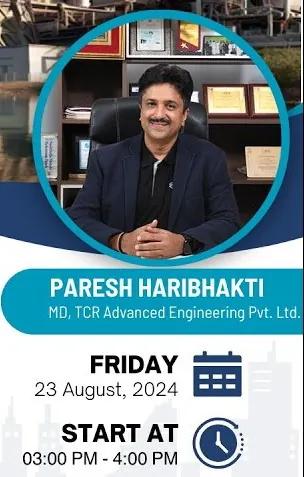
Paresh Haribhakti, Managing Director of TCR Advanced Engineering, presented the Evolve by TCR webinar Remaining Life Assessment (RLA) of Boilers: A Compliance or an Opportunity on 23 August 2024. He set out RLA of ageing boilers under Regulation 391A of the Indian Boiler Regulations as planning evidence for a plant, work TCR Advanced Engineering delivers and signs in India.
- Speaker: Paresh Haribhakti, Managing Director, TCR Advanced Engineering
- Host: Evolve by TCR, the training academy of TCR Advanced Engineering at Vadodara
- Date: 23 August 2024, online
- Subject: remaining life assessment of boilers: the regulation, the testing behind an assessment and case studies from plants
- Recording: the full webinar, on this page
- Earlier talks by the speaker: MICMEP-EAC 2009, on reformer tube failure investigation, and the INS National Workshop on Corrosion and Condition Monitoring, 2013, on in-situ metallography
In the webinar, Mr. Paresh Haribhakti, Managing Director of TCR Advanced and co-author of Failure Investigation of Boiler Tubes: A Comprehensive Approach, published by ASM International, explored how Remaining Life Assessment (RLA) is changing boiler management, shifting the narrative from compliance challenges to planning opportunities.
Here are the key takeaways of the webinar:
1. Extending Boiler Life and Improving Safety
RLA lets plant operators assess and manage the remaining life of their boilers in advance, for steadier performance and safer operation. By identifying early signs of wear and degradation, RLA allows for timely interventions, reducing the risk of unexpected failures.
2. The Techniques Behind an Assessment
The webinar highlighted current-generation tools and methodologies used in RLA, including:
- Non-Destructive Testing (NDT) techniques that measure the condition of pressure parts.
- Material analysis that shows how far wear and degradation have progressed.
Together they give the plant actionable findings for operating and maintaining its boilers.
3. Navigating Regulatory Compliance
Compliance with stringent boiler safety regulations is often seen as a burden. However, RLA turns this into an opportunity by aligning operational practices with regulatory standards, minimising downtime and avoiding costly penalties.
4. Case Studies from Plants
The session presented case studies of plants that used RLA, with outcomes that included:
- Longer boiler service life, deferring replacement.
- Improved safety records and operational reliability.
Why RLA Matters
The webinar made the case for RLA as a standing part of boiler management. By integrating RLA into their maintenance strategies, organisations can achieve:
- Enhanced operational efficiency.
- Prolonged equipment lifespan.
- Stronger compliance and safety records.
RLA is not just a tool; it is a planning approach for boiler operations that also meets regulatory demands.
On video
FAQ
Who presented the Evolve by TCR webinar on RLA of boilers?
Paresh Haribhakti, Managing Director of TCR Advanced Engineering, presented it on 23 August 2024. He is a co-author of Failure Investigation of Boiler Tubes: A Comprehensive Approach, published by ASM International, and the webinar drew on the remaining life assessment work that TCR Advanced Engineering delivers and signs for boilers in India.
Which regulation covers remaining life assessment of ageing boilers in India?
Regulation 391A of the Indian Boiler Regulations covers remaining life assessment of ageing boilers. Within the TCR group, the Central Boilers Board recognition for remnant life assessment is held by TCR Advanced Engineering, Vadodara, and TCR Engineering supplies laboratory evidence as a Central Boilers Board Well-Known Material Testing Laboratory.
Can the webinar on RLA of boilers be watched again?
Yes. The full recording, Remaining Life Assessment (RLA) of Boilers: A Compliance or an Opportunity, plays on this page. It covers why RLA matters to a boiler owner, the testing behind an assessment, regulatory compliance and case studies from plants that used RLA to plan the life of their boilers.