
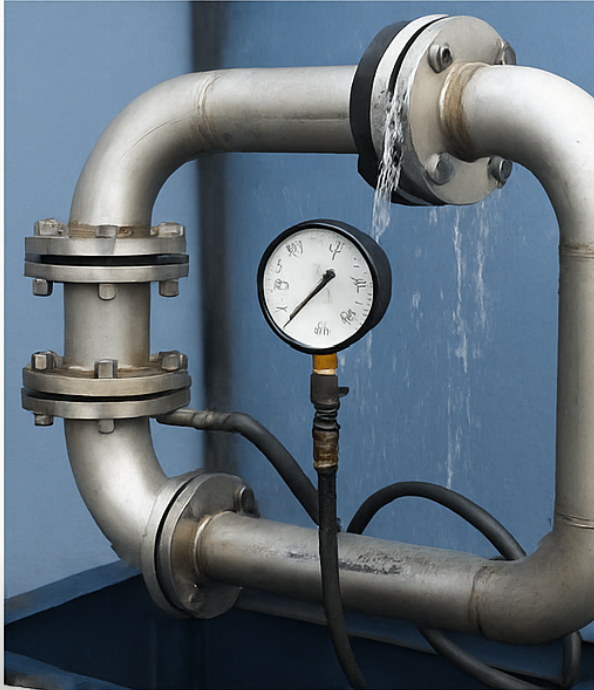
TCR Engineering Services Pvt. Ltd. provides hydrotesting services for pipes, tubes and fittings at its laboratory in Mahape, Navi Mumbai, using fresh water as the test medium. Hydrostatic pressure tests to ASTM A450, A530, A999, B75, B111 and IS 2501, and hydrostatic leak tests to ASTM E1003, are on its NABL scope under certificate NABLT0726MH18640.
- Test medium: fresh water, with dye-assisted visual leak detection
- NABL scope: hydrostatic pressure and leak tests to the ASTM and IS methods above, for the tube and pipe sizes the scope lists
- Fittings: tested against ANSI B16.9 and B16.11 requirements, reported outside the NABL scope
- Test pressure: set by the governing standard or the client's specification
- Report: the pressure held, the hold period and any leak or permanent deformation observed
Pressure Integrity and Leak-Free Performance
At TCR Engineering Services' laboratory at Mahape, Navi Mumbai, we specialise in conducting hydrostatic (HYDRO) tests on stainless steel pipes, including SS316 and similar alloys, using fresh water as the test medium. These tests are performed at varying bar pressures to verify the structural integrity and leak resistance of the pipe systems and fittings. Fittings are tested against the requirements of ANSI B16.9 and B16.11, which are reported outside the NABL scope.
What is Hydrostatic Testing?
Hydrostatic testing is a crucial non-destructive testing method used to validate the strength and leak tightness of pipelines, pressure vessels, plumbing systems, and gas cylinders. The process involves:
- Filling the system with water (sometimes dyed for visibility),
- Pressurising it above normal operating limits,
- Monitoring for pressure drops or visible leaks,
- Evaluating for any permanent deformation.
Why Hydro Testing is Important
- Safety Assurance: Confirms vessels can withstand required pressures without failure.
- Leak Detection: Identifies potential failure points before commissioning.
- Regulatory Compliance: Supports compliance with ANSI, ASME and customer-specific requirements.
- Integrity Evidence: Shows the component held the test pressure without leaking or permanent deformation.
Water is the preferred fluid because it is nearly incompressible, inexpensive and safe. It stores little energy under pressure, so a failure under test releases far less energy than compressed gas, which poses an explosion hazard.
TCR's Hydro Testing Capabilities
- Testing of various pipe diameters and lengths
- Pressure ranges customised to client or regulatory requirements
- Dye-assisted visual leak detection
- Fitting tests to ANSI B16.9 and B16.11 requirements, reported outside the NABL scope
- A test report for each tested component
- Hydrotest witness at manufacturers' works through third-party inspection
Applications
Industries that benefit from hydrostatic testing include oil & gas, chemical processing, pharmaceuticals, power generation, and infrastructure. Whether for newly manufactured systems or periodic requalification, TCR Engineering tests your pressure systems for safety, efficiency, and compliance.
Partner with TCR for Testing
Founded in Mumbai in 1973, TCR Engineering Services carries out metallurgical and mechanical testing for industries across India. Each report records the pressure held, the hold period and the result.
FAQ
Is hydrostatic testing at TCR Engineering NABL accredited?
Yes, for the methods on its scope. NABL certificate NABLT0726MH18640 carries hydrostatic pressure tests to ASTM A450, A530, A999, B75, B111 and IS 2501 and the hydrostatic leak test to ASTM E1003, for the tube and pipe sizes the scope lists. Tests against ANSI B16.9 and B16.11 are reported outside the NABL scope.
What test pressure is used in a hydrostatic test?
The test pressure comes from the governing product standard or the client's specification, usually a multiple of the design or rated pressure, held for the period that standard sets. TCR Engineering applies the pressure the specification calls for and records the pressure held, the hold period and any leak or permanent deformation.
Why is water used instead of air for pressure testing?
Water is nearly incompressible, so it stores very little energy at test pressure. If a component fails under a hydrostatic test, the water escapes with far less force than a compressed gas would release, which is why pneumatic testing is kept for cases where water cannot be used, under stricter safety precautions.
Does TCR witness hydrotests at a manufacturer's works?
Yes. Hydrotest witness is part of TCR's third-party and source inspection work, alongside welder and procedure qualification, positive material identification and coating checks on pipeline projects. The inspector confirms the test pressure, the hold period and the result against the approved procedure and records them in the inspection report.