

Concrete temperature monitoring records the temperature of concrete from placement through early curing, so engineers can control strength gain and thermal cracking. TCR Engineering measures fresh concrete temperature on site to ASTM C1064, a test on its NABL site scope (certificate NABLT0726MH18640), and logs in-place temperatures with embedded thermocouples at sites across India.
- Fresh concrete temperature: ASTM C1064, on site, on the NABL site scope; part of TCR's concrete testing.
- In-place monitoring: embedded thermocouple sensors through curing, reported outside the NABL scope.
- Maturity estimates: ASTM C1074, reported outside the NABL scope.
- Guidance: ACI 305 for hot weather and ACI 306 for cold weather concreting.
When it comes to concrete, temperature is everything.
TCR Engineering's Civil Testing Laboratory at Mahape, Navi Mumbai, offers on-site temperature monitoring of fresh concrete at construction sites across India: a service that is critical to the durability, safety, and structural performance of a pour.
Why Does Concrete Temperature Monitoring Matter?
Concrete might be the most widely used construction material in the world, but it is surprisingly sensitive in its early life. The curing process is driven by hydration: a chemical reaction that is directly affected by temperature. If the concrete gets too hot or too cold during this stage, it can lead to:
- Slowed or poor strength development
- Thermal cracking
- Premature setting
- Structural compromise
Whether you are building a high-rise in the Mumbai heat or laying a bridge in cold northern regions, temperature control is key to quality.
TCR's Field Support
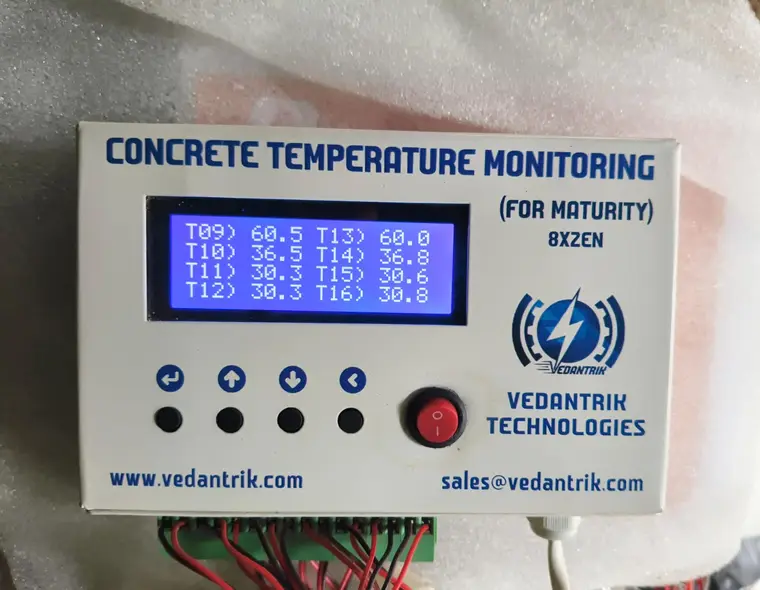
TCR Engineering deploys real-time temperature monitoring systems at project sites to give engineers the critical data they need, right when they need it.
Our systems use embedded thermocouple sensors placed directly within the concrete mix. These sensors continuously capture temperature data throughout the curing process, providing actionable data to help avoid costly structural issues.
Where Temperature Monitoring Is Essential:
- Mass concrete pours (e.g., dams, basements, bridge piers)
- Hot or cold climate zones
- High-performance or fast-setting concrete applications
- Critical load-bearing elements
Standards We Follow:
We follow international norms:
- ASTM C1064 – Measuring temperature of fresh concrete
- ASTM C1074 – Maturity method for strength estimation
- ACI 305 – Hot Weather Concreting
- ACI 306 – Cold Weather Concreting
Why Choose TCR Engineering?
With material testing since 1973 and a pan-India reach, TCR Engineering brings site instrumentation and field methods to your job site. Our temperature monitoring services are customisable, standards-compliant, and backed by engineering professionals who understand the science behind every pour.
Don't let temperature sabotage your concrete strength. Monitor it. Control it. Build with confidence, with TCR Engineering.
FAQ
Why is concrete temperature monitored during curing?
Hydration is driven by temperature. Concrete that runs too hot gains early strength but risks thermal cracking from the gradient between core and surface, and concrete that runs too cold sets and gains strength slowly. Monitoring tells the site when curing can stop and whether a mass pour needs cooling or insulation.
Which standard covers the temperature of fresh concrete?
ASTM C1064, the test method for temperature of freshly mixed hydraulic-cement concrete. TCR Engineering performs it on site under its NABL site scope, certificate NABLT0726MH18640. In-place monitoring with embedded thermocouples, and strength estimates by the maturity method of ASTM C1074, are reported outside the NABL scope.
Which pours need temperature monitoring?
Mass concrete pours such as rafts, basements, dams and bridge piers, where the heat of hydration builds a gradient between core and surface; pours in hot or cold weather, under ACI 305 and ACI 306; high-performance and fast-setting mixes; and critical load-bearing elements where early strength decides the construction sequence.