
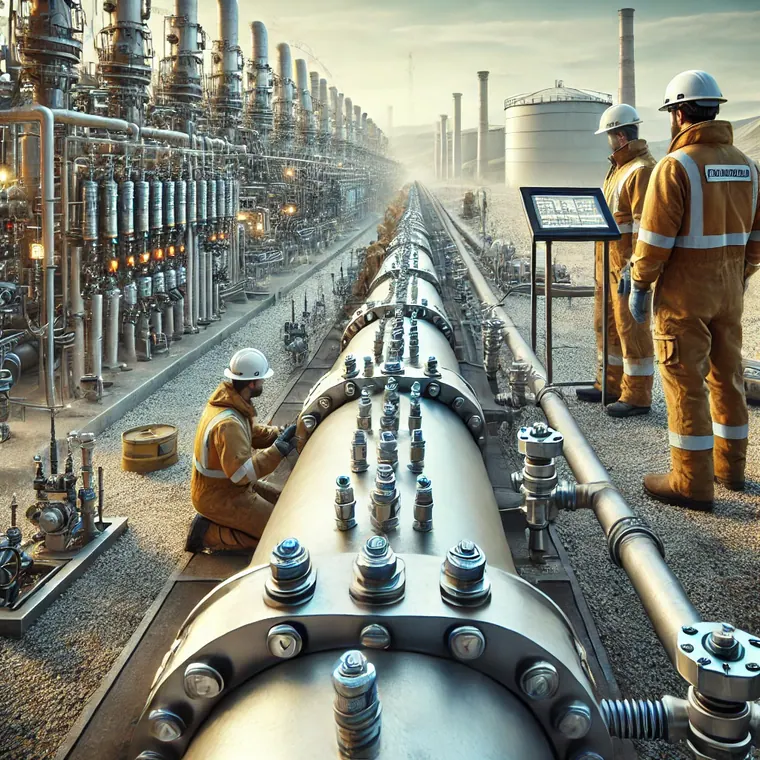
Pipeline cathodic protection holds buried and immersed steel at a protective potential that suppresses corrosion. In the TCR group it is delivered by TCR Advanced Engineering's CP Division, Vadodara, led by Chiral Patel, with 20+ years in cathodic protection and pipeline integrity: system design, installation, surveys and maintenance for pipelines across India.
- Division: TCR Advanced Engineering's CP Division, Vadodara, with a regional office in Bhubaneswar
- Systems: impressed current and sacrificial anode
- Surveys: CIPS, DCVG, Pearson, conductance attenuation and stray current
- Standards: NACE SP0169 and ISO 15589 for pipelines, DNV-RP-B401 offshore
- Monitoring: CP monitoring of installed units to GAIL practice by TCR Engineering
Corrosion is an inevitable challenge faced by the oil and gas sector, especially when it comes to preserving the integrity of pipelines and other critical infrastructure. The TCR group works in corrosion engineering, and TCR Advanced Engineering's CP Division delivers its Cathodic Protection (CP) work. The group's CP work covers buried and immersed metallic structures.
Driving Value for the Oil and Gas Sector
For pipelines, corrosion is a threat to operational continuity. The CP Division designs cathodic protection systems to the criteria of the standard the owner names.
Periodic surveys and failure investigation are meant to find a problem while a repair can still be planned rather than done as an emergency.
Preserving Assets, Enhancing Longevity
Pipelines are the arteries of the oil and gas industry. The CP Division's cathodic protection services cover design, installation and maintenance. From impressed current systems to sacrificial anode installations, the division designs each system for pipelines, storage tanks, reinforced concrete, and other infrastructure.
The CP Division designs and maintains each system to the cathodic protection standard the owner names.
Services Across the CP Lifecycle
TCR Advanced Engineering's CP Division works across the full spectrum of cathodic protection services:
- Design and Consultancy: The division designs CP systems for each project, including offshore platforms, and audits third-party designs.
- Field Services: From DCVG and CIPS surveys to stray current investigations, to diagnose and maintain CP systems.
- Installation and Maintenance: The division installs CP systems and maintains them on a regular schedule.
- Failure Investigations: TCR Advanced Engineering investigates corrosion-related failures, identifies the root cause and recommends remedies.
What the CP Division Provides
The CP Division designs each system for the structure and the environment it protects, and holds CP products and materials in stock for project work.
Its surveys and maintenance help clients maintain pipeline integrity and find a fall in protection before corrosion sets in.
Cathodic Protection in the TCR Group
In the oil and gas sector, corrosion is a risk to infrastructure and safety. TCR Advanced Engineering's CP Division offers Cathodic Protection (CP) for buried and immersed metallic assets.
The TCR group carries out pipeline protection work in India and, through TCR Arabia, in Saudi Arabia, and the CP Division designs its systems to slow corrosion over the service life of the asset.
TCR Advanced Engineering's CP Division offers turnkey services that include:
- Custom CP Design: Tailored solutions for pipelines, tanks, offshore platforms, and more.
- Installation and Commissioning: Installation of the designed system, with protection levels checked at handover.
- Maintenance and Troubleshooting: Periodic checks that find a fall in protection before corrosion sets in.
- Failure Investigations: Analysis to diagnose and resolve corrosion-related failures.
The CP Division runs its practice out of Vadodara, with a regional office in Bhubaneswar, and holds CP materials and equipment for project work across India.
While the oil and gas sector remains a core focus, the CP Division's work extends to diverse industries and applications, including:
- Offshore structures and platforms
- Marine vessels and jetties
- Steel-reinforced concrete structures
- Bridges, tunnels, and ports
Projects in India have taken the work from offshore oilfields to urban infrastructure; in Saudi Arabia the group works through TCR Arabia, the joint venture.
The Cathodic Protection Division of TCR Advanced Engineering is led by Mr. Chiral Patel, who has over 20 years of experience in Cathodic Protection (CP) and Pipeline Integrity. Under his leadership, the division designs, installs and maintains CP systems across diverse environments, including onshore and offshore applications, and applies current-generation methods to protect critical infrastructure against corrosion.
Services from Consultation to Implementation
From consultation to implementation, the CP Division offers these cathodic protection services:
- Design: CP systems for pipelines and other structures, to the standard the owner names.
- Advanced Field Surveys: DCVG, CIPS, and stray current testing, to assess pipeline protection.
- Pipeline Integrity Management: Pigging consultancy, feasibility studies and project management.
- Onshore and Offshore Capabilities: CP design, installation and surveys for onshore pipelines and offshore structures.
Research and Current Practice
TCR Advanced Engineering's contract R&D and the division's continuous learning keep its CP practice abreast of industry practice and current CP technology.
The CP Division's work combines corrosion science with field practice, for pipelines in the oil and gas sector and beyond.
The division combines corrosion engineering with field experience from pipeline work across India.
Cathodic Protection Work
For pipelines in India, the CP Division's engineers and field specialists design, install, survey and maintain cathodic protection systems with the asset owner.
Get in Touch
Planning cathodic protection for a pipeline? Contact TCR today to discuss design, surveys or maintenance with the CP Division of TCR Advanced Engineering.
On video
FAQ
Who delivers pipeline cathodic protection in the TCR group?
TCR Advanced Engineering's CP Division, Vadodara, delivers it, led by Chiral Patel with 20+ years in cathodic protection and pipeline integrity. The division runs its practice out of Vadodara with a regional office in Bhubaneswar and works across India for cross-country pipeline and city gas distribution operators, from system design to surveys and maintenance.
What is the difference between impressed current and sacrificial anode cathodic protection?
A sacrificial anode system connects the pipeline to a more active metal, such as magnesium or zinc, which corrodes in its place and needs no power supply. An impressed current system drives protective current from a transformer-rectifier through an anode bed, and suits long or poorly coated pipelines that need more current.
Which surveys show whether pipeline cathodic protection is working?
A close interval potential survey (CIPS) measures the pipe-to-soil potential along the route, and a direct current voltage gradient (DCVG) survey locates coating defects. Pearson and conductance attenuation surveys add coating condition, and stray current investigations find interference from nearby DC sources. TCR Advanced Engineering's CP Division runs these surveys across India.
Which standards govern pipeline cathodic protection?
NACE SP0169 covers control of external corrosion on underground or submerged metallic piping, and ISO 15589 covers cathodic protection of pipeline systems. DNV-RP-B401 governs cathodic protection design for offshore structures. TCR Advanced Engineering's CP Division designs and assesses systems against the standard the owner names, and reports protection levels against it.